Private Banking, Wealth, Trust and Family Office Risk
Private banking and wealth services combine high-value relationships, complex ownership, cross-border assets and personalised service. A trust separates legal ownership, control and beneficial interests according to its governing law. A family office coordinates services for a family but is not automatically a bank, trustee, investment adviser or regulated AML entity. Identify the actual role and jurisdiction.
Source of wealth explains how a person's overall wealth accumulated; source of funds explains the origin of money used for a particular transaction or relationship. The two should be coherent but are not interchangeable. A bank statement proves a transfer from an account more readily than it proves the economic legitimacy of the wealth.
FATF Recommendations 10, 12 and 25 are relevant to CDD, politically exposed persons (PEPs) and legal arrangements. Foreign PEP measures differ from the FATF risk-based treatment for domestic and international-organisation PEPs. PEP status is a risk factor, not a finding of wrongdoing or an automatic account ban. National implementation determines binding scope.
For trusts, identify the settlor, trustees, protector if any, beneficiaries or class of beneficiaries and other persons exercising ultimate effective control as applicable. Nominees and professional intermediaries do not remove the need to understand natural-person ownership or control. The legal arrangement's complexity should be explained, not admired as evidence of sophistication.
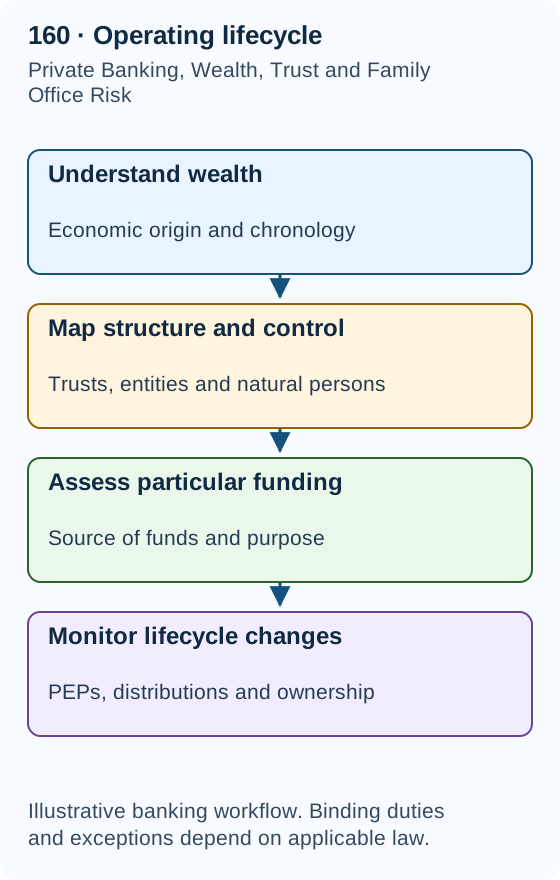
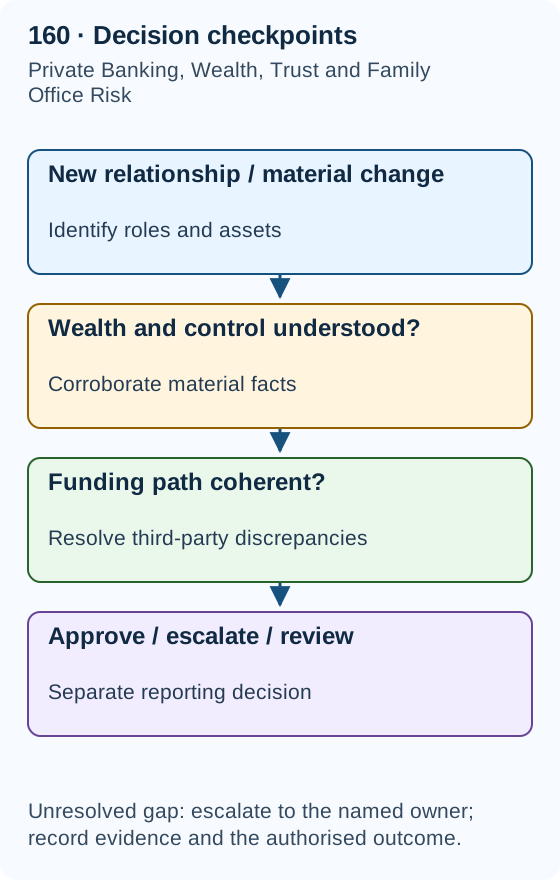
Understand the relationship before ranking its prestige
A private-banking relationship can involve deposit accounts, discretionary investment management, advisory portfolios, custody, lending, foreign exchange, trust administration and payments for family expenses. The bank should identify which legal entity supplies each service and which person or arrangement is its customer. A family name on a relationship dashboard can hide several customers with different owners, mandates and legal obligations.
Consider a fictional family led by Mira Dev. Mira sold part of a manufacturing business, inherited an investment portfolio and now uses a family office to coordinate advisers. Her personal account, an investment holding company and a trust may be serviced by the same relationship team. They should not be treated as one indistinguishable customer. Money moving between them needs an explanation of ownership, entitlement and authority, even when all are associated with the family.
The bank's first task is to describe the service and party roles. Who owns the account or assets? Who can instruct? Who receives economic benefit? Who can appoint or remove decision-makers? Who supplies funds? Who is the adviser rather than the principal? These questions expose a structure's practical operation. They should be answered from evidence appropriate to the arrangement, not solely a family-office presentation.
High asset value can make a relationship commercially attractive and increase the complexity of transactions. It does not establish legitimacy. Long-standing personal familiarity can help explain history, but it can also discourage challenge when a structure changes. A relationship manager's recollection belongs in the evidence record as a recollection; it should not become a substitute for ownership, authority or material wealth corroboration.
Complexity should have a purpose. A holding company may facilitate investment, a trust may organise succession, and different booking centres may offer particular services. Explain those purposes and whether the structure behaves accordingly. An unexplained chain of entities, circular ownership or changing nominee arrangements can make the bank's knowledge weaker even if each document is formally valid.
Build two connected narratives: wealth and the current funds
Source of wealth describes accumulation over time. Source of funds describes the origin of the money or assets used in the particular relationship or transaction. The distinction is easiest to see in Mira's case. Her manufacturing sale may explain much of her overall wealth, while a new account deposit may come from a loan, a trust distribution or a portfolio sale. The bank needs the relevant current funding path as well as the larger history.
A wealth narrative should state material events, approximate dates, economic activity, ownership share and plausible financial scale. Distinguish a customer's gross business revenue from personal profit or equity value. A company with substantial sales can have modest margins and considerable debt. A headline sale price does not establish the amount personally received by one shareholder after debt, expenses, tax and other distributions.
Corroboration should focus on facts material to risk. For a recent large business sale, documents about ownership and the transaction may be more useful than decades of small personal bank statements. For an inheritance, estate and entitlement evidence may matter. For accumulated employment wealth, remuneration and investment history may support the account. The bank should explain why the selected sources are sufficient, rather than assembling documents without a reasoned conclusion.
A bank statement usually supports that funds moved from a particular account. It may also help show continuity in the path. It does not, by itself, prove the lawful economic origin of the balance. A transfer from a prestigious institution likewise does not remove the receiving bank's need to understand its customer and material inconsistencies. A payment chain is evidence of movement; an economic narrative explains why the value exists and belongs to the customer.
Evidence can be incomplete for legitimate reasons. A decades-old family enterprise may lack current digital records. A legal arrangement may keep some documents private. The response should be proportionate and specific: identify the material question, available alternatives, uncertainty and risk implication. Do not require impossible historic documents automatically, but do not record an unsupported claim as verified simply because it is difficult to corroborate.
Legal ownership, beneficial interest and effective control
Company ownership and trust roles require different data models. A company can have shares, voting rights, directors, nominees and contractual control arrangements. A trust separates roles according to its governing law and terms. For a trust relationship, a shareholder-percentage screen may not capture the settlor, trustees, protector, beneficiary class and other effective-control relationships the bank needs to understand.
Read the structure as it actually operates. If the trustee has legal title and discretion, identify the trustee and the relevant authority. If a protector can appoint or remove the trustee or approve distributions, record that power. If a settlor retains particular rights, understand them rather than assuming the trust makes the settlor irrelevant. A letter of wishes, power of attorney and trust deed may have different legal force; legal interpretation belongs with the appropriate specialist.
A beneficiary class can be legitimate. The bank should understand how membership is defined and when individual beneficiaries become relevant under applicable rules, such as a distribution event. It should not invent a fixed ownership percentage for every potential beneficiary. Similarly, a professional trustee is not necessarily the ultimate economic beneficiary; its corporate identity and the natural-person roles relevant under the governing framework remain distinct.
A family office can act as an administrator, investment adviser, employer, company director or payment coordinator. Its regulatory status depends on activities and jurisdiction. The title does not automatically permit CDD reliance or make all associated family members its customers. Establish whether the bank contracts with the office, with a family member, with an entity or with a trust, and which mandates permit the office to instruct.
Risk factors should change the inquiry, not replace it
Political exposure, opaque structures, higher-risk geography, unexplained third-party funding and inconsistent wealth claims can require deeper inquiry or specific measures. They should not be treated as equivalent facts. A PEP relationship raises corruption-related considerations; a payment redirection may indicate fraud; a named-party match may require a sanctions decision. The bank can coordinate facts while preserving the distinct legal tests and responsible owners.
The FATF PEP standard differentiates foreign PEP measures from the risk-based treatment of domestic and international-organisation PEPs. National rules may implement additional or different operational requirements. Family members and close associates also need role-aware assessment. A screening result should be resolved for identity and relevant status before it changes the relationship's treatment; a similar name is not enough.
Do not turn political exposure into a statement of wrongdoing. A customer may have lawfully earned wealth long before taking office. The bank should understand material wealth and funds, relevant influence, risk and required approval. It should also respond to a change in office or association without treating a database's stale status as a complete current assessment.
Risk ratings need a reasoned narrative. A high rating should lead to the applicable additional measures and review, while a lower rating should not suppress a specific material inconsistency. Explain which facts drive the rating and what would change it. Avoid a dashboard that averages away an unresolved ownership gap through several low-risk attributes.
Banking decisions have different owners
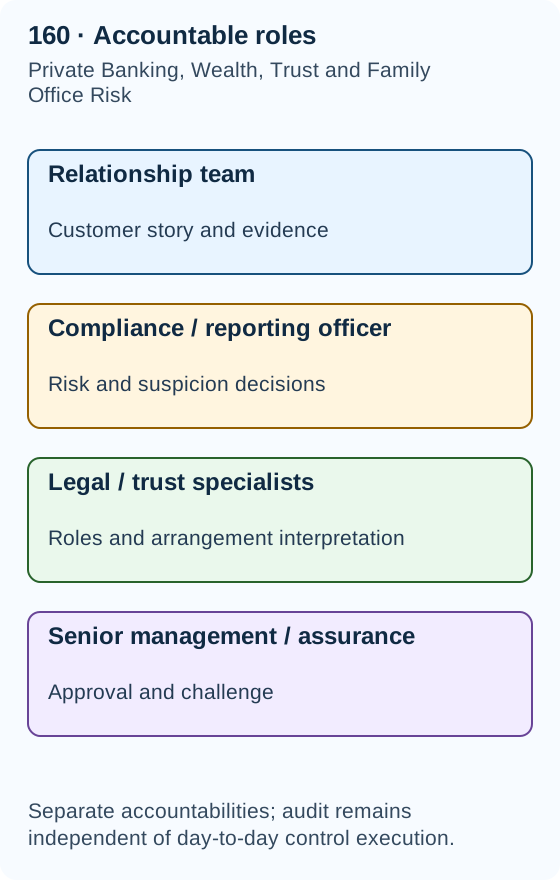
The relationship manager gathers and explains business information. Product specialists describe investment and lending mechanics. Operations validates mandates and executes instructions. Financial crime assesses customer and activity risk. Legal interprets arrangements and applicable restrictions. Authorised senior management accepts residual risk where permitted. A reporting officer applies suspicious-activity reporting requirements separately.
Commercial urgency may justify efficient coordination, but it does not make missing required information immaterial. If Mira requests a time-sensitive acquisition payment, the bank should identify the precise unresolved point, whether a lawful bounded action is available and who can decide. The file should not replace evidence with “important client” or “relationship manager comfort.”
The aim is a defensible understanding of ownership, control, wealth, current funds and expected activity. That understanding supports proportionate service and meaningful ongoing review. It is neither an assumption that wealthy customers are safe nor an assumption that every sophisticated structure is criminal.
Wealth narrative and structure analysis
Build a chronology of material wealth events: employment, business ownership, inheritance, investments or asset sales. Corroborate important claims using evidence proportionate to risk, such as company records, sale documentation, probate information or other credible sources. Distinguish gross proceeds from net wealth after debt, taxes and ownership shares.
Map entities, trusts, signatories, advisers and decision-makers. Explain each structure's purpose and the customer's control over distributions or assets. A relationship manager's personal familiarity cannot substitute for documented ownership and authority. Record conflicts between the customer's explanation and external evidence.
Expected activity should reflect the relationship: investment subscriptions, asset sales, trust distributions, secured lending or family-office payments. Monitor unexplained third-party funding, rapid movement through investment accounts, opaque entities and unexpected jurisdictions with context. Loan proceeds backed by assets can obscure the original wealth story; collateral quality does not establish clean ownership or source.
Commercial escalation must not override CDD or reporting duties. Compliance and authorised senior management assess risk within applicable requirements, while the reporting officer separately decides suspicious-activity reporting. Preserve rationale for both continuation and exit. An exit should not move restricted assets or reveal protected reports.
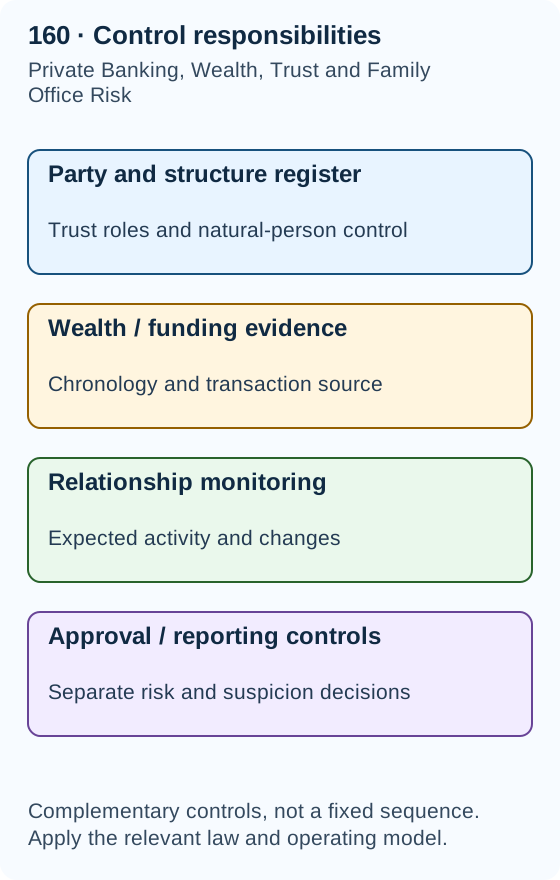
A wealth chronology that reconciles amounts and ownership
Build the chronology around material value-creating events. For each event record the customer's role, asset or business, jurisdiction, period, claimed amount and corroborating evidence. Note whether the amount is revenue, income, asset value, transaction proceeds or net personal entitlement. These categories answer different questions and should not be copied into a single wealth-total field.
Mira states that a fictional business sale generated 18 million units of currency. The sale agreement gives a total consideration of 30 million for the company. Mira owned 60 percent, which explains an initial gross share of 18 million. However, an escrow, debt settlement and fees reduce immediate cash proceeds. The bank should reconcile the amount actually received rather than treating multiplication as proof that the full headline amount became liquid personal wealth.
The evidence may include ownership records, sale documentation, completion statements and payment records. Each serves a distinct purpose. Ownership records support entitlement; the agreement supports the transaction terms; completion records support the distribution; bank records support the funding path. If an escrow later releases funds, the source-of-funds explanation should link to the original event and the release conditions.
Where sale proceeds flow first to a holding company, establish why and who controls it. A company receipt is not automatically a personal receipt. A later dividend, loan or capital reduction may explain the transfer to Mira, subject to the actual legal arrangement. The AML analyst need not certify every tax or corporate-law conclusion, but should understand the claimed entitlement and route material legal uncertainty to the appropriate specialist.
An inheritance needs a different chronology. Identify the estate, deceased person's relationship to the customer, relevant entitlement, executor or administrator, asset distribution and payment route. A probate document can support the estate process without by itself explaining the origin of every asset in the estate. The depth of further inquiry should follow risk and materiality, not a universal requirement to investigate all generations of family wealth.
Investment accumulation requires scale and time. A claimed high return over a short period may be plausible for a concentrated risky investment or may contradict available records. Distinguish realised proceeds from an estimated portfolio valuation. Borrowing secured on an appreciated asset provides current liquidity but does not create a new historical source of wealth. Record the economic effect accurately.
Evidence quality and uncertainty
Classify evidence by the fact it supports, its source, date and limitations. A customer statement can explain a purpose; an official registry can support legal ownership recorded there; an audited account can support historical financial information within its scope; a professional letter can convey a specialist's conclusion. None should be assigned universal authority beyond what it actually establishes.
Independence is not binary. A long-standing family lawyer may hold valuable documents but also acts for the customer. A valuation report can be independent of the bank yet rely on customer-supplied inputs. An analyst should understand these dependencies, particularly when an unsupported input drives the wealth conclusion. Record the relevant limitation rather than rejecting all adviser evidence or accepting it uncritically.
Contradictions require reconciliation. If a sale document names a different seller, establish whether it is an entity controlled by Mira, a nominee arrangement or an unrelated party. If public records show a lower ownership share, determine whether the records reflect a different date or whether the claim is wrong. A plausible explanation becomes stronger when supported by a dated chain of evidence.
Do not erase uncertainty from the final narrative. A decision may be supported by sufficient evidence despite an immaterial gap. Another may require restrictions until a material gap is resolved. The record should identify which situation applies, why the gap matters and who made the decision. “Verified” should have a defined meaning linked to the reviewed facts.
Map a trust as roles, powers and events
For the fictional Dev Family Trust, legal counsel explains the governing law and relevant provisions. The structure record identifies Mira as settlor, Rowan Trustees Ltd as trustee, a named protector and a beneficiary class. The trust holds shares in an investment company. The bank's customer and contractual account title are established separately from the overall family relationship.
Map the trustee's ownership and authority where relevant, the protector's powers and the people who can instruct the account. Preserve the distinction between a authorised signatory and a person exercising ultimate effective control. A signatory may carry out instructions without controlling distribution decisions; a person without signing authority may possess significant appointment or veto powers.
Review changes to the arrangement. A new trustee, protector, beneficiary, governing-law clause or reserved power may alter the bank's understanding. Record the effective date and evidence. Do not overwrite the historical map because an earlier payment must be assessed against the roles and powers that existed then.
A distribution adds an event-specific question. Who is entitled to receive it, who authorised it, which assets fund it and where will value go? A beneficiary previously described only by a class may become specifically relevant at that point. The bank should apply the applicable identification, verification, screening and risk process without assuming that the initial trust file answers every payout question.
The structure can also own a company that borrows against assets. Understand the borrower, collateral owner, guarantor and recipient of loan proceeds. If different parties perform those roles, explain the commercial and legal relationship. A sound collateral valuation does not establish that the assets were lawfully acquired or that proceeds can be paid to an unrelated recipient without inquiry.
Expectations for a multi-service wealth relationship
Expected activity should follow the services and customer circumstances. Mira's personal account may receive portfolio income and fund living expenses. The holding company may make investment subscriptions and receive dividends. The trust may make scheduled distributions. A lending account may receive drawdowns and repayments. Each has a different normal pattern even though one relationship manager supports all of them.
Define material expected counterparties and event types. The aim is not to pre-approve every future transaction. It is to make meaningful comparison possible. If the trust begins paying commercial suppliers while its stated purpose is passive family investment, the analyst should ask whether the purpose or service has changed. If a portfolio account suddenly receives many unrelated retail payments, the explanation may differ from ordinary investment funding.
Cross-booking-centre analysis needs lawful data access and consistent identities. The same person may appear under transliterations, old addresses or different entity records. Resolve identities with evidence and preserve local roles. A group dashboard should not merge a trustee company, beneficiary and settlor simply because they share a family name or contact address.
Some transactions are naturally large and infrequent. A property purchase, inheritance distribution or business sale can create a sharp value spike. Risk-based monitoring should assess event context and evidence rather than dismissing every spike as normal wealth activity or escalating every large amount automatically. The control should focus on unexplained change in purpose, parties, authority or funding.
Lending can change the apparent source story
Private-bank lending may provide liquidity against securities, property or other collateral. Current loan proceeds explain the immediate source of funds for a payment. They do not explain the original wealth used to acquire collateral. Keep the two questions linked. The bank should understand whether collateral and borrowing fit the customer's wealth and activity, particularly where ownership is complex or assets move between parties.
A third-party guarantee or collateral pledge can be legitimate, but introduces another party and economic relationship. Establish why the guarantor supports the customer and whether repayment expectations are coherent. The lending team evaluates credit enforceability; financial crime examines the relevant customer, value and control concerns. Credit approval should not be treated as a completed source-of-wealth assessment.
Unusual repayments can also matter. A customer who borrows against a portfolio then repays rapidly from an unrelated company may have a legitimate asset-sale explanation. The bank should examine that path rather than looking only at the loan balance. Repeated borrowing and repayment can create movements of value not captured by ordinary portfolio-trading monitoring.
Exceptions and proportionate decisions
A customer with old inherited wealth may not possess every original business document. Identify the material facts that need corroboration and use available credible alternatives where permitted. A proportionate decision can state that the history is supported by estate records, longstanding asset holdings and consistent current activity, with defined limitations. It should not fabricate a precise historic verification date or amount.
By contrast, a newly formed entity supplying a major unexplained deposit creates a current, material question. Relationship history does not make that question disappear. A bounded restriction or additional inquiry may be necessary under the applicable framework. Record the rationale and route urgent business requests to authorised owners without bypassing required controls.
Customer treatment should remain respectful. Explain the necessary information in clear terms and avoid repeated requests for documents already held by another authorised team. Financial-crime depth is improved by precise questions and coordinated evidence, not by burden for its own sake. The bank should also recognise vulnerable customers and possible coercion or fraud without assuming incapacity from age or wealth alone.
At the end of the review, write a coherent conclusion connecting the chronology, structure, current funding and expected service. The approval should identify residual uncertainties, required measures, review triggers and limits. That conclusion gives the next analyst something more useful than a collection of certificates and a high-value customer label.
Death, incapacity and disputed family authority
A death or possible incapacity can change who may give instructions, but its legal effect depends on the account, arrangement and governing law. Operations should obtain reliable notification and route authority questions to the relevant specialist. A relationship manager should not assume that the person who usually coordinates family documents automatically acquires authority over the assets. The bank must distinguish a personal account, company account and trust account rather than applying one family-wide action.
Suppose Mira dies while a trust distribution and a personal securities sale are pending. The trust's continuing authority may depend on its terms and roles; the personal account may need estate handling; the company may retain valid directors and mandates. Legal clarifies each arrangement. Operations records which instructions were given, by whom, when and whether they remain valid. Financial crime considers any relevant changed ownership, beneficiary or funding facts. The bank should avoid both unauthorised execution and unsupported freezing of every linked entity.
A claimed executor should provide the relevant authority evidence under the applicable jurisdictional process. A document translated into another language should retain its original and the translation source. If competing parties assert control, identify the precise disputed instruction and lawful interim handling. The bank should not resolve a family succession dispute by accepting whichever person speaks to the most senior relationship manager.
Possible financial abuse creates another concern. An older customer may legitimately delegate administration, but an unexplained sudden transfer to a new adviser-controlled entity, unusual pressure or inconsistent instructions may warrant safeguarding and fraud review. Age alone does not establish incapacity. The bank should use facts and authorised procedures, communicate appropriately and preserve the customer's rights while assessing the specific risk.
For example, a family-office employee asks to liquidate a portfolio and pay a newly opened overseas account, claiming the customer cannot be contacted. The existing mandate allows document collection but excludes trading and payments. Operations should verify authority and use the approved contact process. Fraud staff assess possible coercion or account takeover. Financial crime examines the value path if facts raise relevant concerns. None of these teams should record the employee as a beneficial owner merely because the employee is requesting action.
Evidence should distinguish contact attempts, customer confirmation, authority documents, legal interpretation and system restrictions. Record what is known and what remains uncertain. A failed phone call is not proof of incapacity or death; a family member's assertion is not automatically a valid instruction. Conversely, verified new authority should be implemented promptly through controlled changes rather than leaving the estate or customer in indefinite administrative limbo.
Acceptance testing should cover a revoked power of attorney, competing instructions, a deceased authorised signatory, a continuing corporate mandate and a trust distribution after a role change. Confirm that trading, custody and payment systems receive the relevant restriction or authority update. A customer record marked deceased is insufficient if an old portal credential can still create instructions.
Finally, preserve continuity. The new authorised party may need a clear explanation of lawful service steps and existing obligations. The bank should reuse valid evidence where appropriate and request what the changed situation actually requires. Properly governed succession and safeguarding controls protect customers while maintaining the distinct financial-crime questions about ownership, entitlement and movement of value.
Testing complex wealth relationships
Test a changed trustee, beneficiary distribution, nominee shareholder, PEP family member, collateral-backed loan and a sale that materially changes wealth. Determine which event triggers refreshed evidence or approval under local rules and the bank's risk model.
Review whether wealth evidence is current and proportionate. Exhaustive requests for old low-risk documents can add little value, while a major unexplained acquisition may need detailed corroboration. Record why evidence was sufficient rather than using a uniform checklist for every customer.
Family-office involvement does not automatically place all its clients inside an AML regulatory perimeter or create permitted CDD reliance. Classify the activities and any reliance arrangement separately.
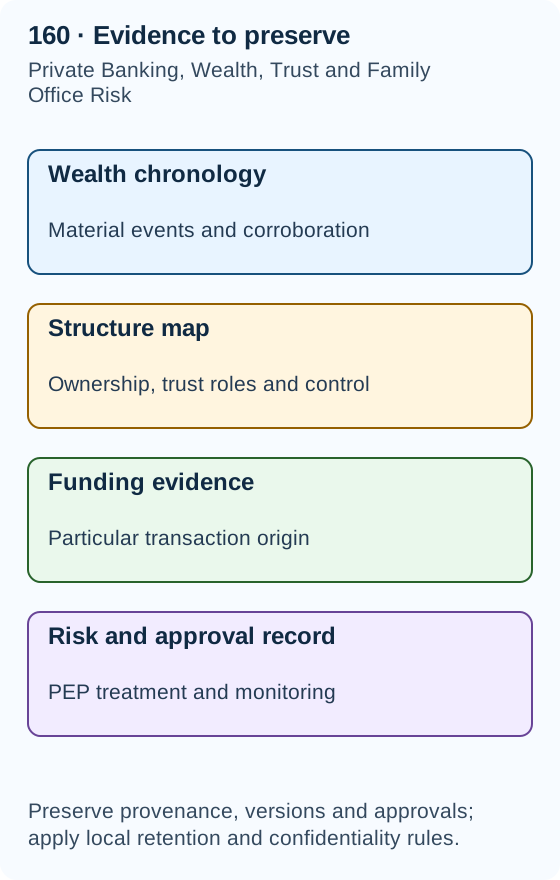
Ten control tests for wealth and legal arrangements
These tests examine specific failure modes using fictional records. Set the expected evidence and authorised outcome before execution. Run the relevant events through actual relationship, custody, lending and payment processes, not just a demonstration screen.
1. Gross sale price confused with personal proceeds
Create a company sale in which the customer owns only part of the business and completion reduces cash received. The wealth process should preserve the total sale value, ownership share, deductions and personal entitlement separately. A control fails if the customer is credited with the whole enterprise price without explanation. Test the narrative and the structured wealth fields because a correct analyst paragraph can coexist with a misleading dashboard total.
Next provide a reconciled completion statement. The process should allow a reasoned conclusion and retain the original inconsistency. The bank should not permanently reject a legitimate sale merely because the first document did not show net proceeds. The expected result is accurate reconciliation, not automatic suspicion.
2. Trust roles forced into shareholder percentages
Create a trust with settlor, corporate trustee, protector, beneficiary class and a person holding an appointment power. The data model should record role and power rather than inventing equal ownership shares. Test whether screening and review populations include the relevant people under the applicable framework. A model that accepts only one “owner” can conceal material control relationships.
Introduce a new protector and a changed power. The system should preserve the previous version and trigger the relevant review. Confirm that a historical payment still shows the roles effective at that time. Today's trust chart must not rewrite yesterday's evidence.
3. Family-office instruction beyond its mandate
Give the family office authority to provide investment advice but no authority to instruct payments. Submit a payment request through its usual adviser contact. Operations should verify the instruction against the actual mandate and route an unauthorised request appropriately. Personal familiarity with the office should not create authority.
Repeat with a valid limited power of attorney and then with an expired or revoked power. Test both the normal payment route and a relationship-manager-assisted exception. The control should recognise the specific authority, scope and effective date rather than treating all adviser-originated requests as equivalent.
4. Source of wealth used as source of current funds
Record a well-supported business-sale wealth history, then fund a new investment from an unrelated company. The system or reviewer should ask about the current payer and entitlement. A bank should not close the concern solely because the customer is wealthy. Provide a legitimate documented loan explanation in a second run and check that the case can be resolved on its merits.
The test should retain the account-owner evidence, economic explanation and value path. A single “wealth verified” tick must not suppress all later source-of-funds questions. Equally, the bank should not demand a complete repeat of the old sale review when the material question concerns the new payer.
5. PEP name match without identity resolution
Create a customer with a name similar to a foreign official but conflicting date of birth and career evidence. The process should resolve identity before imposing the PEP treatment. Then create a confirmed politically exposed person and test applicable status, approval and wealth/funds measures. A positive vendor score is an input, not a complete identity or legal classification.
Include a family member or close associate and an international-organisation role. Check that the bank's national implementation and policy determine the correct treatment rather than copying one foreign-PEP workflow indiscriminately. Record why the classification applies and when it should be reconsidered.
6. Collateral quality mistaken for clean wealth
Create a loan secured on a valuable portfolio whose ownership history is materially unexplained. Credit controls may accept valuation and enforceability, but the financial-crime concern should remain visible. The workflow should connect the lending decision and customer evidence without allowing collateral quality to replace origin and ownership analysis.
Then introduce third-party collateral. Test whether the guarantor, collateral owner, borrower and recipient of proceeds are represented separately. The bank should be able to explain the relationship and relevant checks for each role. A generic “secured” flag is inadequate evidence.
7. Distribution to a newly identified beneficiary
Create a trust whose beneficiary class was appropriately recorded at onboarding, then request a distribution to a named individual. The event should trigger the applicable beneficiary assessment, authority and destination checks. It should not bypass review because the trust itself is already active.
Change the destination account after the distribution is approved. Test whether the material change invalidates or reopens the relevant transaction approval. An approval for payment to one beneficiary account should not become reusable permission for any later account entered by an operator.
8. Commercial exception without an authorised owner
Submit an urgent acquisition payment while required ownership evidence is unresolved. A relationship manager attempts to release it using a commercial escalation flag. The system should require the relevant authorised decision and applicable legal prerequisites. If a bounded exception is permitted, preserve its rationale, scope, expiry and conditions.
Test whether an exception can be copied to another customer or reused after expiry. The design should distinguish a transaction-specific decision from a relationship-wide approval. Senior status or revenue should not operate as an undocumented override credential.
9. Cross-centre duplication hides activity
Create two records for Mira in different booking centres with legitimate transliteration differences. Each receives a part of a materially unusual funding pattern. Test identity resolution, lawful visibility and escalation. The bank should detect relevant linked activity where permitted without merging unrelated people who happen to share a name.
Include a false-match control with distinct identity evidence. Investigators should be able to separate the records and preserve the reason. A graph or family-name grouping is a hypothesis requiring evidence; it is not proof of ownership, association or criminal activity.
10. Protected report information in client records
Place a reporting decision in the appropriate restricted case, then generate a relationship briefing and client-service letter. The documents should not disclose protected reporting information beyond authorised access and lawful communication. Test notes, attachments, metadata and export permissions.
The relationship team may need to know a permitted service restriction without seeing the report itself. Verify that the system can communicate operational action while preserving confidentiality. The test should include an authorised reporting officer, an ordinary relationship manager and a support user to show the access distinctions.
Quality assurance beyond checklist completion
Select files with different wealth origins: recent entrepreneurship, old inheritance, employment accumulation, investment gains and a complex trust. Review whether the evidence supports the narrative's material claims. A sample of only straightforward salaried wealth cannot show whether the bank handles complex structures or unexplained corporate funding.
Trace at least one current transaction from each selected relationship. Assess whether the payer, owner, instruction authority and destination fit the explanation. This connects CDD to actual activity. A beautifully documented wealth chronology can coexist with a later payment the bank cannot explain.
Review rejected and withdrawn applications as well as accepted relationships. Determine whether the bank had specific unresolved requirements or simply used broad status labels. A proportionate risk-based programme should document the evidence and decision in either direction. It should not treat an account refusal as proof that the applicant committed an offence.
Challenge management information about “verified wealth.” Ask what the field means, which facts were corroborated and whether unresolved uncertainty is visible. Distinguish an amount claimed, an amount plausibly supported and the bank's current valuation. Data should not communicate more precision than the evidence permits.
Finally, review the relationship team's incentives and escalation practice. A written policy supporting challenge is useful, but evidence that material concerns reached an authorised decision is stronger. Look for undocumented overrides, repeated exception renewals and cases closed after commercial pressure without resolving the material fact. Those are operating-model concerns rather than mere formatting defects in a file.
Worked inherited-wealth case
A fictional customer says wealth came from an inheritance but funds arrive from a recently formed company in which a third party controls payments. The bank should reconcile the estate evidence, company ownership, customer entitlement and actual funding path. A prestigious adviser does not answer those questions.
Identify what supports source of wealth, what supports this transaction's source of funds, and how unresolved inconsistencies affect acceptance or escalation.
Worked case: Mira, the holding company and the family trust
All people, entities, amounts and events in this case are fictional. Mira Dev seeks a private-banking relationship after a partial business sale. The bank expects an initial personal deposit, custody of investments and a possible credit facility. Her family office coordinates documents but is not the account owner. A family trust and an investment holding company are proposed as separate customers later.
First account: reconcile the wealth claim
Mira says the sale created 18 million in wealth and provides a press article reporting a 30 million company transaction. The relationship manager initially writes “sale verified: 18 million.” A reviewer asks for the basis. Mira's 60 percent ownership is supported, but the completion statement shows deductions and an escrow. The bank revises the narrative to distinguish gross entitlement, immediate proceeds and deferred proceeds.
This correction is material without necessarily indicating misconduct. Mira may have used “wealth” to describe the economic value of her interest rather than current cash. The file should record the clarified meaning and evidence. An analyst should not call the initial difference a false statement without considering the customer's wording and the documents.
The initial deposit arrives from the sale escrow agent into Mira's personal account. The bank links the sender, completion process, entitlement and payment. It verifies relevant identity and authority under its applicable framework. The funding path agrees with the material wealth event, giving a more coherent conclusion than the article alone.
The holding company receives a different deposit
Mira then asks to open an account for Dev Investments Ltd. The company is owned through a structure documented separately from her personal account. A deposit arrives from Orion Trading Ltd, a recently formed company not mentioned in the original plan. The relationship manager says Mira is a longstanding client whose wealth is already understood.
The analyst explains that the current question concerns Orion's payment and Dev Investments' entitlement, not whether the business sale occurred. The bank asks about Orion, the relationship and the economic basis. Mira describes a loan from a business acquaintance. The first agreement lacks a clear repayment purpose and has inconsistent borrower details. The bank records these precise gaps rather than a vague “high-risk third party.”
Further documents establish a legitimate financing arrangement in one version of the case. Legal clarifies the borrower and authority; financial crime assesses the payer and economic explanation; operations verifies the account instruction. The bank can then decide whether the funds fit the relationship. A source-of-wealth review need not be restarted completely when the evidence resolves the current funding question.
In the alternative version, the sender cannot be connected to the agreement and Mira gives contradictory explanations. The analyst escalates the unresolved facts. The reporting officer applies the relevant suspicion threshold; authorised management assesses continued service within applicable requirements. The bank does not use a commercial exception to declare the funding clean.
A trust introduces control and beneficiary questions
The Dev Family Trust becomes a proposed customer. The family office provides a glossy chart showing Mira at the top and a single box marked “family beneficiaries.” Legal documentation identifies a corporate trustee, a protector with appointment powers and a beneficiary class. The account will be instructed by authorised trustee representatives, not by Mira automatically.
The bank records the actual roles and powers. It identifies which persons and entities require assessment under the applicable framework and maps the customer, signatories, source of assets and expected distributions. It explains why the trust exists and how it owns the investment company. The diagram remains a useful orientation tool, but the evidence comes from the relevant documents and corroboration.
The family office requests payment authority to simplify administration. Its existing mandate covers document coordination and advice. Operations explains that a new valid authority is needed for payment instruction. Personal access to the relationship manager does not establish power to move trust assets. Any accepted delegation is reviewed for scope, date, revocation and permitted channels.
Distribution and changed destination
The trustee later approves a distribution to a named beneficiary. The beneficiary becomes specifically relevant to the event. The bank checks the applicable identity, risk, authority and destination requirements. It does not assign a fictitious shareholding percentage merely because the system expects a corporate-owner field.
The day before payment, an email changes the destination to a company account overseas. The sender uses the family office's usual address. Operations pauses to verify the instruction through the authorised process and informs the relevant control owner. Fraud assessment considers possible email compromise. Financial crime asks about the beneficiary's entitlement and the company relationship. Legal considers trust authority if needed.
If the account belongs to a legitimately controlled company and the trustee has authorised an appropriate payment, the evidence may resolve the concern. If the destination cannot be substantiated or the instruction is unauthorised, the bank must follow the relevant restriction and escalation. A valid distribution decision does not automatically validate every substituted destination.
Lending and repayment
Mira draws a loan against her portfolio to fund a property acquisition. The credit team reviews valuation and enforceability. Financial crime links the collateral ownership, loan proceeds and property-payment purpose to the relationship. Loan funding explains the immediate source of the acquisition money; the earlier sale and investment history remain relevant to the collateral's origin.
An early repayment arrives from another family entity. The bank establishes why that entity is repaying Mira's debt, its source of funds and the authority. A legitimate intercompany or family arrangement may explain the payment, but the analysis should not be limited to whether the outstanding credit balance decreases. The value path has added a party and needs context.
Review after a political-status change
Mira's spouse takes a prominent public role abroad. A vendor update generates a screening event. The bank confirms identity, role, relevant relationship and the applicable national PEP treatment. It considers whether additional approval or wealth/funds measures are required and updates the review record. It does not write that Mira has become corrupt or that her earlier wealth is illegitimate.
The review examines actual influence and relevant risk alongside the existing chronology. Recent transactions with public-contract counterparties may merit targeted inquiry; an ordinary trust distribution need not be assumed improper. The bank's reasoned decision should identify which facts changed and how its controls respond.
Examiner reconstruction
An independent reviewer receives the personal sale deposit, Orion funding, trust distribution and loan repayment. For each event, the reviewer should identify the customer, parties, authority, value path, evidence, unresolved questions and decision. The personal wealth conclusion cannot be used as a blanket answer to every company or trust transaction.
If the reviewer finds that all events have been summarised under one family dashboard with no separate legal-entity records, the bank has an evidence and control problem. If the linked records preserve roles and decisions, the relationship can be understood coherently without treating the family as a single legal person.
Short cases with different evidential answers
Old inheritance with limited original records. An older customer holds assets inherited several decades ago and provides estate documents, longstanding custody history and a consistent current activity profile. Assess whether the material facts are sufficiently supported in context. A blanket demand for every historic income document may add little value. Record the evidence and limitations rather than inventing exact original acquisition amounts.
A nominee director in an operating company. The bank receives a professional director's details but the customer says another person directs all decisions. Examine the governing documents, authority and effective control. Nominee involvement can be lawful; it does not answer who ultimately controls the company. The model should keep the professional role and controlling person distinct.
A family office serves several unrelated families. Determine its actual business and the bank's customer. A service provider with several clients may have a different regulatory perimeter and risk profile from a single-family administrative office. Do not infer a permitted reliance arrangement from the phrase “family office.” Assess relevant activities, jurisdiction and evidence.
A charitable distribution. A trust pays an organisation identified by the family as a charitable recipient. Establish the authority, recipient and purpose in the applicable context. A charitable label is not proof of legitimacy, but an overseas donation is not automatically terrorist financing. Apply relevant screening and risk assessment with factual evidence.
A former official with established business wealth. Confirm identity and status, applicable treatment and the ongoing risk associated with the former role. The passage of time may be relevant to influence, but should not be converted into a universal automatic removal period unless the applicable framework specifies it. Document the actual basis for the assessment.
Questions with worked reasoning
- What does the escrow statement add to the press article? It supports the amount and timing of proceeds attributable to Mira, including deductions and deferred value; the article primarily supports that a public transaction was announced.
- Why is Orion funding a new question? It concerns the present payer, entitlement and economic basis. A well-supported historic sale does not explain an unrelated company's current payment.
- Can a relationship manager's trust in the family office create payment authority? No. Authority follows the actual mandate and governing arrangement; familiarity is contextual information.
- Why preserve a beneficiary class? It may accurately reflect a discretionary arrangement. The bank should apply event-specific requirements when individuals become relevant rather than fabricating fixed ownership shares.
- Does valuable collateral settle source-of-wealth concerns? No. Valuation and enforceability support credit decisions; original ownership and economic origin are different facts.
- How can the bank treat incomplete old records proportionately? Focus on material facts, credible alternatives, current risk and reasoned sufficiency, recording uncertainty rather than pretending comprehensive verification.
- Why separate PEP status from suspicion? Political exposure determines relevant risk treatment and measures; wrongdoing or suspicion requires its own factual assessment and legal threshold.
- What should change when a payout destination changes? Reassess the material instruction, recipient, authority and applicable controls; the old approval may not cover the new destination.
- What is lost by grouping every account under a family name? The bank may lose the specific customer, owner, entitlement, legal authority and value path for each transaction.
- What evidence supports continuation? A coherent documented understanding, applicable measures, resolved material gaps and authorised acceptance of remaining risk within legal requirements; a high asset balance alone is insufficient.
Relationship records and review controls
Keep the wealth chronology, structure map, party roles, evidence sources, expected activity and approvals linked but distinct. Record uncertainty and preserve previous versions when ownership changes. Systems should support trusts and control relationships rather than forcing every party into a shareholder-percentage field.
Release tests should demonstrate event-driven reviews, protected reporting access and customer activity across multiple booking centres. Relationship teams, compliance, legal and data owners need an agreed escalation for inconsistent structures.
The outcome is a defensible understanding of who controls the assets, how wealth arose and why actual activity fits the relationship.
Data architecture for wealth relationships
Use separate records for people, legal entities, legal arrangements and service relationships. Link them through roles with source evidence and effective dates. Mira can be a shareholder of one company, settlor of a trust, signatory for an account and guarantor of a loan. These roles should not be reduced to one generic “owner” attribute.
For a company, store the ownership or control basis and relevant intermediate entities. Preserve percentages where they are meaningful and powers where control is not expressed through equity. For a trust, store the arrangement, governing law, roles, authority and beneficiary description. A common graph can connect these records, but the edge type must communicate what the evidence actually supports.
Keep claimed wealth, corroborated events and current asset valuation distinct. A customer may report an approximate overall wealth amount, the bank may corroborate material events within a range, and custody may value the current portfolio daily. Combining these into a single changing figure can cause a market move to appear as a revised source-of-wealth conclusion.
Evidence records should identify source, date, entity scope, fact supported, reviewer and limitation. Link a sale agreement to ownership and proceeds facts; link a mandate to instruction authority; link a payment record to movement of funds. A document can support several facts, but its presence in a folder is not itself a conclusion about all of them.
Party and authority histories must be versioned. If a trustee changes at the beginning of a month, a payment from the previous week remains associated with the old arrangement. Record both when the change took effect and when the bank learned of it. These dates answer different questions in an investigation or control review.
Event-driven review implementation
Define events according to their effect on the relationship: material wealth change, new funding source, changed ownership or control, revised trustee or protector, new beneficiary distribution, changed mandate, altered booking centre, political-status update, material adverse information or unexplained activity. A review event should carry the relevant facts and target the affected customer and service.
Not every event requires the same workflow. A routine address update differs from a new controller. An ordinary portfolio gain differs from a major unexplained asset acquisition. Design the triage so that important events receive the appropriate review without creating a full repeat of CDD for every minor maintenance change. Applicable legal requirements remain the minimum boundary.
An event should identify who owns the response and what evidence closes it. If the family office changes, operations may need new mandate verification while financial crime examines whether control or funding has changed. Legal may interpret the document. The relationship manager coordinates customer contact. Assigning every task to “compliance” obscures the operational work and accountability.
Test failures in the event feed. A new protector recorded in a document repository may never reach the screening population if the role field is not mapped. A political-status update may be delivered to a vendor system but not the relationship case. Reconcile the events received, relevant parties and cases created, with explanations for intentional exclusions.
Source-of-wealth assessment notes that support judgement
A useful assessment note begins with the material claim and economic chronology. It then explains the evidence, reconciliation, uncertainty and risk conclusion. Avoid a document index masquerading as analysis. “Passport, statement, agreement received” does not explain how wealth accumulated or why the current funds belong to the customer.
For Mira's sale, the note should distinguish enterprise consideration from her share, immediate cash from escrow and a corporate receipt from personal entitlement. It should state which facts are supported by which source and whether the resulting amount is consistent with the proposed relationship. The conclusion should be clear enough for another reviewer to challenge.
For old wealth, explain why the evidence is proportionate. Perhaps longstanding asset records and a well-supported estate process address the material question, while an unavailable historic record would add little. For recent unexplained wealth, explain why stronger corroboration is needed. A consistent method can produce different evidence requests because the risks and facts differ.
The note should use precise language. “Customer states” identifies an assertion. “Document records” identifies what a source says. “Bank corroborated” should identify the fact examined. “Legal advised” communicates an interpretation within its scope. These verbs prevent an attestation, inference and independently supported fact from appearing equivalent.
A review meeting under commercial pressure
The relationship team requests an immediate acquisition payment for a valuable client. Financial crime identifies a material unresolved controller in the funding entity. The business says the client will move its portfolio if delayed. An effective meeting identifies the legal prerequisite, current operational state and available authorised options before discussing commercial consequences.
The business explains the transaction and customer impact. Legal clarifies what can be established from the available documents and whether a lawful bounded action exists. Operations explains payment deadlines and revocability. Financial crime states the material risk and evidence gap. Authorised management makes any residual-risk decision within the legal boundary, while the reporting officer assesses reporting separately.
The meeting record should not say merely “senior approval obtained.” It should state what was approved, by whom, for which transaction, with which conditions and evidence. An approval cannot make a prohibited action lawful or declare an unsupported controller identified. If no permissible outcome is available, the bank should communicate the necessary restriction clearly and efficiently.
The follow-up should resolve the underlying relationship issue, not repeatedly renew temporary exceptions. Set an owner and evidence requirement. Management information should expose recurring cases in which the same customer or team relies on urgency instead of completing necessary work. Commercial value may justify faster coordination; it should not produce a parallel undocumented control regime.
Cross-border booking and information boundaries
A family may use several bank entities for different investment, custody or lending services. Map the actual contracting and booking entities and relevant jurisdictions. A group relationship view is helpful, but it does not erase local requirements or make all information transferable to every employee. Identify lawful purposes and access routes for shared facts.
Where one booking centre has a material concern, the group may need coordinated risk management. Distinguish ordinary underlying customer facts from protected reporting information. The appropriate legal and privacy owners should determine what can be shared, with whom and under which safeguards. Do not place protected report existence or contents in a broadly visible family dashboard by default.
Local restrictions may affect the form of coordination. A permitted risk summary, locally reviewed fact or targeted question can sometimes support a decision without transferring an entire document set. The solution should address the actual legal and evidence requirement; a euphemistic note that reveals a protected report is not made safe by avoiding its formal title.
Cross-border services also raise tax, licensing, suitability and conduct questions. Financial crime should identify relevant inconsistencies and route them to specialists, but should not certify those other frameworks merely because CDD is complete. A product can be acceptable from an AML perspective while still unsuitable or unauthorised for distribution in a particular place.
Management information with evidential meaning
Report material wealth reviews by origin and status, not only total asset value. Distinguish incomplete mandatory facts, unresolved material contradictions, proportionate documented limitations and approved residual risk. A count of files with documents attached is not a measure of coherent understanding.
For legal arrangements, report missing relevant roles, unreviewed control changes, stale mandates and beneficiary-event exceptions. For current activity, show third-party funding, unusual destination changes, unexplained linked-entity movement and lending-related value paths requiring review. These populations should have owners and meaningful decision outcomes.
Monitor exception use. Identify reason, legal boundary, approver, scope, expiry and whether the underlying issue was resolved. A temporary allowance renewed indefinitely can become an unapproved standing service. The committee should see repeated renewal and the evidence preventing closure, not merely a green “exception approved” status.
For screening, distinguish unresolved identity matches from confirmed political exposure or a sanctions concern. Otherwise management may misinterpret an open name-resolution queue as a count of confirmed high-risk customers. Report relevant data-quality limitations, such as missing birth dates or incomplete role feeds, alongside case volumes.
For relationship exits, separate commercial choices, unmanaged residual risk and legal asset restrictions. Preserve the lawful basis of the action and customer communication. An exit decision should not be recorded as a finding that the customer committed a crime unless that conclusion is independently established and appropriate to record.
Assurance and lessons from a file reconstruction
Ask an independent reviewer to trace a major asset event and a later payment without help from the relationship manager. The reviewer should identify the customer, entitlement, authority, evidence and decision. If the narrative depends on personal memory or inaccessible emails, the bank has a continuity problem even if the original analyst made a reasonable judgement.
Trace a trust-role change through document receipt, data update, screening, mandate review and later distribution. Verify effective and knowledge dates. A process can have every checklist ticked while the role never enters a required control population. The assurance conclusion should assess the end-to-end result.
Review a collateral-backed loan from asset origin through drawdown and repayment. Check that credit and financial-crime records are linked sufficiently to explain the movement without confusing their approvals. A well-performing loan can still have an unexplained payer; a legitimate source-of-funds path does not establish credit quality.
Challenge broad comfort statements. “Respected family,” “regulated adviser” and “assets held at another bank” are context, not complete control conclusions. Ask what specific fact each statement supports and what remains unresolved. Good review is neither reflexive distrust nor deference to reputation; it is a clear explanation of the evidence and decision.
The operational result is a relationship the bank can continue to understand as wealth, parties and instructions change. Accurate role data, proportionate corroboration, explicit authority and specific review events support both effective control and less repetitive customer contact. They also preserve the boundaries between commercial service, risk acceptance, reporting and legal restrictions.
References and further reading
Reviewed 2 October 2026. FATF provides international standards; applicable national law determines binding duties. The operating examples are fictional teaching cases.
-
FATF Recommendations, updated June 2026 — relevant anchors: 10, 12, 24 and 25.
-
FATF politically exposed persons guidance — foreign, domestic and international-organisation roles, family members and close associates; read with current Recommendations and national implementation.
-
FATF legal-arrangements beneficial-ownership guidance, March 2024 — trust and similar-arrangement roles, transparency and risk-based evidence following the 2023 Recommendation 25 revision.