Managing FinCrime Risks in M&A
A merger or acquisition can change a bank's financial-crime exposure overnight. The acquiring group may inherit customers it did not onboard, products it did not design, countries it did not previously serve, agents and intermediaries it did not appoint, historic alerts it did not investigate, and technology whose screening or monitoring logic it has never tested. The transaction may be commercially attractive and still create a control problem that becomes visible only after legal ownership changes.
The simplest mental model is therefore inheritance plus integration. Before a transaction closes, the buyer tries to understand what financial-crime risk it may inherit and what can realistically be verified with the access available. At signing and closing, it decides which risks can be accepted, priced, contractually protected, restricted or made subject to remediation. After closing, it must turn assumptions into evidence: refresh risk assessments, integrate customers and systems, resolve backlogs and findings, and prove that the combined control environment actually works.
This is not only an AML question. Depending on the target and transaction, the review may need to connect AML/CFT, sanctions, proliferation-financing exposure, anti-bribery and corruption, fraud, tax-crime indicators, beneficial ownership, PEP exposure, adverse media, correspondent and nested relationships, virtual assets, trade, data privacy, recordkeeping and regulatory commitments. The legal effect of an acquisition also differs by jurisdiction and transaction structure. A share acquisition, statutory merger, asset purchase, minority investment and joint venture do not automatically create the same liabilities, control rights or information access. Local legal and regulatory advice must therefore determine transaction-specific obligations.
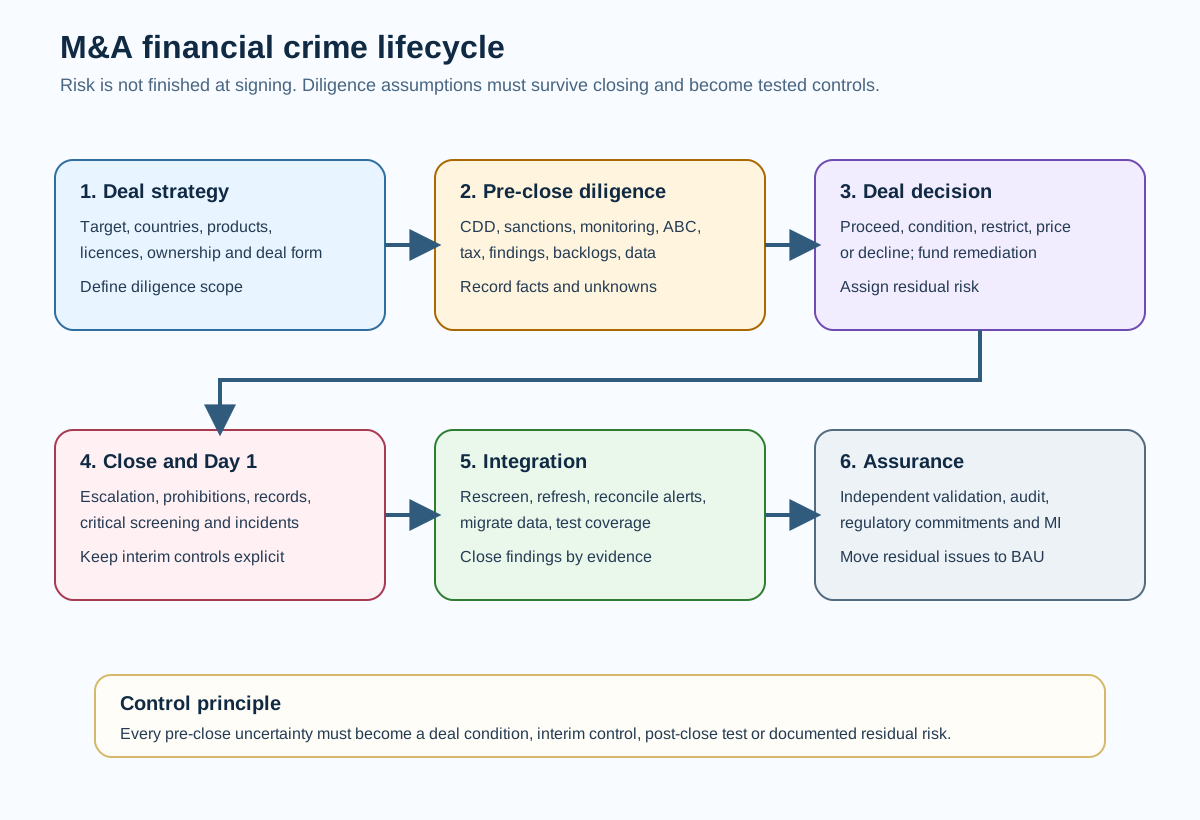
Why M&A creates a special control problem
Ordinary customer due diligence begins with a customer the bank is choosing to onboard. M&A due diligence is different because the subject is an entire business and its control environment. The buyer may need to understand thousands or millions of customers, multiple legal entities, historic transactions, branches, agents, vendors, products and jurisdictions within a compressed deal timetable. It may not have unrestricted access to customer-level information before closing because of competition law, confidentiality, bank secrecy, data-protection rules, deal sensitivity or the seller's own restrictions.
This creates an information asymmetry. The buyer is expected to make a risk decision while some of the best evidence may still sit inside the target. A mature process does not pretend that uncertainty can be eliminated. It records what was reviewed, what could not be reviewed, why access was constrained, what assumptions were made, which risks remain open and what post-close work is mandatory.
Financial-crime risk can affect the economics of the deal. A material remediation programme can require new screening technology, additional investigators, customer remediation, data cleansing, lookbacks, regulator engagement or product restrictions. Historic misconduct can create investigation, litigation or enforcement exposure. Weak controls can delay system migration or prevent a product from being brought onto the buyer's platform. These are not merely "compliance costs"; they can affect valuation, timing, integration sequencing and the willingness to proceed.
The same principle applies to joint ventures and minority investments, but governance becomes more complex because the bank may not control the entity. A 20 percent investment does not give the same ability to replace systems or direct staff as a full acquisition. The due-diligence conclusion therefore has to consider not only risk but also control rights: what information can be obtained, what policies can be imposed, what audit rights exist, who appoints compliance leadership, what escalation rights the investor has and what happens if the venture refuses remediation.
Global standards and jurisdiction-specific enforcement
FATF provides the global AML/CFT foundation rather than an M&A rulebook. Its current Recommendations, amended through June 2026, require risk-based controls, customer due diligence, beneficial-ownership transparency, recordkeeping, suspicious-transaction reporting, targeted financial sanctions and group-wide programmes as implemented through national law. For M&A, those principles matter because a buyer must understand whether the target's customers, ownership data, products and controls are capable of meeting the standards that apply to the combined group.
The Basel Committee's current consolidated AML/CFT guidelines likewise place ML/TF risk inside a bank's overall risk-management framework and emphasise group-wide and cross-border governance. That matters when an acquisition introduces a legal entity whose local practices, data standards or risk appetite differ from the parent group's minimum standard.
Anti-bribery expectations add another layer. The Wolfsberg Group's 2023 Anti-Bribery and Corruption guidance expressly addresses investments and acquisitions and adds post-acquisition due diligence to its risk-based framework. The UK Ministry of Justice's Bribery Act guidance identifies due diligence as one of six principles for procedures designed to prevent bribery. Those materials are useful control benchmarks, but the exact legal consequences still depend on the jurisdictions and entities involved.
United States guidance is particularly explicit about M&A but must not be universalised. The U.S. Department of Justice's 2024 Evaluation of Corporate Compliance Programs asks whether compliance is involved in transaction due diligence and whether acquired entities are integrated in a timely and orderly manner. OFAC's sanctions-compliance framework recommends risk assessment at important touchpoints including mergers and acquisitions, and OFAC enforcement material has repeatedly highlighted sanctions risk in acquisitions. These are U.S. enforcement expectations, not a global statutory timetable.
The practical lesson is to build one global M&A financial-crime methodology with jurisdiction overlays. The global layer defines the minimum questions, evidence and governance. Local legal and compliance teams then add rules on successor liability, disclosure, reporting, sanctions nexus, bank secrecy, data transfer, licensing and regulator notification.
Scope the transaction before scoring the risk
A strong review starts by understanding what is actually being acquired. The target may be a bank, payment institution, card acquirer, broker, wealth manager, remittance company, fintech, crypto service provider, software platform, portfolio of customers, branch network or non-financial company. The risks differ radically.
The deal structure matters as much as the target. A full acquisition may bring legal entities, employees, contracts, customers, systems and historical records. An asset purchase may transfer only selected contracts, customers or technology. A merger may combine entities under a new legal structure. A joint venture may create shared governance without full operational control. A minority investment may give economic exposure with limited control rights.
The review should therefore establish at least: legal entities in scope; ownership and control before and after closing; countries and regulators; licences; products and customer types; transaction volumes and currencies; branches, agents and distributors; major intermediaries and vendors; correspondent relationships; data and systems; and the planned integration model. Without that map, a risk score is not meaningful.
Build the pre-close financial-crime information request
The information request should be risk-led rather than an indiscriminate document dump. A mature bank usually asks for evidence in several connected groups.
The first group is governance and risk. This includes enterprise or business-unit financial-crime risk assessments, risk appetite, policies, committee papers, material compliance findings, open remediation, regulatory correspondence that can lawfully be shared, internal audit reports, independent testing, model-validation results and management information. The objective is not to count documents. It is to understand what management believes the risks are, whether control weaknesses are known and whether remediation is credible.
The second group is customer and counterparty risk. Useful evidence includes the size and segmentation of the customer base, high-risk customer populations, PEP exposure, non-resident customers, complex legal persons and arrangements, high-risk sectors, correspondent banks, MSBs, VASPs, charities, trade customers, private-banking relationships, agent networks and material third parties. Customer-level data may be restricted before closing; if so, aggregate profiles, samples, anonymised extracts or clean-team arrangements may provide proportionate insight.
The third group is screening and sanctions. Reviewers need to understand which sanctions and PEP lists are used, how often they update, matching logic, ownership/control treatment, payment-screening points, alert volumes and ageing, true-match history, blocked or rejected transactions, licence handling, list-change testing and unresolved incidents. For a global group, it is critical to distinguish local legal obligations from policy overlays and U.S., EU, UK, UN or other sanctions nexus.
The fourth group is transaction monitoring and investigations. The buyer should understand data sources, scenarios or models, coverage, thresholds, tuning, validation, alert ageing, investigator capacity, quality assurance, SAR/STR governance, lookback history and material typologies. A target that reports low alert volumes may be genuinely low risk, or its systems may not be detecting enough. Volumes must therefore be read alongside coverage and data quality.
The fifth group is anti-bribery, tax and internal misconduct. Depending on the target, reviewers may examine third-party intermediaries, procurement, gifts and hospitality, charitable donations, sponsorship, public-sector business, facilitation risks, whistleblowing, investigations, books-and-records controls and tax-reporting processes. The question is not whether the target has a policy; it is whether high-risk activity can be identified, approved, evidenced and challenged.
Treat red flags as questions, not verdicts
M&A diligence often produces incomplete signals. A regulator finding, high SAR volume, concentration of PEPs, business in a FATF-monitored jurisdiction, use of agents, historical sanctions matches, customer files with missing data or a whistleblower allegation can all be important. None should automatically be treated as proof that the target is criminal or unmanageable.
The quality of the response matters. A target that identifies weaknesses, quantifies them, assigns owners, funds remediation and tests closure may present less residual risk than a target that reports "no issues" but cannot produce evidence. A mature buyer therefore evaluates both inherent exposure and control credibility.
Warning signs become more significant when they connect. For example, rapid growth through agents, weak beneficial-ownership data, high-risk corridors, poor monitoring coverage and a large alert backlog create a stronger risk story together than any one indicator alone. The reviewer should document the chain of reasoning rather than use a checklist where each red flag adds an arbitrary point.
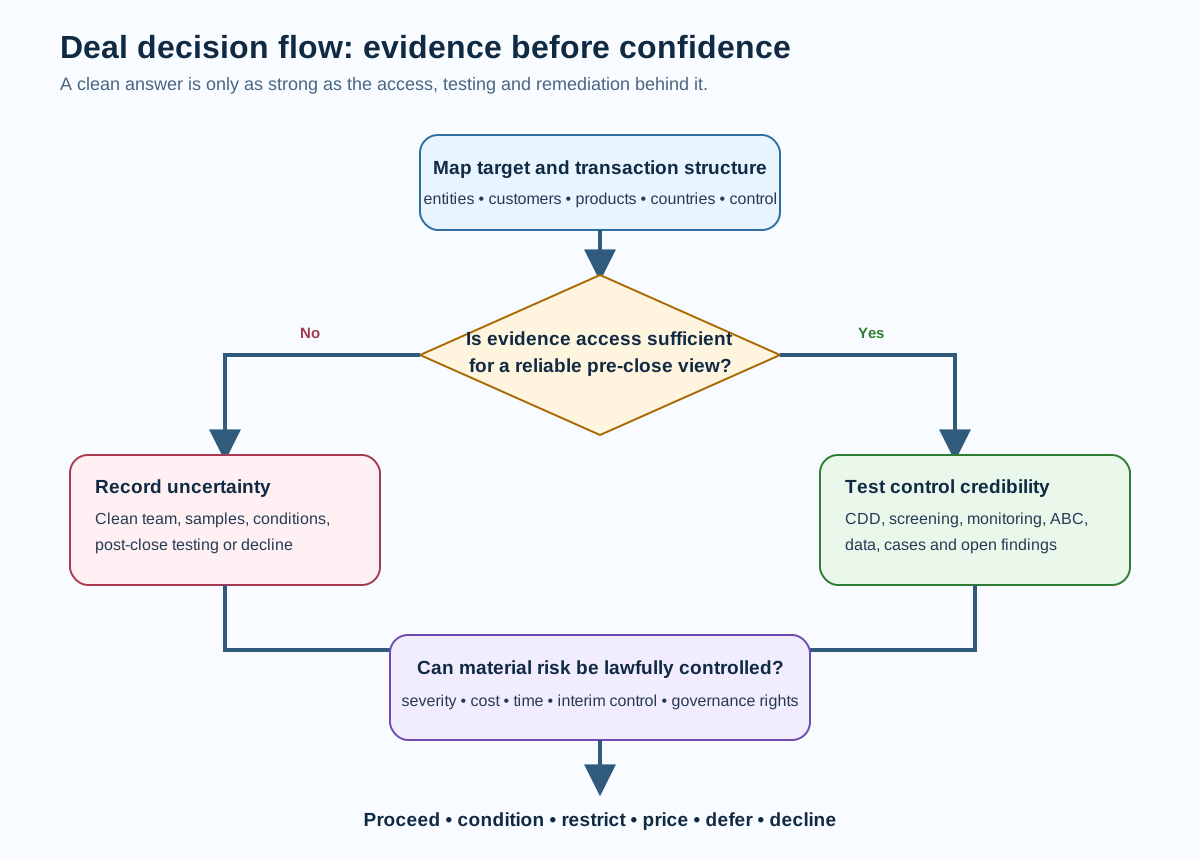
Decide what the evidence means for the deal
Financial-crime due diligence should produce decisions that transaction teams can use. The outcome is rarely a binary "pass" or "fail". Depending on materiality and legal advice, options may include proceeding without special conditions, proceeding with a funded remediation plan, requiring pre-close actions, restricting certain products or customers, delaying migration, changing contractual protections, adjusting valuation assumptions, creating a holdback or escrow, obtaining warranties, strengthening audit rights in a joint venture, or declining the transaction.
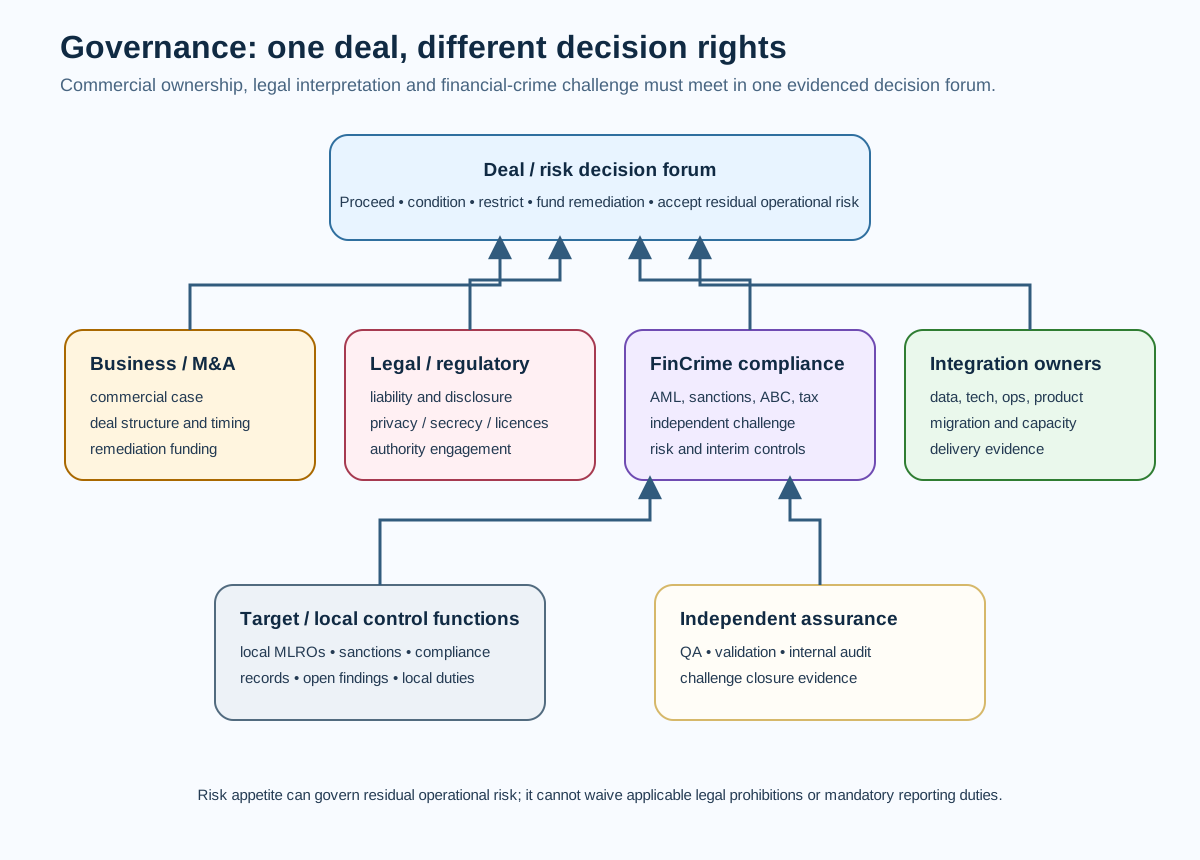
Compliance should not decide commercial terms alone, and commercial teams should not accept financial-crime risk alone. A decision forum needs the facts, severity, uncertainty, regulatory implications, remediation feasibility, cost, ownership and residual risk.
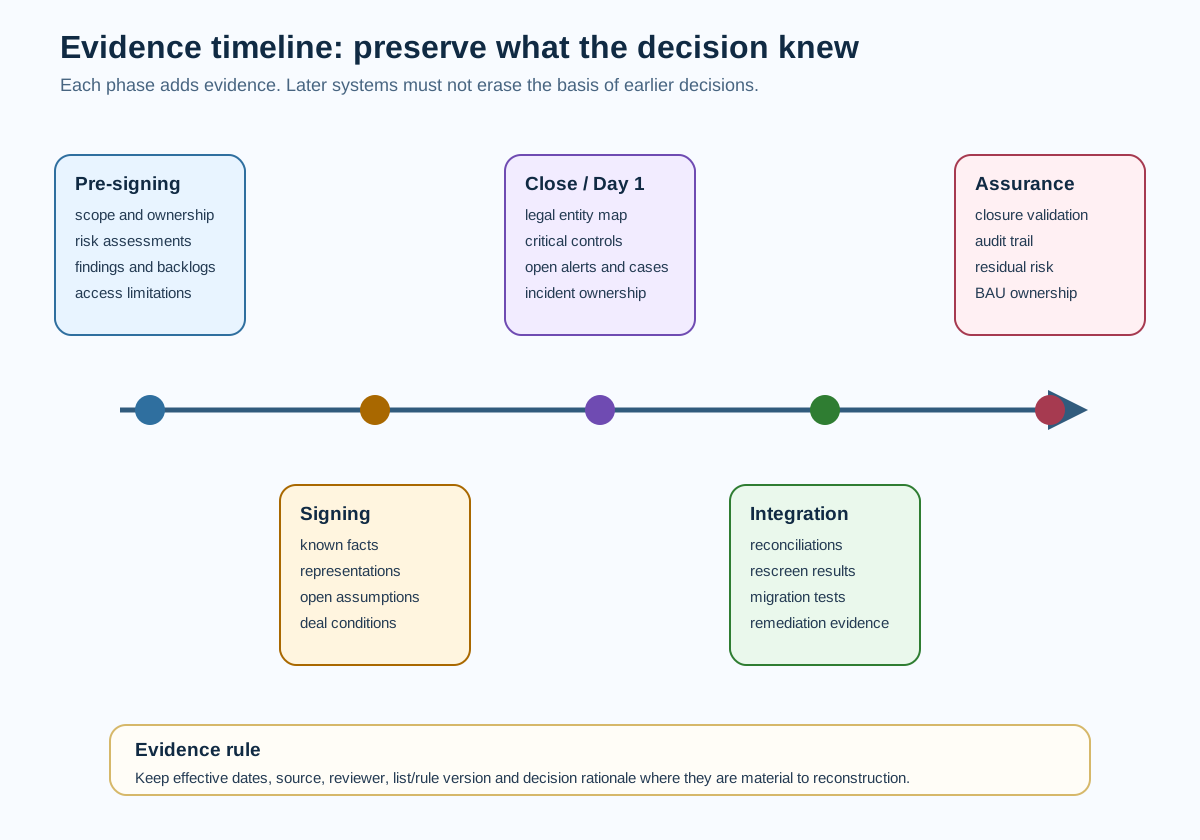
The evidence pack should distinguish three categories. Known facts are supported by documents or validated data. Management representations are statements made by the target that may require verification. Open assumptions are matters that cannot yet be proven. Blurring these categories is dangerous because post-close teams may later treat an assumption as if it had been independently verified.
Pre-close constraints and clean-team design
Some of the most useful data cannot always be shared freely before closing. Customer names, transaction records, pricing, strategy, employee investigations or competitively sensitive information can be restricted. The answer is not to bypass those restrictions. Legal teams should define what can be shared, with whom, for what purpose, in which environment and with what retention or deletion rules.
A clean-team model can separate sensitive diligence from commercial decision makers. For example, approved compliance reviewers or external advisers may review customer or sanctions samples and provide an aggregated risk conclusion without exposing unnecessary personal or competitive data to the deal team. The exact design depends on law and deal structure.
If access remains insufficient, the diligence report must say so plainly. "No issue identified" is not equivalent to "evidence proved no issue." A good report states the limitation and converts it into a post-close action with an owner and deadline based on risk.
Day 1 is a control event, not just a legal date
Closing changes ownership, governance and sometimes sanctions or regulatory nexus. Day 1 planning should therefore identify which controls must work immediately and which can be integrated later.
Immediate controls may include updated sanctions-nexus analysis, screening of acquired legal entities and key connected parties, escalation routes for serious alerts, incident reporting to the parent, restrictions on prohibited business, preservation of books and records, access for the group MLRO or equivalent, and a mechanism to stop activity that breaches applicable law or risk appetite.
Not every system must be migrated on Day 1. A rushed migration can be more dangerous than temporary coexistence if it loses customer attributes, alert history or audit trails. The correct question is whether the interim environment is controlled. Parallel systems need clear ownership, list updates, monitoring coverage, case-routing, reconciliation and evidence that neither platform creates a blind spot.
Post-close integration converts diligence into control
Post-close work should test the assumptions made before closing. This usually starts with a refreshed risk assessment using the fuller information now available. The buyer may need to rescreen customers and connected parties, validate beneficial ownership, review high-risk relationships, test sanctions and transaction-monitoring coverage, reconcile alert and case inventories, assess SAR/STR backlogs, review regulatory findings, and determine whether a lookback is justified.
Integration should be prioritised by risk rather than by organisational convenience. A material sanctions-screening weakness may need immediate remediation, while a low-risk policy-format difference can wait. The remediation plan should show issue, severity, customer or product population, interim control, owner, target date, evidence of closure and independent validation where appropriate.
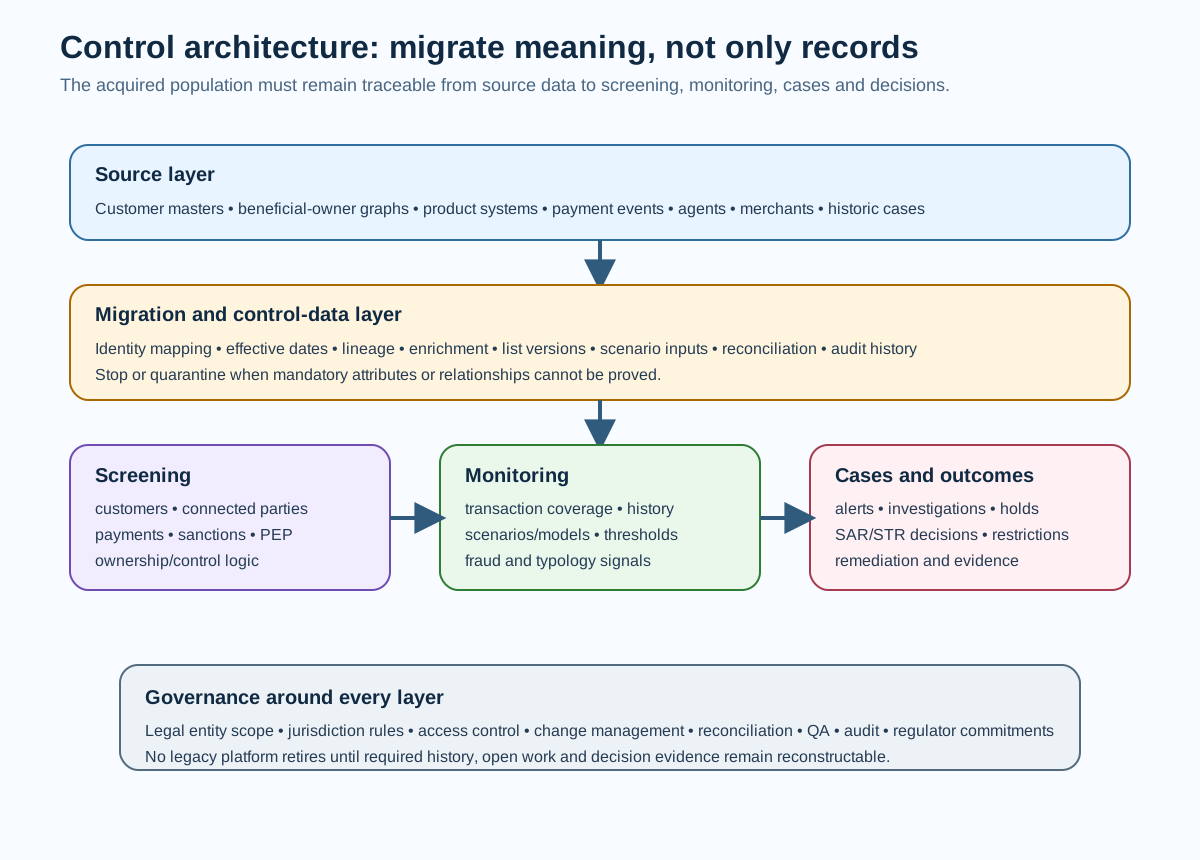
Customer migration deserves particular care. Records can be lost when customer identifiers, legal-entity models or risk-rating scales differ. A legacy "high risk" code may not map directly to the buyer's taxonomy. Beneficial owners may be stored as free text. PEP relationships may have different effective dates. Historical cases may use different closure reasons. A technical migration that copies every row can still fail if the meaning of the data changes.
Investigations, reporting and historical misconduct
An acquisition may surface historical misconduct or previously unknown control failures. The buyer should have an escalation route that brings together financial-crime compliance, legal, investigations, tax, sanctions specialists and senior management as required. Teams should preserve evidence and avoid contaminating investigations through uncontrolled access or premature conclusions.
Whether historical activity creates a SAR/STR, sanctions report, voluntary disclosure, regulator notification, employment action or law-enforcement engagement depends on applicable law and facts. These decisions must be jurisdiction-specific. A group should not copy a U.S. self-disclosure policy into every country, nor assume that a local suspicious-reporting threshold is identical elsewhere.
The same caution applies to lookbacks. A lookback is not automatically required because a control weakness exists. The decision should consider the nature and duration of the gap, customer and product exposure, legal expectations, regulator direction, data availability and the likelihood that relevant activity was missed.
Governance and decision rights
M&A financial-crime governance needs three lines of ownership without turning the deal into a compliance-only exercise. The business or transaction sponsor owns the commercial decision and must understand the residual risk. Financial-crime compliance provides independent challenge, specialist assessment and policy interpretation. Legal advises on liabilities, disclosure, confidentiality and regulatory obligations. Technology, operations, data, finance, HR, tax and product teams own parts of integration. Internal audit may later provide independent assurance.
A deal committee or equivalent forum should be able to answer: What risk are we buying? What did we verify? What remains unknown? What is the worst credible failure? Which issues must be fixed before close? Which can be controlled after close? Who funds and owns remediation? What happens if remediation slips? Which regulator or authority may need to be engaged? Which products or customers cannot migrate until controls are ready?
Those questions turn a diligence report into governance.
Practical mini case: acquiring a regional payment institution
Consider a banking group acquiring a regional payment institution operating in six markets. The target has grown quickly through merchant and remittance partnerships. Pre-close diligence shows no public enforcement action, but three issues emerge.
First, 18 percent of corporate customers were onboarded before the target introduced structured beneficial-ownership capture. The records are not necessarily wrong, but some ownership information is stored in documents rather than searchable fields. Second, payment screening is performed by a third-party engine, but the target cannot demonstrate consistent regression testing after list-provider and matching-configuration changes. Third, transaction-monitoring alerts have a material ageing tail because growth outpaced investigator hiring.
None of these facts proves criminal activity. Together, however, they create a credible risk that high-risk customers or transactions may not have been identified consistently.
The buyer separates the decision into inherited risk and controllability. It obtains samples through an approved clean-team process, reviews high-risk customer segments, tests a selection of sanctions scenarios, analyses alert ageing by typology and geography, and evaluates whether the target's remediation plan is realistic. The samples show that most ownership data can be reconstructed, but a defined legacy population requires refresh. Sanctions testing identifies no confirmed prohibited activity but does reveal weak evidence of configuration governance. Alert review finds a small number of cases needing expedited investigation but no basis for a broad conclusion of systemic laundering.
The deal committee decides to proceed subject to controls. Before close, the target must preserve configuration history, freeze unapproved screening changes and fund a backlog-reduction plan. At Day 1, the buyer imposes its escalation standard for serious sanctions and AML events. In the first integration wave, the highest-risk legacy corporate customers are refreshed, all acquired customers are rescreened using an approved method, and the monitoring backlog is triaged under joint governance. System migration is delayed until customer identifiers, beneficial-owner relationships, alert history and case outcomes reconcile between source and target platforms.
This is a good M&A financial-crime outcome because the buyer neither ignored uncertainty nor pretended it had perfect pre-close knowledge. It converted uncertainty into specific controls, evidence and accountable post-close work.
What good looks like
A strong M&A financial-crime process leaves a reconstructable chain from deal scope to risk decision. It shows why the target was considered higher or lower risk, what evidence supported that view, what could not be tested, which issues affected transaction terms, what interim controls applied at closing, how customers and systems were integrated, and how remediation closure was independently evidenced.
The most common failure is not the absence of a checklist. It is loss of continuity. Pre-close diligence identifies an issue, the deal closes, ownership changes, integration teams focus on technology and customers, and the original risk assumptions disappear into a data room. The control is complete only when those assumptions have been tested or closed.
For business analysts and architects, the final test is simple: can the combined bank explain which customers, transactions, products and entities came from the acquisition; which risk rules applied at each point in time; which alerts and investigations were inherited; which data transformed during migration; and which evidence supports the decision to continue, restrict or exit a relationship? If the system cannot answer those questions, the combined bank cannot yet demonstrate effective financial-crime controls.
Operational deep dive: proving that the acquired control environment actually works
Pre-close diligence is usually performed on a sample of evidence. Post-close integration has a harder job: it must establish whether the acquired control environment is complete enough to operate safely at scale. This deep dive focuses on the mechanics that determine whether a financial-crime integration succeeds or merely appears to succeed.
Build a control inventory before changing systems
An integration team should first identify every control that protects the acquired business. The inventory normally includes customer onboarding and refresh, customer and connected-party screening, payment screening, transaction monitoring, fraud-to-AML hand-offs, sanctions interdiction, PEP and adverse-media review, beneficial-ownership capture, correspondent due diligence, VASP or high-risk-sector controls, SAR/STR workflow, case management, list governance, third-party oversight, ABC controls and relevant tax-crime processes.
For each control, the team should record the legal entity, business line, customer or transaction population, source systems, rules or models, list source where relevant, trigger frequency, decision owner, escalation path, evidence retained, open findings and dependencies. This is more useful than a policy comparison because it exposes coverage gaps. Two organisations can have similarly worded policies while one screens payment parties at initiation and the other screens only after booking.
The inventory also prevents accidental control removal during integration. If a legacy system contains a niche scenario for a specific local product, migrating customers to a global platform without an equivalent scenario can reduce coverage even if the new platform is technically superior.
Customer data migration is a semantic problem
Migration teams often focus on whether fields moved, but financial-crime controls depend on meaning. A customer table can reconcile row-for-row and still be unsafe if values are reinterpreted.
Consider customer risk. The target may use four bands while the buyer uses three. A direct mapping can hide the reasons that produced the original rating. Better migration preserves both the source rating and the drivers: geography, occupation or industry, product, ownership, PEP status, delivery channel, expected activity and other locally relevant factors. The buyer can then recalculate risk using its own methodology and explain why the new result differs.
Beneficial ownership is more complex. The target may store natural persons, intermediate legal entities, control relationships, ownership percentages and effective dates differently. A safe migration preserves the graph, not only a list of names. Where evidence is incomplete, the record should be flagged for remediation rather than populated with an apparently precise value that was never verified.
PEP and sanctions data need effective dates and source context. A person may have been a PEP at onboarding, ceased to hold office later and remain subject to a policy-defined treatment period. A sanctions alert may have been cleared against a specific list version and identity evidence. If the buyer imports only the final status, it loses the basis for later audit or investigation.
Establish a data lineage for inherited controls
For each material detection or screening control, integration teams should be able to trace data from source event to decision. The chain might run from a channel or core platform through an integration layer, enrichment service, screening or monitoring engine, alert queue, case-management system and reporting store.
The important questions are concrete. Which fields are mandatory? Which can be null? Are names transliterated or normalised? Are addresses structured? Are ultimate parties available? Are transaction timestamps converted between time zones? Are rejected transactions included in monitoring? Can duplicate events be created during replay? Are historic transactions available for behavioural models? Does the case system retain the exact data that generated the alert, or does it display a later version?
During acquisition integration, every transformation should have an owner and reconciliation control. This is especially important when source systems are retired. Once a legacy platform is decommissioned, a missing mapping may be impossible to reconstruct.
Screening integration requires more than a rescreen
A full or risk-based rescreening of acquired customers and connected parties is often an important post-close activity, but it is not the whole control. Teams also need to assess list scope, matching configuration, suppression rules, ownership and control logic, transliteration, address and identifier matching, alert workflow, decision quality and list-update operations.
A buyer may discover that the target and group use the same commercial screening vendor but materially different configurations. The shared vendor name does not prove equivalent effectiveness. Test packs should include true-match scenarios, close false positives, aliases, non-Latin names, dates of birth, ownership relationships and jurisdiction-specific requirements. Any change in matching thresholds should be justified through testing rather than chosen simply because it reduces alerts.
Payment screening needs lifecycle mapping. A payment can be screened at channel entry, orchestration, repair, gateway, correspondent or settlement stages. During integration, teams must know which population is screened in which system and whether any routing path bypasses the intended control.
Monitoring integration needs coverage analysis
Transaction-monitoring integration should begin with a product-to-data-to-scenario map. For each acquired product or channel, the team should identify relevant typologies, available fields, scenarios or models, thresholds, exclusions and downstream investigation process.
A common error is to migrate customers before all their transaction data are available to the buyer's monitoring environment. The customer exists in the new customer master, but some legacy product transactions still occur in an old platform and never reach the global monitoring engine. Coverage testing must therefore use actual event populations and reconciliation totals rather than architecture diagrams alone.
Historical depth also matters. Behavioural monitoring may need months of prior activity to establish a baseline. If only transactions after migration are loaded, the model may treat established behaviour as new or fail to identify a sudden change. The integration plan should decide which history is needed for each control and verify that it loads correctly.
Alert, case and SAR/STR inventories must reconcile
Open financial-crime work is part of the acquired risk. Integration should inventory open alerts, investigations, information requests, sanctions holds, customer restrictions, SAR/STR decisions, regulator commitments and remediation actions.
Every item needs a disposition. Some can remain in the target's case platform until closure; others may need migration. If cases move, the buyer should preserve evidence, comments, attachments, decision timestamps, user identity, approval history and links to source transactions. A summary PDF is rarely an adequate substitute for structured history when an investigator later needs to understand the chronology.
The team should also reconcile counts before and after migration. If the source has 12,417 open alerts and the destination has 12,301, the difference must be explained. Duplicate suppression, invalid records and deliberate exclusions should be documented rather than silently accepted.
Suspicious-activity reporting requires special care because filing obligations, confidentiality rules and access controls differ by jurisdiction. A group integration should not centralise reports or investigator access across borders without checking local law, bank secrecy and data-transfer constraints.
Backlogs are not just staffing problems
An acquired backlog can indicate several different risks. It may reflect under-resourcing, poor alert quality, excessive false positives, weak triage, system outages, rapid growth or genuine increases in suspicious activity. The response should diagnose the cause before setting a closure target.
Risk-based triage can prioritise sanctions-sensitive alerts, high-risk customers, serious fraud-to-AML referrals, high-value or rapid movement, vulnerable-customer harm and alerts close to legal or policy deadlines. The method must not simply close old alerts to improve an ageing dashboard.
Where a material backlog exists at closing, governance should track both volume and quality. Useful measures include ageing distribution, risk mix, investigator productivity, escalation rates, quality-assurance failures, repeat alerts, conversion to investigations and resourcing assumptions. If temporary contractors are used, their training, access and quality controls need the same scrutiny as permanent staff.
Testing the combined control environment
Testing should include positive, negative, boundary and failure scenarios. Positive tests prove known risk patterns generate the intended alert or intervention. Negative tests prove legitimate activity does not create unreasonable friction. Boundary tests examine thresholds, missing data and timing. Failure tests simulate unavailable screening services, delayed feeds, duplicate messages, list-update failures, expired licences and case-system outages.
For data migration, testers should use end-to-end trace cases. Select customers with complex ownership, PEP relationships, historic alerts, multiple products and cross-border activity. Trace each from legacy source through migration to the new customer master, screening engine, monitoring platform and case tools. Verify not only values but effective dates, relationships and audit history.
A business analyst should express requirements as observable outcomes. "Migrate sanctions data" is too vague. A stronger requirement might state that all active customer and connected-party identities in scope must be available for screening before migration cutover, that source and destination counts must reconcile to an agreed rule, that unresolved matches must retain their status and evidence, and that no customer can become transaction-enabled if a mandatory screening state is missing.
Decommissioning legacy platforms
Legacy decommissioning is a financial-crime decision as well as an infrastructure decision. Before retirement, the bank should confirm that required historical records are retained for the legally applicable period, open cases remain accessible, audit trails can be reproduced, regulators or law enforcement can be answered, and models or rules can be explained where required.
Data retention must follow the law applicable to the entity and data type. Keeping everything forever is not a safe substitute for understanding retention requirements because privacy and secrecy rules may require deletion or access restriction.
An exit checklist should identify the authoritative system for each record after decommissioning, the retrieval method, access owner, legal-hold process and evidence that migrated data were complete. If a regulator asks two years later why a customer was cleared during the acquisition, the combined bank should not depend on a retired employee's memory.
The integration control room
For a significant acquisition, a time-limited financial-crime integration control room can bring together AML, sanctions, ABC, fraud, tax, operations, technology, data and legal teams. Its purpose is not permanent centralisation. It is to manage dependencies while two control environments converge.
The forum should track critical issues, interim controls, incidents, customer migration waves, list and scenario changes, backlog, regulator commitments and remediation evidence. Issues should have severity, owner, target date and escalation trigger. Red status should mean something operational, such as migration cannot proceed, a product remains restricted or senior risk acceptance is required.
The control room can close only when residual issues have stable ownership in the target operating model. Otherwise integration risk simply moves from a visible programme into ordinary operations before the work is finished.
Advanced practice: deal structure, residual risk and transaction conditions
Financial-crime due diligence becomes difficult when the legal transaction, control rights and compliance risk point in different directions. This section examines the decisions that experienced teams need to make when the answer is not a simple acquisition of a wholly owned bank.
Share deals, asset deals, mergers and joint ventures
The transaction structure changes what is inherited and what can be controlled. A share acquisition generally preserves the target legal entity and its history, contracts and licences unless law or transaction terms provide otherwise. An asset acquisition may transfer selected customers, books, technology or contracts while leaving other liabilities or records behind. A legal merger may combine entities. A joint venture creates shared governance, while a minority investment can leave operational control with another shareholder.
Those distinctions matter for financial crime, but they do not create a universal liability rule. Successor liability, reporting duties, licence transfer, regulator approval and access to historic records are questions for local counsel and regulators. The compliance team should avoid statements such as "the buyer always inherits all sanctions liability" or "an asset deal eliminates historic risk." Both can be wrong depending on jurisdiction and facts.
Instead, financial-crime teams should translate legal structure into control questions. Which customers become ours? Which employees and agents transfer? Which records can we obtain? Which entity remains the reporting entity for historic activity? Which licences survive? Who can change controls before and after close? Which contracts permit audit or termination? Who owns remediation if the target continues as a separate subsidiary?
Minority investments and joint ventures
A bank can face reputation and facilitation risk even where it lacks full control. The diligence should therefore assess governance rights explicitly.
Useful rights may include board representation, access to compliance information, audit rights, approval over high-risk business lines, appointment or removal rights for control functions, information on investigations, rights to require remediation, restrictions on sanctioned or prohibited business and exit rights for material compliance breaches. The commercial team and counsel decide what is negotiable; compliance explains what control weakness remains if those rights are absent.
A joint venture can also create data-sharing constraints. The bank may be entitled to oversight but not unrestricted customer data. The operating model should define what aggregated MI, samples, attestations, independent testing or incident notifications provide enough oversight without breaching privacy or bank-secrecy rules.
Risk segmentation for an M&A target
One overall "high/medium/low" target rating is rarely sufficient. A useful assessment separates several dimensions.
Jurisdiction and regulatory risk considers where the target is licensed and active, the quality of supervision, sanctions exposure, FATF public statements, corruption risk and cross-border constraints. FATF listing is one factor, not a substitute for a complete country assessment.
Customer risk considers customer types, ownership opacity, PEP exposure, non-resident business, high-risk sectors, correspondents, MSBs, VASPs and private-banking or trust structures.
Product and channel risk considers cash, instant payments, cross-border wires, trade, acquiring, prepaid value, crypto, agents, APIs and other channels whose speed or opacity can affect detection.
Control risk considers whether CDD, screening, monitoring, investigations, reporting, governance and assurance are designed and operating effectively.
Conduct and integrity risk considers bribery, corruption, fraud, employee misconduct, whistleblowing and books-and-records concerns.
Data and technology risk considers lineage, coverage, model governance, vendor dependency, legacy systems, cyber incidents and the feasibility of integration.
The final assessment should explain the interaction between these dimensions. A target in a higher-risk market can still have mature controls; a target in a lower-risk market can be dangerous if its data and governance are poor.
Materiality is not only financial
Deal teams naturally focus on financial materiality, but small financial-crime issues can be legally or reputationally material. A low-value transaction involving a designated person, a public official or a serious bribery allegation may require action regardless of its percentage of revenue.
The diligence methodology should therefore define qualitative escalation triggers. Examples include credible evidence of sanctions breaches, deliberate concealment, senior-management involvement, regulator deception, systemic CDD failure, destruction of records, active obstruction of investigators, or material ongoing criminal conduct. These are not automatic conclusions; they are reasons for specialist escalation.
Conversely, a large alert backlog is not automatically a reason to terminate a deal. If root cause is understood, high-risk items are protected and remediation is feasible, the risk may be manageable. Materiality should connect severity, likelihood, legal consequence, duration, affected population and controllability.
Contractual protections are controls only if they can be used
Representations, warranties, covenants, indemnities, holdbacks, conditions precedent, audit rights and termination rights can allocate risk. They do not repair an AML system.
A representation that the target complies with all laws may support transaction remedies but does not tell operations how to screen customers on Day 1. A covenant to remediate a backlog matters only if the issue is measurable, a responsible party has resources, deadlines are realistic and the buyer can verify completion.
Financial-crime teams should therefore link contractual protections to an operational remediation register. If a contract requires the target to complete beneficial-ownership refresh before migration, the integration programme should define the population, evidence standard, exception handling and acceptance test. Contract and control then reinforce each other.
When pre-close diligence is constrained
Competitive auctions, hostile deals, privacy restrictions or incomplete seller data can make detailed diligence impossible. The appropriate response is a graded confidence assessment.
A report might conclude that customer segmentation is reliable, sanctions governance is partially evidenced, transaction-monitoring effectiveness cannot be fully tested, and historic ABC investigations are accessible only in summary. Each conclusion should show confidence and consequence.
The deal forum can then choose compensating measures: a narrower pre-close sample, external independent review, clean-team analysis, stronger contractual protections, additional reserves, a restricted Day 1 operating model, accelerated post-close testing or a condition that certain evidence be provided before closing.
What the bank should not do is silently convert "not reviewed" into "satisfactory."
Integration sequencing
A risk-based sequence usually places legally critical or high-severity controls ahead of cosmetic harmonisation. For example, a bank may prioritise sanctions list coverage, payment interdiction, high-risk CDD, serious alert backlogs and regulatory findings before harmonising policy templates or management-report formatting.
The order should also respect dependencies. There is little value moving monitoring scenarios before transaction feeds and customer-risk attributes are stable. Rescreening before ownership data are cleansed may create false comfort. Migrating cases before user entitlements and legal-secrecy restrictions are mapped can expose sensitive reports to unauthorised staff.
A useful integration plan therefore identifies predecessor controls. Customer master and ownership mapping support screening; source transaction completeness supports monitoring; case entitlements support investigation; legal-entity mapping supports reporting.
Risk acceptance and the "temporary" control trap
Acquisitions create many temporary controls: manual sanctions checks, restricted transaction limits, dual approval, enhanced sampling, additional investigator review or daily reconciliation. Temporary controls can be appropriate, but they often become permanent by inertia.
Every interim control should have a specific risk, owner, start date, monitoring method, exit criterion and escalation if the strategic remediation slips. Manual controls should include capacity assumptions. A manual review that works for 500 cases a week may collapse when migration volume rises to 5,000.
Senior risk acceptance should not be used to waive a legal requirement. It can address residual risk within the bank's discretion, such as a temporary operational weakness with effective compensating controls. Legal prohibitions, filing duties and sanctions requirements require compliance, not appetite acceptance.
Regulator and authority engagement
Whether and when regulators must be notified is jurisdiction-specific. Bank acquisitions may already require prudential, competition or licensing approvals. Financial-crime issues can influence those processes, especially where there are open findings, enforcement matters or remediation commitments.
The integration team should maintain an authority map showing each target entity, supervisor, FIU, sanctions authority where relevant, open commitments, reporting obligations and contact owner. Communications should be coordinated so that one part of the group does not make a statement inconsistent with another.
A commitment made to a regulator before acquisition does not disappear because ownership changes. The buyer should identify such commitments during diligence and incorporate them into the integration plan, with legal advice on any required notification or amendment.
Scenario: acquiring a fintech through an asset transaction
Suppose a bank buys a fintech's customer contracts, brand and payment technology but not the selling company itself. Commercial teams initially assume historic financial-crime issues are irrelevant because the legal entity is not acquired.
Compliance challenges that assumption. The bank will onboard a transferred customer population using data generated by the seller, continue relationships with some of the same merchants and rely on historical transaction profiles to monitor future behaviour. Even if particular legal liabilities remain with the seller, poor historical KYC data can become the buyer's current control problem the moment customers transfer.
The bank therefore makes customer transfer conditional on minimum identity and beneficial-ownership data, rescreens the population before activation, migrates sufficient transaction history for monitoring, obtains rights to retrieve source evidence for an agreed retention period, and routes unresolved high-risk customers into enhanced review. It separately asks counsel to determine which historical incidents, reports or investigations transfer and what disclosures are required.
This example shows why legal liability and operational risk must be analysed together but not conflated.
Practice close: requirements, testing and audit questions
This section converts the chapter into delivery artefacts that can be used in a real M&A programme.
Minimum requirement set
A financial-crime integration should define the target population unambiguously. Requirements should identify which legal entities, customers, connected parties, products, transactions, agents, merchants, correspondents, vendors and historic cases are in scope. "All target customers" is insufficient if the target operates multiple customer masters or if dormant, blocked and closed relationships require different treatment.
Data requirements should specify source, destination, mandatory attributes, effective dates, relationships, transformation rules, reconciliation logic and evidence retention. Sensitive categories such as SAR/STR data, investigations and employee misconduct may need separate access controls and local legal analysis.
Screening requirements should define populations, list scope, frequency, matching logic governance, unresolved-alert treatment, ownership/control logic and cutover behaviour. Monitoring requirements should define product coverage, required transaction history, scenario or model mapping, exclusions, latency and the handling of events that occur during migration.
Case requirements should preserve chronology. At minimum, investigators need trigger, relevant customer and transaction data, evidence reviewed, comments, decision, approvals, timestamps and attachments or references. If legacy cases stay in place, the retrieval and access model must remain supported.
Governance requirements should state who can approve a migration wave, who can accept residual operational risk, who can stop cutover, and which issues require legal or senior-compliance escalation.
Acceptance criteria examples
A useful acceptance criterion is observable. Examples include:
- Every active in-scope customer and connected party has a valid screening state before transaction capability is enabled.
- Source and destination customer populations reconcile under documented inclusion and exclusion rules, with every variance explained.
- Beneficial-owner relationships retain entity links, ownership or control basis where available, evidence source and effective dates.
- Open sanctions alerts, investigations and customer restrictions cannot be lost or reset to a clean state during migration.
- All in-scope transaction sources feeding the legacy monitoring environment are either mapped to the strategic monitoring platform or covered by an approved interim control.
- The destination case-management environment enforces jurisdiction-appropriate access to suspicious-reporting information.
- A failed list update, missing feed or delayed screening response generates a detectable operational event and invokes an approved fallback or stop path.
These are examples of control design, not universal regulatory wording.
Test design
Positive test cases should include high-risk customers, PEP relationships, sanctioned-name variants, ownership chains, rapid cross-border movement, partner or correspondent exposure and known typology patterns relevant to the acquired business.
Negative cases should include legitimate international customers, common-name screening matches, ordinary ownership changes, expected high-volume corporate activity and customer migrations that should not trigger unnecessary restrictions.
Boundary cases should test missing dates of birth, incomplete addresses, conflicting country codes, threshold-edge transaction values, ownership percentages near policy triggers, dormant customers and payments received during cutover windows.
Failure tests should simulate unavailable list feeds, delayed monitoring files, duplicate events, replayed messages, partial migration, expired user access, case attachment failure and mismatch between source and destination counts.
Regression testing should be repeated after matching changes, scenario changes, data transformations or vendor upgrades. A passing test before migration does not prove controls remain effective after configuration changes.
Audit questions
An independent reviewer should be able to ask a small number of hard questions and receive evidence quickly.
What financial-crime risks were identified before the deal? Which could not be tested? How did those uncertainties affect transaction conditions? What changed on Day 1? Which controls remained on legacy systems? Which customer populations were refreshed or rescreened? How were alert and case inventories reconciled? Which historical data were migrated? Which data were intentionally not migrated, and why? Which remediation actions remain open? Who accepted them? What evidence proves that a closed issue is actually fixed?
If the answer depends on a presentation created for the deal committee rather than source evidence, the control is fragile.
Customer and operational impact checklist
Integration can harm legitimate customers if controls are poorly sequenced. Teams should monitor false-positive spikes after rescreening, duplicate information requests, account or payment restrictions caused by migration errors, delayed payments, repeated KYC outreach and inconsistent customer communication between legacy and group channels.
Customer impact is not a reason to weaken legal controls. It is a design requirement. High-quality data mapping, clear case ownership and controlled exceptions reduce unnecessary friction while preserving risk decisions.
Operational capacity should be tested against peak migration volume. Rescreening a large acquired population can create an alert surge even when the underlying risk has not changed. Staffing, queue prioritisation and service continuity should be planned before activation.
Closure evidence
A remediation item should close only when the bank can show that the root cause is fixed, the affected population has been addressed, the control operates as designed and any required retrospective review is complete. A project status of "implemented" is not enough.
Evidence may include reconciliations, test results, quality-assurance samples, model or rule approvals, updated data lineage, closed-case samples, customer-remediation totals, independent validation and governance approval. The appropriate package depends on severity.
For significant issues, closure should be challenged by someone independent of the delivery owner. This avoids the team that designed the fix also being the only team to decide that it worked.
Knowledge check
Why is a clean pre-close diligence report not proof of low risk? Because access may be limited and evidence may be sampled. The report must distinguish verified facts from representations and unknowns.
Why can a technically successful customer migration still fail financial-crime control? Because field meaning, relationships, effective dates, alert history or transaction coverage can be lost even when records transfer.
Should every M&A control gap trigger a deal rejection? No. The decision depends on legal severity, exposure, controllability, cost, uncertainty and risk appetite. Some gaps can be remediated; some legal or integrity concerns may make proceeding unacceptable.
Can senior management accept the risk of breaching a sanctions prohibition or mandatory reporting duty? No. Risk acceptance cannot waive applicable law.
What is the best evidence that integration is complete? A traceable control environment in which acquired populations, data, alerts, cases, decisions and remediation can be reconstructed and independently tested.
Masterclass: a deal that looked clean until the controls were mapped
This case is fictional but reflects recurring patterns in bank and fintech acquisitions. It is designed to show how the evidence changes the deal decision.
NorthBank, a diversified banking group, plans to acquire SwiftHarbor, a profitable cross-border payments company. SwiftHarbor operates through two licensed entities and a network of local payout partners. Revenue has grown rapidly, loss rates are low and the target has never received a public AML enforcement penalty.
Phase 1: the first diligence pack
The seller provides policies, the latest enterprise risk assessment, sanctions vendor certificates, an internal-audit report and summary customer statistics. At first glance the control environment looks mature.
The AML policy was updated within the past year. Customer screening runs daily. Payment screening is real time. Transaction monitoring has 26 scenarios. The board receives a quarterly compliance dashboard. More than 95 percent of alerts are closed within the target's service standard.
A weak review could stop there.
NorthBank's financial-crime team instead asks how those controls connect to the business. It requests product-to-scenario coverage, list-update evidence, data-lineage diagrams, high-risk customer segmentation, agent and payout-partner due diligence, alert ageing by risk rather than total volume, open regulator commitments, and samples of closed investigations.
Phase 2: the control picture changes
The deeper review identifies four issues.
First, SwiftHarbor's transaction-monitoring engine receives settled payments but not payment attempts rejected by certain payout partners. The target explains that rejected payments never create customer exposure. NorthBank disagrees: repeated failed attempts can be relevant to evasion, fraud and behavioural monitoring.
Second, payout partners are risk-rated at onboarding, but ownership refresh is event-driven and there is no reliable feed for ownership changes. Several partners operate in markets where corporate information is difficult to obtain.
Third, the sanctions vendor updates lists promptly, but regression tests after matching-rule changes are informal. The target can demonstrate current performance on standard test names but cannot reproduce the rationale for two threshold changes made eighteen months earlier.
Fourth, alert service-level reporting hides a tail. Most alerts close quickly, but a small high-risk investigation queue is more than 90 days old because the specialist team has vacancies. The absolute number is modest, yet the queue includes correspondent-like partner activity and complex cross-border cases.
None of these issues proves laundering or sanctions breaches. They do show that the original "mature control environment" conclusion was too broad.
Phase 3: decision before signing
The deal committee asks compliance to rate the issues and quantify uncertainty.
The missing rejected-payment feed is classified as a material monitoring coverage gap, but technically remediable. The partner ownership weakness is a CDD governance issue affecting a defined population. The sanctions-testing weakness is a control-evidence gap requiring validation. The ageing investigations create potential historical exposure because serious cases remain unresolved.
NorthBank does not demand that every issue be closed before signing. Instead it changes the deal plan.
SwiftHarbor must preserve and make available rejected-payment data. A targeted review of the highest-risk payout partners must be completed before close. An independent sanctions test pack must be run before customer migration. The specialist investigation backlog must be triaged, with serious matters escalated immediately. The purchase agreement includes information, remediation and cooperation provisions drafted by counsel. Integration funding is increased and the technology migration date is moved behind the control-validation milestone.
The commercial team accepts the cost because it is now visible in the economics of the transaction.
Phase 4: closing and Day 1
On closing, SwiftHarbor remains a separate regulated subsidiary while systems are integrated. NorthBank applies group escalation standards for material sanctions, AML and bribery matters but does not pretend local SAR/STR rules are identical. Local MLROs retain their statutory or regulatory responsibilities.
A joint control room tracks high-risk customer refresh, partner review, sanctions validation, alert backlog and monitoring-feed remediation. NorthBank also freezes discretionary changes to sanctions matching configuration until the target enters the group's model-change process.
Most importantly, customer migration is not used as the first control test. The acquired business continues on its legacy systems under enhanced governance while the buyer validates data and mappings.
Phase 5: post-close discovery
Three weeks after close, one aged investigation identifies a payout partner whose beneficial owner changed before the transaction. The new owner is connected through corporate layers to a PEP and appears in adverse reporting about public-procurement corruption. There is no sanctions match and no proof of criminal conduct.
The correct response is investigation, not automatic exit. The bank reconstructs ownership dates, payment flows, counterparties, due-diligence history and the target's knowledge. It assesses whether enhanced due diligence should have been triggered earlier and whether suspicious-activity reporting is required under the relevant local law. It also checks whether other partners share the same corporate-service provider or ownership pattern.
The investigation exposes a process weakness: ownership changes were not systematically ingested. The bank therefore expands remediation from one partner to the population and adds a verified ownership-refresh mechanism.
What the case teaches
The acquisition was not "safe" because no public penalty existed. Nor was it "bad" because control gaps were found. The quality of the outcome came from converting uncertainty into evidence and controls.
The strongest decisions were sequencing decisions. NorthBank did not rush customer migration, did not close aged cases merely to hit a metric, did not assume the sanctions vendor guaranteed configuration quality and did not treat a PEP link as proof of corruption.
The case also shows why M&A diligence must survive the deal. The payout-partner issue became actionable only because pre-close findings were carried into post-close governance with owners and data. Had the diligence report simply been archived, the same weakness could have continued after the acquisition under NorthBank's name.
For a business analyst, the central artefact is the traceability matrix linking diligence finding, affected population, interim control, strategic remediation, system requirement, test evidence and closure approval. For an architect, it is the source-to-control lineage showing which data feeds screening, monitoring and case decisions. For compliance, it is the evidence that residual risk was knowingly governed rather than accidentally inherited.
References and further reading
The sources below were used to frame this chapter. They are public, authoritative or recognised financial-sector guidance. M&A liability, regulatory notification, suspicious reporting, sanctions nexus, data transfer and successor-liability questions remain jurisdiction- and transaction-specific.
Global AML/CFT and banking standards
-
Financial Action Task Force, The FATF Recommendations, as amended June 2026. The risk-based approach, CDD, beneficial ownership, suspicious reporting, targeted financial sanctions and group-wide controls provide the global AML/CFT foundation that national laws implement. https://www.fatf-gafi.org/en/publications/Fatfrecommendations/Fatf-recommendations.html
-
Financial Action Task Force, Guidance on Beneficial Ownership of Legal Persons, 10 March 2023. Useful for understanding why accurate and current ownership information matters when a buyer inherits legal entities, customers and counterparties. https://www.fatf-gafi.org/en/publications/Fatfrecommendations/Guidance-Beneficial-Ownership-Legal-Persons.html
-
Basel Committee on Banking Supervision, Anti-money laundering and counter-terrorist financing, current Basel consolidated guidelines. Covers AML/CFT within overall bank risk management, group-wide and cross-border controls, supervision, third-party CDD and correspondent banking. https://www.bis.org/committees/bcbs/basel-consolidated-guidelines/module/afs/10
Anti-bribery, corruption and acquisition due diligence
-
Wolfsberg Group, Anti-Bribery and Corruption Compliance Programme Guidance, published 17 April 2023. The updated guidance includes investments and acquisitions, risk-based ABC due diligence and post-acquisition due diligence. https://wolfsberg-group.org/news/39/
-
UK Ministry of Justice, Bribery Act 2010 guidance, page last updated 22 January 2025. The guidance presents six principles for bribery-prevention procedures, including risk assessment, due diligence, monitoring and review. It is UK guidance and should not be treated as a universal legal rule. https://www.gov.uk/government/publications/bribery-act-2010-guidance
-
United Nations Office on Drugs and Crime, UNODC Business Integrity Portal: the United Nations Convention against Corruption and the private sector. Provides the UNCAC private-sector context for integrity, accountability and prevention of corruption. https://businessintegrity.unodc.org/
United States enforcement and sanctions context
-
U.S. Department of Justice, Criminal Division, Evaluation of Corporate Compliance Programs, updated September 2024. The M&A section asks whether compliance participates in due diligence and whether acquired entities are integrated into compliance controls in a timely and orderly way. This is U.S. prosecutorial guidance, not a global mandatory timetable. https://www.justice.gov/criminal/criminal-fraud/page/file/937501
-
U.S. Department of Justice, Deputy Attorney General Lisa O. Monaco Announces New Safe Harbor Policy for Voluntary Self-Disclosures Made in Connection with Mergers and Acquisitions, 4 October 2023. Useful for understanding a specifically U.S. voluntary-disclosure enforcement context; local legal advice is required before applying it to any transaction. https://www.justice.gov/archives/opa/speech/deputy-attorney-general-lisa-o-monaco-announces-new-safe-harbor-policy-voluntary-self
-
U.S. Department of the Treasury, Office of Foreign Assets Control, A Framework for OFAC Compliance Commitments, published 2 May 2019. OFAC identifies mergers and acquisitions as an important sanctions risk-assessment touchpoint. The framework applies in the U.S. sanctions context and should not be presented as a global rule. https://ofac.treasury.gov/recent-actions/20190502_33
-
U.S. Department of the Treasury, Office of Foreign Assets Control, Wells Fargo Bank, N.A. settlement and compliance considerations, 30 March 2023. OFAC expressly highlighted the need for comprehensive sanctions due diligence when one entity acquires another. https://ofac.treasury.gov/system/files/2023-03/20230330_wells_fargo.pdf