Global Standards and Local AML Laws
Financial crime regulation becomes confusing when every external requirement is described as a “global rule”. There is no single worldwide AML statute. Banks operate inside a layered system in which international standards, United Nations measures, regional legislation, national statutes, regulations, supervisory rules, FIU requirements, sanctions regimes, industry guidance and internal bank policy can all influence a control. The legal force of those sources is not the same, and their scope is not the same. A rule may apply to one legal entity, product or transaction and not to another one in the same banking group.
This distinction matters in daily banking. A compliance officer needs to know whether a requirement is legally binding or a group-policy choice. An investigator needs to know which reporting regime applies to a suspicious case. Operations needs to know whether a payment should be released, held, rejected, blocked or escalated. A business analyst must translate legal interpretation into requirements without accidentally hard-coding one country's law into a global platform. Architects and developers need effective-dated rules and legal-entity context. Testers need to prove that the correct rule is selected under the correct facts. Audit and supervisors need evidence showing not only what happened, but why the bank believed a particular rule applied at that time.
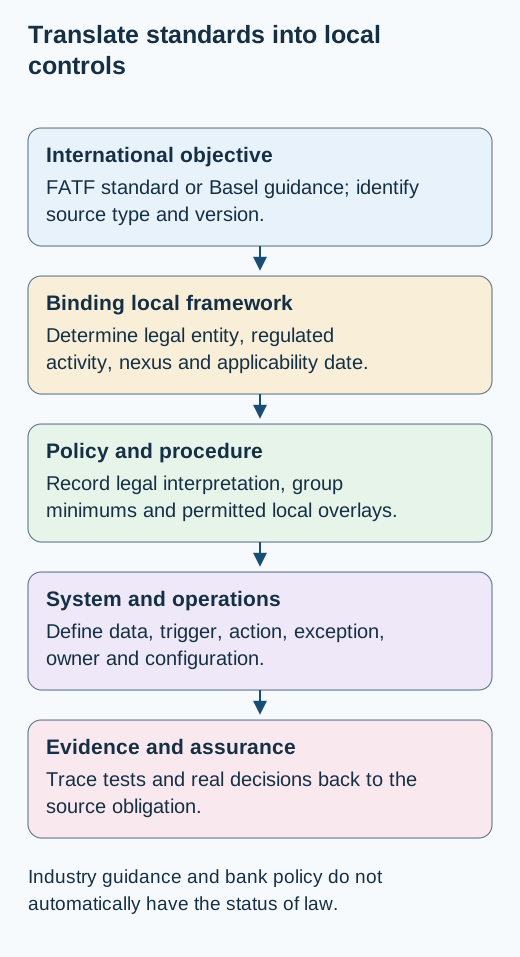
The core mental model is:
International standard or external measure → regional or national implementation → supervisory and FIU expectations → bank policy → procedure and control → system logic → operational decision → evidence and assurance.
The arrows matter as much as the boxes. A well-written law can still produce a weak control if applicability is misunderstood, data is missing, the wrong entity is selected, a local exception is lost, a system rule is not versioned, staff use an outdated procedure or evidence is not retained. Conversely, a bank can choose an internal standard that is stricter than local law, but it should be clear that this is an internal risk decision rather than a statement that every jurisdiction legally requires the same thing.
1. Start by separating the kinds of authority
Inside large institutions, the word regulation is often used as shorthand for almost anything external. That shorthand becomes dangerous when requirements are designed, challenged or audited. The first discipline is to classify the source.
An international standard establishes outcomes and principles that participating countries are expected to implement. The Financial Action Task Force (FATF) Recommendations are the most influential global AML/CFT and counter-proliferation-financing standards. FATF evaluates countries against those standards, but FATF is not the national supervisor of a bank and its Recommendations are not one universally self-executing banking statute. A bank should understand FATF because local frameworks are heavily shaped by it, while still asking what domestic or regional instrument creates the enforceable obligation for the entity concerned.
A treaty, United Nations Security Council measure or other international legal instrument sits in a different category. Some international obligations bind States, which then implement them through domestic or regional law. In sanctions, this distinction is especially important. A UN designation or Security Council resolution can be the international origin of a requirement, but the operational duty of a bank normally needs to be understood through the legal framework applicable to that bank. In some regional legal systems, measures may have direct effect; elsewhere national implementation is required. A sanctions analyst therefore should not stop at “UN listed”. The analyst needs the applicable legal measure, ownership or control rule, exemptions, licences, reporting route and required asset treatment.
A statute or directly applicable regulation creates binding legal duties within its legal order. These may govern customer due diligence, beneficial ownership, suspicious reporting, record retention, internal controls, targeted financial sanctions, wire-transfer information, governance and enforcement. The detailed obligation can differ materially from the international standard that inspired it.
A directive can require participating States to achieve specified outcomes while leaving implementation to national law. This is particularly relevant in the European Union, where a regulation and a directive have different legal mechanics. Treating them as interchangeable creates poor requirements and incorrect effective-date assumptions.
A supervisory handbook, rule, guideline, examination manual or statement explains how a regulator expects institutions to comply or how it will assess them. The precise legal status varies by jurisdiction and document. Some guidance is formally recognised in legislation or enforcement practice; some is persuasive rather than binding. The important point for a bank is to record the status instead of flattening all documents into “law”.
An FIU instruction may define reporting channels, forms, schemas, acknowledgement processes or operational expectations for suspicious transaction reporting. Again, its legal basis and force come from the jurisdictional framework.
Industry guidance from bodies such as the Wolfsberg Group can be highly valuable for control design. It can represent mature market practice, especially for correspondent banking, sanctions screening or financial-crime risk management. It should not be described as legislation. A bank may adopt it into policy, but that makes the internal policy mandatory because the bank chose it, not because Wolfsberg is a legislature.
Finally, bank policy and standards are internal mandatory rules. A group may deliberately apply a minimum standard across all entities to support consistent risk management. That internal minimum can exceed local legal requirements. Employees still need to know which element is a legal obligation, which is a supervisory expectation and which is a bank risk decision, because exceptions, customer communication, legal challenge and audit treatment may differ.
2. FATF provides the architecture, not one worldwide statute
The FATF Recommendations remain the central global framework for AML, counter-terrorist financing and counter-proliferation-financing systems. They cover the risk-based approach, customer due diligence, beneficial ownership, politically exposed persons, correspondent banking, wire-transfer transparency, suspicious transaction reporting, internal controls, targeted financial sanctions, FIUs, supervision, law-enforcement powers and international cooperation.
FATF's role is often misunderstood in two opposite ways. One mistake is to treat FATF as if it directly regulates every bank. The other is to treat FATF as remote international policy with little operational relevance. Both are wrong. FATF shapes national laws, supervisory priorities, country risk analysis, mutual evaluations and reform programmes. Its standards therefore matter profoundly to banks, but the binding detail normally comes through the jurisdiction that implements them.
FATF also distinguishes technical compliance from effectiveness. A country can have laws that appear aligned on paper but weak outcomes in practice. Mutual evaluations examine whether the AML/CFT system works. For a bank, the analogy is useful: policy wording is not evidence of an effective control. The institution must show that risk is understood, customers are identified appropriately, monitoring works, suspicious activity is investigated and reported where required, sanctions measures are implemented, deficiencies are detected and remediation is governed.
The Recommendations evolve. On 23 June 2026 FATF announced an update to Recommendation 6 on targeted financial sanctions relating to terrorism and terrorist financing so that the Standards reflect humanitarian exemptions in relevant UN Security Council resolutions. The lesson is larger than that one amendment: a global standards inventory must be versioned. “FATF compliant” is too vague to be an auditable requirement. A bank should know which Recommendation text and interpretive note informed a policy, when it changed and whether the change requires local legal or control remediation.
Payment transparency provides another example. FATF revised Recommendation 16 in June 2025 and continued implementation work thereafter. An international standard can change before every jurisdiction has enacted corresponding final domestic requirements. A programme therefore must distinguish a standard-setting milestone from a local legal effective date. Technology should not enforce a future local obligation simply because an international standard has been published, unless the bank has deliberately chosen an earlier policy standard and understands the customer and scheme impact.
FATF public statements and country monitoring also require nuance. A jurisdiction appearing on a FATF list can affect risk assessment and, depending on national law, may trigger specific measures. It does not follow that every FATF-monitored jurisdiction must be treated identically by every bank worldwide. The local legal framework and the bank's risk-based policy still matter.
3. Basel, Egmont, the United Nations and industry bodies play different roles
The international financial-crime ecosystem contains several institutions with different mandates. Good governance depends on not confusing them.
The Basel Committee on Banking Supervision publishes banking supervisory standards and sound-practice material. Its guidance on managing risks related to money laundering and terrorist financing connects financial-crime controls to governance, customer acceptance, risk management and prudential supervision. Basel material is especially valuable to banks because it frames AML/CFT as a bank-wide risk-management responsibility rather than a narrow compliance function. It does not replace applicable AML law.
The Egmont Group is a global network of Financial Intelligence Units. FIUs are national centres for receiving and analysing suspicious transaction reports and related financial intelligence and disseminating relevant analysis. Egmont supports cooperation and secure information exchange among FIUs. It is not a supranational bank regulator and it does not itself investigate bank customers. This distinction matters when requirements are written. A bank submits a report to the legally designated FIU or reporting authority under the applicable regime; it does not “report to Egmont”.
The United Nations is central to international cooperation, criminal-law conventions and targeted financial sanctions. UN Security Council measures can create international obligations for States, especially in terrorism and proliferation contexts. A bank must connect those measures to the regional or domestic legal framework that applies to its legal entity and activities. This is one reason sanctions architecture needs legal-regime mapping rather than only a consolidated names list.
The Wolfsberg Group and similar industry bodies can provide detailed practical guidance. Their work can help institutions design correspondent-banking due diligence, transaction-monitoring principles, sanctions screening and broader financial-crime controls. But industry guidance should remain labelled as guidance. If a bank adopts a Wolfsberg principle, the internal control inventory should identify the bank policy that makes it mandatory and the legal or risk rationale supporting the decision.
This source classification prevents a common audit problem: a requirement cites an authoritative document, but nobody can explain whether the document is law, supervisory expectation, industry practice or internal policy. The distinction affects applicability, exception governance and remediation urgency.
4. The same global objective can become different local obligations
Consider suspicious transaction reporting. FATF expects countries to require reporting of suspicious transactions. The operational detail can still differ by jurisdiction: the reporting entity, threshold of suspicion, treatment of attempted transactions, deadline, reporting form, FIU, approval model, continuation of activity, defence or consent processes, confidentiality restrictions, tipping-off rules, supplementary reporting and record retention can all vary.
This is why a global requirement such as “all SARs must be filed within 30 days” is unsafe. Thirty days may describe an important U.S. rule in a defined context, but it is not a FATF filing deadline and it is not a safe global configuration. A reusable platform requirement should instead say that the system must identify the reporting legal entity and regime, record the legally relevant trigger event, calculate the configured deadline, route the required approvals, produce the correct filing payload and preserve submission evidence.
Customer due diligence illustrates the same point. Global standards expect institutions to identify and verify customers and beneficial owners using reliable evidence and to apply enhanced measures in higher-risk situations. Local rules can differ in definitions, threshold concepts, documentary expectations, timing, simplified measures, acceptable reliance and remediation of legacy customers. The technology capability should support these variations without pretending that one threshold is universal.
Targeted financial sanctions are even more jurisdiction-sensitive. Different authorities maintain different programmes, ownership and control tests, sectoral restrictions, licensing frameworks and reporting duties. A party can be restricted under one regime and not another. A bank may still choose a group-wide restriction because of risk appetite or operating model, but it should record that as a bank decision rather than invent a non-existent universal legal prohibition.
Record retention provides another example. A group may want one global retention period for operational simplicity. Local AML law may require a minimum period while data-protection or secrecy rules limit unnecessary retention or cross-border access. The correct design is not automatically “keep everything for the longest period anywhere”. The bank needs a legal retention schedule that understands the data type, legal entity, purpose, jurisdiction, hold requirements and permitted destruction.
5. Group minimum plus controlled local overlay
Multinational banks need common standards. Without them, every country can develop a different KYC process, monitoring model, sanctions approach and investigation workflow. That fragmentation creates inconsistent risk decisions, duplicated technology and weak governance. A group standard therefore normally defines minimum control objectives for customer identification, beneficial ownership, PEPs, sanctions screening, transaction monitoring, suspicious reporting governance, correspondent banking, recordkeeping, training, quality assurance and management information.
The mistake is to assume that a group minimum eliminates local law. It cannot. A local entity may have an additional national sanctions list, a different STR form, distinct high-risk country treatment, specific management approvals, local-language requirements, more restrictive information-sharing rules or a different reporting clock.
The practical model is group minimum + controlled local overlay.
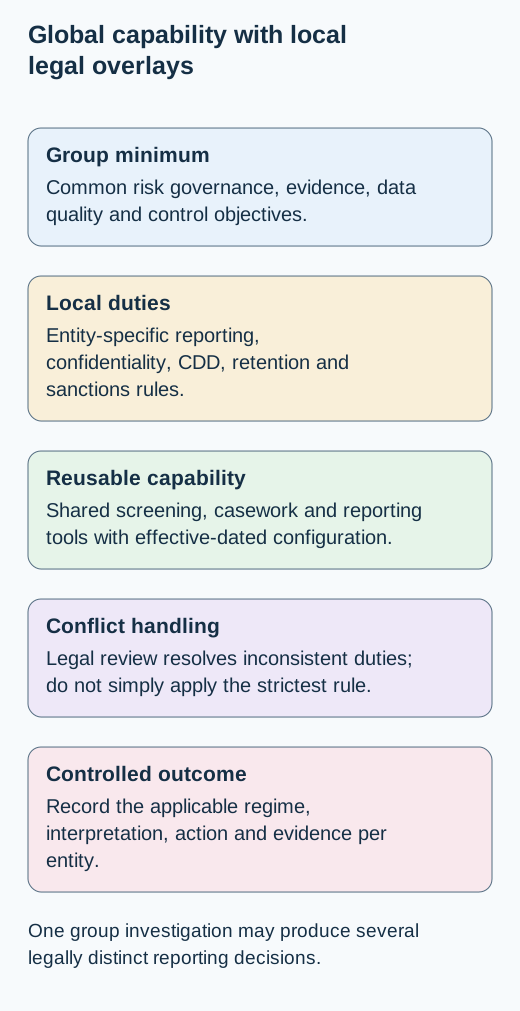
A local overlay should be structured data, not a country memo hidden in a shared drive. It should identify the jurisdiction, legal entity, external source, source status, interpretation owner, obligation, effective dates, difference from group policy, impacted control, process, product, system, data element, control owner, evidence requirement, testing requirement and review date.
The overlay also needs conflict handling. A local rule can require something different from the group standard, but the answer is not always to apply whichever rule appears stricter. A stricter customer-identification rule may be easy to apply globally; a stricter data-sharing practice may be unlawful elsewhere. A reporting requirement can conflict with confidentiality restrictions in another jurisdiction. A sanctions restriction can depend on nexus. A bank therefore needs legal interpretation, not a mathematical “maximum strictness” function.
A mature group standard explains when local law may displace or supplement the group rule and who approves the resulting implementation. It also records compensating controls where a group capability cannot lawfully or technically operate in the same way in one jurisdiction.
6. Legal entity is a critical financial-crime data attribute
Customers often see one banking brand. Law sees regulated legal entities. A group can contain banks, branches, payment institutions, e-money institutions, broker-dealers, securities firms, asset managers and service companies. The entity that owns the relationship, books a transaction, provides a service or employs an investigator can determine the applicable AML law, supervisor, FIU, sanctions regime, accountable officer, reporting duty and record-retention rule.
A central investigation platform may create a group-wide view of linked activity, but that does not make the parent company the reporting institution for every transaction. A group customer ID can connect relationships, yet each account can belong to a different regulated entity. If case data loses that distinction, investigators can make a factually sensible decision and still take the wrong legal action.
Legal-entity master data should therefore be treated as critical regulatory data. It should include stable identifiers, jurisdiction, entity type, licence, branches, booking relationships, relevant supervisors, reporting authorities, policy overlays and effective dates. Historic changes must remain reconstructable. If a business migrates from one booking entity to another, the bank must still be able to show which entity was responsible for a decision made before the migration.
This is also important for outsourced operations. A case can be investigated by a central service centre while the regulatory duty remains with the regulated entity. The operating model must distinguish who performs the work from who owns the legal obligation.
7. Jurisdiction is not one country field
A cross-border customer or payment can have many legal connections. Relevant facts may include customer residence and nationality, company incorporation, place of business, legal-entity booking location, servicing branch, originator and beneficiary location, debtor and creditor agents, intermediaries, currency, correspondent route, asset location, service location, employee location and place where personal or SAR-related data is stored or accessed.
Different rules can attach to different facts. A sanctions nexus may arise through a person, entity, currency, service, asset or jurisdiction. A suspicious-reporting duty may attach to the regulated legal entity. Data-protection rules may govern where investigation material can be viewed. Payment-transparency requirements may depend on the type of transfer and legal framework. A global platform therefore needs a jurisdiction and nexus model, not a single countryCode that pretends to answer every legal question.
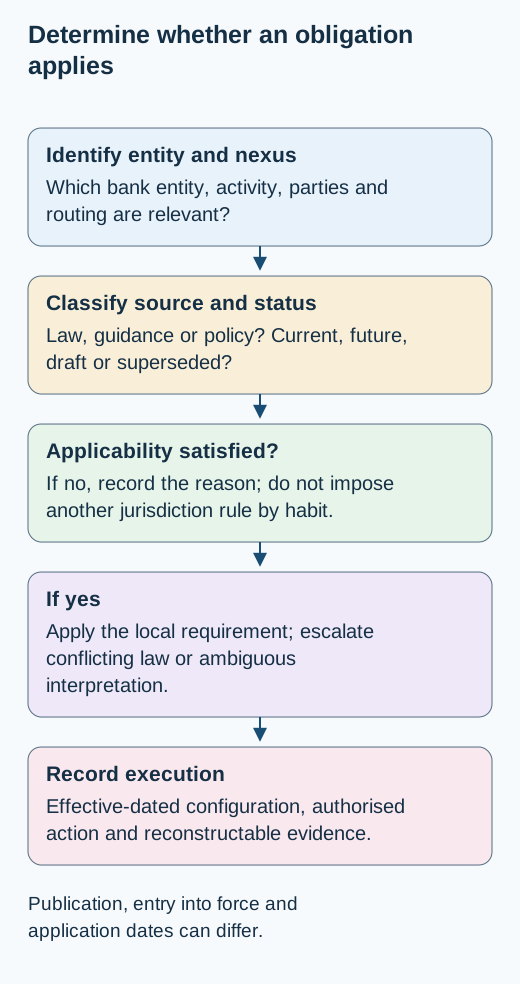
The decision process should start with facts. Which entity owns the customer? Which entity executes or books the transaction? Which service is provided? Which parties and assets are involved? Which countries and currencies are present? Which rule source may apply? What is its legal status and effective date? Only then should the system or human reviewer determine the required action.
The architecture should preserve the facts even if the legal interpretation later changes. A country code or ownership link known on the decision date may be different months later. Investigation evidence needs temporal context.
8. The European Union: regulation, directive and a new supervisory architecture
The EU's 2024 AML/CFT legislative package is a useful example of why source mechanics matter. Regulation (EU) 2024/1624, commonly referred to as the AML Regulation or AMLR, establishes a more harmonised set of directly applicable requirements for obliged entities. It generally applies from 10 July 2027, with specific exceptions and staged provisions. Publication in 2024 did not mean banks were required to operate every AMLR provision immediately in 2024.
Directive (EU) 2024/1640 addresses mechanisms Member States must put in place, including aspects of supervision and FIU arrangements. Because it is a directive, implementation through national legal frameworks remains important. Requirements teams need to distinguish the EU source from national transposition where the legal effect depends on national measures.
Regulation (EU) 2024/1620 established the Authority for Anti-Money Laundering and Countering the Financing of Terrorism, AMLA. On 1 January 2026, the European Banking Authority and AMLA completed the transfer of the EU-level AML/CFT mandates and functions from EBA to AMLA. Existing EBA AML/CFT guidelines and standards remain in force until replaced, preserving continuity while AMLA develops the new framework. AMLA is also preparing for direct supervision of selected complex, high-risk financial institutions or groups from 2028.
A bank implementing the EU package in 2026 therefore has several states to manage simultaneously. It must comply with laws currently applicable. It must prepare policy, data, customer processes and technology for rules applying in 2027 and later. It must monitor AMLA technical standards and guidance. It must not configure consultation drafts as though they were final binding law. It must also preserve existing national requirements until they are displaced or changed by the new framework.
For a BA, this should produce explicit status values such as current_binding, future_binding, draft, consultation, guidance_current, guidance_superseded and internal_policy. Without status, horizon-scanning output easily becomes accidental production logic.
9. The United States: BSA obligations and examination expectations
The United States provides a different legal architecture. The Bank Secrecy Act (BSA) is the common name for a set of statutes and related requirements that authorise recordkeeping, reporting and other measures intended to help detect and prevent money laundering and other financial crime. FinCEN administers important parts of the BSA framework and its implementing regulations.
The U.S. framework contains detailed obligations for covered institutions, but those rules must stay labelled as U.S. rules. For example, particular U.S. SAR filing timelines or dollar thresholds should not be embedded as universal logic. Even within the United States, requirements can differ by financial-sector type.
The FFIEC BSA/AML Examination Manual is important because examiners use it when assessing covered banking organisations. It helps institutions understand examination expectations, but the manual should not be misrepresented as the statute itself. A well-designed obligations inventory can map one legal obligation to relevant implementing regulations and then to supervisory examination material without collapsing their statuses.
This distinction matters when an issue is raised. If a control fails, the bank should be able to say whether it breached a statutory or regulatory requirement, fell below supervisory expectations, violated internal policy or some combination. That affects severity, legal analysis, remediation and management escalation.
The U.S. example also illustrates why sanctions and AML should remain related but distinct. OFAC administers U.S. economic and trade sanctions under separate legal authorities. A payment that triggers an OFAC block or rejection question is not automatically a FinCEN SAR decision, although the same facts can create multiple obligations. Systems need separate decision types and evidence chains.
10. The United Kingdom: national law, approved guidance and the UKFIU
The United Kingdom's AML framework includes the Money Laundering, Terrorist Financing and Transfer of Funds (Information on the Payer) Regulations 2017, the Proceeds of Crime Act 2002, the Terrorism Act 2000 and related legislation and guidance. Different pieces govern preventive controls, criminal offences, suspicious activity reporting and other duties.
The UK example demonstrates why the phrase “follow FATF countries” can be too simplistic. On 30 June 2026, amendments to the Money Laundering Regulations changed the mandatory enhanced-due-diligence treatment of high-risk third countries. HM Treasury explained that the amended Regulation 33 requirement focuses mandatory EDD on jurisdictions FATF lists as High-Risk Jurisdictions subject to a Call for Action, while firms still need to consider FATF mutual evaluations and other geographical risk factors and apply enhanced measures where their own risk assessment identifies high risk. A static application that simply maps every FATF monitored jurisdiction to one legal outcome can therefore become wrong when national law changes.
Suspicious Activity Reports are submitted to the UK Financial Intelligence Unit within the National Crime Agency. The NCA explains that SARs support intelligence on money laundering and terrorist financing and that regulated-sector obligations arise under UK law. The reporting route, legal threshold, confidentiality and any defence-against-money-laundering process need to be modelled as UK-specific rules rather than copied from another jurisdiction.
The Joint Money Laundering Steering Group (JMLSG) guidance is another good example of why source status matters. It is influential industry guidance, parts of which can be formally approved by HM Treasury and considered in legal or supervisory contexts. It is not sensible to label every sentence “the law”, but it is equally poor practice to ignore it because it is guidance. Requirements should capture the source and its recognised status accurately.
11. Australia: staged legal change and transition management
Australia's AML/CTF reforms show how a large legal change can be staged. AUSTRAC states that updated obligations for existing reporting entities took effect from 31 March 2026, subject to transitional rules, while newly regulated professional sectors came into the AML/CTF regime from 1 July 2026. AUSTRAC also published transitional arrangements for particular requirements.
This matters because “effective date” can be more complex than one field. A provision can commence on one date while a transitional rule permits an existing process until a later date. A reporting obligation may retain an earlier rule during transition. A newly regulated sector can have enrolment deadlines different from the date on which substantive obligations begin.
A bank or financial group operating in Australia therefore needs at least the following dimensions in its rule inventory: commencement date, entity or service in scope, transition eligibility, transition end date, internal readiness milestone and evidence of any transition plan. Hard-coding the new requirement for all customers from the first statutory commencement date can be as wrong as failing to implement it at all.
AUSTRAC's 2026 material also reinforces an outcome-focused principle: institutions need effective programmes that identify and manage ML/TF risk, not only procedural compliance. This aligns with the broader FATF effectiveness concept while remaining a national legal and supervisory implementation.
12. Do not apply “the strictest rule everywhere” without legal analysis
Global policy discussions often use a seemingly safe principle: apply the strictest requirement globally. Sometimes that works well. A stronger group identity-verification standard may simplify operations and improve risk management. But as a universal legal algorithm it is unsafe.
Suppose Jurisdiction A permits group sharing of investigation data and Jurisdiction B restricts export of certain suspicious-report information. The “strictest” AML information-sharing practice from A may conflict with B's confidentiality or data rules. Suppose one jurisdiction requires a particular filing to its FIU while another prohibits disclosure of the existence of a report to personnel without a need to know. Combining both rules indiscriminately can create a confidentiality breach.
The same issue arises with retention. A longer AML retention period is not automatically safer if another applicable law requires deletion once the lawful purpose expires. Sanctions can create another conflict: a global group may choose to avoid business with a party for risk reasons even when a specific local entity has no direct legal prohibition. The operational action can be legitimate, but the customer communication and legal basis should not falsely say “prohibited by law everywhere”.
The better model is legal minimum + group risk standard + conflict analysis + approved local implementation. The group can choose a higher standard where lawful, but conflicts need explicit legal ownership and documented decisions.
13. Build an obligation taxonomy before building rules
A global bank can face tens of thousands of financial-crime requirements across laws, licences, regulatory commitments and internal standards. If each requirement is captured as free text, technology mapping becomes nearly impossible. An obligation taxonomy helps normalise them.
Useful categories include enterprise risk assessment; customer identification and verification; beneficial ownership; customer risk rating; PEP controls; correspondent banking; high-risk countries; enhanced due diligence; sanctions screening; payment screening; transaction monitoring; suspicious reporting; targeted financial sanctions; proliferation-financing controls; wire-transfer transparency; recordkeeping; information sharing; confidentiality and tipping off; training; governance; compliance testing; independent audit; regulator notifications; FIU requests; law-enforcement requests; outsourcing; and data quality.
Each obligation should then be decomposed into machine-relevant properties. What triggers it? Which entity is in scope? Which customer or product types? What event starts the clock? What data is required? What action must occur? Who approves? What evidence must be retained? What exceptions exist? What is the effective date? Is the source current, future, draft or superseded?
This does not mean lawyers must express law as code. Legal interpretation should remain a controlled professional activity. The purpose of structured decomposition is to make the approved interpretation implementable and testable.
14. Trace law to control, system, evidence and assurance
A mature bank should answer two questions quickly: Which control satisfies this obligation? and Which obligations depend on this control? That requires bidirectional traceability.
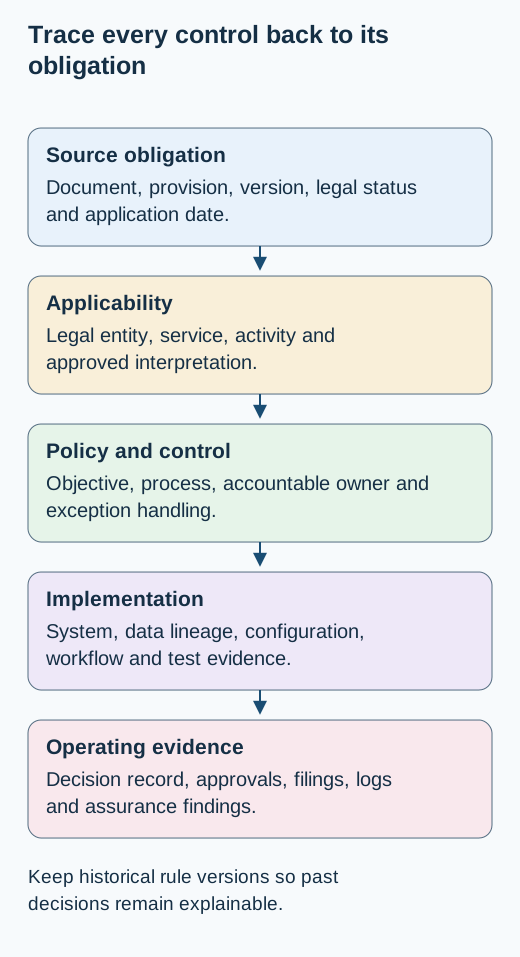
An obligations inventory should contain, at minimum, an obligation ID, source title, source URL or legal citation, source type, jurisdiction, legal entity scope, interpretation summary, applicability criteria, publication date, effective date, transition date, policy mapping, control objective, control ID, process, product, system, data dependencies, control owner, evidence, testing frequency, issue linkage, regulatory commitment and change history.
Traceability should work in both directions. When a law changes, the bank can identify affected controls, procedures, data and releases. When a screening service changes, technology can identify every obligation relying on it. When an incident occurs, compliance can identify the legal requirements potentially affected. When audit samples an alert, the investigator can reconstruct the rule and data that were in force when the alert was created.
A simple spreadsheet can begin this discipline, but large banks usually need a governed obligations and controls repository with stable identifiers and integrations to policy, issue management, architecture and testing records.
15. Effective dating is a control requirement, not administrative metadata
Financial-crime systems frequently make time-dependent decisions. A sanctions designation can begin at a specific time. A law can have an application date after publication. A transition can expire. A bank policy can become effective after staff training. A customer can move legal entity. A beneficial owner can change. A screening list can be updated several times per day.
The control therefore needs more than “current configuration”. It needs versioned configuration with effective dates and, where required, effective timestamps. An investigation performed today may need to reconstruct what the rule engine knew six months ago.
Useful date fields include publication date, legal adoption date, entry-into-force date, application date, transition start, transition end, policy approval date, policy effective date, technology deployment date and validation date. These dates can be different. A single effective_date field often hides too much.
The model should also preserve valid_from and valid_to for ownership relationships, legal-entity mappings, sanctions-list records, customer risk factors and rule versions. Historical reconstruction is a core regulatory capability.
16. Regulatory change should follow a controlled lifecycle
Horizon scanning is only the first step. A strong regulatory-change process identifies a change, classifies its status, obtains legal interpretation, assesses applicability, maps impacted obligations and controls, decides the target design, builds changes, tests them, deploys them on the correct date and preserves evidence.
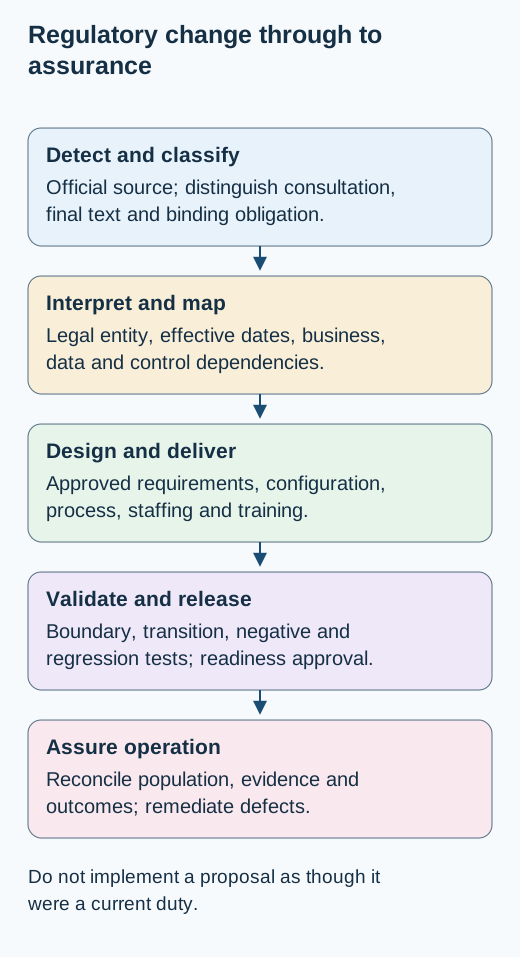
The process also needs a feedback loop. Regulatory examinations, control failures, suspicious-reporting feedback, sanctions incidents and audit findings can show that the existing interpretation or implementation is ineffective even if the law has not changed.
Change status should be visible. A consultation is not a final rule. A final rule may not yet apply. An effective rule may have transitional relief. A supervisor may publish guidance after the legal date. A bank can choose early adoption. Each state has different implications for production controls.
For major changes, governance should explicitly decide whether interim tactical controls are required. If a technology release cannot meet the legal date, risk acceptance is not a substitute for law. The bank may need manual controls, restricted products, additional review, customer remediation or another lawful mitigation while the permanent solution is delivered.
17. Data and system touchpoints
Legal interpretation becomes real when systems select a rule. A global financial-crime platform commonly depends on legal-entity master data, branch, customer type, residency and incorporation, product, channel, beneficial-ownership relationships, PEP information, transaction parties, currency, payment route, agent data, sanctions-list versions, customer risk, case type, event timestamps and evidence references.
A control can fail even when its code is technically perfect because the inputs are wrong. A customer name can be accurate in onboarding but truncated in a downstream screening feed. A legal entity can be missing from an alert. A branch can be mapped to the wrong reporting regime. An ownership relationship can have no effective date. A rule can use the latest country-risk table rather than the table applicable when the transaction occurred.
Financial-crime data requirements therefore need semantic meaning, lineage, quality controls and temporal context. A field called country should specify whether it means residence, nationality, incorporation, booking location, beneficiary-bank country or something else. A field called riskRating should state whose rating, for which risk domain, under which methodology and as of what date.
Critical data elements should have owners, quality thresholds and exception handling. If legal-entity data is missing, the system should not silently default to a group entity. If the reporting regime cannot be derived, the case should move to controlled exception handling.
18. Screening, monitoring and reporting use different legal logic
A global platform may combine sanctions screening, PEP screening, adverse media, transaction monitoring and case management, but these controls answer different questions.
Sanctions screening asks whether a party, asset or activity may be prohibited or restricted under an applicable sanctions regime. PEP screening identifies political exposure requiring risk-based treatment; a PEP match is not a sanctions prohibition. Transaction monitoring identifies behaviour that may warrant investigation; an alert is not a finding of money laundering. Suspicious reporting is a legal decision under the applicable reporting regime. Fraud controls may protect the customer and institution while generating intelligence relevant to AML.
The rule inventory should preserve these distinctions. A single generic field such as financialCrimeHit=true is inadequate. Downstream actions can differ dramatically: request more information, apply EDD, escalate, hold a payment, block assets, reject a payment, close an alert, open a case, file an STR, restrict an account or exit a relationship.
Legal requirements also interact. A sanctions issue may create suspicious-activity concerns. A fraud scam can expose mule activity that AML needs to investigate. A law-enforcement request can trigger event-driven customer review. Systems should support intelligence handoffs without merging the legal decisions.
19. Alert-to-case-to-investigation-to-reporting outcomes
A bank-practical control chain often begins with an alert from monitoring or screening. The alert is triaged using customer, transaction, jurisdiction and typology context. If concern cannot be reasonably resolved, it may become a case. The investigator gathers evidence, considers related accounts and parties, assesses plausible explanations, and documents a conclusion. Where the applicable legal threshold is met, the case can move to external reporting or another required action.
The important point for this chapter is that the final step must branch by reporting regime. The same group case can involve several legal entities. Each entity may have a separate filing decision, deadline, reporting authority and confidentiality rule. A central investigation can provide a common factual narrative while preserving distinct legal conclusions.
Case systems should therefore store the factual analysis separately from jurisdiction-specific legal outcomes. Suggested entities include case, customer_relationship, legal_entity, transaction, investigation_finding, reporting_decision, external_report, sanctions_decision and evidence_item. This structure supports group intelligence without pretending there is only one legal duty.
A closure decision also needs evidence. “False positive” or “no suspicion” without reasoning is weak. The case should record what was reviewed, what explained the activity, which rule applied and who approved the outcome where required.
20. Roles and governance
Legal, compliance, business, operations, technology, data, model-risk, quality-assurance and audit teams all have roles, but their decision rights should be explicit.
Legal interprets law and advises on conflicts, legal privilege and difficult applicability questions. Compliance owns or oversees the financial-crime framework, translates legal requirements into policy and provides challenge. Business and product owners own the risks created by their customers and services. Operations and investigators execute controls. Technology builds and operates capabilities. Data owners maintain critical data definitions and quality. Analytics or model teams develop detection logic where relevant. Quality assurance checks execution consistency. Independent audit assesses the design and effectiveness of governance and controls. Senior management and boards provide oversight, resources and accountability appropriate to the legal and governance framework.
Problems arise when these boundaries blur. A developer should not make a legal interpretation because a ticket is vague. Compliance should not approve a technology implementation without understanding data lineage and failure behaviour. Operations should not invent a country workaround because the platform is missing a legal overlay. Legal should not sign off a control design it has not seen operate in practice.
A RACI is helpful only if it reflects actual decision rights. For high-impact rules, the requirement should name the interpretation owner, policy owner, control owner, system owner, data owner and assurance owner.
21. BA requirements: separate reusable capability from jurisdiction configuration
Business analysts can prevent many globalisation defects by writing requirements at two levels.
The global capability describes reusable behaviour. Example: “For every case approved for external reporting, the platform shall identify the reporting legal entity and applicable reporting regime, derive the configured filing deadline from the legally relevant trigger event, apply the required approval workflow, generate the correct reporting payload and preserve submission acknowledgement.”
The jurisdiction configuration contains the local values: authority, form, schema, trigger, timing logic, approval, language, escalation, confidentiality label and retention rule. That configuration must be effective-dated.
The same pattern works for beneficial-ownership thresholds, PEP workflows, sanctions lists, EDD triggers, record retention and payment controls. It reduces code duplication while preserving legal correctness.
Acceptance criteria should test both the reusable capability and the local overlay. A requirement is incomplete if it explains only the happy path for one country.
22. Architecture considerations
A robust design separates at least five layers: source obligations, policy/control definitions, decision configuration, operational transaction or case data, and immutable evidence. This avoids embedding legal prose directly in application code.
A rules or policy service can provide effective-dated jurisdictional parameters. A legal-entity service can resolve the entity responsible for the customer or transaction. A customer master supplies verified identity and relationship data. Screening and monitoring services generate detections. Case management preserves investigation and decisions. Regulatory reporting produces jurisdiction-specific filings. Audit and evidence services preserve versions, timestamps and approvals.
Configuration requires governance equal to code. A sanctions-list routing table changed by an administrator can alter legal outcomes just as much as a software release. Configuration changes should therefore be peer reviewed, approved, tested, versioned and recoverable.
Resilience matters too. If a regulatory reporting gateway is unavailable near a filing deadline, the bank needs a contingency process. If screening data is stale, the system should surface the condition rather than silently process as normal. If a jurisdiction rules service is unavailable, fail-open versus fail-closed behaviour must be risk-assessed and documented.
23. Testing considerations
Testing should prove legal applicability, not only technical execution. A good test pack contains positive, negative, boundary, transition and historical scenarios.
A positive test proves that a rule applies when all relevant facts are present. A negative test proves that the system does not apply the rule where legal nexus is absent. A boundary test checks thresholds and dates. A transition test verifies old and new rules around the legal cutover. A historical reconstruction test verifies that an old case can still be explained using the rule and data that were valid at the time.
Multi-jurisdiction testing is especially important. Change the booking entity while keeping the customer facts constant. Change the currency or payment route. Change the customer-incorporation country. Change the rule effective date. The expected outcome should change only where the approved legal interpretation says it should.
Test evidence should capture input facts, rule version, expected result, actual result and source obligation. That allows a failed test to be assessed in regulatory terms rather than only as a software defect.
Regression scope should be obligation-driven. If a shared customer-risk service changes, tests should identify every jurisdiction and control that depends on it. If a local overlay changes, the regression pack should ensure unaffected countries remain unaffected.
24. Common failure modes
The first failure mode is source confusion: FATF guidance, law, supervisory material and bank policy are mixed together. The result is requirements that cannot explain their legal basis.
The second is country-code simplification: one country field is used to drive customer risk, sanctions, reporting and data residency. The same code cannot safely represent all those concepts.
The third is global hard-coding: a threshold, deadline or sanctions outcome from one jurisdiction is built into a shared service without configuration.
The fourth is uncontrolled local spreadsheets: local teams maintain exceptions that central systems do not know about. The control works only because individuals remember manual steps.
The fifth is missing temporal logic: the system stores only the current rule and current ownership information. Historical decisions become impossible to reconstruct.
The sixth is draft-as-law implementation: consultation text is treated as final and production controls are changed too early.
The seventh is law-without-operational-design: the requirement copies a paragraph from legislation but does not define data, trigger, workflow, exception, evidence or owner.
The eighth is evidence blindness: the bank performs the right action but cannot demonstrate the list version, rule version, decision-maker or supporting facts.
The ninth is conflict by simplification: “apply the strictest standard” is used instead of analysing competing legal requirements.
The tenth is unowned change: compliance identifies a rule change, technology assumes operations will cover it, operations assume policy will be updated, and nobody owns end-to-end readiness.
25. Operational and customer impact
AML/CFT law is not abstract when controls reach customers. Incorrect jurisdiction logic can delay salary payments, stop trade, freeze access to funds, duplicate KYC requests, wrongly classify a customer as high risk or create unnecessary exits. Under-control is dangerous, but over-control can also create legal, conduct and inclusion problems.
Customer communication should distinguish legal necessity from internal policy where appropriate. Staff should not tell a customer “the regulator requires this” when the bank has actually chosen a stricter risk policy. That may seem like a wording detail, but accuracy matters for trust, complaints and legal challenge.
Operations also need explainable reason codes. A case routed for review because RULE_17 fired is not enough. The user interface should expose the relevant obligation category, jurisdiction, entity, decision reason and required next action without disclosing prohibited internal or SAR information to unauthorised users.
Service-level design should distinguish regulatory deadlines from internal targets. If an STR must be filed within a legal time window, the bank may create a shorter internal SLA to preserve review capacity. Metrics should identify which is which.
26. A realistic mini case: one customer, four regulatory touchpoints
Imagine Northstar Components Ltd, a legitimate industrial manufacturer incorporated in the United Kingdom. It maintains a primary GBP account with a UK bank entity, a EUR account with an EU subsidiary of the same group and a treasury relationship serviced through the group's U.S. branch. It also pays an Australian supplier for specialist industrial equipment.
The group customer master gives Northstar one enterprise identifier, but its accounts sit with different legal entities. A monitoring scenario identifies three unusual features at the same time: a rapid increase in cross-border value, a new intermediary company in the payment chain and a beneficiary whose ownership information changed recently.
A central financial-crime operations team opens one group investigation. The analyst sees all linked transactions. That group view is useful because fragmentation could hide the economic story. But the analyst must not jump from “one investigation” to “one legal outcome”.
First, the platform resolves the customer-owning and transaction-booking entities. The UK account is owned by the UK bank. The EU account is owned by an EU credit institution. The U.S. relationship has its own regulatory perimeter. The Australian supplier relationship is not automatically regulated by AUSTRAC simply because the beneficiary is in Australia; the legal question depends on the service and entities involved.
Second, the platform identifies relevant legal nexuses. The UK entity applies its AML and suspicious-reporting framework. The EU entity applies currently applicable national/EU rules while preparing for the AMLR regime that generally applies from 10 July 2027. The U.S. entity assesses BSA and any relevant U.S. sanctions obligations. Payment routing and currency may create additional sanctions screening requirements under the bank's approved legal framework.
Third, the investigator reviews customer purpose, invoices, ownership information, expected activity and the new intermediary. The facts may be consistent with legitimate expansion, or they may show unexplained routing and ownership opacity. The bank should not call the activity money laundering merely because it is unusual. Monitoring identifies a question; investigation establishes the evidence.
Suppose the UK investigator concludes that the UK legal threshold for a SAR is met. The UK reporting decision is recorded against the UK legal entity and submitted through the UKFIU process. The EU entity reviews the same factual package under its own reporting regime and may reach a separate decision. The U.S. entity applies its own SAR rules where relevant. The outcomes can differ without the group being inconsistent, because the facts are shared while legal duties are entity-specific.
Now suppose sanctions screening also produces a potential match to an owner of the intermediary. That creates a separate sanctions decision. The bank must resolve identity, determine which sanctions regime applies, analyse ownership/control where relevant and decide whether the payment must be blocked, rejected, held or can proceed. The STR decision does not substitute for the sanctions decision.
From a technology perspective, the case should preserve at least: group customer ID, local relationship IDs, legal entities, accounts, transactions, parties, ownership graph, rule versions, screening-list version, monitoring scenario, investigation evidence, each legal reporting decision, filing acknowledgements and sanctions disposition. Access controls should ensure sensitive reporting information is shared only where lawful and necessary.
From a BA perspective, this case creates powerful acceptance tests. Change only the booking entity and confirm the reporting regime changes. Change only the date to cross a rule effective date. Remove the sanctions nexus and confirm the sanctions action changes while the AML investigation remains. Change the ownership effective date and verify historical reconstruction. Deny one user access to SAR data and confirm the group case remains usable without exposing restricted details.
This case shows the real meaning of global standards and local law: one risk story can require several legally distinct decisions, all supported by one controlled evidence architecture.
27. What good looks like in a mature bank
A mature institution can answer, for any major financial-crime control, five questions without a forensic project. What external obligations does this control support? Which legal entities and jurisdictions rely on it? Which data and systems make the decision? What evidence proves it operated? Who owns interpretation, execution and assurance?
Its policies clearly separate group minimums from local overlays. Its obligations inventory is effective-dated. Legal-entity and jurisdiction data are governed. Regulatory change is connected to technology change. Screening and monitoring rules are versioned. Investigations preserve entity-specific legal outcomes. Reporting platforms know the correct authority and deadline. Configuration is controlled like code. Tests cover transitions and historical reconstruction. Audit can trace a sampled decision back to its source.
Most importantly, the institution does not confuse uniformity with control. Some capabilities should be global; some legal outcomes must remain local. The design objective is a consistent control architecture with accurate jurisdictional execution.
28. Review questions for practitioners
When reading any AML requirement, ask: What kind of source is this? Is it a statute, regulation, directive, sanctions measure, supervisory rule, guidance, FIU instruction, industry paper or bank policy?
Then ask: Who is legally in scope? Which entity, branch, customer type, product, service or transaction? What creates the legal nexus?
Ask: When does it apply? Is the document merely published, legally in force, applicable now, transitional, future, draft or superseded?
Ask: What must the bank actually do? Identify a customer, collect data, verify evidence, screen, monitor, investigate, report, freeze, reject, retain, notify, govern or test?
Ask: What proves it happened? Which source data, rule version, decision record, approval, submission acknowledgement, audit log and test evidence must be retained?
Finally ask: What happens if the rule conflicts with another requirement? The answer should be a controlled legal and governance process, not an undocumented local workaround.
Key takeaways
Global AML/CFT standards create a common architecture, but banks comply through the legal frameworks applicable to their regulated entities and activities. FATF, Basel, the UN, FIUs and industry bodies all matter, but they do not play the same legal role. National and regional laws determine enforceable detail. Supervisors and FIUs shape implementation. Group policy creates consistency. Local overlays preserve legal correctness.
For change and technology teams, the strongest design principle is traceability:
source → legal status → applicability → interpretation → effective-dated rule → control → system and data → decision → evidence → assurance.
When that chain is explicit, a bank can manage regulatory change, explain decisions and reuse technology safely across jurisdictions. When the chain is hidden in documents, code or individual expertise, even a sophisticated financial-crime platform becomes fragile.
References and further reading
- Financial Action Task Force (FATF), The FATF Recommendations: https://www.fatf-gafi.org/en/publications/Fatfrecommendations/Fatf-recommendations.html
- FATF, Methodology for Assessing Technical Compliance with the FATF Recommendations and the Effectiveness of AML/CFT Systems: https://www.fatf-gafi.org/en/publications/Mutualevaluations/Fatf-methodology.html
- FATF, The FATF strengthens its standards to help ensure access to financial services for humanitarian assistance, 23 June 2026: https://www.fatf-gafi.org/en/publications/Fatfrecommendations/update-recommendation-6-june-2026.html
- Basel Committee on Banking Supervision, Sound management of risks related to money laundering and financing of terrorism: https://www.bis.org/bcbs/publ/d505.htm
- Egmont Group, Financial Intelligence Units: https://egmontgroup.org/about/financial-intelligence-units/
- Egmont Group, About the Egmont Group: https://egmontgroup.org/about/
- EUR-Lex, Regulation (EU) 2024/1624 on the prevention of the use of the financial system for the purposes of money laundering or terrorist financing: https://eur-lex.europa.eu/eli/reg/2024/1624/oj/eng
- EUR-Lex, Directive (EU) 2024/1640 on mechanisms to prevent the use of the financial system for money laundering or terrorist financing: https://eur-lex.europa.eu/eli/dir/2024/1640/oj/eng
- EUR-Lex, Regulation (EU) 2024/1620 establishing AMLA: https://eur-lex.europa.eu/eli/reg/2024/1620/oj/eng
- European Banking Authority, EBA and AMLA complete handover of AML/CFT mandates, 19 January 2026: https://www.eba.europa.eu/publications-and-media/press-releases/eba-and-amla-complete-handover-amlcft-mandates
- AMLA, EBA and AMLA complete handover of AML/CFT mandates, 19 January 2026: https://www.amla.europa.eu/eba-and-amla-complete-handover-amlcft-mandates_en
- FinCEN, The Bank Secrecy Act: https://www.fincen.gov/resources/statutes-and-regulations/bank-secrecy-act
- FFIEC, BSA/AML Examination Manual: https://bsaaml.ffiec.gov/manual
- UK legislation, Money Laundering, Terrorist Financing and Transfer of Funds (Information on the Payer) Regulations 2017: https://www.legislation.gov.uk/uksi/2017/692/contents
- HM Treasury, Money Laundering Advisory Notice: June 2026: https://www.gov.uk/government/publications/money-laundering-advisory-notice-high-risk-third-countries--2/money-laundering-advisory-notice-high-risk-third-countries--2
- National Crime Agency, Suspicious Activity Reports: https://www.nationalcrimeagency.gov.uk/what-we-do/crime-threats/money-laundering-and-illicit-finance/suspicious-activity-reports
- AUSTRAC, About the AML/CTF reforms: https://www.austrac.gov.au/industry-and-business/about-amlctf-reforms/about-reforms
- AUSTRAC, Changes to AML/CTF obligations: What you need to do, 1 July 2026: https://www.austrac.gov.au/news-and-media/article/changes-amlctf-obligations-what-you-need-do
- AUSTRAC, AML/CTF transitional rules 2026: https://www.austrac.gov.au/about-us/legislation/updates-legislation/amlctf-transitional-rules-2026
Deep practitioner expansion: operating a global AML framework without flattening local law
The most difficult part of global financial-crime compliance is rarely identifying that a rule exists. The difficult part is translating several layers of authority into one operating model that can still explain, for each customer and transaction, which legal entity acted, which rule applied, who made the decision and what evidence supports it.
A global bank typically wants common platforms because common platforms reduce fragmentation. The legal environment, however, remains local. That tension is not a defect; it is a design constraint. The platform should centralise what can be common and parameterise what must remain jurisdiction-specific.
A useful way to separate the problem is to distinguish five layers: facts, legal interpretation, bank policy, configuration and evidence. Facts describe what actually happened: the customer, legal entity, transaction, country, currency, ownership chain, payment route and time. Legal interpretation determines which obligations those facts trigger. Bank policy decides whether the institution applies a common minimum or a stricter risk appetite. Configuration translates the rule into executable parameters. Evidence proves which rule and facts were used and what decision followed.
When those layers are mixed together, change becomes expensive. If a developer encodes a beneficial-ownership percentage directly into application logic without jurisdiction and rule version, a future legal change becomes a code release and historic decisions become difficult to reproduce. If the platform instead stores the ownership graph as facts and applies effective-dated determination rules, legal change can be managed through controlled configuration and testing.
Build the legal hierarchy before writing the requirement
A requirement should begin with its authority chain. The origin may be a FATF Recommendation. A country or regional legal order then implements that objective through legislation or regulation. The supervisor publishes guidance. The bank's legal and compliance teams interpret the requirement for the relevant entity. Group policy may add a higher standard. A local procedure defines how an analyst works. Technology implements the data and workflow.
A practical requirement record should therefore capture the exact external source, its status, jurisdiction, legal entity, approved interpretation, control objective, group standard, local overlay, triggering event, required action, relevant clock, evidence, rule version and owner.
This avoids a common regulatory-project failure: requirements are written as summaries of legislation rather than statements of system behaviour. “Comply with enhanced due diligence requirements” is not implementable. “When the approved customer-risk model classifies a relationship as high risk under rule version X, the onboarding workflow shall require the configured EDD evidence and designated approval before activation, and retain the evidence and decision time” is much closer to a testable requirement.
Source categories matter during change control. A statutory prohibition cannot normally be waived through ordinary product governance. A group-policy rule can be changed through the bank's internal approval process. A consultation should influence readiness but must not silently become a production obligation. A supervisory expectation may permit more than one implementation approach if the bank can demonstrate an effective outcome. Requirements should preserve these distinctions.
Home supervisor, host supervisor and group governance
Cross-border banking introduces another layer. A banking group may be supervised on a consolidated basis in its home jurisdiction while branches or subsidiaries are also subject to host-country AML/CFT supervision. Consolidated oversight does not automatically displace local responsibility.
A branch generally operates as part of the same legal person as its head office, whereas a subsidiary is a separate legal entity. That distinction can affect licences, supervision, reporting and accountability. A global platform should therefore distinguish legal person, branch, booking location and servicing location rather than collapsing them into a single “country” field.
FATF Recommendation 18 addresses internal controls and foreign branches and subsidiaries. The practical lesson is that financial groups need group-wide programmes and information-sharing arrangements subject to safeguards and applicable local law. If local law prevents implementation of a group measure, the issue should be escalated and mitigated rather than silently ignored. The exact treatment depends on the legal framework and facts, so the system should record the conflict, approved interpretation and compensating control.
Basel guidance reinforces the importance of group-wide ML/FT risk management. For architects, the operating model needs both central visibility and legal separation. A central financial-crime function may set standards, run shared technology and analyse network risk while a local entity retains statutory reporting duties and accountable officers.
Information sharing is not unrestricted data movement
Financial-crime detection benefits from group-wide information because criminal networks exploit fragmentation between products, entities and countries. Yet information sharing must be designed lawfully. AML/CFT laws, data-protection rules, banking secrecy, professional secrecy and restrictions around suspicious reports can interact.
A mature design asks what information is needed, for what purpose, under which lawful basis, by which users, for how long and with what safeguards. Some jurisdictions may permit central investigators to view full customer data. Others may require masking, local storage, restricted fields or a formal request process. SAR or STR information may have especially strict confidentiality controls.
Technology can support this. A group platform can expose permitted risk metadata while sensitive documents remain local. Access can be attribute-based, using legal entity, role, case purpose and jurisdiction. Data can be masked until an authorised user demonstrates a need. Every access can be logged. None of these patterns replaces legal analysis, but they give legal teams practical design options rather than an all-or-nothing centralisation choice.
Current, future and draft obligations need different statuses
Regulatory-change programmes fail when all publications are treated alike. A consultation paper is not the same as a final regulation. A final regulation that applies next year is not the same as a rule already in force. Guidance may clarify an existing duty without creating a new statutory obligation.
An obligations inventory should therefore distinguish monitoring, adopted but future-effective, implementation, in force, transitional, superseded and retired states. The EU AML package demonstrates the point. During 2026, firms must prepare for the AML Regulation even though its principal application date is 10 July 2027. AMLA is also developing technical standards and guidelines. Draft material can shape readiness, but the bank should label it as draft until the required legal process is complete.
The same discipline applies elsewhere. A national reform can have staged commencement. Technology may need to be ready before the legal date, but production configuration should activate only when the approved applicability conditions are met.
The effective-date problem is a temporal-data problem
Regulatory systems need to answer not only “what is the rule?” but “what was the rule on the date of the event?” Suppose a customer was onboarded on 20 June, a regulation changed on 1 July and an investigation began in September. The reviewer may need the onboarding rule that applied in June, the monitoring rule that applied when transactions occurred and the reporting rule that applies when suspicion is formed.
A rule record should therefore include validity dates, jurisdiction, legal entity, obligation type and version. Transactions and decisions should retain the rule version they used. Testing should cover events immediately before and after the boundary, cases queued during deployment and investigations reopened later.
Time zones also matter. “Effective 1 January” can mean local regulatory time, UTC or another approved boundary. A globally hosted application must not activate a rule everywhere at the first midnight reached somewhere in the world unless that is the approved interpretation. Effective-time logic belongs in requirements and testing.
This design supports audit. Instead of asking an engineer to reconstruct an old deployment, the bank can show the versioned configuration and evidence attached to the original decision.
Map obligations to preventive, detective and responsive controls
Preventive controls attempt to stop inappropriate activity before it occurs. Customer identification, sanctions screening before payment release, product restrictions, high-risk approvals and access controls are examples.
Detective controls identify activity requiring review. Transaction monitoring, unusual-activity detection, periodic screening and data-quality surveillance belong here.
Responsive controls govern what happens after a risk signal exists. Investigation, external reporting, freezing, rejection, customer restriction and remediation are examples.
One obligation can require several control types. Beneficial-ownership rules influence onboarding, periodic review, sanctions analysis and investigations. Suspicious-reporting law depends on detective monitoring but creates a responsive reporting process. Sanctions regimes can require preventive screening and time-critical responsive action.
Mapping the full chain exposes gaps. A programme may have excellent detection but no reliable reporting clock. It may screen customers at onboarding but lack rescreening when lists change. It may identify high-risk customers but fail to route them to enhanced approval. External rules are effective only when the end-to-end control chain works.
Regulatory interpretation should be a governed artefact
Many defects begin with an undocumented interpretation. Someone reads a rule, explains it in a meeting and a developer implements that explanation. Months later nobody can identify who approved it or whether it was meant to apply globally.
A governed interpretation should record the source, issue, relevant facts, conclusion, jurisdictions and entities, assumptions, approver, date, dependencies and review trigger. If external counsel is used, the bank should record how the advice is operationalised rather than storing only a legal memo that delivery teams cannot translate.
A BA should not make legal determinations independently, but the BA can force clarity. Questions such as “Is this law or group policy?”, “Which entity is responsible?”, “What event starts the clock?”, “Does this apply to attempted transactions?”, “What happens if required data is unavailable?”, and “What evidence will satisfy audit?” expose ambiguity before it becomes code.
Sanctions show why detection and legal disposition must be separate
The word “sanctions” can cover asset freezes, sectoral restrictions, trade restrictions, service prohibitions, investment restrictions, ownership and control rules and licensing conditions. Screening identifies possible risk; it is not itself the legal decision.
A global bank may screen against a broad consolidated dataset. When a potential match occurs, the bank must resolve identity and determine legal applicability. Which entity is involved? Which sanctions regimes have nexus? Is an owner or controller relevant? Is the transaction prohibited? Does a licence or exemption apply? Is the required action to freeze, block, reject, decline to process, report or take another measure?
A global system should therefore separate screening_result from legal_disposition. If a vendor engine returns “sanctions hit” and the payment hub interprets that as “reject” in every jurisdiction, one legal outcome has been embedded into a detection flag. Separating the stages also improves auditability because the bank can show the candidate, identity evidence, ownership assessment, applicable programme, permissions analysis and final action.
Store ownership facts before applying legal tests
Beneficial-ownership rules are another area where global objectives can produce different implementation detail. The safest data design stores factual relationships first: direct ownership, indirect ownership, contractual control, trust roles and other control relationships.
The legal determination can then apply the relevant jurisdiction's rule to those facts. This avoids reducing the model to a final beneficial_owner = yes/no flag. It also supports sanctions ownership and control analysis, which may use a different legal test from KYC beneficial ownership.
Historic ownership should be retained with effective dates. If ownership changes after a transaction, an investigator may need to reconstruct who owned or controlled the entity when the activity occurred.
The same principle applies to politically exposed persons. Public office, dates, family relationships and close-associate relationships are facts. The applicable treatment, approvals and duration of enhanced measures depend on law, guidance and policy. A permanent unexplained PEP=true flag loses that context.
Suspicion requires judgement; the workflow can still be engineered
AML investigations often require human judgement. Technology should not reduce suspicion to one universal score. But the workflow around that judgement can be structured.
A case system can record information considered, investigator analysis, decision-maker, legal entity, decision time and rationale. Once a reportable decision is made, configuration can determine the filing regime, authority, form, data fields, deadline, approvals and confidentiality restrictions. The system can restrict unauthorised customer communication, generate reminders, evidence submission and track supplementary reports.
The aim is not to automate legal judgement beyond what policy permits. It is to automate the controlled consequences of accountable judgement.
Local exceptions should be governed, tested and retired
When local law prevents a group control, institutions sometimes create a spreadsheet exception and move on. Over time, exceptions can accumulate without owners or expiry dates.
A better exception record includes the group requirement, local restriction, approved interpretation, scope, affected systems, residual risk, compensating control, accountable owner, approval, effective date, review date and exit plan. If the legal barrier disappears or the platform gains a compliant capability, the exception should close.
Testing should verify the compensating control. If central investigators cannot access full local case data, a local team might perform the restricted analysis and share permitted risk indicators. Assurance should test whether that process actually works and whether escalation remains timely.
Data lineage is part of legal defensibility
A financial-crime decision is only as reliable as the data presented to the control. For sanctions screening, lineage should show which source fields were mapped to party name, address, bank and remittance data; what normalisation occurred; what was truncated; which list version was used; and which result reached the payment decision.
For transaction monitoring, lineage should show whether relevant accounts, channels and transaction types are covered and whether transformations preserve amount, currency, time and counterparty information. For jurisdiction selection, lineage should show where legal entity, branch and booking country came from. A wrong reference-data mapping can select the wrong legal rule even when the financial-crime algorithm works exactly as designed.
Third-party technology does not outsource accountability
Banks use vendors for screening data, matching engines, adverse media, identity verification, monitoring, case management and regulatory reporting. A vendor can provide technology or data, but the regulated institution remains responsible for understanding how its configured implementation meets applicable obligations.
Vendor governance should cover data sources, update frequency, matching logic, configuration, change management, service levels, security, resilience, testing, audit rights, incidents and exit planning. If the vendor changes an algorithm, the bank should assess validation needs. If list ingestion fails, the bank needs a recovery process. If a cloud case platform changes data-hosting regions, privacy and secrecy analysis may need to be revisited.
A contractual statement that a vendor is “compliant” is not evidence that the bank's implementation is compliant.
Translate legal language into acceptance criteria
Suppose an approved interpretation says that a new local rule applies from 00:00 local time on 1 January to Legal Entity A but not Legal Entity B. Strong acceptance criteria can require Entity A transactions before the boundary to use the old rule, transactions at or after the boundary to use the new version, Entity B to remain on its approved version, queued transactions to retain the legally relevant event time, investigators to see the rule version applied, and evidence records to preserve the source and configuration version.
The criteria should also define failure. If the rule service cannot determine the legal entity, should the transaction stop, route to manual review or use a specifically approved fallback? A silent default to a generic global rule is difficult to defend.
This is far more testable than “system complies with the new AML regulation.”
Test boundaries and failure—not only happy paths
A strong test strategy should include the same facts through two legal entities; the minute before and after an effective-date boundary; missing legal-entity data; unavailable configuration; local data-sharing restrictions; historic reconstruction under an old rule; sanctions divergence between regimes; future configuration that must not activate early; and in-flight cases when a rule changes.
Expected results should include both business behaviour and evidence. It is not enough for a case to route correctly if the system cannot later show why. It is also not enough to store a rule ID if operations applied the wrong procedure.
Resilience deserves specific scenarios. If an FIU filing portal is unavailable near a legal deadline, the procedure may require an approved contingency or documented escalation. If sanctions screening is unavailable, policy may prohibit automatic release. These behaviours should be agreed before an outage occurs.
Operational readiness is separate from code completion
A regulatory project is not complete when code reaches production. Procedures must be updated, users trained, queues staffed, reference data loaded, reporting credentials tested, management information available, support teams briefed and contingency procedures proven.
A new suspicious-report form may be technically available while investigators have not been trained on mandatory fields. A new KYC rule may reach onboarding while periodic-review logic still uses the old data model. A new sanctions requirement may be loaded while payments operations does not understand licensing conditions.
The completion gate should therefore include legal and policy approval, data readiness, technology validation, operations readiness, training, evidence design and post-implementation monitoring. A regulatory deadline is an operating deadline, not merely a deployment deadline.
Assurance should trace from source to evidence and back
Strong assurance checks traceability in both directions. Start with an external obligation and trace it to interpretation, policy, control, configuration, evidence and testing. Then start with a system control and identify which obligations depend on it.
The reverse trace is particularly important for shared services. One screening engine may support many legal entities and sanctions regimes. A change to that engine can affect many obligations. A service owner should know those dependencies before approving a major change.
Useful management information therefore goes beyond alert or case counts. It can show obligations without mapped controls, controls without current testing, expired interpretations, local exceptions past review date, regulated fields affected by data-quality defects, cases approaching statutory deadlines and repeat control findings.
Worked case: one global payment, several legal connections
A corporate customer of Bank Entity A sends a cross-border payment. The customer is incorporated in one country, the account is booked in another, the beneficiary is in a third, the transaction is denominated in an international currency and an intermediary bank in a fourth country is used.
The payment triggers a screening alert because a director of the beneficiary has a similar name to a listed person. The originating customer's profile was created under an older KYC rule and is due for review. A future AML rule relevant to another group entity has already been loaded into a test environment.
A weak system treats the customer's country as the jurisdiction, uses one global sanctions flag and allows future KYC logic to affect all entities. Operations either releases or rejects the payment based on a generic “sanctions hit.”
A strong system identifies Entity A as the responsible booking and payment entity. It records relevant nexus facts rather than reducing them to one country. Screening produces a potential match, not a legal conclusion. The workflow resolves identity, ownership and applicable regimes. The system retrieves the effective rule versions for the transaction date and entity. Future configuration cannot drive production decisions before activation. The KYC review uses the rule applicable to Entity A and records transition treatment. If the sanctions candidate is false, the payment can proceed subject to other controls; if a restriction applies, the correct disposition and reporting route are selected. Every decision retains the evidence and versions used.
This is why global standards and local laws are not an academic topic. They determine whether a bank makes the right decision where customer service, payment execution, legal compliance and financial-crime risk meet.
Worked case: local secrecy law conflicts with central investigation design
A bank launches a global case-management platform. Group policy expects central investigators to see all KYC documents and transaction narratives. During rollout, Legal concludes that one jurisdiction restricts cross-border disclosure of certain customer and suspicious-report information.
The wrong response is to grant access anyway because the group standard is “higher.” Another wrong response is to remove the jurisdiction from group monitoring entirely.
The programme records a formal conflict and maps the restricted data classes. Central users receive permitted risk metadata and network relationships while restricted documents remain with the local entity. A local investigator reviews those documents and can escalate permitted findings. Access logs prove central users cannot retrieve restricted fields. The exception has an owner and review date, and QA tests whether escalation remains timely.
The bank preserves group risk visibility without pretending that group policy overrides local law.
Worked case: one global reporting objective, two local mechanics
Two legal entities identify suspicious activity involving the same criminal network. Both jurisdictions implement the FATF objective of suspicious transaction reporting, but Entity A uses one FIU portal and filing trigger while Entity B uses another channel and timing rule.
The group investigation team shares permitted intelligence and agrees the factual indicators. The reporting module then branches by entity and regime. Each filing uses its required data, approval and deadline. The system links the local reports to the common group investigation without exposing restricted report content to unauthorised users.
The bank has achieved global consistency in purpose without forcing identical legal mechanics.
Common failure modes
“FATF says so.” This identifies the international policy origin but not necessarily the local binding source.
One global deadline. Deadlines can differ by jurisdiction, event and report type.
One country per customer. Cross-border obligations can depend on legal entity, branch, currency, service and route.
One sanctions outcome. Detection does not determine legal disposition.
One beneficial-owner flag. It loses the ownership and control graph needed for local rules and historical reconstruction.
Policy described as law. It hides risk-appetite decisions and produces inaccurate explanations.
Draft rule treated as final. Consultation text can change.
No rule version. Historic decisions become difficult to reproduce.
Evidence assembled after the event. Retrospective reconstruction is weaker than contemporaneous evidence.
Local exceptions with no expiry. Workarounds become permanent shadow processes.
Vendor-responsibility assumption. Outsourcing technology does not outsource regulated accountability.
BA and architecture blueprint
For every jurisdiction-sensitive financial-crime requirement, capture the exact source and status. Establish applicability: legal entity, licence, jurisdiction, customer, product, transaction and relevant nexus. Obtain an approved interpretation and distinguish it from business preference. State the control objective. Identify the trigger. Define whether the decision is deterministic, human judgement or a combination. Define action, clock, data, evidence, failure behaviour, owner and test strategy.
This sequence turns broad compliance language into a product specification and makes later change less disruptive because the organisation can see which parts are stable capabilities and which are jurisdiction-specific configuration.
Knowledge check
- Why is a FATF Recommendation normally insufficient on its own to define a bank's exact statutory filing deadline?
- What is the difference between an external legal obligation and a stricter internal risk-appetite decision?
- Why should legal entity and branch be separate reference-data concepts?
- Why should factual ownership relationships be stored before applying a beneficial-ownership rule?
- Why should draft regulatory guidance be tracked without automatically becoming production logic?
- What is the difference between a sanctions screening result and a legal disposition?
- Why must rule versions be effective-dated?
- What should happen when local secrecy law prevents a group-standard data-sharing control?
- How can one group investigation support several local legal reporting decisions?
- What evidence would prove which rule a system used for a historical transaction?
Closing perspective
The strongest global financial-crime programmes do not choose between centralisation and localisation. They centralise what can safely be common—risk taxonomy, technology capability, governance, data standards and enterprise intelligence—while making legal execution configurable to the entity and jurisdiction carrying the obligation.
The objective is not perfect uniformity. It is consistent financial-crime outcomes produced through legally correct local execution and evidence that can be defended later.
References and further reading
The links below are authoritative public sources used to ground this chapter. They are intentionally separated by source type and jurisdiction so that an international standard is not mistaken for a locally binding rule.
Global standards and banking guidance
-
FATF — The FATF Recommendations, consolidated text as amended June 2026: https://www.fatf-gafi.org/en/publications/Fatfrecommendations/Fatf-recommendations.html
-
FATF — Guidance for a Risk-Based Approach: Banking Sector: https://www.fatf-gafi.org/en/publications/Fatfrecommendations/Risk-based-approach-banking-sector.html
-
FATF — Public consultation on implementation guidance for strengthened Recommendation 16, published 24 June 2026: https://www.fatf-gafi.org/en/publications/Fatfrecommendations/R16-Public-Consultation-June-2026.html
-
FATF — Risk-Based Approach topic and official publications: https://www.fatf-gafi.org/en/topics/risk-based-approach.html
-
Basel Committee on Banking Supervision — Anti-money laundering and counter-terrorist financing, Basel Consolidated Guidelines, published 1 January 2026: https://www.bis.org/committees/bcbs/basel-consolidated-guidelines/module/afs/10
-
Wolfsberg Group — public guidance and principles library, including risk-based-approach and payment-transparency materials: https://wolfsberg-group.org/resources
European Union and AMLA
-
EUR-Lex — Regulation (EU) 2024/1624 on the prevention of the use of the financial system for money laundering or terrorist financing. Article 90 provides the principal application date of 10 July 2027, with the stated later date for the specified categories: https://eur-lex.europa.eu/eli/reg/2024/1624/oj
-
EUR-Lex — Directive (EU) 2024/1640 on mechanisms Member States must put in place for AML/CFT: https://eur-lex.europa.eu/eli/dir/2024/1640/oj
-
EUR-Lex — Regulation (EU) 2024/1620 establishing AMLA: https://eur-lex.europa.eu/eli/reg/2024/1620/oj
-
AMLA — EBA and AMLA complete the handover of AML/CFT mandates, 19 January 2026. Existing EBA AML/CFT guidelines and standards remain in force until replaced by AMLA: https://www.amla.europa.eu/eba-and-amla-complete-handover-amlcft-mandates_en
-
AMLA — FAQs, including the timetable for selecting 40 directly supervised entities during 2027 and the start of direct supervision in 2028: https://www.amla.europa.eu/faqs_en
United States
-
FinCEN — The Bank Secrecy Act: https://www.fincen.gov/resources/statutes-and-regulations/bank-secrecy-act
-
FFIEC — BSA/AML InfoBase, including the 27 February 2026 Examination Manual updates: https://bsaaml.ffiec.gov/whatsnew
-
OFAC — A Framework for OFAC Compliance Commitments: https://ofac.treasury.gov/system/files/126/framework_ofac_cc.pdf
United Kingdom
-
UK legislation — The Money Laundering, Terrorist Financing and Transfer of Funds (Information on the Payer) Regulations 2017: https://www.legislation.gov.uk/uksi/2017/692/contents
-
HMRC — Anti-money laundering guidance for supervised businesses, updated July 2026 and reflecting the 2026 amendments that came into force on 30 June 2026: https://www.gov.uk/hmrc-internal-manuals/anti-money-laundering-guidance-for-supervised-businesses
-
HMRC — Economic Crime Supervision Handbook, amendments to MLR 2017, updated 30 June 2026: https://www.gov.uk/hmrc-internal-manuals/economic-crime-supervision-handbook/ecsh21075
Australia
-
AUSTRAC — About the AML/CTF reforms, including changes for existing reporting entities from 31 March 2026 and staged transition arrangements: https://www.austrac.gov.au/industry-and-business/about-amlctf-reforms/about-reforms
-
AUSTRAC — Changes to AML/CTF obligations: What you need to do, published 1 July 2026: https://www.austrac.gov.au/news-and-media/article/changes-amlctf-obligations-what-you-need-do
-
AUSTRAC — New reporting regime now in force, 1 July 2026, covering newly regulated sectors and updated reporting arrangements: https://www.austrac.gov.au/news-and-media/article/new-reporting-regime-now-force
Important legal-scope note
This chapter explains the architecture by which global standards, regional measures, national laws, supervisory material and bank policy become operational controls. It is not legal advice. Binding AML/CFT, sanctions, privacy, reporting, recordkeeping and information-sharing obligations must be verified against the law, regulatory perimeter, effective date and supervisory framework applicable to the specific legal entity, customer, product and transaction.
References and further reading
The detailed source sections above are the governing reference set for this chapter. The key public sources below are repeated here so the final references section remains independently auditable.
- FATF — The FATF Recommendations, consolidated text as amended June 2026: https://www.fatf-gafi.org/en/publications/Fatfrecommendations/Fatf-recommendations.html
- FATF — Guidance for a Risk-Based Approach: Banking Sector: https://www.fatf-gafi.org/en/publications/Fatfrecommendations/Risk-based-approach-banking-sector.html
- FATF — Public consultation on implementation guidance for strengthened Recommendation 16, published 24 June 2026: https://www.fatf-gafi.org/en/publications/Fatfrecommendations/R16-Public-Consultation-June-2026.html
- FATF — Risk-Based Approach topic and official publications: https://www.fatf-gafi.org/en/topics/risk-based-approach.html
- Basel Committee on Banking Supervision — Anti-money laundering and counter-terrorist financing, Basel Consolidated Guidelines, published 1 January 2026: https://www.bis.org/committees/bcbs/basel-consolidated-guidelines/module/afs/10
- Wolfsberg Group — public guidance and principles library, including risk-based-approach and payment-transparency materials: https://wolfsberg-group.org/resources
- EUR-Lex — Regulation (EU) 2024/1624 on the prevention of the use of the financial system for money laundering or terrorist financing. Article 90 provides the principal application date of 10 July 2027, with the stated later date for the specified categories: https://eur-lex.europa.eu/eli/reg/2024/1624/oj
- EUR-Lex — Directive (EU) 2024/1640 on mechanisms Member States must put in place for AML/CFT: https://eur-lex.europa.eu/eli/dir/2024/1640/oj
- EUR-Lex — Regulation (EU) 2024/1620 establishing AMLA: https://eur-lex.europa.eu/eli/reg/2024/1620/oj
- AMLA — EBA and AMLA complete the handover of AML/CFT mandates, 19 January 2026. Existing EBA AML/CFT guidelines and standards remain in force until replaced by AMLA: https://www.amla.europa.eu/eba-and-amla-complete-handover-amlcft-mandates_en
- AMLA — FAQs, including the timetable for selecting 40 directly supervised entities during 2027 and the start of direct supervision in 2028: https://www.amla.europa.eu/faqs_en
- FinCEN — The Bank Secrecy Act: https://www.fincen.gov/resources/statutes-and-regulations/bank-secrecy-act