Gifts, Entertainment, and Hospitality Controls
A meal with a customer, a conference invitation, a small seasonal gift, tickets to a sporting event or travel to a product demonstration can all be perfectly legitimate parts of business. The same forms of value can also be used to create obligation, reward a favourable decision, disguise a benefit to an official or circumvent a bank's procurement and conflict-of-interest controls. The control problem is therefore not to ban human relationships. It is to distinguish ordinary business interaction from value that creates an unacceptable risk of improper influence, and to leave enough evidence that the decision can be explained later.
That distinction matters in banks because relationship activity occurs everywhere. Corporate bankers host clients. Markets teams attend industry events. Procurement staff meet vendors. Public-sector coverage teams deal with state-owned entities and government bodies. Senior executives attend conferences. Marketing teams sponsor events. Employees receive invitations from suppliers. A weak policy can be defeated by splitting expenses across employees, describing tickets as marketing, routing travel through a third party or keeping a series of individually modest events below a per-event threshold. A strong programme therefore looks beyond the price of a single dinner.
The simplest mental model is purpose + recipient + context + value + timing + pattern + evidence. A monetary threshold may decide whether extra approval is needed, but it is not a legal safe harbour. A low-value benefit can still be inappropriate when it is offered to a decision maker during a tender. A higher-value event may be legitimate where there is a clear business purpose, transparent approval, permitted attendance, proportionate travel and accurate records. The control has to understand the facts, not merely compare an amount with a number.
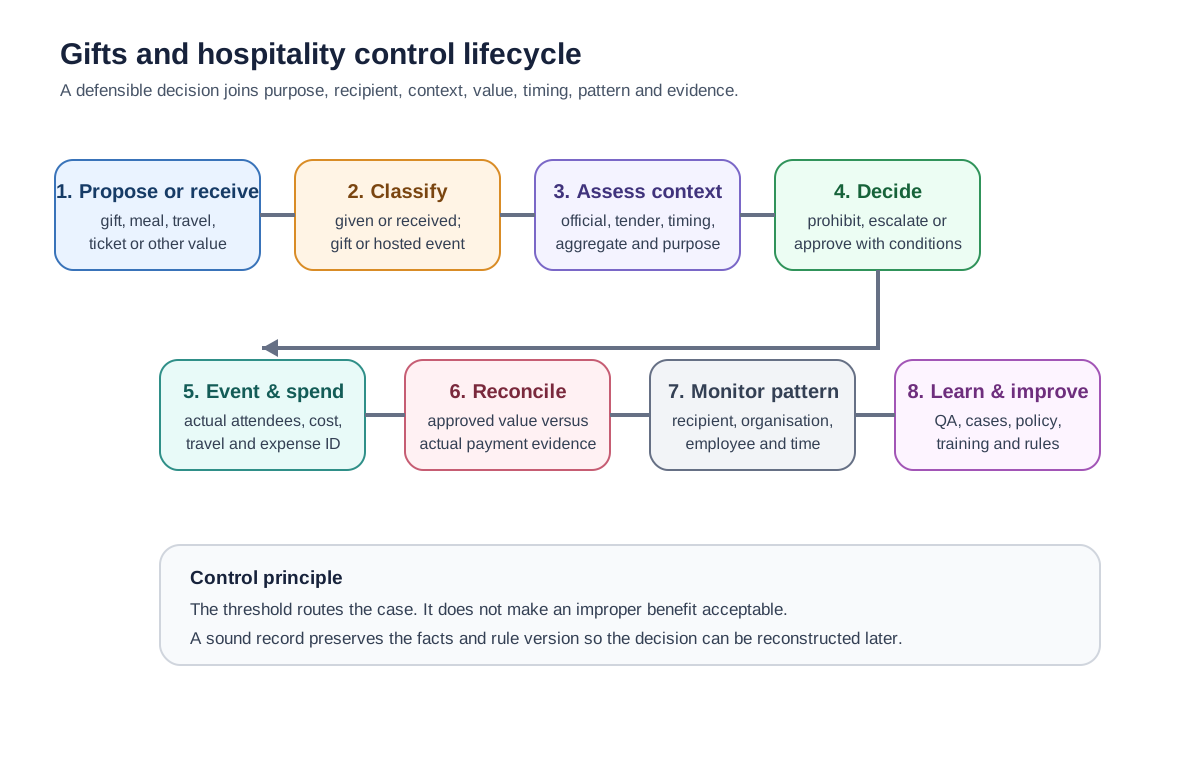
What the control is trying to prevent
Bribery is commonly framed as giving, offering, promising, requesting or receiving something of value to induce, reward or influence improper conduct. The exact legal elements vary by jurisdiction. For a bank, gifts and hospitality controls sit inside a wider anti-bribery and corruption framework because value can move in both directions. An employee can give a benefit to a customer or public official, or receive one from a vendor, intermediary or customer. Both directions can create conflicts and influence risk.
The control objective is to make legitimate business interaction transparent and proportionate while preventing benefits from becoming a route to improper advantage. That means the bank must be able to answer basic questions: Who offered what to whom? What was the business reason? Was the recipient allowed to accept it? Was a public official or government-linked organisation involved? Was there a live procurement, licence, mandate, tender, inspection, financing decision or other sensitive event? Who else attended? Was travel or accommodation included? What was the value in local and control currency? Had the same employee, recipient or organisation received other benefits recently? Who approved it, and on what facts?
The answer is rarely contained in one system. The request may start in a gifts register, the cost may settle through a corporate card, the business opportunity may sit in CRM, the recipient's organisation may be recorded in customer data, a procurement event may sit in a sourcing platform and a conflict-of-interest declaration may sit in HR. Effective control joins these pieces instead of asking one form to know everything.
Gifts, hospitality and "anything of value"
A gift is generally a benefit provided without the giver participating in the underlying activity. Business hospitality involves the host and recipient participating in a business-related meal, event, meeting or similar activity. That distinction matters because many financial institutions apply lower limits or tighter rules to gifts than to genuine hosted business hospitality. The 2023 Wolfsberg Anti-Bribery and Corruption Guidance makes this practical point directly: if a financial institution gives event tickets but no representative attends, the item should be treated as a gift rather than business hospitality.
The category is broader than physical presents. Business hospitality can include meals, entertainment, transport, lodging, training, conferences and invitations to events. "Anything of value" can also include discounts, upgrades, fees, travel extensions, benefits to relatives, employment-related opportunities and other advantages. A bank therefore weakens its control if its register only accepts two event types called gift and meal.
Cash and cash-equivalent benefits deserve particular caution. Wolfsberg recommends that financial institutions prohibit cash gifts and cash equivalents such as vouchers, gift cards and certificates to the extent feasible. The reason is straightforward: a cash-like instrument is easier to transfer, conceal and disconnect from a legitimate business purpose than ordinary hospitality. Local cultural practices do not remove the need for controlled handling. A policy can provide a safe operational route for unavoidable ceremonial items, for example by declining, returning, donating or recording them according to local rules, without pretending that a cultural label removes the bribery risk.
Legal and industry context without false universality
There is no single global gifts threshold. Laws differ, public-sector rules differ, recipient organisations have their own codes and a bank may impose controls stricter than the legal minimum. A global policy therefore needs a common risk model plus jurisdiction-specific rules and approval requirements.
In the United Kingdom, the Bribery Act 2010 criminalises specified forms of bribery and includes the corporate offence of failure by a commercial organisation to prevent bribery by associated persons, subject to the statutory defence concerning adequate procedures. The Ministry of Justice guidance, updated in January 2025, explains six prevention principles: proportional procedures, top-level commitment, risk assessment, due diligence, communication including training, and monitoring and review. UK prosecution guidance also makes an important distinction for hospitality: reasonable, proportionate, good-faith hospitality is an established part of business, but lavishness, concealment or lack of a legitimate business connection can contribute to an inference of improper intent. These are contextual factors, not mechanical monetary rules.
For firms within the Financial Conduct Authority's perimeter, the FCA Financial Crime Guide provides separate systems-and-controls guidance. It expects firms to assess bribery and corruption risks, including exposure to public officials and their own corporate hospitality practices, and asks whether policies cover expenses, gifts and hospitality, conflicts of interest, escalation, whistleblowing and monitoring. The FCA does not replace criminal law and should not be presented as the prosecutor of the Bribery Act; its focus here is the adequacy of financial-crime systems and controls for firms it supervises.
In the United States, the Foreign Corrupt Practices Act has its own jurisdictional and statutory scope. The anti-bribery provisions focus on corrupt payments, offers, promises or authorisations of money or things of value involving foreign officials and related covered conduct, while the accounting provisions create books-and-records and internal-accounting-control obligations for issuers. The DOJ and SEC Resource Guide is useful for understanding the framework, but an FCPA example should not be transformed into a global rule. The Foreign Extortion Prevention Act, addressed in DOJ's December 2024 addendum, adds a U.S. demand-side offence for specified foreign-official conduct. Again, the key lesson for a global bank is to identify the legal perimeter before applying a conclusion.
At industry level, the 2023 Wolfsberg ABC Guidance is especially valuable because it is written for financial institutions. It recommends a risk-based programme, firm-wide policy, clear governance, risk assessment, controls over anything of value, training, monitoring and testing. Its gifts and business hospitality section provides practical risk factors that can be converted into bank controls without pretending the guidance itself is law. OECD anti-bribery instruments and UNODC practical guidance reinforce the need for internal controls, ethics, compliance, transparent expenditures and risk-sensitive treatment of gifts, hospitality, travel and entertainment.
A decision is contextual, not just monetary
A good approval flow begins by classifying the benefit and identifying the parties. It then tests the context. Public-official involvement usually requires enhanced treatment because laws and government ethics rules may restrict what officials can accept and because the consequences of improper influence are higher. But politically exposed person status is not the same thing as public-official status for anti-bribery law. PEP classification is an AML risk concept with its own definitions. A person may be a PEP yet fall outside a particular bribery statute's definition of foreign public official, or vice versa depending on the facts and law. Systems should preserve those distinctions rather than use one PEP = public official shortcut.
The recipient's own rules also matter. A bank may be willing to provide hospitality, but the recipient may be prohibited from accepting it by law, employer policy, procurement rules or professional standards. Giving-side approval does not override receiving-side restrictions. The request should therefore capture, where proportionate, confirmation or evidence that the recipient can accept the proposed benefit.
Timing is another major factor. Hospitality offered while a customer is deciding a mandate, a regulator is conducting an inspection, a government body is awarding a licence, or procurement is selecting a vendor is different from an ordinary relationship meal months later. The amount may be identical, but the influence risk is not. Similarly, repeated low-value benefits can become material in aggregate. A control that only looks at each event individually creates an obvious route for circumvention.
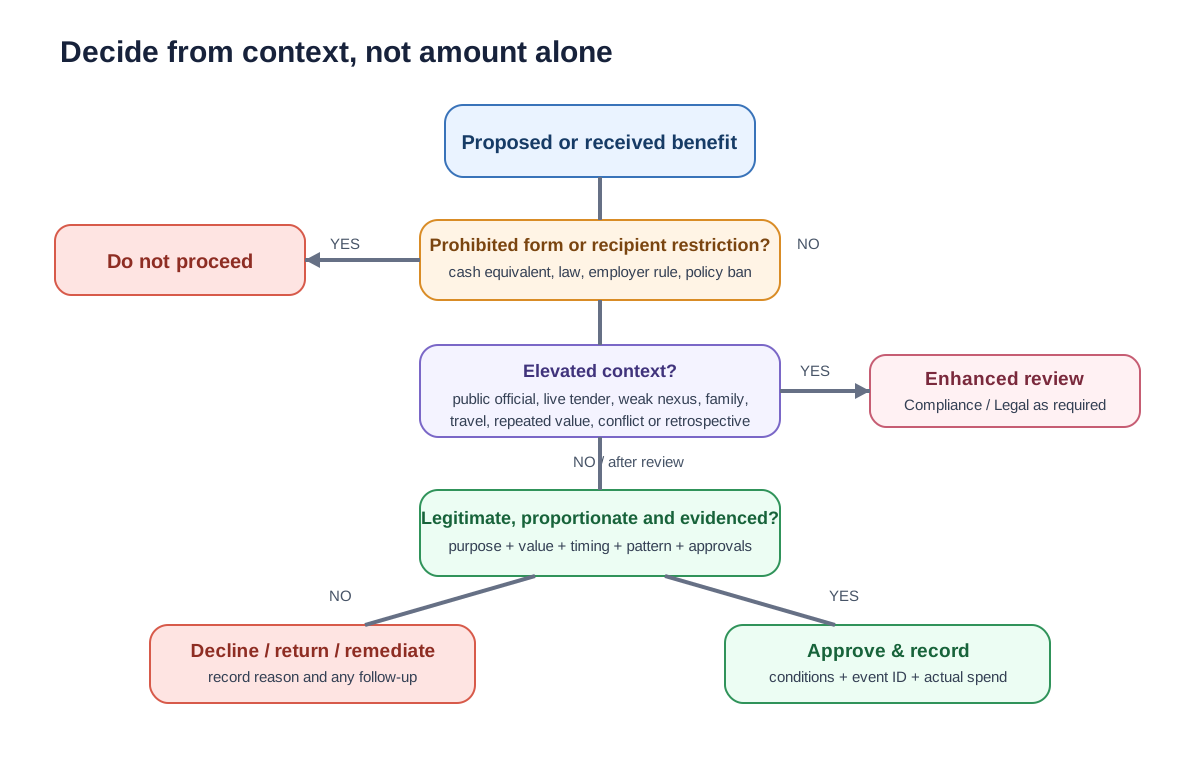
The practical risk factors
Wolfsberg's risk factors translate well into a bank operating model. Elevated attention is appropriate when a public official is involved; value is lavish for the circumstances or high in aggregate; family members or guests receive benefits; hospitality is close to an award of business; the business rationale is weak; a conflict of interest exists; documents are incomplete; cash or cash equivalents are involved; travel includes unnecessary side trips; employees attempt to self-fund an item to avoid control; costs are split across claims; or prior approval was required but not obtained.
No single factor automatically proves bribery. A spouse attending a conference dinner is not evidence of corruption by itself. A missing receipt is not proof of improper intent. A public official attending a legitimate industry seminar is not inherently problematic. The value of the model is that it tells the bank when ordinary approval is insufficient and more facts are needed.
A useful control therefore separates three outcomes. Some requests are prohibited by policy and should not proceed. Some are low enough risk to follow a simplified approval and recording route. Others require enhanced review by ABC compliance or Legal because the answer depends on legal definitions, public-official rules, conflicts, timing, unusual travel, repeated activity or other higher-risk facts. Those outcomes should be deterministic enough for operations to follow but flexible enough for qualified judgement where the law and evidence require it.
Giving and receiving need symmetrical controls
Banks often design strong rules for what employees give customers and much weaker rules for what employees receive from vendors. That is a mistake. Procurement teams, technology buyers, facilities staff, real-estate teams, event organisers and senior executives may be offered meals, trips, tickets or gifts by suppliers competing for contracts. A receiving-side control should consider the employee's decision-making role, the supplier's current commercial position, value and frequency, whether other colleagues received similar benefits, whether the offer was declined and whether the employee has declared a conflict.
Declined offers can still be useful data. A vendor that repeatedly offers prohibited hospitality to different people creates a pattern even if every employee declines. Recording every trivial offer would be burdensome, so policy should define when a declined benefit must be logged, particularly for higher-risk counterparties, public officials, cash-like items, repeated attempts or prohibited categories.
The same principle applies to employee self-funding. An employee should not be able to avoid the policy by paying personally for a customer's expensive entertainment and choosing not to claim reimbursement. If the activity is undertaken in the course of business, the influence risk remains. Policies and training should make clear that personal payment does not convert a controlled business benefit into a private event.
Control architecture: one register is not enough
The gifts register should be the authoritative workflow record for requests, decisions and evidence, but it should not operate as an isolated spreadsheet. A mature architecture links or reconciles the register with expense management, corporate cards, accounts payable, CRM, customer and organisation data, procurement systems, third-party master data, HR conflicts data, public-official or PEP reference information where relevant, case management and analytics.
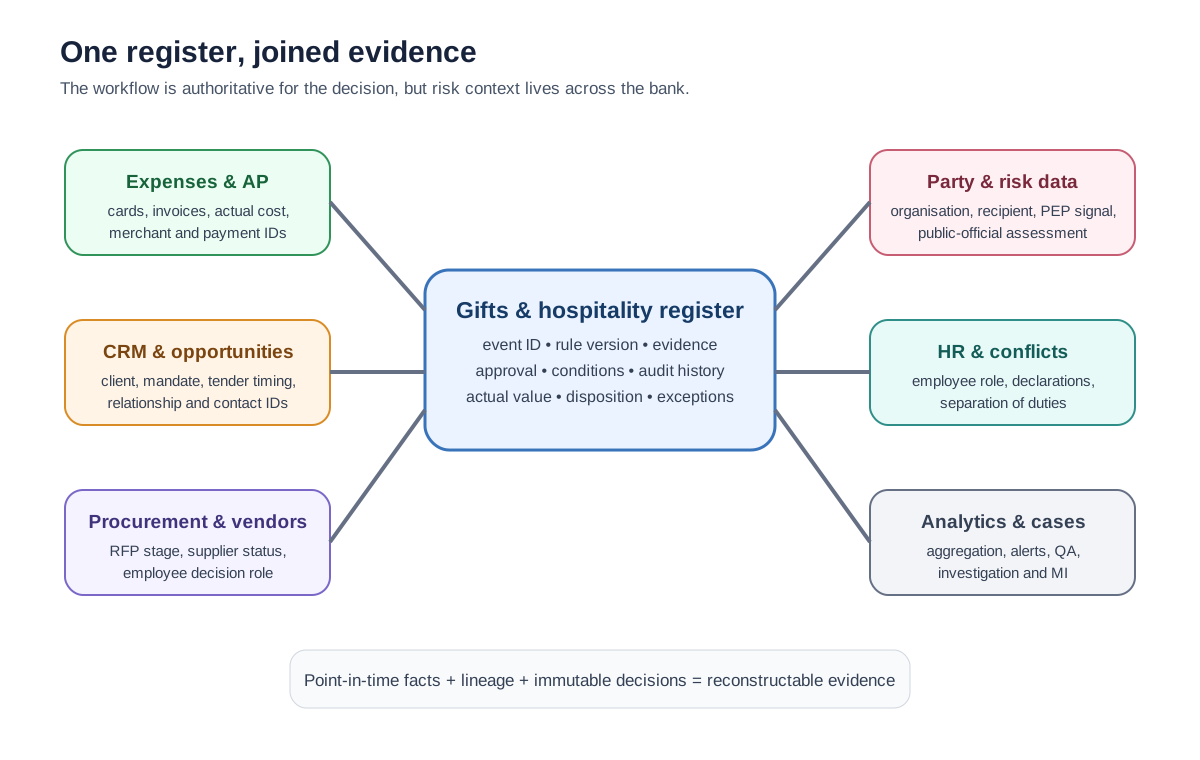
The request record needs enough structured data to support decisioning and later monitoring. Typical fields include giver and receiver; direction; recipient organisation; relationship to the bank; event type; date and location; business purpose; business opportunity, tender or procurement reference where relevant; public-official indicator with evidence source; attendees and guests; travel and lodging components; estimated and actual value; currency and conversion basis; previous related benefits; approval route; decision; conditions; actual expense identifiers; and the reason for any retrospective approval or exception.
Not every field must be mandatory for every case. Good design uses conditional requirements. For example, travel fields appear only when travel is included, public-official evidence is required only when the party classification triggers it, and a tender reference is mandatory when the request is linked to a sourcing event. This keeps the journey usable while preserving the evidence needed for riskier cases.
System design should version policy rules. Thresholds, approval levels and prohibited categories can change by jurisdiction, business line, recipient type or date. An auditor investigating an event from eighteen months ago needs to know which rule set applied at that time, not today's configuration. The decision record should therefore store rule version, evaluated facts, resulting route and human overrides rather than merely the final status approved.
Books, records and payment evidence
Approval is only half of the control. The bank must also ensure that the expenditure is recorded accurately. A hospitality request approved for a client conference should reconcile to the actual expense or invoice. If the actual cost materially exceeds the estimate, the control should determine whether reapproval is required. If an employee labels football tickets as "consulting" or a travel extension as "meeting expenses," the problem is not solved because a gift form exists elsewhere.
Expense and accounts-payable controls should therefore check for missing approval references, duplicate claims, split invoices, suspicious merchant types, multiple employees claiming parts of the same event, high-risk recipients, weekend or side-trip components and actual values above approved amounts. This is particularly important where accounting laws or issuer requirements create separate books-and-records obligations. Even where those rules do not apply, accurate classification is essential to auditability and management information.
Monitoring the pattern, not merely the event
Post-event monitoring is what turns a register into a control system. Analytics should aggregate by employee, recipient, recipient organisation, customer group, vendor, public body, event, business opportunity and time period. Entity resolution matters because "Ministry of X," an agency subsidiary and a named official may represent one relationship. Currency conversion also matters: aggregation should use a consistent control currency and preserve the original amount, original currency, FX source and conversion date.
Patterns worth reviewing include repeated benefits just below approval thresholds; alternating claims across employees; frequent hospitality to the same recipient; multiple gifts around a tender or mandate decision; repeated family or guest attendance; expense claims with no register entry; retrospective approvals; unusual use of cash equivalents; offers from suppliers during procurement; and a surge in activity before contract renewal. None is an automatic bribery conclusion. They are signals for review.
The control should also identify policy circumvention. If a threshold is EUR 100, five EUR 95 dinners are not inherently acceptable simply because each event passes the single-event test. Aggregate limits, frequency rules and contextual escalation prevent employees from turning a risk-based policy into a transaction-splitting exercise.
From exception to investigation
A control alert begins with facts, not accusations. The reviewer should establish what was offered or received, the parties, purpose, value, timing, decision context, approvals, related expenses and history. Public-official status should be verified against the applicable legal and policy definition rather than inferred from a name or PEP flag. Procurement or sales teams may need to explain whether a live decision existed. Finance may need to reconstruct payments. HR may need to establish employee responsibilities and prior declarations.
Possible outcomes include closing the review with a documented rationale; declining the proposed benefit; asking the recipient to reimburse or return value; requiring the employee to return or donate an item under policy; imposing conditions on attendance or travel; reassigning a conflicted decision maker; initiating employee disciplinary review; enhancing third-party due diligence; expanding the review to related claims; or escalating to Legal, ABC compliance, AML investigations or law enforcement where the facts and applicable rules justify it. Suspicious activity reporting is jurisdiction-specific and should never be described as an automatic consequence of a gifts breach.
A gifts investigation can also reveal other risks. A vendor offering benefits to procurement staff may require a third-party review. A customer contact receiving unexplained personal benefits may create conduct or fraud concerns. A pattern involving payments to a shell company may require AML analysis. The case-management model should permit referrals without collapsing every risk type into one generic financial-crime case.
Roles and decision rights
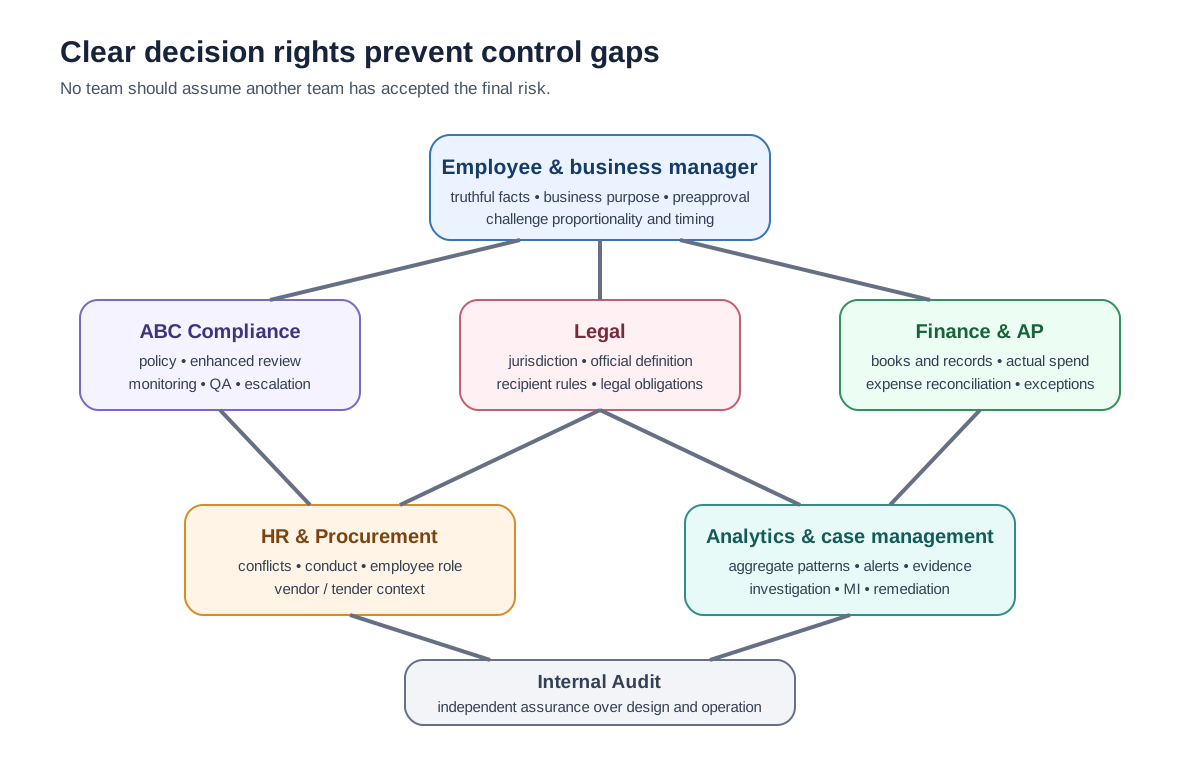
First-line employees own truthful request information and must seek approval before the event where policy requires it. Managers challenge business purpose, proportionality and relationship context rather than acting as rubber stamps. ABC compliance owns policy interpretation and enhanced risk review. Legal advises on applicable law and difficult public-official or cross-border questions. Finance, corporate-card and accounts-payable teams enforce payment and books-and-records controls. Procurement and vendor management provide sourcing context. HR handles employee conduct and conflicts. Internal Audit provides independent assurance.
Senior governance should receive management information that shows more than volumes. Useful measures include high-risk approvals, public-official cases, retrospective approvals, exceptions, average and aggregate value by segment, repeated recipients, policy breaches, unregistered expense matches, ageing, QA findings, disciplinary outcomes and remediation. Trend information should be contextualised; a rise in registrations may reflect better transparency rather than worsening misconduct.
The most dangerous governance pattern is diffuse ownership. If business assumes Compliance approved the relationship, Compliance assumes the manager checked recipient rules, Finance assumes the gifts platform checked the invoice and everyone assumes Legal would have been involved if necessary, the control can fail even though every team performed its narrow task. Decision matrices and workflow routing should make the hand-offs explicit.
What good looks like
A mature gifts, entertainment and hospitality programme does not try to remove all discretion. It makes discretion visible. Employees can understand the rules before committing the bank. Low-risk activity moves efficiently. Higher-risk activity receives proportionate challenge. The register captures both value and context. Expenses reconcile to approved activity. Public-official and recipient-side restrictions are checked correctly. Repeated low-value patterns are visible. Rule changes are versioned. Investigations preserve facts and avoid premature allegations. Governance can explain why the control is working and where it is being improved.
Most importantly, the programme teaches a simple habit: never ask only "Is this under the limit?" Ask whether the benefit is legitimate, proportionate, permitted, transparent and defensible in context. That is the difference between a threshold mechanism and an anti-bribery control.
Operational deep dive: from invitation to defensible decision
The base chapter established the mental model. This section examines the situations that make gifts and hospitality difficult in real banks: travel, conferences, public-sector contacts, events without a host, family members, local customs, retrospective requests and the difference between a monetary trigger and a legal conclusion.
Thresholds are workflow controls, not legal safe harbours
Banks need monetary thresholds because a global workforce cannot send every coffee or ordinary meal to specialist compliance. The mistake is to present the threshold as the answer rather than as a routing device. A threshold can determine when manager approval, Compliance approval or registration becomes mandatory. It cannot make an otherwise improper benefit acceptable.
A sound policy therefore combines amount with context. A modest meal with a procurement official during a live tender may deserve more scrutiny than a more expensive client conference held after a mandate is complete. A low-value gift repeated monthly can create more influence than one transparent annual event. A jurisdiction may prohibit an official from accepting any benefit even though the bank's normal private-sector threshold would allow it. Systems should treat amount as one dimension among several.
Thresholds also need an aggregation rule. A bank can aggregate benefits by recipient, organisation, employee and relationship over a rolling or calendar period, depending on policy. The objective is not to create a universal mathematical model but to stop the obvious circumvention in which a relationship is divided into individually low-value events. The aggregation basis should be documented, versioned and consistent enough for testing.
Local thresholds should be stored as configuration rather than embedded in code. Each rule record should carry jurisdiction, business unit if relevant, direction (given or received), recipient type, benefit type, threshold, effective date, expiry date, approval level and policy source. Historical decisions then remain reproducible when limits change.
A hosted event is different from an unhosted ticket
Consider two superficially similar cases. In the first, a relationship manager invites a customer to a football match and attends with the customer, spending the evening discussing a longstanding corporate relationship. In the second, the manager sends two premium tickets to the customer's home and does not attend. The cost may be identical, but the control classification is different. The second case resembles a gift because the bank is not participating in the hospitality.
That distinction matters for three reasons. First, gifts may be subject to lower policy limits. Second, unhosted benefits have a weaker business nexus. Third, the bank has less direct evidence about who actually used the benefit. The gifts register should therefore capture whether a bank representative will be present and, for hosted events, identify the host and expected attendees.
Virtual events create a related issue. If the bank sends food or a voucher to support a virtual client meeting, the control should preserve evidence that the business meeting actually occurred. Without that link, the item can look like a gift delivered to the recipient rather than incidental hospitality. Wolfsberg explicitly recommends maintaining evidence for virtual or remote hospitality to avoid this ambiguity.
Public officials and government-linked entities
Public-official cases should not be handled through guesswork. Different laws define officials differently, and government-linked or state-owned entities can create difficult perimeter questions. The bank needs an approved definition and escalation path, with Legal involved where the status materially affects permissibility.
A common design error is to reuse an AML PEP flag as the only public-official control. PEP data is valuable as a risk signal, but PEP definitions serve AML objectives and are not interchangeable with every anti-bribery statute. The system can use PEP information to prompt review while preserving a separate public-official assessment with evidence, legal regime and effective date.
Recipient rules become especially important here. Public bodies may have their own codes or statutory restrictions. An official may be barred from accepting even modest hospitality. The bank should therefore check the recipient's acceptance rules where proportionate and document the basis rather than relying solely on the bank's internal threshold.
The same discipline applies to speakers' fees, travel reimbursements and conferences. An official invited to speak at an industry event may legitimately receive travel that is necessary for attendance, but unnecessary side trips, premium leisure extensions, benefits for family members or unexplained allowances increase risk. The business purpose and itinerary should be specific enough to show why each element is needed.
Travel, lodging and conferences
Travel creates a larger evidence burden than a meal because it can include flights, hotels, local transport, meals, entertainment and personal extensions. A bank-funded customer visit to a technology centre may be legitimate. A week at a resort with one short business presentation raises a different question. The control should separate necessary business costs from leisure or personal costs and ensure personal extensions are borne by the traveller unless policy and law permit otherwise.
The travel record should capture origin and destination, dates, business agenda, class of travel, accommodation, attendees, side trips, guests, payer, reimbursement route and any personal component. Where a third party books travel, the bank should still know the underlying value. Hiding the cost behind an event agency does not reduce the benefit provided to the recipient.
Conference invitations deserve similar care. The event fee may be legitimate, while premium entertainment attached to the conference is not. A bank may sponsor a customer to attend an educational session but should separately assess companion travel, golf days, spa packages, exclusive excursions or extra nights. Bundled event invoices should not prevent item-level assessment where the components have different risk characteristics.
Family members, companions and connected persons
A benefit provided to a spouse, child or guest can still influence the primary business contact. The risk model should therefore capture who receives the value, not merely whose name is on the invitation. Family participation is not automatically prohibited, but it weakens the business nexus and can materially increase aggregate value.
For example, inviting a customer's spouse to an evening reception that is open to companions at an industry conference may be explainable. Paying the spouse's long-haul travel and luxury accommodation for the week is different. The decision should consider necessity, proportion, recipient rules, timing and whether the benefit would withstand independent scrutiny.
Connected-person analysis must also respect privacy. The bank should collect only information necessary for the control and apply local data-protection and employment-law requirements. "Know every relationship of every employee" is neither proportionate nor technically sensible. The data model should capture relevant guests and connections for the specific event, with access restricted to teams that need it.
Cultural gifts and ceremonial situations
Global banks operate in markets where ceremonial gifts are expected during holidays, visits or significant events. A useful policy acknowledges this reality rather than forcing employees to hide it. The control can distinguish modest ceremonial items from cash-like value, luxury goods or benefits connected to a decision.
Where accepting an item would breach policy, practical routes include polite refusal, return to the giver, surrender to the bank, donation to charity or another locally approved treatment. The chosen route should be transparent and recorded. The policy should not rely on a vague "local custom" exception because custom can become an uncontrolled override.
Cash gifts and cash equivalents need a stricter stance because they are highly transferable. Red envelopes, gift cards, vouchers and certificates may be culturally familiar, but the bank should follow its approved rule, normally prohibition or tightly controlled handling. Staff need scripts and escalation channels so they can manage sensitive situations without improvising.
Live tenders, mandates and other decision points
Timing can transform ordinary hospitality into a high-risk event. Procurement selection, contract renewal, credit or financing mandates, underwriting decisions, licence applications, regulatory inspections, asset sales and other competitive decisions all create moments when a benefit may be perceived as influencing the outcome.
A mature register therefore asks whether a live decision exists and, where possible, links the request to the opportunity or procurement record. This enables both preapproval and post-event analytics. It also protects employees: a banker who can show that an ordinary working meal was approved, documented and unrelated to the selection decision has better evidence than one relying on memory months later.
Business units sometimes resist this integration because CRM and procurement identifiers are not always known at invitation time. The requirement can allow a temporary free-text reference with later enrichment, but the unresolved state should be monitored. A permanent unknown value around a sensitive event is not adequate evidence.
Retrospective approvals and urgent exceptions
Some requests arrive after the event. An employee may discover that a customer paid for an unexpected dinner, or an event organiser may change the itinerary at short notice. A mature policy needs a retrospective route, because pretending such events never happen pushes them underground. The route should not, however, become an alternative to preapproval.
Retrospective requests should capture why prior approval was not obtained, whether the event could reasonably have been foreseen, what action was taken at the time and whether the value can be returned or reimbursed. Repeated retrospective requests by the same employee or team should trigger management review. Monitoring should distinguish a genuine unforeseen event from a pattern of bypassing controls.
An urgent exception should also preserve decision rights. A senior business executive should not be able to self-approve simply because the event is important. The workflow needs delegated approvers, emergency Compliance contacts or clearly defined fallback rules. If the risk cannot be assessed in time, the safe outcome may be to decline.
Receiving hospitality from vendors and intermediaries
Receiving-side risks often emerge outside front-office sales teams. A technology vendor invites architects to a luxury resort during an RFP. A recruitment firm offers concert tickets to HR buyers. A property agent provides hospitality to corporate real-estate staff. A law firm offers an expensive weekend to executives who allocate panel work. These are not customer gifts, but the influence problem is similar.
The system should know the employee's role and whether the counterparty is participating in a current sourcing, renewal or performance decision. Procurement data can provide that context. A benefit offered to someone with scoring or approval authority may require rejection or recusal even where the same event would be acceptable for an employee with no decision role.
Supplier codes and contractual clauses can reinforce expectations. They should not replace employee controls. A vendor may sign an anti-bribery clause and still offer inappropriate benefits. Repeated attempts should be visible to vendor management and, where warranted, affect supplier risk assessment.
Declined, returned and reimbursed benefits
A declined or returned benefit can still provide intelligence. Suppose a supplier sends expensive gifts to five employees and all five return them. The bank has avoided the immediate benefit but learned something about the supplier's behaviour. Policy should define when such attempts are recorded so patterns can be identified without flooding the register with every trivial offer.
Reimbursement can also be a remediation tool. If an employee unexpectedly receives hospitality that cannot be accepted, paying fair value may remove or reduce the personal benefit, subject to local rules and Compliance advice. The evidence should show how value was determined, when reimbursement occurred and to whom it was paid.
Return and donation processes need controls of their own. A luxury item should not disappear into an office cupboard. Chain of custody, recipient organisation, valuation and approval should be recorded where material. The aim is to show that the employee did not retain the benefit and that the bank handled it consistently.
Investigating a suspicious pattern
Imagine a vendor competing for a three-year technology contract. Over four months, it hosts several individually modest dinners for members of the selection team, sends unhosted event tickets to one manager and pays for an industry conference at which the same manager is a speaker. Every item is separately below the highest approval threshold. The correct question is not whether any one dinner was expensive. It is whether the pattern, timing, recipient roles and cumulative value create an improper-influence concern.
An investigation would reconstruct the tender timeline; identify everyone who received value; aggregate offers and accepted benefits; obtain event agendas, expense records and approvals; check whether recipient policies were followed; review any personal or undisclosed relationships; and assess whether vendor scoring, contract terms or decisions changed. The investigator should avoid assuming the hospitality caused the decision. The task is to establish evidence and determine whether control, conduct, fraud, procurement, disciplinary or reporting obligations are triggered.
The case should end with explicit outcomes. Even if bribery is not established, the bank may find a control weakness: missing aggregation, absent vendor-to-employee matching, no requirement to record declined tickets or approval rules that ignore live tenders. Remediation can therefore be valuable even when the allegation is not substantiated.
Advanced practice: data, architecture, analytics and testing
A gifts and hospitality policy becomes operational only when systems can represent its decisions accurately. This section translates the control into data, integration, monitoring and testing requirements for business analysts, architects, developers, product owners and assurance teams.
Build an event model, not a free-text register
The core object should be a benefit_event or equivalent record with a stable identifier. It represents an offer, promise, giving, receipt or attempted transfer of value in a business context. The record then links to people, organisations, business opportunities, procurement events, expenses and approvals.
A practical schema includes direction (given, received, offered, declined); benefit type; hosted/unhosted flag; event date and location; giver and recipient; organisation; employee sponsor; business purpose; relationship type; estimated value; actual value; currency; control-currency value; FX source/date; public-official assessment; PEP signal where relevant but separately stored; recipient-rule evidence; family or guest involvement; travel/lodging components; business-opportunity or tender identifier; preapproval status; decision; conditions; actual expense references; retrospective reason; policy version; and timestamps for every material state change.
The model should distinguish person, organisation and role at event date. An official may change jobs; a vendor employee may become a customer; a bank employee may leave a procurement panel. Point-in-time role history matters because the risk decision must be reproducible based on the facts that existed then.
Free text remains useful for rationale, but it should not carry facts that analytics require. If "public official" appears only in a comment, automated routing cannot reliably detect it. If the customer organisation appears only as "ABC Ltd dinner," aggregation will fail. Structured data and narrative explanation serve different purposes.
Identity resolution and aggregation
Aggregation is technically harder than it looks. A recipient can appear as Dr. A Khan, A. Khan, an email address, a CRM contact and a procurement-system user. The bank needs entity resolution good enough to join events without creating false matches. Stable internal contact identifiers are preferable where available; otherwise the matching service can use verified email, organisation, phone or other authorised attributes with confidence levels.
Organisation hierarchy matters too. Benefits provided to different employees of the same ministry, state-owned company or corporate customer may be relevant to one relationship. The data model should support parent-child organisations and allow analytics at both entity and group level. It should not automatically treat every entity under a sovereign as one recipient; aggregation rules must reflect policy and business reality.
Currency normalisation should preserve both original and converted values. A control-currency amount enables thresholds and aggregation, while original currency supports evidence. The conversion method should specify rate source and date. Backdated changes to FX rates should not silently alter historical approvals.
Integrating expenses and accounts payable
A register that cannot be reconciled to actual spend is easy to bypass. Expense systems should carry the gift/hospitality event ID when policy requires registration. Accounts payable should do the same for event agencies, conference organisers and vendor-paid reimbursements. Corporate-card feeds can be matched after settlement.
Reconciliation logic can detect an expense with no approved event, an event with no eventual expense, actual cost materially above approved estimate, duplicate claims, multiple employees charging the same event, merchant-category anomalies, split invoices, missing attendee information and expenses posted under unrelated categories. The purpose is not to reject every mismatch automatically. Mismatches are workflow exceptions that need explanation and, where appropriate, reapproval.
Some legitimate events are centrally purchased and never appear in an employee expense claim. The architecture therefore needs multiple payment paths. Marketing may pay an event agency, Procurement may issue a purchase order, and Corporate Affairs may pay a conference invoice. The event record should link to whichever financial object funded the benefit so reporting is complete.
Integrating CRM, procurement and HR context
CRM provides business timing. It can tell the control whether the recipient is linked to a live opportunity, recent mandate or contract decision. Procurement provides supplier status, RFP stage and employee decision roles. HR provides organisational position and declared conflicts where lawful and proportionate. Third-party systems identify vendors and intermediaries. Public-official and PEP reference data provides risk signals, but the final anti-bribery status may require specialist interpretation.
The integration should minimise data copying. A gifts platform does not need to become a shadow CRM or HR database. It can store stable references and the minimum point-in-time facts used in the decision. Sensitive attributes should be access-controlled, and purpose limitation should be documented. Employee monitoring also needs local privacy, works-council and labour-law consideration in some jurisdictions.
Rule engine design
A rule engine can route ordinary cases efficiently if its boundaries are clear. Example rules may prohibit cash equivalents; require Compliance approval when a public official is involved; require enhanced approval for family travel; block self-approval; require preapproval above a configured value; require tender context when a vendor or customer decision is live; and escalate when aggregate value or frequency crosses a limit.
Every rule should have an identifier, description, jurisdiction or policy scope, effective date, priority, owner and test cases. The decision log should capture which rules fired and the input facts used. This allows an auditor to reproduce why a request took a particular route.
Overrides should be explicit. A manager should not be able to edit the risk facts until the request falls below a threshold. If an authorised specialist overrides a rule-generated route, the record needs approver, rationale and evidence. Override volumes and patterns belong in management information.
Monitoring scenarios
Post-event analytics should complement preapproval. Useful scenarios include repeated events just below thresholds; the same recipient receiving value from multiple employees; supplier hospitality to employees assigned to a live RFP; family or guest participation above expected norms; unhosted tickets classified as hospitality; high rates of retrospective approval; frequent expense-register mismatches; unusual cash-equivalent requests; repeated rejected offers from one counterparty; and spikes in hospitality immediately before or after a mandate decision.
Scenarios need tuning. A global conference team may legitimately generate many events. A relationship manager may host the same client regularly. The alert should combine frequency with business context rather than treating volume alone as misconduct.
False positives should feed control improvement. If a scenario repeatedly triggers on a specific legitimate event model, policy or analytics may need refinement. But closure reasons must be specific enough to learn from; business as usual is not a useful feedback label.
BA acceptance criteria
A requirement such as "system must enforce gifts policy" is not testable. Better acceptance criteria describe observable behaviour. When a user selects cash equivalent, the workflow must prohibit the request except for explicitly configured local exception routes. When publicOfficialAssessment = true, the request must route to the required Compliance or Legal approval path for the applicable rule version. When actual spend exceeds the approved amount by a configured tolerance, the event must reopen or create an exception. When multiple events for the same recipient cross an aggregate threshold, the system must use linked identity data and include prior events in the decision context.
Other acceptance criteria should cover data lineage: the UI must show the source and timestamp of public-official or recipient attributes used; policy version must be immutable after decision; later corrections must create a new audit event; deleted attachments must remain governed by record-retention rules; and users must not be able to alter an approval after settlement without a traceable correction workflow.
Testing strategy
Positive tests prove expected routing. Create cases for ordinary private-sector meals, gifts, hosted events, unhosted tickets, public officials, supplier hospitality, travel, speakers' fees, family guests, cash-equivalent attempts and high aggregate value. Verify that each reaches the correct approval route and that downstream expense matching works.
Negative tests are equally important. A legitimate low-risk meal should not be sent to senior Compliance merely because the customer is high value. A PEP flag should not automatically transform the person into a foreign public official without the required assessment. A modest event after a completed tender should not inherit the live-tender restriction forever if the policy does not require it.
Evasion testing should deliberately split value. Submit several claims below the single-event threshold, vary spellings of the recipient, route claims through different employees and use separate payment methods. The analytics should still identify the pattern when identity resolution and aggregation rules say the events are connected.
Boundary tests matter for time and currency. Test an event just before and after a policy effective date, expenses posted in different time zones, currencies with changing rates, duplicate events across systems and backdated actual values. The expected outcome must be based on the correct rule version and preserved conversion logic.
Resilience tests should cover unavailable dependencies. If CRM is down, can the user submit a request? Does the system fail closed for higher-risk cases or allow a controlled pending state? If public-official data cannot be retrieved, does it silently assume false? It should not. Degraded-mode behaviour must be documented and proportionate.
Access-control tests verify that employees cannot approve their own requests, junior users cannot see unrelated sensitive investigations, Finance can view payment evidence without unnecessary HR details, and audit users have read-only access. Separation of duties should be enforced technically where policy depends on it.
QA and assurance
Quality assurance should sample both approvals and declines. Sampling only approved high-value cases can miss repeated low-value circumvention; sampling only policy breaches cannot show whether normal decisions are consistent. A risk-based QA plan can include public officials, retrospective approvals, travel, cash-equivalent attempts, tender-linked cases, overrides, repeated recipients and expense mismatches.
QA should distinguish design errors from analyst errors. If reviewers consistently miss family travel because the UI hides guest information, retraining alone will not fix the problem. If a rule does not aggregate across recipient aliases, the root cause is data architecture. Remediation should therefore identify whether the weakness lies in policy, data, workflow, training, supervision, technology or governance.
Internal Audit provides independent assurance over the programme, not case-by-case approval. Auditors may test risk assessment, policy governance, rule configuration, sample decisions, data completeness, expense reconciliation, monitoring coverage, issue management and senior oversight. The bank should be able to demonstrate how issues were tracked to sustainable closure rather than merely showing that a finding was marked complete.
Management information that changes decisions
Useful MI combines activity and risk. It can show total registrations, high-risk approvals, public-official cases, amounts and aggregate values, received-vs-given activity, vendor-related hospitality, retrospective approvals, exceptions, average approval time, expense mismatches, repeated recipients, rule overrides, QA fail rates, disciplinary referrals and remediation ageing.
Dashboards should not rank employees by raw hospitality spend without context. Client-facing roles differ from operations roles. The purpose of MI is to identify unusual patterns and control performance, not to create misleading league tables. Segment-normalised measures and drill-down evidence are more useful than simplistic totals.
Senior committees should be told what changed. If registrations rise after training, that can be positive. If retrospective approvals fall after a mobile workflow launch, that may show better accessibility. If public-official cases rise because the customer master improved its entity classification, the risk may not have changed at all. Good MI separates exposure, detection and control effectiveness.
Change management
Policy changes are software changes when rules are automated. A new threshold, revised public-official definition, updated country restriction or new required approval should create a controlled change with impact assessment, configuration, regression tests, training and effective-date planning. Historical events should not be reinterpreted silently under new rules unless the change explicitly requires lookback.
Horizon scanning should identify changes in law, supervisory expectations, recipient-sector rules and internal risk appetite. Legal and Compliance decide the policy impact; product and technology teams translate it into data and workflow changes; testing proves the intended behaviour; operations receives updated procedures; and management information checks whether the change had the expected effect.
The best architecture therefore treats the gifts programme as a living financial-crime control, not a static form. Its quality depends on traceable policy, reliable data, proportionate routing, evidence-preserving workflow and the ability to detect patterns that no individual approval can see.
Practice close: applying the control to real decisions
These scenarios are deliberately realistic rather than legal hypotheticals. They show how a bank should reason from facts, policy and evidence without turning a red flag into an accusation.
Scenario 1: ordinary client hospitality
A corporate banker proposes dinner with two private-sector treasury executives after a quarterly service review. The restaurant is appropriate for the market, the banker will attend, no procurement or mandate decision is open, the cost is within the normal local approval route and the customer confirms that its employees may accept. The banker records the business purpose and expected attendees before the event.
This is the kind of relationship activity a proportionate policy should handle efficiently. There is a clear business nexus, transparent participation and no obvious elevated factor. The control still records the event and reconciles actual cost, because transparency is what distinguishes controlled hospitality from undocumented value transfer.
If the actual dinner becomes far more expensive than planned or extra guests join, the facts have changed. The system should apply the policy's reapproval or exception rule rather than assuming the original approval covers any final amount.
Scenario 2: tickets without a host
A relationship manager receives two premium concert tickets from a vendor and plans to take a friend. The vendor will not attend. The manager's team is participating in a contract renewal involving that vendor.
Calling this "hospitality" understates the risk. Because the provider will not attend, the item should be treated as a gift under the bank's classification model. The live renewal and the employee's decision role create additional conflict and influence risk. Depending on policy, the correct action may be to decline and record the offer. The value alone should not decide the case.
The vendor's attempt may also be relevant to vendor management, especially if similar offers were made to other employees. The bank should not infer bribery merely from the offer, but it should preserve the pattern.
Scenario 3: customer conference with public-sector attendees
The bank is hosting an educational payments conference. Several employees of a state-owned enterprise and two government officials are invited. The agenda contains substantive sessions, modest meals and one evening reception. The business proposes to pay economy travel and two hotel nights for speakers travelling internationally.
This case requires jurisdiction and recipient-rule analysis. The bank should establish whether the individuals meet applicable public-official definitions, whether their organisations permit acceptance, whether travel is necessary and proportionate, and whether any live commercial or regulatory decision changes the context. A single label such as state-owned = prohibited would be too crude; automatic approval because the conference is educational would be equally weak.
If permitted, the record should identify the legitimate business purpose, itinerary, class of travel, actual attendees, approval basis and recipient-rule evidence. Side trips, companion costs or unrelated leisure should be separated and normally borne personally unless policy and law clearly permit otherwise.
Scenario 4: repeated low-value meals around a tender
Three bankers each host the same procurement executive for meals over six weeks. Every meal is below the single-event Compliance threshold. The customer's tender decision occurs at the end of the period.
An event-by-event control may approve all three. An aggregate control sees the repeated recipient, timing and business decision. That pattern should trigger review. The review needs facts: business purposes, attendees, frequency, customer acceptance rules, tender involvement and whether the meals were coordinated.
The pattern does not prove improper influence. It demonstrates why aggregation is part of the control. If the activity was legitimate but the bank's system failed to surface it, the case is also a technology and policy-design lesson.
Scenario 5: unexpected ceremonial gift
During a branch visit, a senior customer presents an employee with a ceremonial item whose value is unclear. Refusing it publicly could cause offence. The employee accepts it temporarily and immediately reports it to the manager and Compliance.
A sensible policy provides an operational route rather than forcing concealment. The bank can establish value, assess local rules and decide whether the item may be retained, returned, surrendered or donated. Prompt disclosure is a positive control behaviour. The employee should not be criticised merely because the situation occurred; the assessment should focus on value, context, intent, relationship and policy.
Cash or cash-equivalent ceremonial gifts should follow the stricter rule defined by the bank. Cultural context can explain the situation but does not remove the need for controlled handling.
Scenario 6: split expenses and self-funding
A salesperson knows that an event would require Compliance approval above a certain value. The salesperson pays part on a corporate card, asks a colleague to claim another part and pays the remaining amount personally, saying that the customer relationship is too important to delay.
This is a control-circumvention signal even before any bribery conclusion. The bank should reconstruct total value, purpose, recipient, timing and approval history. Personal payment does not remove the business nature of the benefit. The employee's attempt to avoid controls may create a conduct or disciplinary issue even if the underlying event would have been approvable had it been disclosed honestly.
Analytics should be designed to find these patterns through common event date, merchant, recipient, attendee list, employee team and expense references.
Scenario 7: speaker fee and travel
A regulator employee is invited to speak at a bank event. The bank proposes a speaking fee, business-class travel for a short flight and three nights at a luxury hotel although the event lasts one day.
The bank should not decide this from precedent alone. It needs legal and recipient-policy review, a clear basis for any fee, necessary travel, proportionate accommodation and evidence that the official may accept the arrangement. Reducing unnecessary travel or lodging may make the event defensible; in some circumstances the fee or hospitality may not be permitted at all. Legal interpretation belongs to qualified teams applying the relevant regime.
The system should capture each component separately. A single total amount hides the fact that some elements may be legitimate and others unnecessary.
Scenario 8: vendor-funded employee event
A software supplier offers the bank's architecture team a two-day workshop at a resort. The first morning is technical training; the rest of the programme is leisure. The supplier is not currently in an RFP but its major contract renewal is due in two months.
The absence of a live RFP does not eliminate influence risk. The proximity to renewal, leisure-heavy agenda and recipient roles matter. The bank may allow a normal technical workshop while declining or self-funding the leisure elements. Procurement should be informed if the employees influence renewal scoring.
This scenario illustrates why "business purpose exists" is not a binary safe harbour. A legitimate technical element can coexist with disproportionate hospitality.
What an investigator should preserve
A defensible review normally preserves the original request, policy version, approval route, invitations, agenda, attendee list, recipient and organisation data, public-official analysis where relevant, business-opportunity or tender context, expense records, invoices, payment details, messages needed under authorised procedures, prior related events and the final rationale. Evidence should be proportionate to the issue and collected lawfully.
The investigator should construct a timeline. When was the benefit proposed? When did the business decision arise? When were approvals obtained? When did payment settle? Were facts changed after approval? Did the recipient or employee disclose the event elsewhere? A timeline often explains more than an isolated amount.
What the decision record should say
A closure note should state what happened, why it was reviewed, what evidence was checked, which rule or policy applied, what uncertainty remained, what conclusion was reached and what follow-up is required. It should not use unsupported labels such as bribe or corrupt when the evidence only establishes a policy breach or control weakness.
For an approved event, the rationale may be that the business purpose was clear, recipient rules allowed attendance, value was proportionate, no sensitive decision was live, required approvals were obtained and the expense matched the approved event. For a declined event, the rationale should identify the factor that made it unacceptable rather than merely saying "Compliance rejected."
Delivery checklist for BAs and product owners
Before a release, the team should be able to demonstrate the end-to-end journey. A user can classify given versus received value, gift versus hosted hospitality, and travel or other components. The correct rule version is selected from jurisdiction, date and recipient type. Higher-risk factors trigger the intended route. Self-approval is blocked. Public-official assessment is separate from PEP status. Aggregate history is visible. Actual expenses reconcile. Retrospective cases are identified. Overrides are logged. Audit history is immutable. Reporting can distinguish exposure from control failures.
The team should also prove that the design works on mobile. Relationship managers and event staff often need to register activity while travelling. If the form is unusable on a phone, retrospective approvals and off-system notes will increase. Mobile usability is therefore a control consideration, not merely a user-experience preference.
Testing questions that catch weak designs
Can a user avoid the threshold by changing the recipient spelling? Can the same event be submitted twice? What happens when the CRM contact has no organisation? What happens when public-official reference data is unavailable? Does a PEP flag automatically force an incorrect legal classification? Can actual value exceed approved value without reopening review? Can a user claim an expense with no event ID? Can two employees split one invoice? What happens when the policy threshold changes between invitation and event date?
Can an employee approve a direct report's event while also being a beneficiary? Can a senior executive bypass Compliance? Can a vendor event be matched to a procurement cycle? Can declined offers be logged without becoming expense records? Can a returned gift be tracked to final disposition? Can investigators see the rule version used without exposing unrelated employee data?
If these questions cannot be answered from system behaviour and documented requirements, the control is not yet implementation-ready.
Operational failure modes
The most common failure is threshold-only thinking. Staff learn a number and stop asking why the benefit exists. The fix is training and workflow that surfaces purpose, recipient, timing and aggregate history.
Another failure is register isolation. The gifts platform shows perfect approvals while corporate-card data contains unregistered events. Reconciliation and exception reporting close that gap.
A third is generic public-official logic. Teams use PEP status, employer ownership or job title as a conclusive legal test. The fix is a scoped assessment with evidence and Legal escalation where required.
A fourth is rubber-stamp management approval. Approval rates near 100 percent are not necessarily a problem, but managers who cannot explain their role are. Training, approval rationale and QA sampling should test challenge quality.
A fifth is retrospective normalisation. If business regularly registers events after they happen, the programme has become a disclosure register rather than a preventive control. Root-cause analysis may identify poor mobile access, unrealistic lead times, unclear policy or deliberate bypass.
A sixth is over-control. Sending every low-risk meal to specialist Compliance creates queues and encourages workarounds. Risk-based design should reserve specialist capacity for cases where contextual judgement adds value.
Knowledge check
Practice exercise — work through this before reading on.
- Why is a monetary threshold not a legal safe harbour?
- Why might unhosted event tickets be treated as a gift rather than hospitality?
- What is wrong with using a PEP flag as the sole public-official test?
- Name three dimensions that should be used to aggregate gifts and hospitality over time.
- Why should actual expenses be reconciled to approved events?
- What should happen when a higher-risk dependency such as public-official data is unavailable?
- Why can a declined vendor gift still be useful control information?
- What makes a retrospective approval pattern a governance issue rather than only an employee issue?
A learner who can answer these questions with the control logic, not memorised slogans, has understood the topic. The goal is not to recite a threshold. It is to design and operate a transparent system in which legitimate business can continue and improper influence is harder to hide.
Masterclass: the invitation that looked ordinary until the timeline was joined
This is a fictional composite case designed for training. Names, organisations, values and events are invented. The control mechanics are realistic and deliberately combine issues that are often separated across gifts registers, expenses, CRM and procurement systems.
The setup
Northshore Bank is competing for a cash-management and payments mandate from Metro Infrastructure Agency, a government-linked organisation in Country A. The bank's relationship team has worked with the agency for years. A formal procurement process is expected but has not yet been announced.
Six weeks before the expected tender, a senior relationship manager, Maya, invites Daniel, the agency's deputy finance director, to a payments conference hosted by the bank in another city. The agenda contains a full day of technical sessions and an evening football match. Maya submits the conference through the gifts and hospitality system. The estimated hospitality value is within the manager-approval threshold, and the request is approved.
Three facts are missing from the initial request. First, Daniel participates in the internal committee that will recommend banks for the mandate. Second, his employer's code requires prior ethics approval for externally funded travel. Third, the event agency has booked two hotel nights although the conference requires one.
The system does not ask for a procurement or mandate reference because no opportunity has yet been opened in CRM. Daniel is not marked as a PEP in the AML system, so the public-official question defaults to no. The event proceeds.
The pattern develops
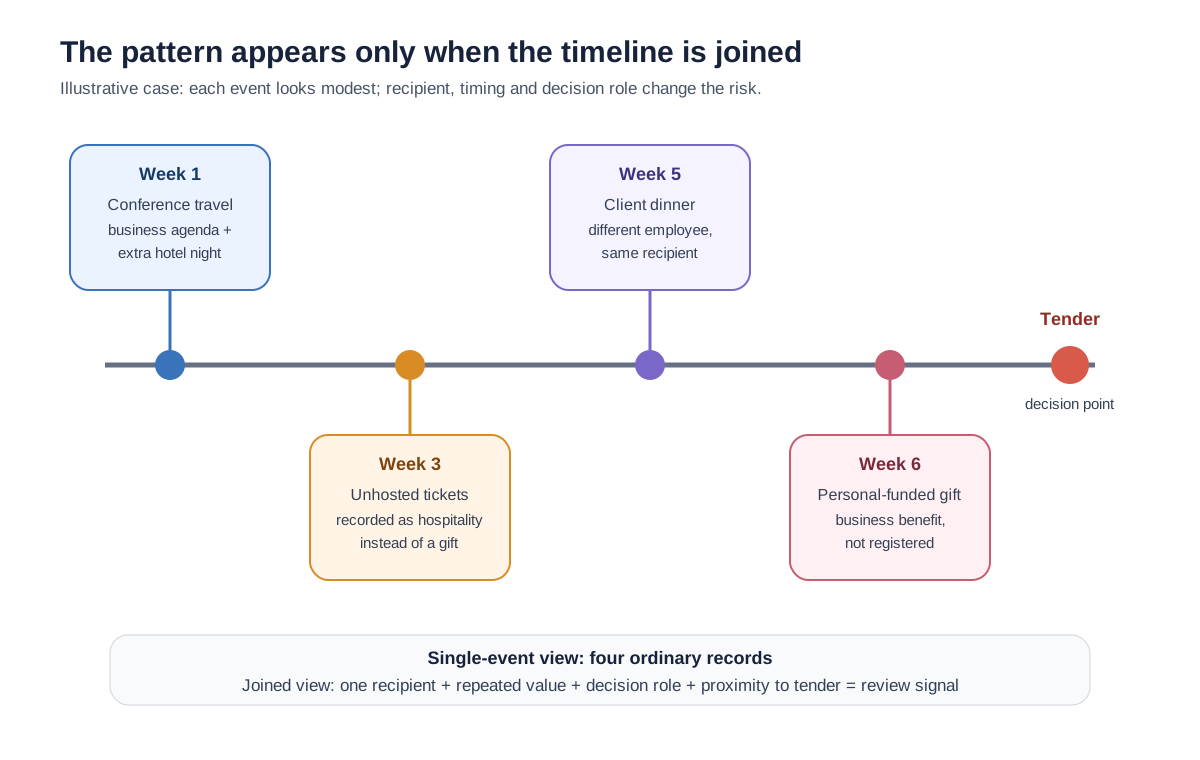
After the conference, the relationship team sends Daniel two premium tickets to a second football match as thanks for attending. No bank employee attends. The tickets are recorded as "client hospitality" and remain below the local hospitality threshold.
Two weeks later, another relationship manager hosts Daniel and his colleague for dinner. A different employee submits the expense, so the per-employee aggregation does not identify the earlier conference. The tender is formally announced the next day.
During tender preparation, Maya pays personally for a small gift delivered to Daniel's office because the corporate-card transaction would exceed her monthly entertainment budget. She does not seek reimbursement and assumes the bank's policy therefore does not apply.
None of the four events is individually spectacular. That is why the case is useful. The risk emerges when the bank connects recipient, organisation, timing, decision role and cumulative value.
How the control discovers it
The trigger is an expense-reconciliation exception. Finance finds that the conference hotel invoice includes the second night and asks for the event ID. A new analytics rule then links the event to the agency organisation and notices multiple gifts and hospitality entries involving Daniel.
ABC Compliance opens a review. The investigator does not begin with the conclusion that anyone has paid a bribe. The questions are factual: What value did the bank provide? Who received it? Why? Was a bank host present? What business decision was underway? What did the recipient's rules allow? Who approved each element? Did any employee try to avoid controls?
The timeline changes the picture. The conference had a legitimate technical purpose, but the extra hotel night was unnecessary. The second football tickets were unhosted and therefore should have been treated as a gift under the bank's policy. The dinner took place immediately before the tender. Maya's personal payment was still a business-related benefit and should have been declared. The recipient's procurement role was material. The bank had never obtained confirmation of the agency's ethics approval for travel.
The public-official question
Compliance also revisits the classification. Daniel works for a government-linked agency, but the exact legal status under applicable anti-bribery laws is not obvious. The AML system's PEP field is irrelevant as a definitive answer. Legal reviews the agency's ownership, function and the relevant statutory definitions. The bank also checks the agency's own ethics rules.
This is an important design lesson. If the system had automatically treated PEP = false as public official = false, it would have hidden risk. If it had automatically treated every government-linked employee as a foreign public official for every jurisdiction, it would also have overreached. The correct solution is a separate, evidenced status with escalation when the legal perimeter is uncertain.
Decision and remediation
The bank pauses further hospitality with the agency while the review is active. It does not alter the tender bid or contact Daniel about the investigation without Legal and Compliance agreement. Procurement and business leadership are informed on a need-to-know basis.
The review concludes that the existing evidence establishes multiple policy and control failures: incorrect classification of unhosted tickets, incomplete travel evidence, failure to identify the recipient's decision role, employee self-funding and inadequate aggregation across employees. Whether the conduct meets any criminal bribery threshold is a legal question and is not assumed from those failures alone.
The bank requires reimbursement for the unnecessary hotel component where legally and operationally appropriate, documents the disposition of the personal gift, addresses employee conduct through HR, and completes the legal and reporting analysis required by the applicable jurisdictions. It also checks whether similar patterns exist for other public-sector relationships.
The bigger remediation is systemic. The gifts platform is integrated with CRM so a relationship can be linked to a planned opportunity even before a formal tender opens. Procurement and public-sector organisation data become risk signals. Unhosted event tickets are explicitly classified as gifts. Personal funding is covered in policy and training. Aggregation is changed from employee-only to recipient and organisation dimensions. Expense reconciliation is expanded to event-agency invoices. Recipient acceptance-rule evidence becomes mandatory for higher-risk public-sector travel.
What the BA writes differently after the case
Before the incident, the requirement said: Hospitality above the local threshold requires manager approval. After the incident, the requirement set becomes more precise.
The platform must classify hosted and unhosted events separately. It must permit the business to link a request to a formal or anticipated opportunity. It must aggregate value by recipient and recipient organisation across employees. It must treat employee-paid business benefits as in-scope declarations. It must require additional fields when travel, family members, public officials or public-sector organisations are involved. It must reopen an event when actual travel cost materially differs from the approved estimate. It must preserve the rule version and the source of all risk attributes used in routing.
Those requirements are testable because they describe observable behaviour. They also address the root cause rather than adding another generic training reminder.
What the architect changes
The architect introduces a canonical party identifier used by gifts, CRM and procurement services. The gifts application consumes opportunity-state events from CRM and vendor/procurement status from sourcing systems. A separate risk-assessment service exposes public-official and PEP signals without collapsing them into one field. Expense and accounts-payable systems publish settled-cost events that reconcile to the gift/hospitality event ID.
The event store keeps immutable decision history. Policy rules are versioned. Analytics reads a privacy-controlled projection rather than unrestricted HR data. Case management receives a linked evidence package when an alert is escalated. The architecture therefore supports both prevention and investigation.
What testing changes
Regression testing now includes cross-employee threshold splitting, public-sector organisations with no PEP flag, hosted versus unhosted tickets, actual travel above estimate, events created before CRM opportunity IDs exist, personal-payment declarations, duplicate recipients with spelling differences and outage of the public-official reference service.
The test team also adds a negative case: a legitimate public-sector educational event with proper recipient approval, necessary economy travel, a full business agenda and no live decision must be able to proceed through the correct enhanced route. A control that blocks every public-sector interaction is not risk-based; it merely moves legitimate activity outside the process.
What senior management should learn
The case is not evidence that all hospitality is dangerous. It demonstrates why fragmented evidence is dangerous. Each team saw a piece: the relationship manager saw a client event, Finance saw a hotel invoice, CRM saw a prospective mandate, the employee saw a personal gift, and Compliance saw separate approvals. The risk became visible only when the bank joined the story.
That is the final lesson of this chapter. Gifts and hospitality controls are not about policing social interaction. They are about making value transfer in business relationships transparent enough that the bank can distinguish legitimate engagement from improper influence, intervene before higher-risk activity occurs, and reconstruct the evidence when questions arise.
Cross-border edge cases: who really provides the benefit?
Some of the hardest gifts and hospitality cases are not expensive. They are difficult because the economic provider, the formal payer and the person who benefits are different. A customer conference may be organised by an event agency, funded jointly by several group entities, invoiced to a marketing cost centre and attended by guests whose travel is booked through a local subsidiary. If the bank looks only at the entity that settles the invoice, it can miss the real relationship and the real influence risk.
The control should therefore identify the economic sponsor as well as the payment route. If a relationship team asks an external event organiser to buy tickets for a customer and later reimburses the organiser through a broad event invoice, the benefit remains attributable to the bank. Using an agency does not turn hospitality into an arm's-length service. The same principle applies when a third-party intermediary, distributor, introducer or consultant provides value on the bank's behalf. Where the facts indicate that the bank requested, authorised, funded or knowingly accepted the arrangement, the event should enter the appropriate ABC control process even if the recipient never sees the bank's name on an invoice.
Jointly hosted events also need a clear allocation method. Suppose three financial institutions sponsor an industry dinner and each contributes a fixed amount. The bank should record its sponsorship and understand the hospitality it is effectively providing, while avoiding a false precision that allocates every plate to a single sponsor where the event genuinely operates as a shared forum. If the bank separately invites a public-sector customer, pays that customer's travel or adds exclusive entertainment, those incremental benefits should be assessed separately because they create a more direct transfer of value.
Reimbursements and after-the-event value
Reimbursement can create a benefit even when no bank employee books the travel. A customer may buy a flight personally and ask the bank to reimburse it after a conference. The control still needs the itinerary, business purpose, class of travel, recipient eligibility, actual amount and evidence that the expense was necessary. A reimbursement route should not become a weaker alternative to the bank's normal travel controls.
The same is true for per diem payments or allowances. A fixed allowance that materially exceeds reasonable business costs can create personal value beyond legitimate reimbursement. Policies should distinguish reimbursement of evidenced business expenditure from allowances, honoraria and other payments that may require a different approval or legal analysis. Where local rules permit a standard allowance, the basis and applicable rule should be recorded rather than assumed.
If an employee discovers after an event that a counterparty paid for more than expected, the response should focus on remediation and transparency. The employee may need to disclose the additional value, reimburse the counterparty, obtain retrospective review or take another action specified by policy. Prompt disclosure should be encouraged. A culture in which employees fear punishment for reporting an unexpected benefit can push small control problems underground until they become larger ones.
Digital benefits and modern forms of hospitality
Digital delivery can obscure value because there is no physical gift. E-vouchers, ride credits, food-delivery credits, premium account upgrades, digital event access, gaming or entertainment subscriptions and promotional codes can all be benefits. Their treatment should follow the substance of the transfer rather than its format. A transferable e-voucher is much closer to a cash equivalent than to a meal actually consumed during a hosted meeting.
Virtual events deserve a particularly clear audit trail. If the bank sends a meal to participants during a remote workshop, the record should connect the benefit to the workshop, attendees and business agenda. If the bank simply emails high-value food vouchers to clients and no meaningful hosted interaction occurs, the arrangement may be better treated as a gift. Classification should reflect whether the bank genuinely participated in the business hospitality.
Group entities and cross-border approval ownership
A global bank may have several legal entities involved in one relationship. The relationship manager sits in Country A, the customer is in Country B, a conference occurs in Country C and the cost is booked by a group service company in Country D. The workflow needs a method to determine which policies and legal reviews apply without pretending that one country's internal threshold is universal.
At minimum, the record should preserve the employing entity, paying entity, recipient location or organisation, event location and any legal-entity relationship that affects the bank's obligations. The policy engine can then route the case using the relevant internal rules, while Legal or Compliance resolves conflicts or uncertainties. Where multiple regimes apply, the bank may choose a stricter internal standard for operational simplicity, but it should describe that as bank policy rather than as a statement that every jurisdiction legally requires the same result.
The practical closing test
Before approving a complicated arrangement, the reviewer should be able to describe the transaction in one transparent sentence: who is providing what value, to whom, for what legitimate business reason, at what time, under which applicable rule, and with what evidence? If that sentence requires several euphemisms, hides the real payer, ignores a connected person or cannot explain why the benefit is necessary, the case needs more work.
This test is deliberately simple. It does not replace legal analysis, monetary limits or specialist judgement. It forces the control back to economic substance. Bribery and influence risk can be hidden by invoice structure, cost centres, agents, group entities and digital delivery, but a well-designed gifts and hospitality programme follows the value and the relationship rather than the label attached to the payment.
References and further reading
- UK Ministry of Justice, Bribery Act 2010 guidance (published 2012, page updated 22 January 2025). The guidance explains the statutory framework and six principles for bribery-prevention procedures: https://www.gov.uk/government/publications/bribery-act-2010-guidance
- UK Crown Prosecution Service and Serious Fraud Office, Bribery Act 2010 Joint Prosecution Guidance. The hospitality section explains why reasonable and proportionate good-faith business hospitality is not automatically criminal while context, lavishness, concealment and business nexus matter: https://www.cps.gov.uk/prosecution-guidance/bribery-act-2010-joint-prosecution-guidance-director-serious-fraud-office-and
- UK National Crime Agency, Protect your business from bribery and corruption. Practical public guidance on prevention principles and the distinction between legitimate gifts/hospitality and bribery: https://www.nationalcrimeagency.gov.uk/what-we-do/crime-threats/bribery-corruption-and-sanctions-evasion/protect-your-business-from-bribery-and-corruption
- Financial Conduct Authority, FCG 6 Bribery and corruption. Financial-sector systems-and-controls guidance covering bribery risk assessment, public-official exposure, corporate hospitality, expenses, gifts, conflicts, escalation, monitoring and review: https://handbook.fca.org.uk/handbook/fcg6
- Financial Conduct Authority, Bribery and corruption (current firm-facing summary). Use with the FCA Handbook and applicable legal requirements, not as a substitute for criminal law: https://www.fca.org.uk/firms/financial-crime/bribery-corruption
- The Wolfsberg Group, Anti-Bribery and Corruption Compliance Programme Guidance (2023). Financial-industry guidance on risk-based ABC programmes, anything of value, gifts, business hospitality, public officials, travel, cash equivalents, approvals, records, monitoring and testing: https://dev.wolfsberg-group.org/resources/general/104
- The Wolfsberg Group, Publication of the Wolfsberg ABC Guidance (17 April 2023), confirming that the 2023 guidance replaced the 2017 version and summarising its risk-based programme expectations: https://wolfsberg-group.org/news/39/
- U.S. Department of Justice and Securities and Exchange Commission, A Resource Guide to the U.S. Foreign Corrupt Practices Act, Second Edition, with DOJ's 2024 FEPA addendum available from the same page. Use for U.S.-specific statutory and enforcement context: https://www.justice.gov/criminal/criminal-fraud/fcpa-resource-guide
- U.S. Department of Justice, Foreign Corrupt Practices Act. Current DOJ programme page for FCPA and FEPA resources and enforcement materials: https://www.justice.gov/criminal/criminal-fraud/foreign-corrupt-practices-act
- OECD, 2021 Recommendation for Further Combating Bribery of Foreign Public Officials in International Business Transactions high-level statement. It describes the updated recommendations on prevention, detection, compliance, reporting persons and data protection: https://www.oecd.org/en/about/news/announcements/2021/12/high-level-statement-on-the-2021-anti-bribery-recommendation.html
- OECD, UNODC and World Bank, Anti-Corruption Ethics and Compliance Handbook for Business. Practical non-binding material covering gifts, hospitality, entertainment, travel, expenses and internal controls: https://www.oecd.org/en/publications/anti-corruption-ethics-and-compliance-handbook-for-business_e1cf4226-en.html
- UNODC and United Nations Global Compact, The Fight Against Corruption interactive learning modules, including receiving gifts/hospitality and providing gifts/hospitality to others: https://thefightagainstcorruption.unodc.org/
- UK Parliament, Bribery Act 2010 statutory text: https://www.legislation.gov.uk/ukpga/2010/23/contents