Financial Crime in the Payment Life Cycle
A payment is not one event. It is a chain of customer intent, identity and entitlement checks, data capture, validation, enrichment, screening, fraud decisions, routing, execution, settlement, booking, monitoring, investigation and evidence retention. Financial-crime risk can appear at any point in that chain, and different controls are designed to answer different questions at different speeds.
That distinction matters because banks often speak loosely about “the AML check” as though one engine can decide whether a payment is safe. In reality, an outbound transfer may pass sanctions screening because no prohibited party or other applicable restriction is identified, pass a fraud engine because the customer appears to be acting genuinely, settle successfully on the chosen payment rail, and still become important to an AML investigation two days later because it forms part of a previously unseen network pattern. The reverse is also possible: a payment may be completely consistent with the customer’s historical behaviour and still have to be stopped because a sanctions prohibition applies.
The practical mental model is therefore one payment, several control clocks. Authentication and fraud decisioning may operate in milliseconds or seconds. Sanctions interdiction may need a decision before release. The payment scheme or market infrastructure imposes its own cut-off, acceptance and settlement clock. AML monitoring and investigation may work over hours, days or months. Regulatory reporting has its own jurisdiction-specific deadlines and confidentiality rules. Good architecture allows those clocks to coexist without confusing their purposes.
This chapter follows the payment from the moment a customer or system creates an instruction until the bank can later reconstruct what happened. It connects international standards, payment transparency, ISO 20022, screening, fraud, transaction monitoring, investigations, operations, data lineage and delivery requirements. The objective is not to prescribe one universal processing sequence. Domestic ACH, instant payments, correspondent banking, cards, internal book transfers, wallets and trade-related payments do not all behave the same way. The objective is to show the control logic that a bank should preserve across those different models.
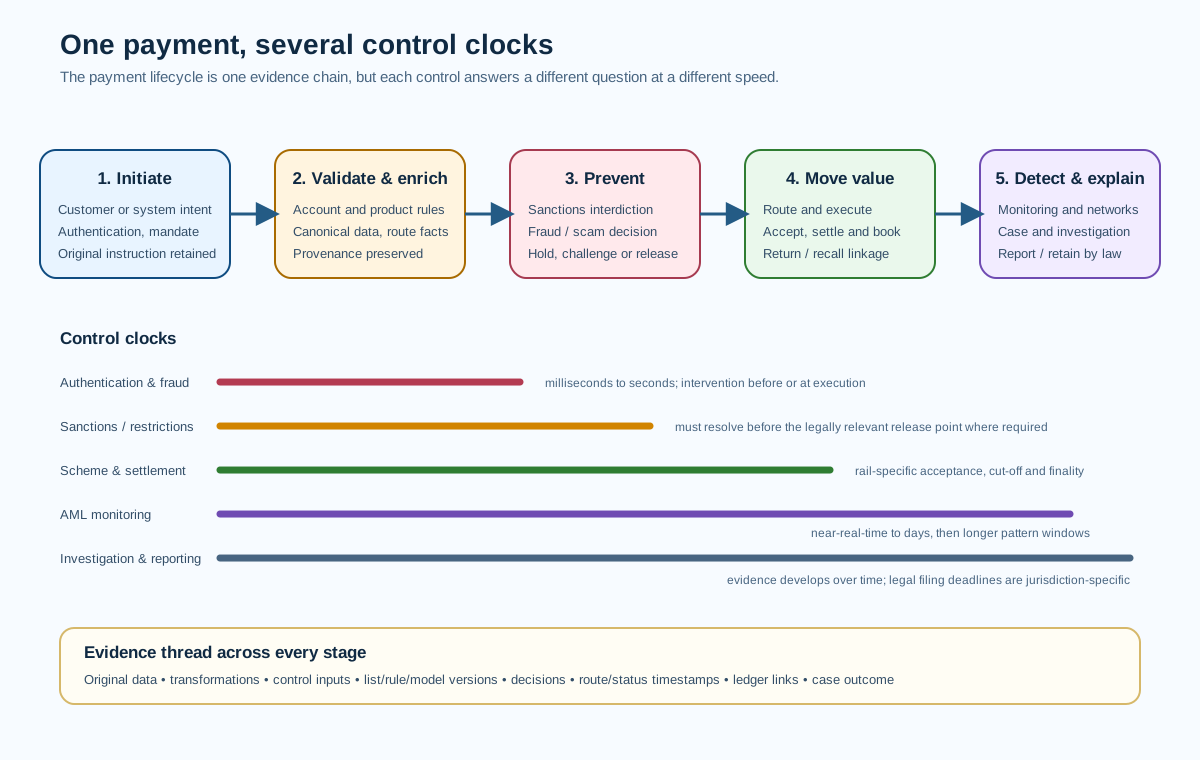
The simplest mental model: intent, data, decision, movement and evidence
A useful payment-control model has five layers.
The first layer is intent. Somebody wants value to move. That person may be a retail customer using a mobile app, a corporate employee uploading a payment file, a treasury system sending an API instruction, a bank employee acting under an operational mandate, another payment service provider, a merchant, a wallet user or an automated process. Before financial-crime controls can work, the bank needs to know which customer relationship, account, mandate and channel the instruction belongs to.
The second layer is data. The bank receives names, account identifiers, amount, currency, addresses, payment purpose, agent information, transaction references and other context. It may add customer risk information, legal-entity context, routing data, country codes, beneficiary-bank information, device signals and sanctions-list results. Every downstream control is limited by the quality of this data.
The third layer is decision. Different engines decide different things. An entitlement service asks whether the user is authorised. A fraud service asks whether the transaction looks unauthorised, manipulated or scam-related. A sanctions control asks whether applicable legal restrictions may prohibit or constrain the transaction. A transaction-monitoring system asks whether the behaviour is unusual or suspicious in context. An investigator asks whether the totality of evidence requires escalation, reporting or another customer or account action.
The fourth layer is movement. The payment is routed, accepted by a scheme or correspondent, executed, settled and booked. The meaning of “sent” or “completed” depends on the rail. A status that means “accepted by our payment hub” is not necessarily the same as “settled between institutions” or “credited to the beneficiary.”
The fifth layer is evidence. Later, the bank may need to prove what the customer submitted, what data each control saw, which list version or model version was used, who changed a field, which decision was made, when the payment was released, how it settled, whether it was returned, and what the investigator concluded. A payment that cannot be reconstructed is a control problem even if it processed correctly at the time.
The important discipline is to keep these layers distinct. A message-valid payment is not necessarily compliant. A fraud-approved payment is not necessarily free from AML concern. A sanctions alert is not a confirmed match. A monitoring alert is not automatically suspicion. A successful settlement does not erase the need for investigation, and a later suspicious report does not mean the original processor should have known everything that became visible only after the event.
A payment lifecycle is not identical across rails
Banks need a reusable control architecture, but they should resist the temptation to force every payment product into one technical sequence.
A retail instant payment can move from customer confirmation to settlement in seconds. There may be almost no time for manual review. Preventive controls must therefore be highly automated and operations must be available outside traditional business hours. A batch corporate payment may contain thousands of transactions, creating both file-level and transaction-level control questions. A correspondent payment may pass through several institutions, each with different visibility. An internal book transfer may settle entirely within one bank and never touch an external clearing system. A card purchase often travels through merchant and card-network data structures rather than a classic account-to-account credit-transfer message. A trade-finance payment can be linked to invoices, bills of lading, vessels, ports and goods that create a much richer risk context.
The control design should therefore begin with the actual rail and product lifecycle. The BA or architect should be able to draw the sequence from customer instruction to final accounting and identify where data is created, transformed, screened, held, enriched, sent externally, booked and monitored. That drawing should include exception paths, not only the happy path.
A common high-level sequence is:
initiate → authenticate and authorise → validate → enrich → screen and risk-assess → route → execute → settle and book → monitor → investigate → report or retain
Some banks screen before enrichment; some enrich key data first. Some fraud controls run before sanctions screening and some run in parallel. Some monitoring is near-real-time and some is post-event. The exact sequence is less important than three control principles: no required control is bypassed, material data changes trigger the right re-evaluation, and the audit trail allows later reconstruction.
What the bank should know about the payment
A payment instruction contains more than an amount and destination account. The exact available fields depend on the product and rail, but the bank should understand the categories of information that can support financial-crime controls.
Customer and account context identifies the relationship from which the payment originates or to which it is credited. This can include customer identifier, account identifier, customer type, risk rating, KYC status, expected activity, relationship country, products held, ownership links and restrictions.
Party data describes the debtor or originator, creditor or beneficiary, and where relevant ultimate debtor, ultimate creditor, initiating party, account owner or other connected parties. Names, postal addresses, dates of birth, organisation identifiers and other identifiers may improve identity resolution where they are legitimately available and required.
Agent data describes payment service providers in the chain: debtor agent, creditor agent and intermediary agents. In correspondent banking this can be essential to understand how the payment is routed and which institutions touch it.
Transaction data includes amount, currency, requested execution date, charge information, payment purpose, remittance information and transaction identifiers. Free-text narratives can add useful context but should not be treated as reliable proof of purpose merely because the customer entered them.
Channel and session data can include mobile, web, branch, host-to-host, API or file channel; device signals; authentication method; user or signer identity; IP and session information; and whether the beneficiary is new. These fields are particularly useful for fraud decisioning and investigation.
Routing and settlement data includes the selected scheme or correspondent route, clearing identifiers, intermediary institutions, settlement status and timestamps. A route change can be operationally significant because it may change the institutions or jurisdictions involved.
Control evidence includes screening request and response, list version, rules or scenario version, model score, fraud outcome, analyst decision, override reason, case reference and timestamps.
The exact fields should be derived from legal requirements, product design and risk assessment. Collecting unnecessary personal information “just in case” creates privacy and data-governance problems. The objective is not maximum data. It is sufficient, accurate, usable data with clear purpose and provenance.
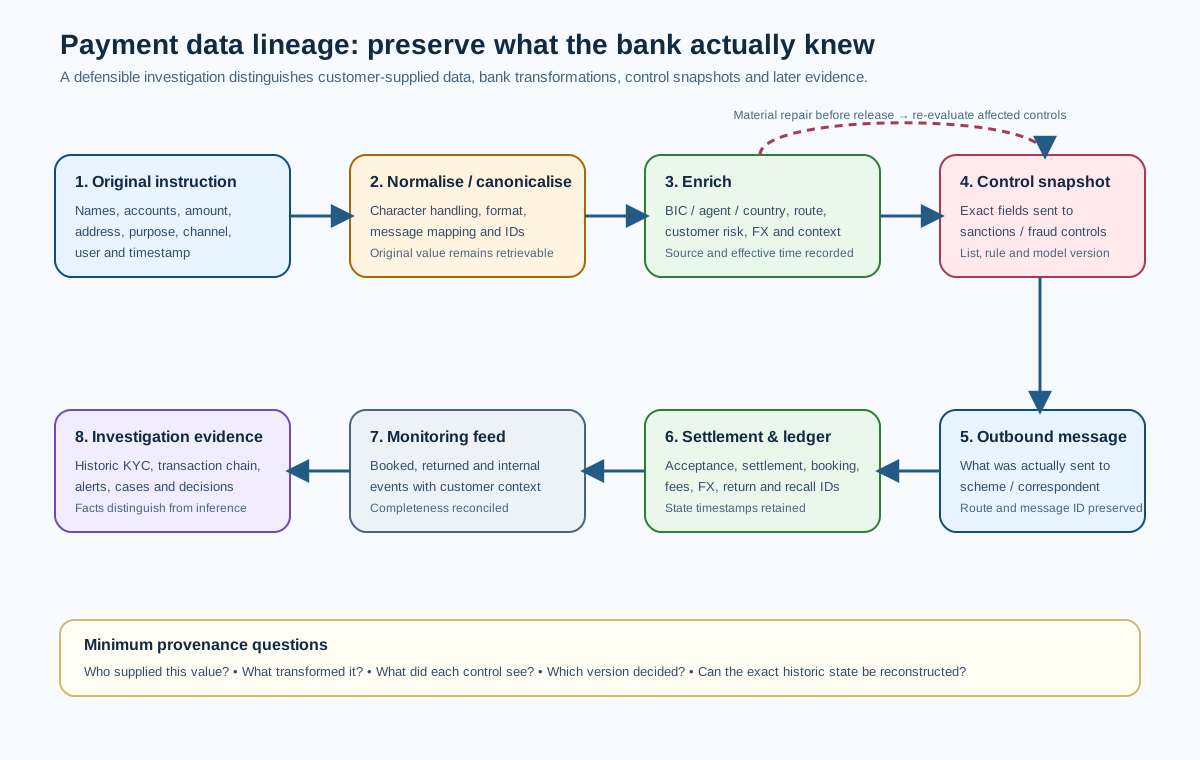
Original, normalised and enriched data must not be confused
Financial-crime systems frequently transform payment data. Names may be uppercased, accents removed, punctuation standardised or tokens rearranged for matching. Country information may be derived from an address or bank identifier. Account numbers may be validated and formatted. A bank may enrich a BIC with institution and country data. A payment hub may map a proprietary channel structure into an ISO 20022 canonical message.
These transformations can improve control performance, but they also create evidence risk. The bank should be able to distinguish at least three states:
- Original data — what the customer or upstream system actually submitted.
- Normalised data — a technically standardised representation used for matching or processing.
- Enriched data — information added by the bank or another source.
If those states are collapsed, an investigator may later be unable to tell whether a suspicious address was supplied by the customer or inferred by a system. A repair operator may unintentionally overwrite the original beneficiary name. A screening platform may receive a normalised value but the case tool may display a different rendering, making the analyst believe the payment was screened against data it never actually saw.
For architects, provenance should therefore be a first-class data concept. Important fields should have source system, effective time, transformation logic and, where relevant, confidence or verification status. For testers, end-to-end evidence should prove that the fields seen in the channel, payment hub, screening service, outbound message, ledger and case system correspond as intended.
Stage 1: initiation — who is asking the bank to move value?
The first control question is not “is the payment suspicious?” It is “what is this instruction, and who is entitled to create it?”
For a retail customer, initiation may be a mobile or web journey. The bank captures the beneficiary, amount, currency, reference and customer confirmation. For a corporate customer, the instruction may come through host-to-host SFTP, API, EBICS, SWIFT corporate connectivity, an uploaded file or a treasury-management platform. The person creating the instruction may not be the person approving it. For payroll or supplier batches, a file can contain many underlying payments.
The initiation layer should preserve enough context to reconstruct the instruction. That includes the original values, channel, user or system identity, timestamp, customer or corporate entity, source account and where relevant file or batch identifiers.
Corporate entitlement is particularly important because “the customer authenticated” may mean several different things. A corporate mandate can require maker-checker approval, dual signatures, signing groups, transaction limits, account-level authority or separate approval for high-value payments. A fraudster who compromises one user may still be unable to release a payment if entitlement controls are correctly designed. Conversely, poorly maintained corporate entitlements can allow a former employee or over-privileged service account to submit valid-looking instructions.
API and machine-to-machine initiation creates another challenge: the bank may authenticate a client application rather than a human user. The payment still needs a clear chain from API credential or certificate to customer, account, permitted scope and transaction. Service-account ownership, secret rotation, certificate expiry, rate controls and consent or mandate context become part of financial-crime evidence even though they are usually owned by security or channel teams.
Stage 2: authentication, consent and entitlement
Authentication is evidence about who is interacting with the bank. It is not evidence that the economic purpose of the payment is legitimate.
A customer may authenticate perfectly while being manipulated in an authorised push-payment scam. A corporate signer may approve a false invoice created after business-email compromise. A mobile session may pass strong authentication even though the criminal has socially engineered the customer into performing the steps.
That is why fraud controls need behavioural and contextual signals beyond credential success. Useful features can include beneficiary age, device change, recent password reset, login anomaly, payment amount relative to history, unusual time, beneficiary reputation, velocity, recent contact with the bank and scam intelligence. Different jurisdictions and schemes may provide beneficiary-name checking services or other confirmation mechanisms, but these tools should not be described as universal or infallible.
From a data perspective, the payment record should retain the authentication method, assurance result and approval chain where policy allows. From an investigation perspective, that evidence helps distinguish unauthorised account takeover from a customer-authorised scam. The distinction can affect customer protection, recovery processes, fraud reporting and the way the receiving account is investigated.
The key principle is simple: authentication establishes control of a credential or approved channel; it does not establish legitimacy of purpose.
Stage 3: product, account and policy validation
Payment engines usually perform business validation before release. The account must exist, the payment type must be permitted, the currency must be supported, the instruction must be complete, funds or credit must be available, and transaction limits or cut-offs must be respected.
Financial-crime restrictions must be integrated into this validation layer without being reduced to a generic “blocked account” flag. Different restrictions can have different legal and operational meanings. A sanctions freeze, fraud security block, AML monitoring restriction, law-enforcement order, deceased-customer status and ordinary credit restriction should not be treated as interchangeable.
A well-designed restriction service therefore carries reason, scope, effective period, authorised actions and source of authority. Some restrictions should prevent debits but permit incoming funds. Some may apply only to a specific product or counterparty. Some may require specialised handling rather than a customer-facing rejection message.
This is important for customer communication. If the true reason for an operational hold is legally sensitive, the channel must not expose internal AML or suspicious-reporting information. Generic payment-status language and escalation routes should be designed with legal and compliance input.
Stage 4: enrichment — improve the instruction without rewriting history
Enrichment turns a customer instruction into a processable payment. A bank may add BICs, clearing codes, country data, correspondent route, legal-entity context, FX information, charges, purpose codes, customer risk attributes or beneficiary-bank metadata.
Enrichment improves automation and can strengthen controls. A customer may supply only an account identifier while the bank derives the beneficiary institution. A payment hub may identify that a route involves an intermediary in a jurisdiction relevant to sanctions analysis. Customer master data can provide the debtor’s structured address for an outbound message.
But enrichment can also create control defects. Common failures include wrong country derivation, stale customer data, BIC-to-country mapping errors, truncation during format conversion, overwriting rather than supplementing the original value, or applying an enrichment rule designed for one payment rail to another.
A high-quality design records where critical enrichment came from and validates it before controls rely on it. An inferred country should not silently become equivalent to a customer-verified country. An operational repair should not alter the evidence of what was first received. If a field that affects screening or legal determination changes, the system should evaluate whether re-screening or another control needs to run again.
Payment transparency: why accompanying data matters
Payment transparency is the idea that enough meaningful originator, beneficiary and payment information should travel with the transfer so that institutions and competent authorities can understand who is sending and receiving value and can investigate misuse.
FATF Recommendation 16 is the main international standard-setting reference for payment transparency. FATF’s Recommendations were last updated in June 2026. The revised Recommendation 16 was agreed in June 2025, with implementation expected by the end of 2030. FATF's June 2026 implementation guidance was published for public consultation, which closed on 21 August 2026; at the date of this review the consultation material remains draft guidance rather than a new self-executing bank rule.
That distinction matters for a global bank. FATF standards shape national and regional requirements, but local law and regulation determine the binding obligation for a particular legal entity and payment. The EU, for example, has specific information requirements for transfers of funds and certain crypto-assets under Regulation (EU) 2023/1113, supported by final EBA travel-rule Guidelines. Those requirements should be applied as EU rules, not mislabelled as universal rules for every country.
For BAs and architects, Recommendation 16 is therefore a requirements source at the global-policy layer, not a substitute for jurisdiction mapping. A requirement such as “all payments below X need only these fields” is unsafe unless the relevant local implementation and payment type have been checked.
Roles across the payment chain
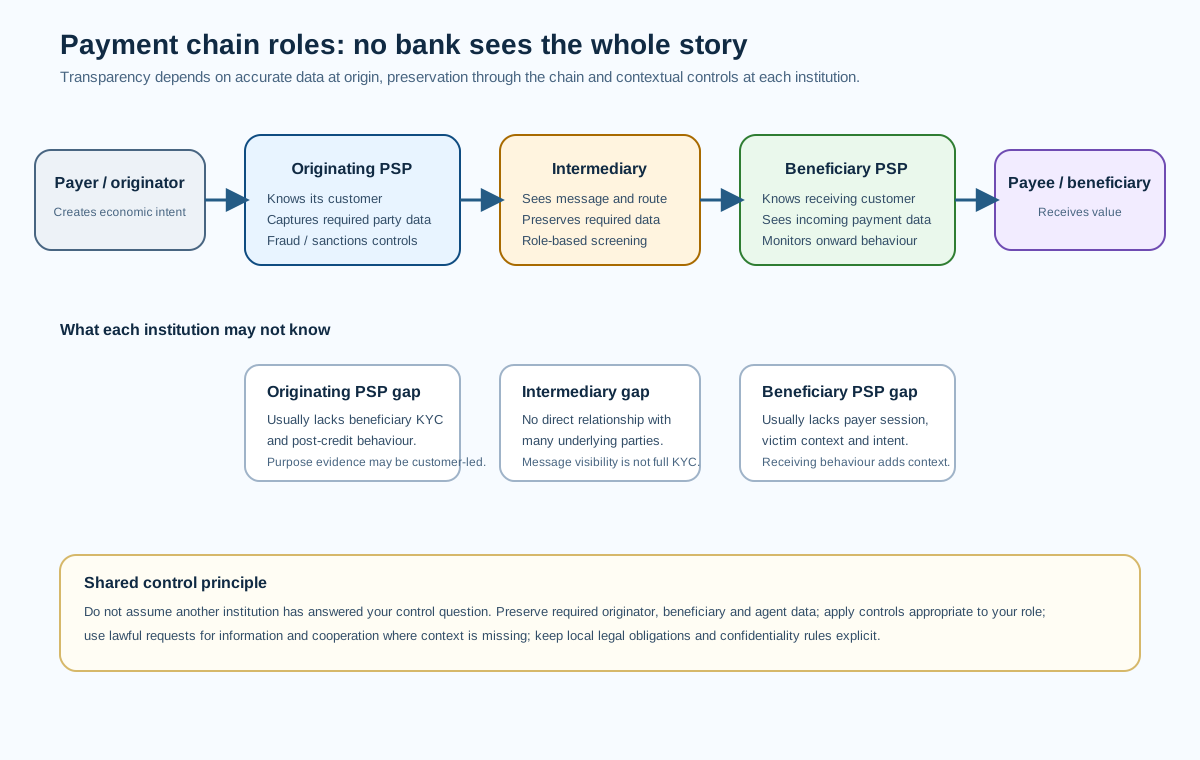
The Wolfsberg Group’s 2023 Payment Transparency Standards and its 2024 roles-and-responsibilities guidance are useful because they frame transparency around the actors in a payment chain rather than assuming every institution has the same information.
The debtor agent or originating PSP is closest to the payer or originator and generally has the strongest ability to collect and validate originator information, understand the customer and create a transparent payment instruction.
An intermediary agent may see only the payment message and the institutions immediately around it. It should preserve required information and apply the controls appropriate to its role, but it cannot be expected to possess the originator’s full KYC file merely because it participates in the chain.
The creditor agent or beneficiary PSP is closest to the receiving account and has information about its own customer. It can compare incoming payment data with the beneficiary relationship it holds and can monitor how received funds are used.
Payment market infrastructures and messaging services also influence transparency through schemas, validation rules and message standards, although they do not replace the compliance responsibilities of the PSPs using them.
The practical lesson is that visibility is asymmetric. An originating bank may understand the customer’s business purpose but not the beneficiary’s KYC. An intermediary may know the route but not the underlying commercial relationship. The beneficiary bank may see rapid onward movement but not the victim’s authentication session. Effective investigation often requires information sharing through lawful channels because no single participant owns the complete story.
ISO 20022 helps only when the data survives the journey
ISO 20022 provides a richer, structured data model than many legacy payment formats. It can represent debtor, creditor, ultimate parties, postal addresses, agents, purpose information, identifiers and remittance information in dedicated elements rather than forcing everything into short free-text fields.
That structure can improve screening, monitoring, reconciliation and investigation. A screening engine can distinguish town from country rather than parse a free-text line. An investigator can identify an ultimate debtor separately from the account-holding debtor. A payment hub can preserve a transaction identifier across several systems.
But ISO 20022 is not a data-quality cure. A structured field populated with the wrong value is still wrong. A channel that captures free text and converts it badly can still lose information. A translation from ISO 20022 into a legacy format can truncate party data. A bank can receive rich structured data and flatten it before sending it to a screening service.
The CPMI’s updated harmonised ISO 20022 data requirements, published on 26 February 2026, exist precisely because inconsistent market implementation can undermine interoperability and transparency. The harmonisation requirements are not themselves a global regulation; they are market-practice requirements intended to promote consistent cross-border implementation, with alignment encouraged by the end of 2027.
For project teams, message migration should therefore include financial-crime lineage testing. It is not enough to validate that the outbound pacs.008 passes schema validation. Tests should prove which debtor, creditor, ultimate-party, agent, address, purpose and identifier fields entered the channel, survived orchestration, reached screening, appeared in the outbound message, were stored for investigation and were available to monitoring.
Structured addresses: an immediate 2026 implementation issue
Address structure is a concrete example of how standards changes become financial-crime delivery work.
As of 14 September 2026, Swift’s CBPR+ transition still allows fully structured, hybrid and unstructured postal addresses, but that changes on 14 November 2026. From that date, town and country must be provided in designated fields at a minimum for relevant parties and agents in CBPR+ payment messages, subject to the documented message exceptions and the option to identify agents using BIC. Swift states that CBPR+ instructions containing fully unstructured addresses will fail network validation and be NAK'ed after the transition date rather than proceeding as valid CBPR+ instructions.
The financial-crime benefit is better machine-readable identification and screening. The delivery implication is broader than a message-mapping change. Retail and corporate channels must capture suitable data. Customer master records may need remediation. Corporate file specifications may need updating. Payment hubs must preserve structured or hybrid data. Screening interfaces must consume the right fields. Test data must include international addresses, missing town or country, non-Latin scripts, corporate channels and legacy records.
The date is especially important for analysts because it is still in the future at the time of this chapter’s review. Requirements should say “from 14 November 2026” rather than describe the change as already fully in force.
Stage 5: sanctions screening — detection is not legal disposition
Payment sanctions screening is usually a preventive control intended to identify data that may correspond to a sanctioned or otherwise restricted person, entity, vessel, institution, geography or activity before the bank releases the payment where applicable law or policy requires intervention.
The fields screened depend on the payment type, sanctions regimes, data availability and bank policy. Common candidates include debtor and creditor names, ultimate parties, agent names, addresses, bank identifiers, remittance text, vessel or aircraft identifiers in relevant trade flows, and other risk-relevant elements.
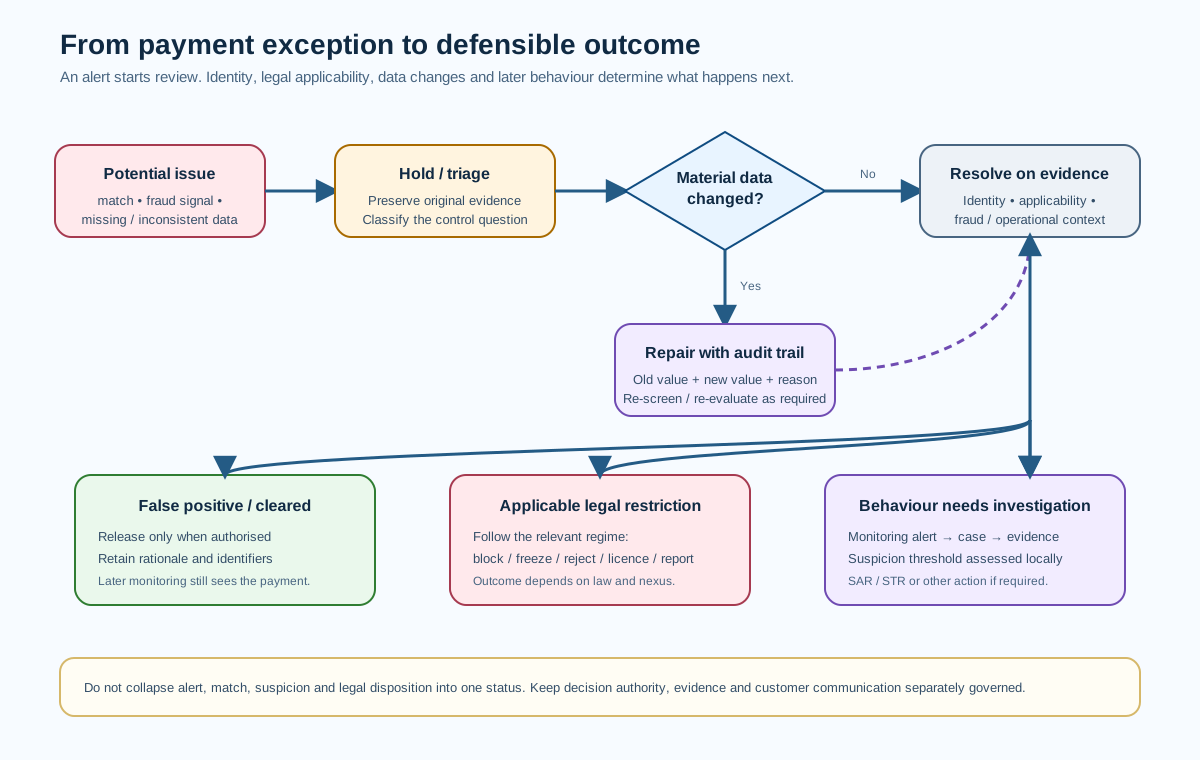
A screening engine performs matching. It does not by itself determine every legal consequence. The lifecycle should distinguish:
Potential match — the screening logic found similarity or another trigger requiring review.
Identity resolution — the analyst or automated process determines whether the payment party is actually the listed or restricted person or entity, using available identifiers and evidence.
Legal applicability — the bank determines whether the relevant sanctions regime applies to the legal entity, currency, transaction, parties, route or activity.
Disposition — the bank decides the operational action: release, reject, block or freeze, return where permitted, seek a licence, report, or another outcome dictated by the applicable framework.
Those stages should not be compressed into one sanctioned=true flag. Ownership and control rules differ across sanctions regimes. Sectoral or activity-based restrictions can apply even when no party is on a blocking list. Conversely, a close name similarity can be a false positive.
The payment platform should store enough evidence to show what was screened, which list and rule versions were used, what the analyst saw, the decision reached and who authorised release where manual intervention occurred.
The consequences of screening latency
Preventive screening must fit the payment’s control clock. A screening service that takes thirty seconds may be acceptable for a conventional cross-border payment but incompatible with a rail expecting end-to-end processing in a few seconds. The response should not be to bypass screening. The control architecture must be redesigned for the rail’s speed.
Options can include highly available screening services, precomputed customer screening, optimised matching, automated disposition for clearly false or low-risk matches under controlled rules, queue prioritisation, 24/7 specialist escalation, and graceful fail-safe behaviour.
Fail-open and fail-closed decisions require explicit governance. A bank should know what happens if a sanctions engine is unavailable: are payments queued, rejected, routed to contingency, limited by product, or processed under a formally approved fallback? The answer may differ by legal entity, product and risk. A system should never silently “continue because screening timed out.”
Operational MI should therefore include screening availability, latency, queue age, timeout rate, manual intervention rate, unresolved cases and the number of payments processed under contingency.
Stage 6: fraud decisioning — a different question with different evidence
Fraud controls ask whether the instruction may be unauthorised, manipulated or scam-induced, and whether customer intervention or transaction blocking is needed. They often operate at the same point in the lifecycle as sanctions screening but use different evidence.
A typical fraud model may combine customer behaviour, beneficiary history, device risk, authentication changes, payment velocity, value, time, geolocation, session events and known scam patterns. A fraud engine may approve, decline, challenge, hold or refer a payment.
The AML significance often appears at the receiving side. A victim’s outbound payment may be genuine from an authentication perspective but directed to a mule account. The receiving bank may observe multiple unrelated credits followed by rapid onward transfers or cash withdrawals. Fraud and AML teams should therefore share appropriate intelligence and case links rather than treating fraud as finished once the victim is reimbursed or the recall is attempted.
A fraud alert should not automatically become an AML suspicion, but repeated mule indicators, scam proceeds and network relationships may create a strong basis for investigation.
Preventive controls and post-event controls must be connected
Banks sometimes design preventive controls and monitoring as separate technology estates. That organisational separation can hide important relationships.
Preventive controls include authentication, entitlement, account restrictions, sanctions screening, certain fraud decisions and payment validation. They operate before release or at a defined real-time point because delay after execution may make the control ineffective.
Post-event controls include transaction monitoring, network analytics, behavioural models, periodic customer review and investigations. They can aggregate activity across time and products and therefore detect patterns that no single payment can show.
The two sides need feedback. A fraud-confirmed beneficiary may become a high-risk monitoring feature. A sanctions investigation may reveal an alias useful to customer screening. A monitoring case may identify a network of receiving accounts that fraud prevention should recognise in real time. A customer review may update expected activity used by monitoring.
The architecture should therefore have controlled feedback mechanisms rather than ad hoc spreadsheets or analyst memory.
Stage 7: routing — the path changes the risk context
After core validations and preventive decisions, the bank selects a route. The route may be an internal book transfer, domestic clearing, instant-payment system, correspondent chain, card network, wallet rail or another payment infrastructure.
Routing can change which legal entities, currencies, jurisdictions and intermediaries are involved. A route should therefore be part of the financial-crime context, not merely a technical field.
For example, a payment may originally be eligible for direct clearing but be rerouted through a correspondent because of outage or liquidity constraints. If the route introduces a new intermediary or jurisdiction relevant to sanctions analysis, the control design should determine whether the existing screening decision remains sufficient. Conversely, banks should avoid unnecessary duplicate screening that creates operational noise without additional risk value.
Routing logic should be versioned and auditable. An investigator should be able to see the route actually used, not only the route that would be selected today under current configuration.
Correspondent banking and limited visibility
Correspondent payments illustrate why payment transparency matters. The originating bank has the customer relationship and may understand the commercial purpose. An intermediary bank may see the payment message but have no direct relationship with the originator or beneficiary. The beneficiary bank knows its receiving customer and can observe what happens after the credit.
No participant should assume another institution has solved every financial-crime question. Each applies controls appropriate to its role and information.
This becomes especially important in nested or downstream relationships, where one bank provides access to another institution that in turn serves underlying institutions or customers. Correspondent due diligence, payment transparency and monitoring need to work together. A payment message can be technically complete while the correspondent relationship still carries elevated risk because of the respondent’s customer base, corridors or downstream model.
Requests for information can fill gaps after the fact, but an RFI process should not be used as a substitute for required payment data that should have accompanied the transfer in the first place.
Stage 8: execution, acceptance and settlement
“Payment sent” is ambiguous.
A payment can be accepted by the customer channel, accepted by the bank’s payment hub, released to an external rail, accepted by the clearing system, settled between institutions and finally credited to the beneficiary. Those are different states.
Financial-crime teams need to know which states are reversible and which are effectively final under the relevant scheme and law. There is no universal point of no return. Instant-payment rails can reach finality very quickly. Batch systems may allow rejection before a later settlement cycle. Correspondent payments may support recalls but without guaranteed recovery. Card transactions have their own authorisation, clearing and chargeback lifecycle.
The system should therefore use explicit statuses and timestamps. Customer-facing wording should align with the real state. Investigators should be able to distinguish a payment stopped before external release from one returned after settlement.
This matters when measuring control effectiveness. A “sanctions stop” before release is different from a post-settlement recall. A fraud payment prevented before execution is different from money recovered after it reached the beneficiary.
Stage 9: booking and accounting evidence
Settlement between institutions and booking on the customer ledger are related but not always simultaneous.
The bank’s ledger should preserve the economic effect of the payment: debit or credit, fees, FX, reversals, returns and adjustments. Financial-crime investigators often need to reconcile payment-system events with ledger entries because a customer can see a booking state that does not map one-to-one to a message state.
Useful links include original payment ID, ledger transaction ID, settlement reference, return reference, fee entries, FX trade or rate where relevant and case references.
Weak linkage creates familiar operational problems: investigators search by exact amount because IDs are missing, multiple same-value payments are confused, returns appear as unrelated credits, and case narratives contain screenshots instead of structured transaction evidence.
A good design treats reconciliation data as investigation data as well as finance data.
Returns, rejects and recalls are part of the same story
A rejected payment never completes the intended movement. A returned payment may have progressed further before being sent back. A recall is a request to recover a payment after release and may or may not succeed depending on the rail and receiving institution.
Those events can carry financial-crime meaning.
A repeated pattern of rejected beneficiary details may indicate poor data quality or attempted misuse. A receiving bank’s fraud-related return can become intelligence for the originating bank. A recall after an APP scam can identify the receiving account for AML review. A sanctions rejection can create a reporting or customer-handling obligation depending on the applicable regime.
The original and subsequent events should remain linked. Monitoring should not count a returned payment as independent legitimate income without recognising its relationship to the original debit. Case systems should display the full event chain.
Instant payments compress the control clock
Instant payments are not inherently more criminal, but their speed reduces the bank’s reaction time. Funds can move through multiple accounts before a traditional batch-monitoring process creates an alert.
The control response should be risk-based rather than simply “hold every instant payment.” Excessive friction can undermine the product and create customer harm. Banks typically combine real-time authentication and fraud controls, sanctions screening appropriate to the applicable legal framework, transaction limits, behavioural features, beneficiary intelligence and post-event monitoring.
Operational readiness is equally important. A rail available 24/7/365 needs a financial-crime operating model that understands what happens at 03:00 on Sunday when a high-confidence sanctions potential match or severe fraud risk occurs. Escalation and contingency cannot depend on staff who are available only during office hours.
Real-time AML models can be useful for a small set of severe behaviours, but not every AML question is suitable for pre-transaction blocking. Some suspicion depends on patterns over time, and holding every transaction that contributes to a future pattern would be disproportionate.
Batch and bulk payments create two levels of control
Corporate payroll, supplier files and treasury batches can contain hundreds or thousands of transactions. The bank needs both file-level and transaction-level lineage.
A file can fail because of schema, signature or authorisation problems even if the individual payments are valid. One transaction can create a sanctions or fraud concern without necessarily invalidating the entire file. The operating model should define whether the bank holds one item, a subset or the whole batch under each scenario.
Identifiers must connect the batch, individual instruction and downstream payment. Repair should be controlled at the correct level. Changing one beneficiary must not silently rewrite another transaction or invalidate the evidence of the original file.
Performance testing also matters. A screening service that handles single payments well may fail under a large corporate file, causing backlog or timeouts. Capacity tests should include realistic batch sizes and peak submission windows.
Instant, batch and correspondent rails create very different intervention windows. Triage should follow the point at which effective action is still possible under the actual payment rail, applicable legal framework and operating model, rather than a generic queue order or assumed universal recall period.
Internal book transfers are still financial transactions
An internal transfer may never leave the bank, but it can still move illicit value between customers, companies or accounts.
Internal transfers should therefore be considered in sanctions, fraud and AML design according to the applicable legal obligations and risk. They may have richer customer context because both accounts are held by the same institution, which can be an advantage for network analysis.
The common failure is to exclude internal movements from monitoring because “no external payment message exists.” That creates a blind spot. Another failure is to assume internal transfers are always reversible; customer impact and accounting finality can still be significant.
Trade-related payments add goods and logistics context
A payment for goods may be ordinary from a pure account-to-account perspective but significant when combined with trade information.
Relevant information can include invoice, purchase order, goods description, quantity, price, ports, vessel, freight forwarder, origin and destination, end user and trade-finance instrument. Sanctions and proliferation risk may depend on goods, end use or shipping route even when every named payment party appears clear.
Banks have different visibility. A trade-finance bank examining documentary credit materials may have far richer goods information than a bank processing an ordinary customer credit transfer with only a short remittance narrative. Requirements should therefore be based on the product and data the institution actually possesses, not an assumption that every payment contains a bill of lading.
Where trade and payment systems are separate, case tooling should allow investigators to link the financial transaction to the trade record.
Stage 10: post-transaction monitoring
Transaction monitoring asks a different question from payment screening: does the customer’s behaviour, considered over time and context, indicate suspicious activity or another risk that merits review?
Relevant patterns can include rapid pass-through activity, structuring, circular movement, unexpected counterparties, sharp changes in corridor, cash-to-wire behaviour, mule networks, repeated fraud proceeds, unusual merchant or wallet activity, trade anomalies or activity inconsistent with the known business model.
Monitoring works best when it combines transaction facts with customer context. A EUR 100,000 transfer can be ordinary for a multinational treasury account and extraordinary for a low-income personal account. A new high-risk corridor may be expected for a company that has documented a new subsidiary but inconsistent for a customer whose profile is stale.
Scenario design should therefore specify data dependencies. If a rule compares activity with expected turnover, testers should prove the turnover field is populated, current and mapped to the correct customer. A mathematically correct rule running on incomplete data is still an ineffective control.
Network analytics reveals what one payment cannot
Criminal activity often spreads across several accounts or institutions. One incoming payment may look ordinary, but ten apparently unrelated customers sending to the same beneficiary, device, address or wallet can reveal a network.
Graph and network analytics can connect customers, accounts, beneficial owners, devices, phone numbers, addresses, counterparties, merchants and transaction flows. The value comes from relationships, but relationship quality is critical.
Under-linking can miss a network because the same person exists in duplicate customer records. Over-linking can falsely connect innocent customers because they share a common address, employer or device. Entity-resolution rules need evidence, confidence and human interpretation.
For investigators, network visualisation is most useful when every edge can be traced back to source evidence. A beautiful graph without explainable relationships is not defensible.
Alert, case, suspicion and report are different states
A monitoring alert is a machine or rule-generated reason for review. It is not a legal conclusion.
Triage determines whether the alert warrants deeper investigation. A case can combine several alerts, transactions, customers or intelligence sources. Investigation evaluates the available evidence, customer profile, transaction history, counterparties, explanations and related information. Only then may the bank reach a suspicion threshold or another reportable conclusion under applicable local law.
A suspicious activity report or suspicious transaction report is therefore not the automatic output of an alert. Reporting thresholds, filing formats, deadlines, confidentiality and tipping-off restrictions differ by jurisdiction.
Sanctions reporting is also separate. A blocked or frozen transaction may trigger a report to the relevant sanctions authority without being an AML SAR/STR. A fraud report may follow yet another route. The case system should support multiple outcomes from one payment while keeping legal authorities and confidentiality controls distinct.
Stage 11: investigation — reconstruct the payment as it happened
A strong investigator should be able to answer the following without opening six unrelated systems and manually reconciling screenshots:
- Who was the customer and what did the bank know about them at the time?
- Who initiated and approved the payment?
- What exact data did the customer submit?
- Which fields were normalised or enriched?
- Which parties and agents were screened?
- Which list, rule and model versions were active?
- What fraud and sanctions decisions occurred?
- Which route and intermediaries were used?
- When did the payment leave the bank, settle and book?
- Was it returned, rejected, recalled or amended?
- What happened before and after the transaction?
- Are there related customers, accounts, devices or counterparties?
- Did the customer provide an explanation, and is it supported by evidence?
- Are there previous alerts, cases or regulatory reports?
The evidence should be time-consistent. Investigators should not see only the customer’s current address or risk rating if the question concerns a payment six months ago. Historical KYC, ownership and restriction data may be necessary to reconstruct the decision context.
Case notes should distinguish fact, source, inference and decision. “Beneficiary is criminal” is not acceptable merely because a monitoring rule triggered. “Beneficiary account received nine unrelated credits within two hours and transferred 93% of the value onward to two newly observed accounts” is an observable fact that can support analysis.
Payment repair is a financial-crime control point
Repair queues exist because payment data can be incomplete, invalid or inconsistent. Human intervention makes them operationally sensitive.
A repair process should preserve the original value, changed value, user, timestamp, reason and approval where required. If the changed field was part of screening or another control, the payment should be re-evaluated according to policy before release.
A classic defect is screen first, repair later, release without re-screening. If an operator corrects the beneficiary name after screening, the result no longer proves that the actual outbound name was assessed. Another defect is the opposite: a harmless formatting repair triggers repeated screening and duplicate alerts because systems cannot distinguish technical normalisation from material change.
Requirements should therefore define which fields are control-relevant and what constitutes a material change.
Manual overrides need authority, evidence and monitoring
Manual release can be necessary. The danger is allowing operational urgency to override control integrity.
A well-governed override has a defined role, reason code, supporting evidence, segregation of duties where appropriate, immutable audit trail and post-event quality review for higher-risk cases. The interface should show the information needed for the decision and prevent a user from releasing a payment they are not authorised to resolve.
Override MI is a valuable control indicator. A sudden increase may indicate poor screening tuning, a broken upstream mapping, staffing pressure or a culture problem. Low override volume is not automatically good either; staff may be rejecting legitimate payments because the process is too difficult.
Outages and degraded modes are part of the control design
Financial-crime controls depend on technology that can fail. Screening services can become unavailable, list updates can be delayed, customer-risk APIs can time out, monitoring feeds can miss a file and case platforms can suffer outages.
A resilient bank defines degraded-mode behaviour in advance.
Questions include:
- Can payments queue safely until the control recovers?
- Which products or legal entities can continue under an approved contingency?
- What transaction limits apply?
- Is there a manual fallback and can it scale?
- How are missed transactions identified and retrospectively screened or monitored?
- Who declares the contingency and who ends it?
- How is customer communication handled?
- What evidence proves the backlog was fully recovered?
A “temporary workaround” can become a material control breach if the bank cannot identify which transactions bypassed normal processing.
Resilience testing should therefore include financial-crime dependencies, not only payment-engine recovery.
Data lineage is a regulatory and operational control
A modern bank may pass one payment through a channel, API gateway, payment hub, enrichment service, screening engine, fraud platform, routing engine, scheme adapter, ledger, data lake, monitoring platform and case-management system.
Each hop can change the data. The control objective is to know what changed, why, and whether the downstream control still received the information the policy assumed.
Important lineage evidence includes source-to-target mappings, transformation rules, mandatory/optional handling, truncation behaviour, character-set conversion, default values, null handling, country derivation, identifier mapping and effective version.
For ISO 20022 migrations, this is especially important when legacy channels remain. A bank can advertise a rich ISO 20022 outbound message while still sourcing a debtor address from a thirty-character legacy field. The schema may be modern while the control evidence is not.
BAs should treat financial-crime data elements as critical data with explicit ownership. Architects should design observable interfaces. Testers should compare values end to end, not only verify that APIs return HTTP 200.
Roles and governance across the lifecycle
No single team owns every financial-crime decision in payments.
Product and business owners define the payment proposition, customer segment, channels and acceptable use. They own the process in which controls operate.
Payment operations manage exceptions, repairs, returns, recalls, routing issues and service-level decisions.
Fraud teams focus on unauthorised activity, scams, account takeover, mule intelligence and customer protection.
Sanctions compliance and interdiction teams interpret sanctions requirements, resolve potential matches and govern release, rejection, blocking or freezing decisions.
AML transaction-monitoring and investigation teams analyse behaviour, alerts, cases and suspicious reporting.
KYC and customer-risk teams provide the profile against which payment behaviour is understood.
Legal and regulatory compliance interpret jurisdiction-specific obligations, confidentiality and regulatory change.
Technology and architecture implement data flows, controls, resilience, access and auditability.
Business analysts and product owners translate policy and operational needs into testable requirements and make cross-system dependencies visible.
Testing and quality assurance prove that controls work not only in ideal conditions but with missing data, exceptions, timeouts, repairs and migrations.
Internal audit and independent assurance challenge design and operating effectiveness.
Governance should specify decision rights. Who can release an unresolved sanctions alert? Who can change a monitoring threshold? Who can approve a degraded mode? Who decides whether a customer-facing message can disclose the reason for a hold? Ambiguity in these decisions is itself a risk.
A BA requirement should describe evidence, not just a control name
Weak requirement:
The system shall perform sanctions screening.
This leaves almost every important decision undefined.
A stronger requirement identifies trigger, data, timing, outcome and evidence:
Before an outbound external payment is released, the payment orchestration service shall submit the configured debtor, creditor, ultimate-party, agent and other sanctions-relevant fields for the processing legal entity to the approved screening service; retain the screening request, response, rule and list version; prevent release while a configured unresolved potential match remains open; and trigger re-screening when a material screened field is changed before release.
Even that requirement needs jurisdiction and product configuration. The value is that it can be tested.
The same method applies to monitoring:
All successfully booked and externally returned transactions for product X shall be delivered to the AML monitoring platform with customer ID, account ID, original payment ID, transaction type, amount, currency, counterparty, route, posting time and configured customer-risk attributes; completeness shall be reconciled daily against the source ledger and any variance above the approved tolerance shall generate an operational incident.
That requirement links detection to data completeness rather than assuming “monitoring receives everything.”
Architecture questions that expose hidden gaps
When reviewing a payment design, architects and BAs should ask:
Where is the system of record for the original instruction? Which service decides the processing legal entity? Which party fields are screened? Which fields can be repaired after screening? What triggers re-screening? What happens on a timeout? Which route is selected and can it change after screening? Does the screening engine receive ultimate parties? How are structured addresses mapped? Does the monitoring platform receive internal transfers, rejects and returns? Can the case system retrieve the outbound message as sent? Are customer restrictions centralised or channel-specific? Can an investigator link a recall to the original payment? Are list, rule and model versions retained? Can historic customer and ownership data be reconstructed?
These questions often reveal that financial-crime control is not missing from the architecture diagram; it is missing between the boxes.
Testing the lifecycle end to end
Unit tests prove components. Financial-crime assurance needs end-to-end scenarios because the most damaging defects occur at interfaces.
A strong test pack should include at least:
Clean happy-path payment. Correct data reaches all controls, payment settles, ledger posts and monitoring receives the event.
Potential sanctions match. Payment is held, correct evidence appears in the interdiction case, release is prevented until authorised disposition and the final decision is retained.
Confirmed restricted-party scenario. The operational outcome follows the applicable test configuration without assuming one universal global action.
False positive. Analyst resolves the match using available identifiers; payment resumes; decision evidence is retained.
Material repair. Beneficiary or other screened data is changed and re-screening occurs before release.
Non-material formatting repair. The process avoids unnecessary duplicate escalation where policy permits.
Fraud hold. Customer-authenticated payment is referred based on behavioural risk and the receiving-account intelligence can be passed to AML where appropriate.
Instant payment. Latency, timeout and 24/7 escalation meet the rail’s service model.
Batch file. One high-risk transaction can be isolated according to policy without corrupting the rest of the file; file and transaction IDs remain linked.
Route change. A payment rerouted through a different intermediary receives any required re-evaluation.
Internal book transfer. The transaction reaches required controls even without an external scheme message.
Return and recall. Subsequent events remain linked to the original payment and reach monitoring correctly.
Missing data. Required party or address fields fail safely and produce the correct repair or rejection path.
Structured-address migration. Fully structured and hybrid data are handled correctly; future CBPR+ validation for 14 November 2026 is tested separately from current-state behaviour.
Screening outage. Approved degraded-mode behaviour occurs and recovery identifies every affected payment.
Monitoring-feed failure. Reconciliation identifies missing events and replay does not create uncontrolled duplicates.
Historic reconstruction. Investigators can retrieve the state, data and decisions applicable at the time of the payment.
Testing should also include negative permissions: an unauthorised operator cannot release, alter list configuration, change a case outcome or view protected investigation data.
Common lifecycle failure modes
The control exists but the route bypasses it. A new payment product is added to the hub but not to the screening or monitoring integration.
The message is rich but the control feed is poor. ISO 20022 carries structured parties, but the screening adapter still receives a truncated legacy string.
The payment is repaired after screening. Material party data changes without re-screening.
The legal entity is wrong. The system applies sanctions rules for the group generally rather than the entity actually processing the transaction.
The original instruction is lost. Only the enriched or repaired value remains, making later evidence unreliable.
Returns are treated as new income. Monitoring loses linkage to the original payment.
Internal transfers are excluded. Criminal value can move inside the bank without entering the external payment feed.
A monitoring alert is treated as proof. Analyst language jumps from pattern to allegation without evidence.
A sanctions potential match is treated as a true match. Customer harm and legal error follow poor identity resolution.
Fraud and AML intelligence are siloed. Victim protection succeeds but receiving mule networks are not investigated.
24/7 payments rely on office-hours escalation. A severe alert becomes an operational incident every weekend.
Contingency has no recovery proof. The bank restarts processing but cannot identify which transactions were missed.
A future standard is described as current law. Project teams implement or communicate the wrong requirement date.
Mini case study: one supplier payment, four control clocks
Consider a corporate customer, Northshore Components Ltd, which manufactures industrial equipment. Its KYC profile shows regular supplier payments in EUR and USD to established counterparties in Western Europe and East Asia. The company uses host-to-host file submission with two corporate signers.
At 09:01, Northshore submits a EUR 186,400 payment to a new supplier. The file passes technical validation. The maker and checker are both authorised. Authentication and entitlement are therefore clean.
At 09:01:02, the payment hub enriches the beneficiary bank identifier and maps the customer’s supplier address into structured fields. The supplier name is similar to a name on a sanctions list, producing a potential match. The sanctions clock now matters: the payment cannot be released under the bank’s configured control while the match is unresolved.
The interdiction analyst compares the list record with the payment data. The listed entity is in a different country and has different registration details. The initial match appears false. However, the payment’s free-text remittance refers to “control modules” and the newly enriched beneficiary-bank route passes through an intermediary not previously used by Northshore. Neither fact proves a sanctions or proliferation issue.
The analyst resolves the name match as a false positive under the bank’s procedures. The payment is technically eligible for release. Before release, however, the fraud engine also notes that the beneficiary is new and the amount is larger than Northshore’s typical new-supplier payment. The customer’s corporate signing pattern is normal, and no device or credential anomaly is present. The fraud model scores the payment below the intervention threshold.
At 09:03, the payment is released and enters the correspondent chain. The scheme and settlement clock has now overtaken the preventive-control clock. The payment settles later that morning and the customer account is booked.
Nothing in this story yet establishes suspicious activity. A common error would be to claim that the bank “missed” a crime because the payment was allowed. Preventive controls only had the evidence available at the time.
Two days later, transaction monitoring detects that Northshore has sent three more payments to different newly added suppliers, all with similar values and all routed through the same beneficiary-bank group. The activity is materially different from the company’s historical pattern. A monitoring alert is generated.
The AML investigator reconstructs the payments. Customer records show that Northshore recently changed its procurement director. Open-source and customer-supplied information show a legitimate expansion programme, but invoices for the new suppliers contain inconsistent addresses. The investigator requests additional information through the relationship team under approved procedures.
Northshore provides contracts and invoices. Two can be independently corroborated; two cannot. The investigator also sees that the counterparties share an address and that the receiving accounts moved much of the value onward rapidly. That new network evidence was not visible to the originating bank at 09:01 on the first payment.
The case is escalated. Compliance evaluates whether the facts meet the local suspicious-reporting threshold. Separately, the sanctions team checks whether the new ownership and routing information changes any sanctions analysis. The bank may restrict further payments while the case is reviewed if policy and law permit, but it should not tell the customer that a suspicious report is being considered.
This case demonstrates the lifecycle:
- Entitlement answered whether authorised corporate users created the instruction.
- Sanctions screening answered whether a potential listed-party match required interdiction.
- Fraud decisioning assessed immediate manipulation or transaction risk.
- Payment processing moved and settled the value.
- Monitoring detected a pattern that did not exist at the first-payment decision point.
- Investigation combined KYC, payment, network and external evidence.
- Reporting, restriction and customer handling were governed by local law and policy.
The lesson is not that one control failed. The lesson is that different controls see different truths at different times, and the bank needs data lineage to connect them.
Designing customer communication without compromising investigations
Payment holds and rejections create immediate customer pressure. Customers reasonably want to know why their money has not moved.
The bank should use customer-facing status language that is accurate but does not expose protected investigation information. “Your payment is under review” may be appropriate in some circumstances; in others, legal or sanctions requirements may permit or require different wording. The design should be approved for the jurisdiction and product rather than invented by an operations user during an incident.
Tipping-off restrictions are especially important around suspicious reporting. Staff should understand the difference between asking a customer for ordinary payment information and revealing that an AML investigation or report exists.
Customer communication also affects complaint risk. Repeated unexplained delays caused by false positives can create real harm. Control tuning, data quality and service-level design are therefore customer-outcome issues as well as compliance issues.
Privacy and financial-crime purpose must be balanced
Payment controls process sensitive identity, transaction and behavioural information. More data can improve detection, but uncontrolled collection and sharing can violate privacy, secrecy or data-localisation rules.
Global banks need a lawful model for cross-border information sharing. A group monitoring platform may need data from several legal entities, but local restrictions can affect which fields may leave a country, who may view them and how long they may be retained.
The design response is not to choose between privacy and financial crime as though one cancels the other. It is to identify legal bases, minimise unnecessary data, apply access control, preserve purpose limitation, encrypt sensitive information, log use and define retention.
Investigators should receive the data needed for their role, not unrestricted access to every customer attribute in the bank.
Record retention and historical reconstruction
Financial-crime investigations can begin long after a payment was processed. The bank may receive a law-enforcement request, regulatory inquiry or internal lookback months or years later.
Retention periods differ by jurisdiction and record type, so the course should not invent one global number. The practical requirement is that the bank identify applicable retention obligations and ensure migrations do not destroy accessibility.
Historical evidence may need to include original payment messages, customer instruction, KYC state, ownership, screening outcome, list version, analyst notes, approvals, route, ledger posting, return or recall, case decisions and relevant communications.
Archive format matters. Saving a screenshot of a payment is not equivalent to preserving structured data and metadata. A screenshot may help a reviewer, but it is difficult to search, reconcile and reprocess in a lookback.
Practical checklist for analysts and delivery teams
Before signing off a payment change, confirm that the team can answer these questions:
- Which payment products, rails, legal entities and customer types are in scope?
- Where is the original instruction retained?
- Which customer, party, account, agent, address, purpose and identifier fields are available?
- Which fields are original, normalised or enriched?
- Which preventive controls run, and at what point?
- What happens when screening or fraud services time out?
- Which changes after screening require re-evaluation?
- What payment state does each customer-facing status actually mean?
- Which route and intermediary information is retained?
- Can returns, rejects and recalls be linked to the original payment?
- Does monitoring receive every in-scope transaction type, including internal and returned activity where required?
- How is feed completeness reconciled?
- Can investigators retrieve historical KYC and control evidence?
- Are local reporting and confidentiality obligations mapped?
- Are future standards changes represented with correct effective dates?
- Are operational overrides and contingencies testable and auditable?
- Do non-functional tests cover latency, peak batch volumes and 24/7 recovery?
- Can the bank prove the lifecycle with one end-to-end evidence pack?
If any answer depends on “operations will know” or “we can find it in logs later,” the requirement is probably not finished.
Final takeaway
Financial-crime control in payments is not one checkpoint and not one team. It is an evidence chain running through the entire movement of value.
The customer and channel establish who is asking to pay. Validation and enrichment turn the instruction into a processable object. Sanctions and fraud controls make time-critical preventive decisions. Routing, execution, settlement and booking move and account for the value. Monitoring looks for wider behaviour. Investigations connect customers, transactions and networks. Reporting and account actions follow jurisdiction-specific law and policy. Data lineage holds the whole story together.
The strongest payment architecture is therefore not simply the fastest or the most automated. It is the architecture that can move legitimate money efficiently while preserving enough accurate, structured and time-consistent evidence to stop prohibited activity when required, identify suspicious behaviour when it emerges, protect customers, support investigators and explain every material decision later.
References and further reading
- Financial Action Task Force (FATF), The FATF Recommendations, last updated June 2026: https://www.fatf-gafi.org/en/publications/Fatfrecommendations/Fatf-recommendations.html
- Financial Action Task Force (FATF), Public consultation on guidance to increase payment transparency, 24 June 2026. The consultation concerned draft guidance for the revised Recommendation 16 and is not itself final binding guidance: https://www.fatf-gafi.org/en/publications/Fatfrecommendations/R16-Public-Consultation-June-2026.html
- Financial Action Task Force (FATF), Explanatory note for revised Recommendation 16, including the transition toward implementation by end-2030: https://www.fatf-gafi.org/content/dam/fatf-gafi/recommendations/Explanatory%20Note%20for%20Revised%20R.16.pdf.coredownload.pdf
- Wolfsberg Group, Payment Transparency Standards 2023: https://wolfsberg-group.org/resources/legacy/136
- Wolfsberg Group, Guidance on Payment Transparency – Roles and Responsibilities, 16 December 2024: https://wolfsberg-group.org/news/81
- Wolfsberg Group, Guidance on the Provision of Banking Services to non-bank Payment Service Providers, 15 July 2026: https://wolfsberg-group.org/resources/correspondent-banking/206
- Bank for International Settlements / Committee on Payments and Market Infrastructures, Harmonised ISO 20022 data requirements for enhancing cross-border payments – updated report, 26 February 2026: https://www.bis.org/publications/harmonised-iso-20022-data-requirements-enhancing-cross-border-payments-updated-report
- Bank for International Settlements / CPMI, Further steps to promote ISO 20022 harmonisation for enhanced cross-border payments, 7 January 2025: https://www.bis.org/media-releases/20250107-bis-cpmi-takes-further-steps-promote-iso-20022-harmonisation-enhanced-cross-border-payments
- Swift, ISO 20022: The removal of unstructured address, including the 14 November 2026 CBPR+ milestone: https://www.swift.com/standards/iso-20022/removal-unstructured-address
- European Banking Authority, Guidelines on information requirements in relation to transfers of funds and certain crypto-assets transfers under Regulation (EU) 2023/1113: https://www.eba.europa.eu/activities/single-rulebook/regulatory-activities/anti-money-laundering-and-countering-financing-terrorism/guidelines-information-requirements-relation-transfers-funds-and-certain-crypto-assets-transfers
Chapter 9 Advanced Practice — Financial Crime in the Payment Life Cycle
Payment financial-crime control becomes difficult where a clean process diagram meets real banking conditions: repaired data, duplicated instructions, instant settlement, correspondent chains, partial outages, customer retries, list updates, message transformation and several platforms holding different versions of the same payment state.
The objective is not simply to show that “screening” and “AML monitoring” exist. A mature bank should be able to prove that every material payment route receives the correct controls, that data transformations do not silently weaken those controls, that exceptions cannot bypass them, and that investigators can later reconstruct exactly what happened.
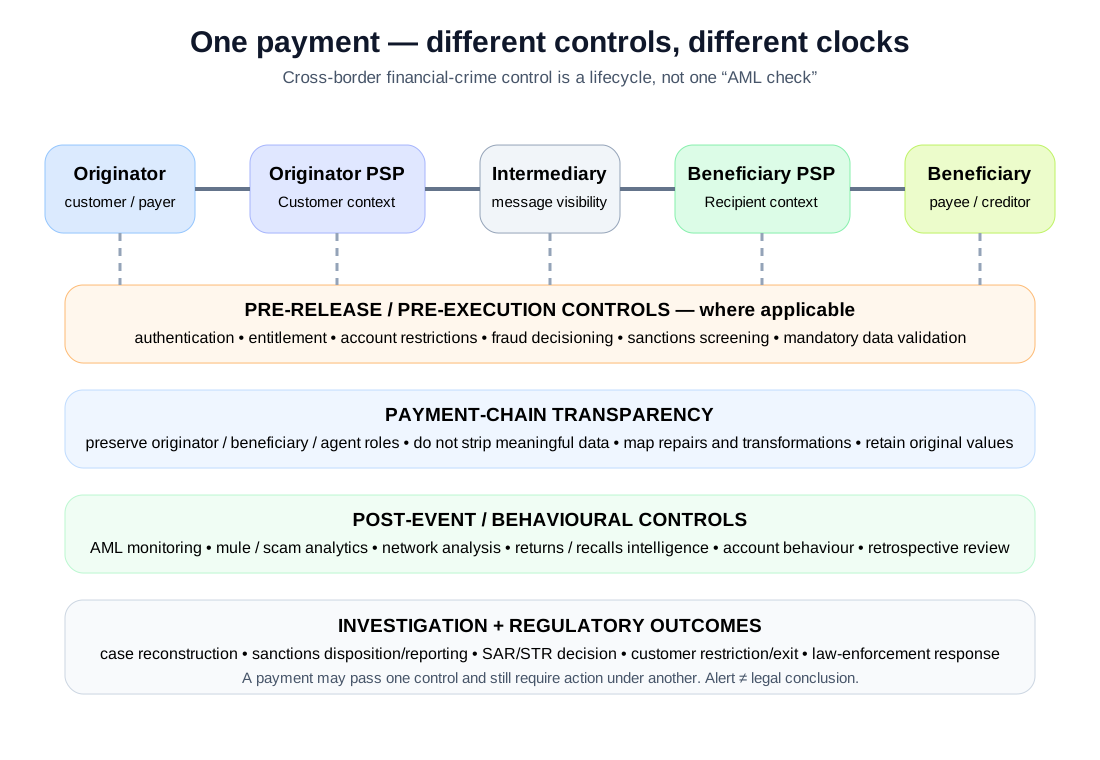
One payment, several decision clocks
A payment can be evaluated by several financial-crime controls, but they do not all operate at the same moment.
Fraud decisioning may need to act in milliseconds or seconds before the customer loses funds.
Sanctions screening may need to identify and disposition a relevant match before release where applicable legal restrictions require preventive action.
Account restrictions must be available before any channel releases value.
Payment-transparency validation ensures required information accompanies the transaction through the payment chain.
AML transaction monitoring may evaluate the payment after execution or as part of a wider pattern over hours, days or months.
Investigation may combine information that did not exist at payment time, such as later victim reports, linked accounts or FIU/law-enforcement intelligence.
Regulatory reporting can follow its own legal clock after a suspicion or sanctions event is established.
A design that treats all of these as one synchronous “AML check” will either miss risk or make the payment product unusable.
Route-based control coverage
A bank can own an excellent screening engine and still have weak screening control if one route does not call it.
Coverage should therefore be mapped by route, not merely by product name.
| Route | Preventive controls | Post-event controls | Key evidence |
|---|---|---|---|
| Domestic transfer | entitlement, fraud, restrictions, sanctions where applicable | monitoring, investigation | instruction, auth, route, ledger |
| Cross-border payment | fraud, restrictions, party/agent screening, transparency validation | monitoring, correspondent analysis | original + outgoing messages, agents, UETR/reference |
| Instant payment | low-latency fraud, restrictions, sanctions | rapid/near-real-time + post-event monitoring | millisecond/second timestamps, decisions |
| Internal book transfer | restrictions, sanctions as applicable | monitoring/network analytics | both internal accounts, ledger linkage |
| Corporate bulk file | file and row validation, sanctions/fraud logic | monitoring by individual transaction/customer | file ID + row ID + approvals |
| API/H2H | authentication, entitlement, idempotency, same control coverage as other channels | monitoring | API client, request ID, instruction ID |
| Manual/repair payment | enhanced maker-checker, rescreen after material changes | monitoring/QA | original and amended values |
During migrations, compare old route versus new route field by field and control by control. “The new hub uses the same screening service” is not enough if it sends different data.
Original instruction, canonical payment object and outgoing message
Banks should distinguish at least three states:
Original customer instruction — what the customer or upstream institution submitted.
Canonical internal payment object — the bank’s normalised/enriched representation used for processing.
External message — what is sent to the clearing system, correspondent or beneficiary institution.
Between those states the bank may:
- validate accounts and formats;
- enrich bank/agent data;
- normalise names;
- transliterate scripts;
- convert addresses;
- calculate FX;
- add routing agents;
- repair invalid values;
- map legacy formats to ISO 20022;
- truncate fields required by older systems.
Investigation and control testing need lineage across all three states. Otherwise the bank cannot answer whether a questionable value came from the customer, an internal enrichment service or a repair user.
ISO 20022 improves structure only if the bank preserves it
ISO 20022 can support richer, more structured party, account, agent, purpose and remittance information. But standards do not guarantee control quality.
A bank can receive structured data and still lose value if:
- the channel captures free text only;
- an internal canonical model has fewer fields;
- a legacy screening interface concatenates several address elements;
- the monitoring platform ignores ultimate-party data;
- a data warehouse stores only display text;
- a repair screen overwrites the original value;
- investigations see transformed rather than source data.
Financial-crime acceptance testing should therefore validate end-to-end field lineage, not just message syntax.
Party roles must remain explicit
Payment messages can contain several parties and agents:
- debtor/originator;
- ultimate debtor;
- debtor agent;
- intermediary agents;
- creditor agent;
- creditor/beneficiary;
- ultimate creditor;
- initiating party;
- instructing/instructed agents;
- account servicers;
- other relevant parties depending on the flow.
A control should define which roles are screened or monitored and why. Flattening all names into one array can make technical implementation easy while destroying business meaning.
An investigator should be able to distinguish “this name is the beneficiary” from “this name is an intermediary bank.”
Payment transparency: current international direction
FATF Recommendation 16 provides the international framework for information accompanying certain payment transfers. FATF agreed revisions to Recommendation 16 in June 2025 and in June 2026 published draft implementation guidance for consultation; FATF states that countries are expected to be ready to implement the strengthened changes by the end of 2030.
That does not mean a bank should wait until 2030 or hard-code one future global rule today. Current legal obligations still depend on applicable national or regional implementation, while transformation programmes need to plan for evolving transparency expectations.
A BA should therefore model payment-transparency requirements with effective dates and jurisdiction/route applicability rather than one global boolean rule.
Wolfsberg payment-transparency perspective
The Wolfsberg Group’s 2023 Payment Transparency Standards and 2024 roles-and-responsibilities guidance emphasise that transparency depends on several actors in a payment chain. Different payment service providers see different data and perform different roles.
That is especially useful for architecture because it prevents an unrealistic assumption that every intermediary owns the same customer information as the originating PSP.
For a cross-border chain, ask at each hop:
- What information did this PSP receive?
- What information is it expected to preserve or transmit?
- What information does it add?
- Which financial-crime controls can it reasonably perform with that information?
- What information could be lost through transformation, bundling or truncation?
Correspondent banking and limited visibility
The originating bank usually knows its customer. A correspondent may see only the payment message plus its respondent relationship. The beneficiary bank knows the receiving customer.
Each institution therefore has a different risk perspective.
A correspondent may rely heavily on:
- payment-message transparency;
- respondent-bank due diligence;
- sanctions screening;
- transaction-pattern analysis;
- geographic and routing context;
- nested relationship indicators.
Removing or obscuring meaningful originator, beneficiary or agent information can weaken downstream controls throughout the chain.
UETR and end-to-end references
Where a flow uses a UETR or another stable end-to-end reference, that identifier can be valuable for investigation, reconciliation and cross-system lineage.
But a bank should not rely on one reference alone. Internal instruction IDs, payment IDs, network references, ledger entries, return/recall references and case IDs should be cross-linked.
A practical lineage model is:
customer instruction ID → internal payment ID → screening/fraud decision IDs → external message/network reference → ledger booking ID → return/recall ID if any → monitoring alert/case ID → reporting ID if any.
This is what allows investigators to move from an alert back to the original customer action without manual guessing.
Screening detection and legal disposition must remain separate
A screening engine detects similarity. It does not determine every legal outcome automatically.
A potential match may require review of:
- name/alias similarity;
- address;
- date of birth/incorporation;
- identifiers;
- ownership/control;
- relevant sanctions regime;
- bank legal entity;
- payment nexus;
- licence/authorisation where applicable.
Possible outcomes can differ by regime and facts: false positive, allow, reject, block/freeze, seek licence, escalate or report.
The data model should therefore separate:
screening event → potential match → investigation/disposition → operational payment action → regulatory outcome.
If “screening_status = blocked” is used for all of those states, later reconstruction becomes unreliable.
List version and temporal accuracy
Sanctions decisions are time-sensitive.
The bank should record:
- list/source version or effective state;
- time the list update was received;
- time it became available to screening;
- screening timestamp;
- payment decision timestamp;
- any rescreening event.
This matters when a designation changes while payments are queued or in flight.
Without temporal evidence, the bank may know the current list but not what was available when the decision was made.
Repair and rescreening
A payment may be screened successfully and then changed.
Material changes can include:
- beneficiary name;
- address/country;
- bank/agent;
- account identifier;
- payment purpose;
- route;
- ultimate party;
- free-text information used by screening.
The system should know whether the change invalidates the prior screening result. Where required, it should rescreen before release.
The key rule is simple: control evidence belongs to the data state that was actually evaluated.
A screening result for version 1 of a payment does not automatically prove version 3 was screened.
Fraud and AML: related but different decisions
A fraud engine asks whether the payment may be unauthorised, manipulated or scam-related and whether immediate intervention is needed.
AML monitoring asks whether behaviour may indicate laundering, terrorist financing or other suspicious activity under the relevant framework.
A scam can generate both perspectives:
- sending bank: customer appears to be a victim;
- receiving bank: account may be a mule collecting criminal proceeds;
- later network analysis: several recipient accounts may share devices or beneficiaries.
Fraud intelligence should therefore be available to AML teams under defined governance, but a fraud decline should not automatically create an AML suspicion conclusion.
Instant payments: seconds change control design
Instant payments reduce the time available for manual intervention and can become final quickly depending on the scheme.
A viable control design normally requires:
- high availability of account restrictions;
- low-latency sanctions screening where applicable;
- automated fraud decisioning;
- manageable refer volumes;
- 24/7 escalation or pre-agreed fail-safe behaviour;
- rapid receiving-bank response to fraud intelligence;
- post-event monitoring that can detect rapid onward movement;
- operational resilience for list/service outages.
A rail cannot be “24/7” if the control escalation model disappears outside office hours.
Fail-safe behaviour during outages
When a preventive control is unavailable, the platform should already know what to do.
Options can include:
- queue and hold;
- decline/fail instruction;
- route to approved contingency process;
- continue only under an explicitly approved degraded mode for controls where that is legally and risk-appropriate.
The correct choice depends on the control, legal requirements, product and risk appetite.
The decision should be governed before an incident, not improvised during one.
After recovery, queued transactions may need current-list screening or reevaluation before release. Recovery itself is a controlled event.
Monitoring-feed completeness is a core control
A sophisticated transaction-monitoring model is useless if a portion of in-scope transactions never reaches it.
Banks should reconcile payment sources to monitoring ingestion using appropriate counts, values and identifiers.
A reconciliation break should answer:
- which routes/transactions are missing;
- since when;
- why;
- whether duplicates exist;
- whether monitoring was delayed or permanently missed;
- what retrospective action is required;
- who owns remediation.
Coverage reconciliation is often a stronger control than assuming “the interface job ran successfully.”
Bulk, batch and file payments
Corporate files introduce two layers of control: the file and the individual transaction.
Useful identifiers include:
- file ID;
- file hash/version;
- customer/corporate uploader;
- approval/signature state;
- row/payment ID;
- original row values;
- repaired row values;
- screening/fraud result per payment;
- file-level processing result.
One problematic row should not silently contaminate or hide the status of thousands of unrelated rows. The exact hold/release behaviour should be defined explicitly.
API and host-to-host initiation
High-volume APIs and H2H channels can create control gaps if teams treat them as “trusted corporate” routes.
Test:
- authentication;
- entitlement;
- signing/approval where applicable;
- idempotency;
- customer/account linkage;
- beneficiary data quality;
- same screening and fraud coverage as equivalent manual channels;
- logging of original payload and transformed payment object;
- rejection/repair feedback;
- monitoring ingestion.
Channel convenience must not become a control bypass.
Returns, rejects and recalls are financial-crime data
A payment’s story does not end when value leaves the originator.
Rejects can show that a payment was not accepted or progressed under the relevant rail process.
Returns can reveal beneficiary/account issues, fraud concerns or other downstream outcomes.
Recalls can indicate customer error, duplicate payment or suspected fraud.
These events should remain linked to the original transaction. Repeated fraud-related recalls or returns involving the same beneficiary can become useful intelligence.
Investigation reconstruction
A good investigator workspace should make the payment reconstructable without opening six unrelated systems.
At minimum, it should expose or link:
- original instruction;
- customer/account context;
- authentication and approvals;
- original and transformed party data;
- enrichment and route;
- sanctions screening events and list state;
- fraud signals/decision;
- repairs and overrides;
- external message/reference;
- ledger debit/credit;
- settlement/acceptance state;
- return/reject/recall events;
- monitoring alerts;
- related counterparties/accounts/devices;
- restrictions;
- case/report outcome.
Derived analytics should be visually distinguishable from source facts.
Worked case — repaired beneficiary after sanctions screening
A cross-border payment is screened with beneficiary “ABC Trading LLC” and clears. A downstream validation fails because the beneficiary name should be “ABC Trading Company Limited.” Operations repairs the field.
Questions the system must answer:
- Is the changed field in screening scope?
- Is the difference material under the control design?
- Does the old result remain valid?
- Must the payment be rescreened?
- Which version is sent externally?
- Are both original and repaired values retained?
- Who changed it and why?
- Did any list update occur between screenings?
A safe design treats screened data as versioned evidence, not a permanent stamp attached to the payment ID.
Worked case — instant scam and mule network
A long-standing retail customer logs in from a new device shortly after a credential reset, creates a new beneficiary and sends a large instant payment.
The fraud engine challenges the payment but the customer confirms it because they are being socially engineered. The payment is released. Hours later the customer reports a scam.
The receiving bank sees the beneficiary receive similar credits from several unrelated senders and rapidly move funds onward.
The end-to-end lesson is:
- authentication can be valid while fraud risk remains high;
- sender-side fraud controls and recipient-side mule monitoring see different facts;
- recall/recovery data has time value;
- AML review may become relevant at the receiving bank;
- network analytics can reveal the broader pattern;
- one transaction can have a fraud outcome, AML outcome and payment-operations outcome that should not be conflated.
Worked case — ISO 20022 migration looks technically successful
A bank migrates a cross-border route to ISO 20022. Scheme certification passes. Messages are syntactically correct.
Financial-crime end-to-end testing discovers:
- ultimate debtor is captured by the channel but dropped before screening;
- structured address is concatenated and truncated by an internal legacy interface;
- monitoring receives the new payment type but maps it to an old product segment;
- investigator UI shows only transformed names;
- return messages no longer link to the original monitoring record.
The migration is technically live but financially-crime incomplete.
That is why financial-crime control testing must be part of payment transformation, not an afterthought.
BA artefact — end-to-end control matrix
For every stage, capture:
| Stage | System | Critical data | Control | Outcome/state | Evidence | Failure handling |
|---|---|---|---|---|---|---|
| Initiation | Channel/API | parties, account, amount, purpose | entitlement/fraud inputs | accepted/rejected | original instruction | retry/idempotency |
| Enrichment | Payment hub | route, agents, country, FX | data-quality checks | enriched | original + enriched version | repair |
| Screening | Screening service | relevant parties/agents | sanctions/watchlist | clear/refer | list state + result | hold/escalate |
| Fraud | Fraud engine | device, behaviour, beneficiary | fraud decision | allow/challenge/decline/refer | features + outcome | fallback |
| Routing | Hub | route/agents | route-control validation | routed | route decision | alternative/hold |
| Execution | Rail/gateway | final message | scheme validation | accepted/rejected | network reference | repair/return |
| Booking | Ledger | account/value | restriction/posting controls | debit/credit | booking IDs | reversal/error |
| Monitoring | AML platform | transaction + customer context | scenario/model | alert/no alert | ingestion + model result | reconciliation |
| Investigation | Case platform | full lineage | human/analytical assessment | disposition | rationale | escalation |
This matrix exposes gaps more effectively than a single high-level process diagram.
BA acceptance-test catalogue
Test at least:
- each payment route calls every mandatory preventive control;
- repaired screened fields trigger required rescreening;
- original and transformed values remain retrievable;
- list update occurs while payment is queued;
- screening service is unavailable;
- fraud service is degraded;
- queued recovery uses current approved control state;
- duplicate API instruction is retried with same idempotency key;
- batch contains one referred row among thousands;
- book transfer reaches monitoring;
- instant payment is executed outside business hours;
- ultimate party and structured address survive transformation;
- monitoring ingestion misses a route and reconciliation detects it;
- return/recall links to the correct original payment;
- investigator reconstructs payment across instruction, screening, network and ledger identifiers;
- user attempts to manually release an unresolved high-risk referral;
- route changes after initial screening;
- an intermediary is introduced after enrichment.
Advanced takeaways
- Payment financial-crime control is an end-to-end data-and-decision problem, not one screening box.
- Fraud, sanctions, payment restrictions and AML monitoring operate on different clocks.
- Control coverage must be proven for every material route and channel.
- ISO 20022 creates richer structure only when internal systems preserve and use it.
- Screening evidence belongs to the exact data version that was evaluated.
- Payment transparency matters across the chain because each PSP sees different information.
- Instant payments require automated preventive control, 24/7 resilience and rapid post-event intelligence.
- Monitoring-feed reconciliation is essential; sophisticated analytics cannot compensate for missing transactions.
- Returns, rejects, recalls and repairs are part of the financial-crime story.
- Investigators need stable lineage from original instruction through network, ledger, alerts and cases.
Educational note: scheme rules, settlement finality, sanctions treatment, payment-transparency obligations, fraud reimbursement arrangements and reporting duties vary by jurisdiction and payment rail. Apply the rules relevant to the bank legal entity, payment service and transaction.
Advanced practice: payment architecture, ISO 20022 and financial-crime decision timing
The hardest payment-control problems sit at the boundaries between systems. Customer channels, payment hubs, fraud services, sanctions engines, core ledgers, clearing gateways, monitoring platforms and investigation tools can each be individually correct while the end-to-end control is incomplete.
A world-class design therefore tests the financial-crime lifecycle as one chain of state, data and decisioning.
Payment state model
A payment should have a defined state model rather than one generic status.
Useful states can include instruction received, authenticated, validated, awaiting screening, referred, authorised for release, submitted to rail, accepted by rail, settled, returned, recalled and cancelled. The exact states vary by payment product.
Financial-crime states should be explicit too. A payment can be operationally valid but held for sanctions review. It can be fraud-referred before technical submission. It can later become part of an AML investigation after settlement.
The state model should allow those dimensions to coexist rather than overwriting one another.
Correlation identifiers
Every control event should be traceable through stable identifiers.
A useful architecture can link customer instruction ID, payment ID, end-to-end ID, rail reference, UETR where applicable, ledger entry, screening alert, fraud decision and case ID.
Without correlation, operations and investigators resort to matching by amount, date and name, which is slow and error prone.
ISO 20022 party model
ISO 20022 payment messages can distinguish debtor, creditor, debtor agent, creditor agent, ultimate debtor, ultimate creditor and intermediary agents.
Financial-crime requirements should identify which of these roles are relevant to each control. “Screen sender and receiver” is too vague for a structured message model.
The system should also preserve organisation and private-person identifiers where supplied and permitted, because they can materially improve match resolution.
Structured postal addresses
Structured address elements improve machine interpretation but require disciplined mapping.
A country should not be inferred solely from free-text address where a structured country field exists. Conversely, migration should not discard legacy free text that contains information not yet mapped into structured elements.
Hybrid address periods can require support for both formats.
The screening and investigation systems should know whether a field is source-structured, derived or parsed from free text.
Truncation testing
Payment transformation should be tested at maximum field lengths and with multilingual names.
Test examples should include long corporate names, multiple surnames, Arabic or Cyrillic scripts, diacritics, non-standard punctuation and long addresses.
The objective is not merely message validity. It is confirming that material information reaches the financial-crime control in a usable form.
Transliteration
Transliteration can help screening where sanctions data and payment data use different scripts, but transliteration is not unique. One name can have several valid Latin representations.
Systems should retain the original script and any derived transliteration. Analysts should be able to see both when resolving matches.
Clearing and settlement differences
Different rails have different finality rules and exception windows.
Financial-crime teams should understand when the bank can still prevent movement and when it can only attempt recall or post-event restriction.
That timing influences control placement. A control running ten minutes after execution may be useful for monitoring but ineffective as a preventive control on an instant rail.
Cut-off risk
Batch and cross-border payments can face cut-off pressure. Operations may be tempted to release borderline items quickly to meet customer deadlines.
Control SLAs should be designed so sanctions or fraud review has realistic time. Commercial cut-offs should never silently override legal restrictions.
Escalation routes are particularly important near cut-off.
Liquidity and financial-crime holds
Holding a high-value payment can affect customer liquidity and bank liquidity management. That operational impact does not change the legal decision, but it means treasury and operations may need visibility that value is delayed without receiving confidential case details.
Status sharing should therefore provide operationally necessary information while protecting sensitive investigation rationale.
FX timing
A cross-currency payment can involve an FX trade before or during payment execution.
If the payment is later blocked or rejected, the bank may need to unwind or manage the FX position. Financial-crime workflows should therefore notify the relevant operational process without allowing treasury considerations to override the control decision.
The investigation should retain both original and settlement currencies and exchange-rate information where relevant.
Charges and payment transparency
Different charging methods can alter the amount received but should not change the identity of parties.
Financial-crime systems should avoid interpreting fee deductions as unexplained value loss. At the same time, unusual fee or intermediary structures can be relevant in specific typologies.
Context remains essential.
Screening of bank agents
Payments can involve several financial institutions. Screening controls may include banks, branches or BIC-linked entities according to policy and sanctions obligations.
A bank should define whether agent screening uses BIC data, legal entity names, addresses or other identifiers. The decision should account for false positives caused by generic bank names or branch locations.
Beneficiary-bank risk
AML monitoring can consider beneficiary-bank and corridor information as risk factors, particularly in correspondent or high-risk jurisdiction contexts.
This should not become an automatic suspicion rule. The risk comes from combination with customer behaviour, counterparties and purpose.
Payment-purpose codes
Some rails provide structured purpose or category-purpose codes.
These can improve customer-profile comparison and monitoring, but they may be customer selected or populated automatically. Investigators should know the source before treating the code as verified economic purpose.
A code saying “salary” does not prove the payment is salary.
Sanctions ownership and control
Payment screening can identify a company name that is not directly listed while ownership information indicates a potential sanctioned nexus.
Automated name screening alone may therefore be insufficient for certain cases. Customer and counterparty ownership information can require specialist analysis.
The exact ownership/control rule differs by sanctions regime and should be applied by the appropriate legal framework.
Vessel and trade data
Trade-related payments can involve vessel names, IMO numbers, ports, commodity information and shipping documents.
Where the bank offers trade-finance products, financial-crime controls may need to screen or assess these objects in addition to payment parties.
The payment message alone may not contain enough context to assess proliferation or sanctions-evasion risk.
Interdiction queues
Sanctions-payment alerts often enter an interdiction queue because payment processing pauses until resolution.
The queue should prioritise by legal and operational urgency rather than simple FIFO where policy permits. High-value, near-cut-off or high-confidence matches may need specialist handling.
Ageing should be measured from the control event, and manual release authority should be tightly governed.
False-positive suppression
Banks may use suppression or good-guy logic to reduce repeat sanctions false positives for known parties.
Such logic should be specific enough that a future true match is not ignored. It should be time-bound or periodically reviewed, linked to identifiers and invalidated when relevant party data or sanctions data changes.
A suppression based only on a common name can be dangerous.
Fraud beneficiary intelligence
Beneficiary intelligence can include previous fraud reports, receiving-account age, number of unrelated payers, recall history and network links.
This can support real-time scam prevention. The system should distinguish internal risk intelligence from externally verified facts and manage retention and sharing lawfully.
Confirmation or verification of payee
Where a payee-verification service exists, it can reduce misdirected payments and some impersonation scams by comparing beneficiary name and account information.
A match result is one control signal. A successful name match does not prove the payment is legitimate; the fraudster can control an account in the correct name.
The user experience should therefore avoid presenting verification as a guarantee of safety.
Step-up authentication
Risk-based fraud controls can require additional authentication for unusual payments.
Step-up authentication proves stronger customer participation, but authorised scam victims may still approve the transaction. Fraud decisioning should therefore combine authentication with beneficiary and behavioural context.
Customer intervention
For high-risk scam indicators, banks may intervene through warnings or contact.
The design should avoid generic warnings that customers click through automatically. Contextual messages can be more effective, but they should not expose confidential AML or sanctions rationale.
The intervention result should be retained as evidence.
Post-settlement fraud recovery
Once a fraudulent payment settles, speed of response matters.
The sending bank may initiate recall or interbank fraud processes. The receiving bank may restrict remaining funds under its legal and policy framework. Investigators should trace onward movement quickly.
Financial-crime architecture should therefore support near-real-time intelligence handoff after confirmed fraud.
Mule-network monitoring
Monitoring can look beyond one receiving account to shared beneficiaries, devices, addresses and onward destinations.
A network that receives small payments from dozens of victims and consolidates to one cash-out point can be significant even when each account remains below conventional thresholds.
Graph-based features can complement traditional scenarios.
Monitoring scenario lineage
An AML alert should record which transactions caused it and which scenario version ran.
If the analyst cannot see the contributing transactions, investigation becomes a manual data exercise. If the scenario version is missing, later validation cannot reproduce the alert accurately.
Event-driven customer review
Payment behaviour can trigger KYC refresh.
A customer whose actual activity differs materially from expected business may need an event-driven review. That review should feed updated customer information back into monitoring rather than remain isolated in a KYC system.
This closes the loop between customer understanding and transaction behaviour.
Monitoring and customer-risk feedback
Repeated suspicious or unusual activity may change customer risk rating according to policy. Conversely, a legitimate business expansion discovered through review may update expected activity and reduce future false positives.
Risk systems should support governed feedback rather than independent static scores.
Reconciliation to ledger
Monitoring completeness can be tested at several points: channel instructions, payment hub transactions and ledger postings.
Which reconciliation is appropriate depends on scope. For example, a monitoring system intended to cover executed payments should reconcile to the population that actually booked or settled, not every failed instruction.
The control specification should define population precisely.
Duplicate and reversed transactions in monitoring
Monitoring feeds need clear treatment of reversals, returns and duplicates. Otherwise velocity or value calculations can be distorted.
The model should preserve the original event while classifying reversal relationships. Simply deleting reversed transactions can remove useful behavioural evidence.
Time zones
Global monitoring systems can create subtle errors if transaction dates are normalised incorrectly across time zones.
A scenario using “within 24 hours” should use timestamps consistently. Daily windows based on local banking day may require legal-entity or customer-local time treatment.
Time-zone logic should be documented and tested.
Scenario: midnight instant-payment pattern
A customer receives multiple credits just before and after midnight and sends them onward immediately.
If monitoring splits the activity into two calendar days, a daily threshold may miss the combined pattern. Rolling-window logic can detect it.
This demonstrates why scenario design must understand event time rather than only reporting date.
Scenario: correspondent repair strips originator address
An incoming cross-border payment arrives with complete originator data. A repair process reconstructs the message but omits address lines.
The payment continues with reduced transparency. Even if screening remains clear, the bank has a data-integrity issue that can affect downstream monitoring and regulatory obligations.
Repair testing should therefore include preservation of all required originator and beneficiary information.
Scenario: monitoring feed fails silently
A new payment type goes live and processes successfully. The transaction-monitoring ETL does not recognise the new code, so the transactions are dropped.
No monitoring alert indicates the failure because the data never arrived. Source-to-target reconciliation is what detects the gap.
This is why completeness controls are as important as sophisticated analytics.
Scenario: sanctions list update during instant outage
The screening engine is unavailable while a new designation is published.
The bank’s contingency plan should determine whether payments queue, stop or use an approved backup. When service returns, the current list must be loaded before queued payments are evaluated.
Releasing the queue against the old list can create a control failure even though the service is technically restored.
BA artefact: payment-control sequence diagram
A detailed sequence diagram can show channel, authentication, account service, fraud, sanctions, payment hub, clearing gateway, ledger, monitoring and case management.
For every call, document input fields, timeout behaviour, response states and audit evidence.
This exposes missing controls and failure paths far better than a high-level box diagram.
BA artefact: financial-crime non-functional requirements
Financial-crime controls need non-functional requirements too:
- screening latency;
- availability;
- list-update timeliness;
- audit-log durability;
- monitoring-feed completeness;
- recovery point and recovery time;
- access controls;
- data retention;
- traceability.
A control that is logically correct but unavailable during peak processing is not operationally effective.
Final practitioner test
For any payment, the bank should be able to reconstruct who instructed it, how authority was proven, which party and agent data was screened, what fraud decision ran, which route and message were used, when value became final, whether monitoring received the transaction, what later alerts arose and what regulatory or customer action followed.
That reconstructability is the foundation of trustworthy financial-crime control in modern payments.
Masterclass: financial crime across the payment life cycle
Payments are where financial-crime controls stop being theoretical. A payment instruction has a customer, an account, an amount, parties, agents, a route, a message, timestamps, status changes and ultimately a movement of value. Each stage can create financial-crime risk, and each stage can create evidence.
The strongest operating model follows the payment from initiation to final outcome rather than treating screening, fraud, AML monitoring and investigation as unrelated systems.
Start before the payment exists
The first control point is the customer relationship itself.
Customer due diligence, beneficial ownership, product permissions, expected activity, risk rating and account restrictions all influence what should happen when a payment is later initiated.
If those facts are unavailable to the payment engine or investigative environment, the bank loses context before the transaction starts.
A customer expected to receive salary and pay household bills creates a very different behavioural baseline from a payment institution processing thousands of third-party transfers.
Initiation
At initiation the bank should know who is requesting the payment and under what authority.
Relevant controls can include authentication, entitlement, account status, beneficiary setup, transaction limits, fraud risk and product eligibility.
Financial crime and fraud overlap here but are not the same decision. A payment can be genuinely authorised by the customer and still create AML or sanctions concerns.
Data quality before screening
Screening is only as good as the data supplied to it.
The control should preserve relevant party names, addresses, account identifiers, agents, intermediaries and other information required by policy and applicable rules. Transliteration, truncation, character-set conversion and field mapping can all affect match quality.
An ISO 20022 migration can improve structure and transparency, but only if the richer data actually reaches the control systems. Converting a structured message into a short legacy string before screening throws away much of the value of the migration.
Sanctions screening
Payment screening can compare relevant payment parties and information against applicable sanctions data.
A potential match is not automatically a true match. Matching logic may use exact and fuzzy techniques and can consider aliases, transliteration and identifiers.
The decision process should distinguish:
- no match;
- potential match requiring review;
- false positive;
- true or confirmed match;
- other legal restriction requiring specialist assessment.
The exact action after a confirmed sanctions issue depends on the applicable regime and facts. Hold, reject, block, freeze, return and report are not interchangeable terms.
Fraud decisioning
Fraud controls often operate at far greater speed than AML investigation.
Signals can include device change, authentication behaviour, beneficiary history, transaction velocity, customer vulnerability, account takeover indicators and known scam intelligence.
A fraud engine may decline or refer a payment even when sanctions screening is clear.
Conversely, a payment can be genuinely authorised by the customer and still be a scam, corruption payment, money-laundering transaction or sanctions concern.
Routing and intermediary banks
Cross-border payments can involve correspondent and intermediary banks. Each institution applies obligations under its own legal framework and risk appetite.
This is why payment transparency matters. Original party and routing information should survive the chain as required by the applicable payment and regulatory framework.
Data stripping, unexplained field loss or unnecessary repair can weaken screening and investigation.
Payment repair is a financial-crime control point
A repaired payment is not simply an operational exception.
If an operator changes a name, address, agent, beneficiary or other screened field, the control environment should determine whether rescreening is required. Original and amended values should be retained.
A good audit trail records who changed what, why it changed, when it changed and which controls reran afterwards.
This is especially important where manual repair occurs under time pressure near a cut-off.
Settlement does not end financial-crime risk
After execution, transaction monitoring may identify patterns that cannot be seen in a single payment.
Examples include rapid movement of incoming funds, structuring, circular transfers, mule-account networks, unexpected geographies, pass-through activity and repeated payments to connected beneficiaries.
The monitoring layer should be able to link the booked transaction back to the original instruction and customer profile.
Returns, recalls and rejects
Operational outcomes can provide useful risk information.
Repeated rejected payments may indicate poor data, sanctions-related attempts, invalid accounts or deliberate testing. Returns may expose beneficiary issues. Fraud recalls can identify mule accounts. Repairs can reveal attempts to alter routing or party data.
Those events should not automatically become suspicious cases, but they can feed risk analytics where relevant.
Case study: authorised scam payment
A retail customer sends a large instant payment to a newly added beneficiary after being manipulated by a scammer.
Authentication is successful. The customer genuinely pressed approve. Traditional "unauthorised transaction" logic therefore may not trigger.
A stronger fraud model looks at the new beneficiary, unusual amount, device and behavioural signals, previous payment history and known beneficiary intelligence.
If the payment reaches a mule account, the receiving institution may see rapid onward movement and multiple unrelated inbound credits. That receiving-side activity can become AML intelligence even though the original event began as fraud.
The end-to-end picture therefore crosses fraud, payments operations and AML.
Case study: sanctions alert during cross-border processing
A corporate payment creates a potential sanctions match on a beneficiary name.
The correct workflow should preserve the payment state while specialists compare available identifiers. The analyst may need legal name, address, registration information, ownership information and the sanctions-list record.
If the match is false, release authority and rationale should be recorded. If the match is confirmed or another restriction applies, the action must follow the applicable sanctions regime and legal advice.
The customer-facing message should not expose protected internal reasoning unnecessarily.
Case study: payment repaired after screening
A payment initially passes screening. Operations later repairs the beneficiary name because the instruction failed downstream validation.
If the bank releases the amended payment without considering rescreening, the original screening result may no longer apply to the data actually sent.
This is a classic control gap created by process sequencing rather than by poor matching technology.
ISO 20022 and financial-crime controls
ISO 20022 can carry richer structured data, including detailed party and agent information. For financial-crime teams, the opportunity is better identification, fewer ambiguous free-text fields and stronger analytics.
But migration creates risks too:
- legacy truncation;
- incorrect mapping;
- duplicated party information;
- missing ultimate parties;
- inconsistent address structure;
- controls still consuming legacy extracts;
- different message versions across rails.
Testing should therefore include financial-crime data lineage, not only message validation.
Real-time payments
Instant payment rails compress preventive-control time.
The bank cannot rely on manual review for ordinary traffic. Real-time architecture usually requires automated sanctions and fraud controls with clearly designed exception handling, plus post-transaction AML monitoring and rapid investigation capabilities.
A risk-based approach becomes essential because every transaction cannot receive manual enhanced review.
Correspondent banking
In correspondent payments, one bank may process transactions for another institution without a direct relationship with the underlying originator or beneficiary.
The correspondent therefore combines respondent due diligence, payment transparency, screening, transaction monitoring and escalation.
The purpose is not to replicate the respondent bank's complete KYC file for every underlying customer. It is to understand the respondent relationship and identify activity inconsistent with the expected profile or legal obligations.
Investigation data model
A payment investigation should ideally connect:
- customer ID;
- account ID;
- payment instruction ID;
- booked transaction ID;
- end-to-end and network references;
- UETR where applicable;
- screening result;
- fraud score or decision where relevant;
- case ID;
- report ID where applicable;
- original and repaired message values.
Without these links, investigators spend time reconstructing transaction identity rather than assessing risk.
BA test pack for payment financial crime
A strong test pack includes normal and exception paths:
- clean payment passes all preventive controls;
- potential sanctions match is held and reviewed;
- false positive is released with evidence;
- confirmed restriction follows the correct legal path;
- fraud refer produces a controlled customer state;
- repaired screened field triggers required rescreening;
- duplicate instruction does not create duplicate reporting or release;
- returned payment remains linked to the original instruction;
- ISO 20022 party data reaches screening without unintended truncation;
- post-transaction monitoring can retrieve the full payment lineage.
Practitioner checkpoint
For any payment, the bank should be able to reconstruct:
Who instructed it, what data was used, which controls ran, what each control decided, what changed during processing, whether value moved, and why the final outcome was permitted.
That is the financial-crime audit trail of a payment.
Further worked cases and independent practice
Use these explanations to apply the chapter's concepts. Read the lesson first, then allow additional time for the exercises and diagram interpretation. Exercise time is additional to the reading estimate.
A payment is a sequence of states, not one event
A customer instruction can pass through channel validation, authentication, fraud controls, sanctions screening, funds checks, enrichment, payment orchestration, clearing or correspondent messaging, settlement, booking, reporting, reconciliation, return or investigation. Different financial-crime controls act at different moments and do not all see identical data.
This is why "the payment passed screening" is an incomplete statement. Which screening? At what stage? Against which data? Before or after repair? Which list version? Which legal entity? Was ownership or control evaluated? Did an intermediary bank make a separate decision? The audit trail should preserve the answers.
Worked case: repaired cross-border payment
A corporate customer sends a cross-border payment. The original instruction includes a beneficiary name, structured address and purpose text. The payment fails validation and operations repairs the beneficiary name based on supporting information. The repaired payment then passes sanctions screening and settles. Two weeks later, an investigation discovers that the original name resembled a designated party more closely than the repaired name.
A mature control environment preserves both values, the reason for change, operator, timestamp and whether the change triggered re-screening. The case investigator should be able to reconstruct the original instruction, all transformations and the final message. The purpose is not to assume the repair was wrong. It is to make the decision reproducible.
Control clocks across one payment
Fraud decisioning may occur in milliseconds or seconds. Sanctions screening may need near-real-time interdiction before release. Payment validation and repair can operate against cut-offs or scheme rules. AML transaction monitoring may aggregate activity later across customers and accounts. Investigation and suspicious reporting have longer but still controlled deadlines.
The architecture should therefore distinguish preventive, detective and post-event controls. A next-day AML model cannot replace real-time beneficiary-risk controls for instant-payment fraud. A real-time sanctions filter does not replace behavioural monitoring for laundering. Each control has a specific risk hypothesis.
ISO 20022 and data richness
ISO 20022 can carry structured debtor, creditor, ultimate-party, address, agent, purpose and remittance information. Richer data improves control only when it survives mappings and is available to screening and investigation. If the channel captures structured address fields but a downstream screening interface sends only one truncated line, the organisation has lost useful context.
A BA should trace critical fields through channel, orchestration, screening, payment engine, gateway, archive, booking and case management. For each transformation, record source field, target field, truncation rule, enrichment, default, repair behaviour and lineage identifier.
UETR and other identifiers
Cross-border SWIFT payments can use UETR for traceability, but UETR is not a universal identifier for every rail. Internal channel IDs, payment-engine IDs, clearing references, EndToEndId, transaction IDs, booking references and case IDs can all coexist. A strong data model links them rather than expecting one identifier to solve every traceability problem.
Practice exercise — work through this before reading on.
Payment-state exercise
Define distinct statuses for received, validated, fraud-referred, sanctions-held, repaired, released, submitted, accepted, settled, rejected, returned, recalled and investigation-linked. Then ask which statuses are mutually exclusive and which can coexist. A payment can be settled and later linked to an AML investigation. A customer relationship can be restricted while a previous payment remains historically settled. A temporary operational hold is not a legal asset freeze.
This exercise matters because poorly named statuses create incorrect reporting and customer communication.
Scenario: instant-payment mule chain
A victim sends an authorised instant payment to a receiving account. The receiving account forwards value to two other accounts within minutes. The sending bank sees scam indicators and customer contact. The receiving bank sees inbound payer diversity, account age and rapid pass-through. Post-event AML analysis sees the network.
A strong operating model connects fraud intelligence, payment traceability and AML network analysis. It also records which bank saw which part of the chain. The receiving bank should not claim knowledge of the victim conversation unless that information was actually shared through an authorised process.
Practice exercise — work through this before reading on.
Failure-mode exercise
Consider five failures: screening service unavailable; customer-risk feed stale; transaction-monitoring feed missing one day's payments; payment repair does not preserve original data; case platform cannot link a return to the original payment. For each, define whether processing stops, degrades to manual review, continues under an approved contingency or creates a post-event remediation obligation.
The correct answer depends on legal requirement, control criticality, risk appetite and operational design. What matters is that failure behaviour is explicit and tested.
Final control-state test
For a payment that triggers fraud, sanctions and AML concerns, write three separate decisions: immediate payment disposition, customer/relationship action and external reporting action. Then list the evidence supporting each. If the three decisions cannot be separated, the system or operating model is probably collapsing distinct financial-crime questions.
A strong learner should finish able to trace a payment from instruction to final state, identify which controls act where, explain what data each control uses and reconstruct every change without screenshots or guesswork.
Worked sequence: a timeout after a payment-release request
The following fictional payment sequence explains why financial-crime controls must preserve the distinction between a decision and its execution. It is a simplified operating example, not a specification for any particular payment scheme. Actual retry, cancellation, reporting and settlement rules depend on the infrastructure and legal framework involved.
A corporate payment has passed the bank's relevant pre-release controls. The payment service sends a release request to an outbound gateway, but the response times out. The customer application now shows “processing.” Operations cannot yet tell whether the gateway failed before accepting the request or accepted it and lost the response. That uncertainty is about processing state. It does not mean the sanctions decision failed, that the payment was rejected or that settlement occurred.
The first recovery step is to establish what the system knows from authoritative records. The payment service has its instruction identifier and release attempt. The gateway may have an accepted outbound message linked to that attempt. An infrastructure acknowledgement, if available, may establish another stage in the process. The ledger can show a reservation or booking, but its meaning depends on the bank's design. No single status label should be interpreted beyond the event it actually represents.
An operator proposes sending the payment again. That can be unsafe if the first request was accepted and the second is treated as a new instruction. Duplicate prevention should distinguish a recovery attempt for the same business instruction from a genuinely new customer instruction. The implementation might use a controlled idempotency key, a persisted release record or another scheme-compatible mechanism. The bank should test the intended behaviour rather than assume that using the same amount and beneficiary will prevent duplication.
The financial-crime evidence also needs to remain attached to the right instruction. Suppose a retry creates a new internal payment identifier and the screening decision is linked only to the old identifier. The new record may appear unscreened even though it represents the same approved instruction. Conversely, copying a “screened” flag onto every retry can be wrong if material party data changed during recovery. The relationship between the original instruction, current data, control result and release attempt must be explicit.
Recovery can change the facts requiring a decision
During the investigation of the timeout, operations receives a customer request to correct the beneficiary name. That is a separate event from resending an unchanged instruction. The bank must establish whether the original payment can still be changed or cancelled through the relevant process. A local database edit cannot rewrite an instruction already accepted elsewhere. If a new or amended instruction is permitted, the controls should assess the data that will actually be used, according to the applicable control design.
A sanctions-list update arrives during the same interval. The relevant question is not simply whether the payment once received a clear screening result. The bank needs to understand the transaction's current state, the applicable legal obligations and the control treatment of a list change before any further action. This example does not prescribe a universal rescreening sequence. It shows why list versions, decision times and release states must be available to the responsible specialists.
The customer-contact team should communicate the operational position accurately. “Your payment is still being processed” may be appropriate where that is the verified state. “The beneficiary has received the funds” would be unsupported without the relevant evidence. Any explanation of restrictions or investigative activity must follow the applicable confidentiality requirements. A desire to reassure the customer does not justify inventing a completed outcome.
Reconciliation restores a coherent payment history
Assume the bank establishes that the gateway accepted the original instruction and that no duplicate was released. The response record links the original instruction to the accepted message and the available downstream status. The timeout incident is resolved, but the payment's financial state may still be pending. Incident closure and payment completion are different events and should remain visible as such.
If a later return arrives, it should be linked to the relevant original payment without erasing that payment's history. Monitoring may need the original movement, the return and the reason or information available about it. Netting the values to zero in an analytical feed can conceal the fact that value moved and later came back. At the same time, counting technical retransmissions as additional economic payments can exaggerate customer activity and create misleading alerts.
An investigation record should therefore separate the economic instruction from technical attempts and subsequent events. It should explain which records represent customer intent, which represent transport or processing, which establish a control decision and which establish a financial outcome. That separation supports operations, customer service, financial reconciliation and financial-crime analysis using the same underlying history without forcing them to use one ambiguous status.
Questions a tester should be able to answer
The useful tests follow the uncertainty in the example. What happens when the gateway accepts an instruction but its acknowledgement is lost? Can a recovery retry produce a second economic payment? Does a party-data correction trigger the appropriate review? Can an investigator see the control result and data version associated with the actual outbound message? Does a later return remain linked to the original event? Can a technical error ever be displayed as an adverse financial-crime conclusion about the customer?
The answers should come from observed behaviour and evidence, not from a diagram that assumes every step succeeds. The chapter's lifecycle and pre/post-control diagrams provide the broad model. This sequence supplies the exception path: a payment can be approved for release, uncertain in transport, awaiting an authoritative status and subject to new information at the same time. Safe operations depend on preserving those distinctions until the bank can make and evidence the next appropriate decision.
References and further reading
The payment-life-cycle chapter should be read against the rules that apply to the bank, legal entity, payment rail and jurisdiction involved. FATF standards provide an international baseline, while binding payment-transparency, sanctions, fraud, settlement, suspicious-reporting, privacy and record-retention obligations are implemented through local law, regulation, scheme rules and bank policy. The sources below are the primary and industry-standard references used for this topic.
- Financial Action Task Force (FATF), The FATF Recommendations, last updated June 2026: https://www.fatf-gafi.org/en/publications/Fatfrecommendations/Fatf-recommendations.html
- Financial Action Task Force (FATF), Public consultation on guidance to increase payment transparency, 24 June 2026. This is consultation material for revised Recommendation 16 and should not be treated as a self-executing bank rule: https://www.fatf-gafi.org/en/publications/Fatfrecommendations/R16-Public-Consultation-June-2026.html
- Financial Action Task Force (FATF), Explanatory note for revised Recommendation 16: https://www.fatf-gafi.org/content/dam/fatf-gafi/recommendations/Explanatory%20Note%20for%20Revised%20R.16.pdf.coredownload.pdf
- Wolfsberg Group, Payment Transparency Standards 2023: https://wolfsberg-group.org/resources/legacy/136
- Wolfsberg Group, Guidance on Payment Transparency – Roles and Responsibilities, 16 December 2024: https://wolfsberg-group.org/news/81
- Wolfsberg Group, Guidance on the Provision of Banking Services to non-bank Payment Service Providers, 15 July 2026: https://wolfsberg-group.org/resources/correspondent-banking/206
- Bank for International Settlements / Committee on Payments and Market Infrastructures, Harmonised ISO 20022 data requirements for enhancing cross-border payments – updated report, 26 February 2026: https://www.bis.org/publications/harmonised-iso-20022-data-requirements-enhancing-cross-border-payments-updated-report
- Bank for International Settlements / CPMI, Further steps to promote ISO 20022 harmonisation for enhanced cross-border payments, 7 January 2025: https://www.bis.org/media-releases/20250107-bis-cpmi-takes-further-steps-promote-iso-20022-harmonisation-enhanced-cross-border-payments
- Swift, ISO 20022: The removal of unstructured address: https://www.swift.com/standards/iso-20022/removal-unstructured-address
- European Banking Authority, Guidelines on information requirements in relation to transfers of funds and certain crypto-assets transfers under Regulation (EU) 2023/1113: https://www.eba.europa.eu/activities/single-rulebook/regulatory-activities/anti-money-laundering-and-countering-financing-terrorism/guidelines-information-requirements-relation-transfers-funds-and-certain-crypto-assets-transfers