Digital Platforms, Gig Economy and Marketplace Payout Risks
Digital platforms can collect buyer funds and pay sellers, workers or service providers. A gig-economy payout represents earned value under a platform's model; a marketplace payout can aggregate sales, refunds, fees and reserves. The platform, seller, worker, merchant of record and payment provider may be different legal persons. Identify their roles before assigning regulatory duties.
An aggregate bank credit does not show every underlying beneficiary or commercial event. Platform ledger entries allocate value internally, while bank payments move funds externally. The two should reconcile, but a ledger balance alone does not prove that a seller exists, a service was delivered or the payout account belongs to the entitled person.
Financial-crime concerns include fabricated activity, mule accounts, identity abuse, hidden merchants, manipulated refunds and unexplained payout redirection. Legitimate workers may share devices or have variable earnings, so those features are signals requiring context rather than proof of wrongdoing.
FATF standards for CDD, payment transparency and reporting are relevant according to actual activities and national implementation. A platform may be a technical marketplace, payment-service provider or another regulated entity. The commercial label gig economy does not establish a universal AML exemption or reporting obligation.
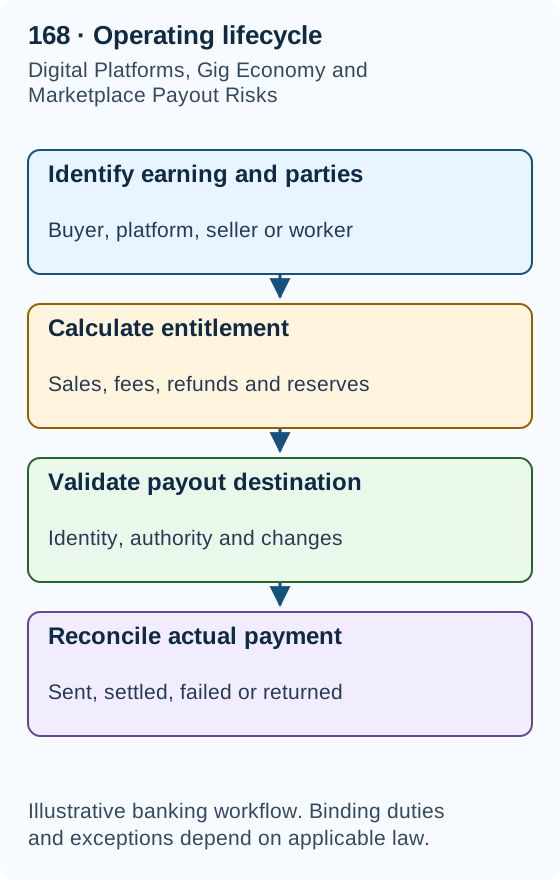
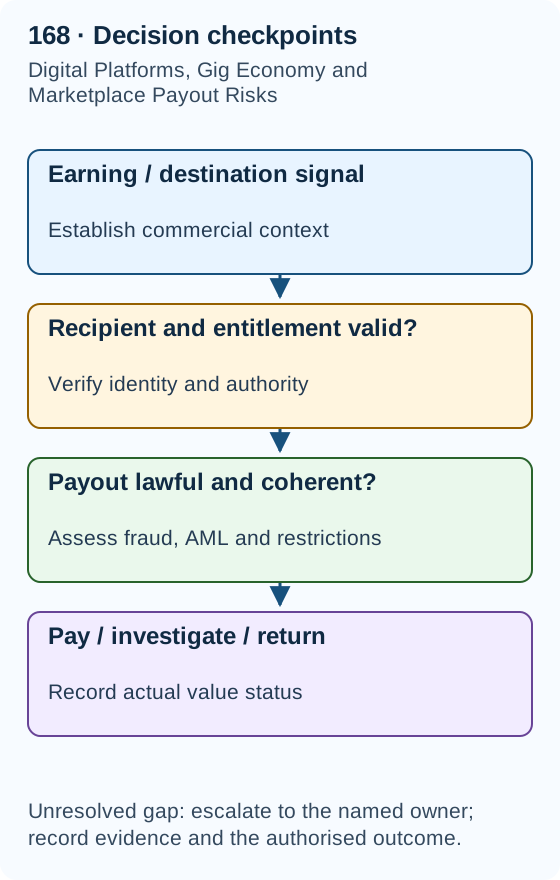
Describe the platform model before assessing the payout
A marketplace connects buyers with sellers, but its payment arrangements can vary substantially. One platform may send the buyer directly to a payment provider, while another receives money and maintains balances before paying sellers. A service platform may owe workers for completed tasks. A merchant of record may be the contractual seller to the buyer and make a separate payment to a supplier. These distinctions affect entitlement, records, refunds and responsibilities. The bank should describe the actual model instead of treating every business with an app as one risk category.
The description should identify each legal person and its role. Who contracts with the buyer? Who provides the goods or service? Who determines the amount payable? Who holds money before payout? Who sends the bank instruction? Who can amend the destination or approve a refund? A group brand can conceal several entities performing these functions. Contracts, account titles, operating procedures and actual transaction samples should support the map. A diagram based only on the platform's sales presentation may omit the party with effective control over funds.
Include exceptional paths as well as the normal flow. A failed payment may return money to a suspense balance. A dispute may create a reserve. A worker may use an authorised agency arrangement. A seller may receive an advance against future sales. A payout may move through a different provider in another country. These paths can change both financial-crime exposure and who owes what to whom. The bank needs to understand them before deciding that all credits represent completed ordinary sales.
The output is an operating model with evidence, not a label such as low-risk technology company. Product owners explain entitlement and commercial mechanics; payments teams explain execution; legal and compliance assess applicable obligations. The model should identify what the bank can directly observe and what it relies on the platform to substantiate. That distinction guides onboarding, data requirements, monitoring and assurance. It also makes later investigation more precise when a transaction pattern departs from the declared business.
Follow value from commercial event to final bank movement
A platform payout is often a net amount. Consider a fictional seller with gross sales of 1,000 units, refunds of 100, platform fees of 60 and a retained reserve of 40. The resulting entitlement is 800 units before any other approved adjustments. The bank payment should be connected to the relevant events and ledger entries. The fact that a bank debit of 800 occurred proves external movement; it does not establish that the underlying sales were genuine or that the recipient was entitled to them.
The gross-to-net calculation needs stable identifiers. Link orders or tasks to the seller or worker, collection events, adjustments, entitlement and payout instruction. Where several earning events are aggregated into one payment, retain the allocation. Where one entitlement is split across payments, retain that relationship too. Without these links, a platform can produce matching aggregate totals while assigning value to the wrong participant. Amount reconciliation and entitlement reconciliation are related but different controls.
Timing can explain legitimate differences. A buyer payment may be authorised before capture, a task may be approved after completion, and a seller's funds may become payable only after a dispute period. A reserve release can create a payout larger than that week's new sales. The investigator should identify the relevant status and date for each event. Comparing today's bank payout directly with today's sales count can produce a false anomaly if the platform operates a lagged settlement cycle.
The bank should distinguish external cash from internal allocation. A platform ledger credit may represent an entitlement, promotional credit, adjustment or financing advance. It is not necessarily a fresh bank receipt. Conversely, a bank credit may fund several ledger categories. Reviewers should understand the codes and posting rules, including reversal treatment. A value-path explanation that identifies the originating event, transformations and final disposition provides a stronger basis for risk assessment than a screenshot displaying a seller's balance.
Identify the person, business and account roles separately
The user who logs into an application may not be the contractual seller, the person who performed the work or the owner of the payout account. A company may employ several workers, an agency may collect authorised payments, and a sole trader may use a business account under a trading name. These are plausible structures, but they need evidence appropriate to the service and applicable obligations. A successful authentication event demonstrates credential use; it does not establish every commercial or legal role.
Identity assessment should distinguish the platform customer, relevant business owners, authorised operators, workers and beneficiaries. Record which checks were performed on which role and by whom. Avoid transferring a verified status from one role to another automatically. For example, verification of a company's director does not show that every person using its seller profile is authorised. Confirmation that a bank account exists does not prove the platform user is entitled to direct payments to it.
Changes need historical records. A worker's profile, seller ownership and payout destination may each change at different times. An investigation concerning last month's payment needs the versions effective at that time, not only today's profile. Record who requested and approved changes, the authentication method, supporting evidence and subsequent activity. A system that overwrites the previous destination can make a redirected payout impossible to explain even when current onboarding appears complete.
Context prevents unfair conclusions. Legitimate workers may share a household device, businesses may share an accountant, and an agency may administer several authorised payees. These arrangements can resemble a network of controlled accounts in a graph. The analyst should test the economic and authority explanation rather than equate shared infrastructure with criminal control. At the same time, a plausible explanation should be corroborated where the risk warrants it; a tick-box statement that everyone belongs to one agency is not sufficient by itself.
Assess obligations and visibility at the bank's actual position
A bank holding a platform's collection account may see aggregate credits and payout debits but little underlying commerce. A bank acting as the payout provider may receive beneficiary information and individual instructions. A bank holding a worker's personal account may see incoming credits without access to the platform's task records. These positions create different information gaps and control opportunities. The bank should identify its own role and applicable duties rather than assume another party has already performed every necessary check.
Platform classification requires activity and jurisdiction analysis. In the UK, the FCA's marketplace guidance explains that a marketplace receiving customer money before passing it to sellers may be providing payment services; exclusions and actual arrangements need assessment. This is a UK perimeter example, not a rule for every country. A commercial label, use of a licensed partner or presence on a register does not alone settle the bank's own customer due diligence or the platform's permissions for each activity.
FATF standards provide relevant anchors for customer due diligence, payment transparency and suspicious reporting, with binding requirements arising through applicable national frameworks. Do not infer a universal threshold, exemption or reporting duty from the phrase gig economy. Employment classification, tax reporting, payment authorisation and AML obligations are distinct questions even when they concern the same person. Where the platform changes its role, the assessment should be updated rather than relying indefinitely on the original legal opinion.
Visibility gaps should become explicit data and assurance requirements. Identify which records the platform or provider holds, how the bank can lawfully obtain them and what evidence demonstrates their quality. A contractual promise to supply information is weaker than a tested retrieval process. If the bank cannot understand material flows or satisfy its duties with available information, the relevant owners need to decide whether to improve the arrangement, constrain the service or decline it under the applicable framework.
From earning event to final recipient
Map the buyer or payer, commercial event, seller or worker, platform, payment provider and final bank account. Record gross value, fees, adjustments, reserves, refunds and net entitlement. Clarify who owns funds at each stage and which entity owes the payout.
Onboard sellers or workers according to the relevant obligations and risk model. Identity, authority, ownership and payout-account evidence should be adequate for the service. A valid login proves credential use rather than genuine economic activity. Where the platform delegates checks, the bank or regulated provider still needs evidence sufficient for its own duties.
Monitor changes to payout accounts, unusual earning spikes, common destinations, rapid onboarding-to-cash-out and transactions inconsistent with the service. Investigate with commercial context: seasonal work, genuine businesses sharing an accountant or permitted agency arrangements can explain patterns. Preserve both supporting and contradictory evidence.
Reconcile platform entitlements to payout files, provider responses and actual bank settlement. A payout marked sent may fail, return or remain pending. Retry controls must prevent duplicate payments and false closure of cases. When a platform fails, outstanding entitlements and safeguarded or held funds require treatment under the applicable contractual and legal framework.
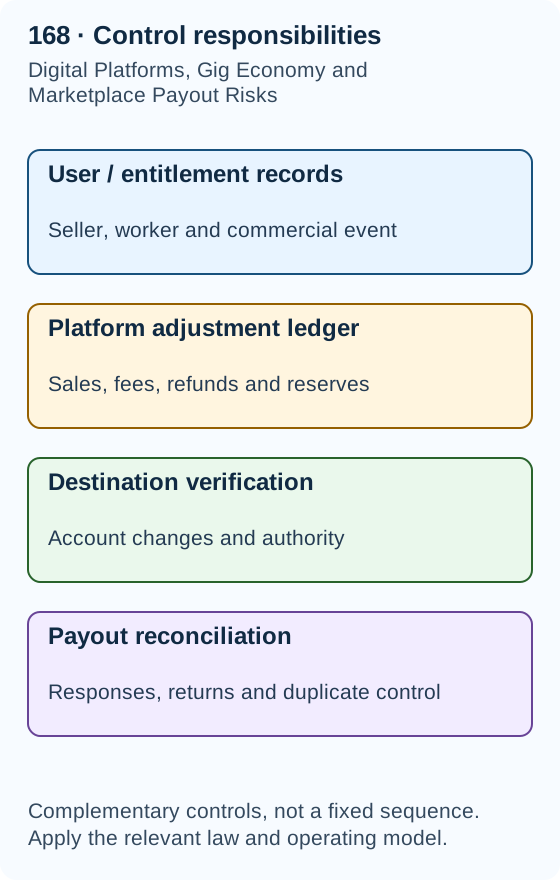
Onboard the platform's commercial model and participant arrangements
Platform onboarding should establish more than incorporation and a website address. Understand the service, intended countries, participant types, collection methods, payout methods, expected volumes and exceptional flows. Obtain an explanation of how the platform creates and approves entitlements. Identify who can change ledger balances, release reserves or redirect payments. These permissions reveal opportunities for abuse that a customer risk score alone may miss. The depth of inquiry should reflect the bank's role, exposure and applicable obligations.
Participant arrangements need their own analysis. A business seller, an individual worker and an agency collecting on behalf of others are different relationships. The bank should understand which party the platform treats as its customer and which checks support payout authority. Where checks are outsourced, identify the provider, scope, evidence and escalation. A statement that all users are verified should be tested: verified for what purpose, using which records, at which time and with what treatment of exceptions?
Expected activity should be specific enough to support later comparison. A transport platform may have many small daily worker payouts and fuel-related adjustments. A specialist marketplace may have irregular high-value sales, shipping records and longer dispute periods. A professional-services platform may pay after milestones and support authorised business accounts. The bank should avoid a single generic expectation for all three. Seasonality, settlement lag and reserve release should be recorded so legitimate changes do not automatically become unexplained spikes.
Information requests should be proportionate and lawful. Collect what supports the applicable duties and risk assessment, with controlled access and retention. The bank should not obtain every worker's sensitive document merely because it could be useful someday. Where information gaps affect the service, explain the required evidence and acceptable alternatives through the approved process. Good onboarding supports both financial-crime control and access for legitimate participants whose circumstances differ from the platform's simplest default model.
Treat payout-destination changes as a controlled state transition
A destination change shortly before payment can redirect legitimate earnings after account takeover or facilitate deliberate concealment. The control should examine the change event, the prior destination, the proposed destination, the user session and the entitlement being paid. A new account number is not just a profile edit when it determines where accumulated value goes. Link the change to the payout instruction and retain the version effective when the instruction was approved.
Verification should address both credential use and account authority. Strong login authentication can reduce takeover risk, but an attacker with compromised credentials may still pass it. A bank-account validation service may establish account details without resolving entitlement or an agency arrangement. The platform and bank should identify which checks are appropriate for the model, including additional review where risk indicators combine. Avoid treating one successful technical check as a universal assurance that the change is legitimate.
Operational design should state what happens while a change is under review. Does the payout remain queued, use the prior destination or require re-approval? Each option can have contractual, customer and risk implications. Product, legal and control owners should decide the permitted treatment rather than leave it to an engineer's default. A worker may have legitimately closed the former account, so automatic reuse can also cause harm. Record the decision and provide an appropriate correction or appeal route.
Monitoring should connect destination changes across profiles without assuming common ownership proves abuse. Several authorised agency workers may use one account; unrelated new profiles may also converge on a mule account. Examine identity, authority, commercial events and timing together. Preserve accepted and rejected explanations. If the change is reversed after payout, retain both versions and the payment result. The historical chain matters when investigating loss, reporting suspicion or explaining why the bank intervened.
Test whether the earning event represents genuine economic activity
A platform can generate a technically valid ledger credit from a fabricated order or task. The financial-crime question is therefore not only whether the payment instruction is well formed, but how the entitlement arose. Review the evidence appropriate to the business: order details, task completion, delivery, customer acceptance, cancellation and dispute records. No single document proves every service. The aim is a coherent, corroborated commercial explanation, with limitations visible.
Collusion can make superficially normal events look credible. A seller and buyer controlled by related parties may create repeated sales, reviews and confirmations while moving value through payouts. An employee with ledger privileges may add manual credits. A worker may submit duplicated tasks or use another person's identity. These are hypothetical abuse paths to test, not allegations about all platform users. Monitoring should look for combinations inconsistent with the declared model and route them for contextual investigation.
Event integrity starts before AML analysis. Stable event identifiers, valid status transitions, duplicate detection and controlled manual adjustments support reliable entitlement records. An earning event should not become payable merely because an integration resent it. A cancelled order should have a defined effect on entitlement. Record who can override the rule and why. If operational data is unreliable, investigators may spend time explaining false patterns while genuine manipulation remains hidden in inconsistent status history.
Investigation should distinguish a commercial dispute from a suspicion of illicit activity. A buyer complaint may be genuine dissatisfaction rather than evidence of laundering. An apparently delivered product may still involve stolen payment credentials. A worker with unusually high earnings may have worked during a seasonal surge. Examine supporting and contradictory evidence before reaching a decision. A useful conclusion explains which aspect of the event is established, which remains doubtful and how that affects payout, fraud and reporting decisions separately.
Keep refunds and disputes connected to the original value path
Refunds can legitimately reverse a failed purchase, but they can also redirect value or conceal fabricated commerce. Link each refund to the original order, collection, entitlement and recipient. Record who approved it and which contractual or scheme process governs it. A refund that exceeds the original eligible value, uses a different destination or follows payout needs explanation. These features are investigation signals; they are not proof of wrongdoing without the commercial and payment context.
The platform should explain how a late refund affects the seller's balance. It may reduce a reserve, create a negative entitlement or lead to a later recovery under the applicable arrangement. The bank should not assume that a debit from the platform's pooled account belongs to the same participant whose sales funded it. Reconcile the internal allocation and external cash separately. A correct aggregate balance can still conceal misallocation of refund losses among sellers.
Disputes and chargebacks have distinct lifecycle states. A claim may be pending, resolved, reversed or subject to further action. Monitoring and customer decisions should use the actual status rather than treat every initial complaint as a final confirmed loss. Preserve the record at each material decision point. If the bank reports a pattern, explain whether the figures concern allegations, accepted disputes or settled recoveries. This avoids overstating the evidence and makes changes after reporting understandable.
Review exceptional refunds as a population. Examine manual approvals, destination overrides, repeated buyer-seller links and concentration around payout dates. Test legitimate explanations such as a failed event, a product recall or a documented system incident. Controls should avoid forcing frontline staff to choose between an unapproved refund and a customer left without a lawful remedy. Define escalation, permitted alternatives and evidence requirements so the commercial process can operate without creating an easy value-diversion path.
Explain reserves, advances and financing separately from sales income
Platforms may retain reserves to cover refunds or disputes, release balances after a period, or provide advances against expected earnings. These mechanisms can create payouts that do not resemble current sales. The bank should identify each ledger category, the contractual basis, source of funding and approval process. A reserve release is not a new sale. An advance is not necessarily earned income. Mixing them into one generic settlement code makes both risk assessment and customer investigation less reliable.
Reserve allocation requires participant-level records. Who owns or is entitled to the retained amount under the applicable arrangement? Which events created it? What conditions allow release or application against losses? A pooled bank balance does not answer these questions. The platform's records should distinguish its own operating money, participant entitlements and other categories as required by the relevant framework. The legal treatment depends on jurisdiction and arrangements; the word reserve does not itself establish safeguarding or ownership.
Advances introduce additional risks and obligations. A platform may fund a seller before the buyer pays or before a dispute period ends. Assess whether the activity changes the regulatory perimeter, creates credit exposure or alters monitoring expectations. A rapid series of advances and repayments could reflect legitimate cash-flow management, fabricated volume or another explanation. The bank needs the mechanics and source records to distinguish them. Do not treat all incoming repayments as sales revenue when assessing commercial activity.
Assurance should trace representative reserve and financing events from approval through ledger treatment and bank movement. Check overrides, changes in terms, loss allocation and termination treatment. Ask what happens if a seller exits with a negative balance or a platform fails while holding reserves. The answer should come from applicable contracts, law and operational capability, not a dashboard label. Clear classification improves both financial-crime analysis and the bank's ability to respond fairly when the participant challenges a withheld payout.
Track payout instructions through rejection, return and retry
A payout has several possible states: created, approved, submitted, accepted for processing, settled, rejected or returned. The exact states depend on the provider and payment rail. A platform status called paid may mean only that an instruction was sent. The bank and platform should agree definitions and reconcile provider responses with actual bank movements. Otherwise an investigator may wrongly conclude that funds reached a beneficiary when the instruction failed before settlement.
Each instruction needs a stable identity and links to its entitlement, batch and beneficiary version. Retries should preserve the original attempt and the reason for another submission. An idempotency control can help prevent duplication in an integration, but its scope and lifetime need to match the operational process. A new identifier created for a retry may bypass a provider's duplicate check. The team should understand this behaviour rather than assume that a vendor's use of the word idempotent solves every replay risk.
Partial batch failure is a common source of confusion. If some payments settle and others fail, resending the entire batch can duplicate successful payouts. The retry population should be based on verified outcomes, with pending items handled explicitly. A delayed response is not proof of failure. Operations needs a controlled method for resolving uncertain states before reissuing value. Record manual interventions and approvals so the resulting history can be reconstructed later.
Returns require entitlement treatment too. A returned payout may need a verified new destination, investigation or refund to the appropriate source under the applicable arrangement. It should not disappear from monitoring because the original status was settled. Reconcile the returned bank credit to the participant ledger and subsequent disposition. If the destination changed between attempts, retain the reason and authority. This sequence can explain legitimate repair or reveal repeated diversion attempts that a final-status-only dataset would hide.
Reconcile pooled cash with participant entitlements and suspense
A pooled account can contain money associated with many participants and several lifecycle states. Reconciliation should distinguish bank cash, platform ledger allocations, pending collections, approved payouts, unsettled instructions, returns, reserves and suspense. The relationship depends on the model and timing. A team should define the expected bridge and explain material differences. Merely matching the opening and closing bank balance does not establish that every participant's entitlement is accurate.
Use both counts and amounts. Ten omitted small payouts may be offset by one erroneous larger payment, producing a matching total. Duplicate earning events can inflate one seller while a missing allocation understates another. Reconcile populations using stable identifiers, then compare values and statuses. Segment by currency, bank account, provider and relevant entity where necessary. A single global total can conceal a local shortfall or an incorrect currency conversion.
Suspense should have clear reasons, owners and ageing. An unmatched return, missing seller identifier or unresolved destination issue should not remain in one undifferentiated holding category. Review material and persistent items, including repeated manual clearance. Explain how the balance is eventually assigned or otherwise treated through an authorised process. Clearing suspense with a balancing journal is not evidence that the original value reached the entitled person.
Independent review should test the source populations and the bridge logic. Confirm that closed sellers, failed batches and exceptional adjustments are included where relevant. Verify how late events affect a completed reconciliation and whether reopening is controlled. If the bank relies on the platform's reconciliation, test its coverage and obtain suitable evidence. A signed summary is useful only when the underlying method can detect the failures that matter to the bank's responsibilities and exposure.
Preserve data lineage across APIs, vendors and ledger versions
Platform data often passes through an application, event queue, ledger service, payout engine, payment provider and bank. Each handoff can change field names, status meanings or identifiers. Map the lineage for material fields such as participant identity, entitlement, destination, instruction status and event time. Record which source is authoritative for each purpose. A monitoring rule using an obsolete field can appear active while receiving incomplete or misleading information.
Integration controls should detect missing and duplicate events, delayed responses and out-of-order updates. Compare source populations with received populations and preserve exceptions. A successful API response can confirm receipt of a request without confirming payment settlement. A webhook can be delayed or replayed. The system should not infer a final outcome solely from the absence of a response. Data owners and operations should agree how uncertainty is represented and resolved.
Version changes need analysis before release. A platform may rename the seller identifier, introduce split payouts or redefine a status from settled to submitted. These changes can alter monitoring and reconciliation even if the interface still renders correctly. Require a documented field contract, representative tests and approval by affected control owners. Retain historical definitions so investigators can interpret records from earlier versions. Silent schema changes can undermine several controls at once.
Vendor assurance should address evidence access, not only uptime. Can the bank retrieve historical destination changes and failed instructions? Are audit logs retained and attributable? Can a provider explain how an export was generated? What happens if the contract ends? The bank should test these questions using actual retrieval rather than accept a generic assurance statement. Controlled access and privacy remain relevant: technical availability does not automatically authorise broad disclosure or indefinite retention of participant information.
Connect fraud, AML and sanctions without merging their decisions
Fraud controls may detect stolen credentials, fabricated work or disputed purchases. AML analysis asks whether the observed facts create suspicion of money laundering or another reportable activity under the applicable framework. Sanctions controls assess applicable prohibitions and restrictions. These functions can use related facts, but their decisions and legal bases differ. A fraud alert is not automatically a sanctions match or a reportable AML conclusion. Equally, resolving a fraud complaint does not necessarily resolve the financial-crime concern.
The workflow should preserve these distinctions while sharing information lawfully. An account-takeover team may authenticate the legitimate worker and stop a redirected payout. The AML team may identify that the proposed recipient also receives unexplained payments from many unrelated profiles. A sanctions reviewer may need additional identifiers to resolve a potential match. Record each conclusion, supporting facts, decision owner and resulting action. One overall risk flag should not conceal an unresolved obligation or force every team to adopt another team's reasoning.
Customer interventions need defined authority and scope. Delaying a payout for verification, applying a contractual reserve, blocking a prohibited payment and exiting a commercial relationship are different measures. Product and legal owners should define the permitted paths and communication. Staff should not claim that AML rules permit permanent confiscation of earnings. Nor should an unresolved identity issue be disguised as a sanctions prohibition when no applicable restriction has been established.
Management information should reflect actual outcomes. Track takeover losses, reporting decisions, sanctions dispositions and payout errors separately, with links where useful. This makes control performance interpretable and avoids counting one case as several independent successes without explanation. Review contradictory evidence and accepted legitimate explanations. A control framework that only records escalations, never corrections or customer remedies, will struggle to demonstrate that it treats legitimate workers and businesses proportionately.
Understand cross-border payout, currency and alternative-asset paths
A platform can collect in one country, allocate value in a second and pay a participant in a third. Identify the legal entities, currencies, providers and accounts at each step. Record who performs conversion, which rate and fees apply, and how the participant's entitlement is represented. A bank movement in one currency may not match a platform ledger amount in another without a documented bridge. Unexplained differences should be investigated rather than automatically attributed to exchange rates.
Cross-border arrangements can affect permissions, information requirements, sanctions exposure and data transfer. The analysis should use the actual applicable frameworks, not assume that one licence or legal opinion covers every destination. A new payout country can introduce a new provider or materially different data visibility. Product change control should assess those dependencies before activation. Risk ratings should guide inquiry and controls rather than become unsupported conclusions about every participant in a country.
An alternative-asset payout creates another value path. If a platform offers virtual-asset conversion or withdrawal, identify the relevant service provider, recipient arrangements, conversion event and available transaction evidence. A blockchain address is not by itself a verified person, and on-chain movement does not explain how platform entitlement arose. Applicable virtual-asset rules and sanctions obligations require separate assessment. The ordinary bank-payout control should not be assumed to cover the new path merely because both begin from the same app balance.
Tax and labour questions remain distinct. A platform may have reporting responsibilities or worker-classification issues under local law, but those do not automatically settle AML suspicion or account entitlement. Use appropriately qualified specialists and current jurisdiction-specific sources when such issues affect the service. The bank's operational map should show relevant dependencies without asserting a universal global treatment. Clear boundaries allow investigators to focus on the facts they can establish and the decisions their function is authorised to make.
Identity, destination and payout assurance
Test a changed destination immediately before payout, repeated beneficiaries, fabricated earning events, refunds after payout and rejected bank payments. Keep identity confidence, fraud signals, AML suspicion and legal restrictions separate so each owner can make the correct decision.
Assess data coverage for individual payouts and underlying commercial events. A platform's summary report can reconcile aggregate cash while hiding excluded sellers or duplicate events. Reconcile population counts, identifiers and amounts, not only the final balance.
Exiting a seller or platform relationship requires a plan for lawful outstanding payouts, returns, disputes, records and protected reporting information. Commercial termination is not authority to confiscate earnings.
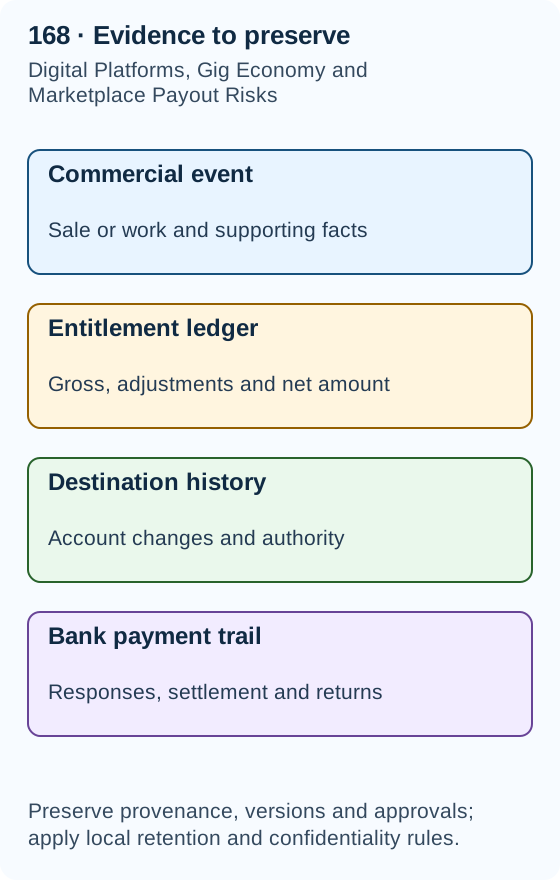
Fictional case: several workers use one agency destination
In this fictional case, a service platform submits payouts for twelve recently enrolled workers to one business account. Several profiles share contact details and device identifiers. A monitoring rule flags the common destination and rapid growth in earnings. The platform says the workers belong to an agency that manages scheduling and collects payment. These facts support inquiry, but they do not by themselves establish a mule network. The bank needs to test identity, authority, commercial activity and value allocation.
The investigator maps the parties: platform, agency, named workers and account holder. The account holder's business profile is compared with the agency explanation. The platform is asked, through the appropriate lawful route, for relevant contractual and authority evidence and a sample of earning-event records. The investigation does not assume that a worker's agreement to use the platform also authorises an agency to collect all earnings. It records which evidence supports each relationship and identifies unresolved participants.
Commercial testing examines task patterns, customer confirmation and the allocation of payouts. A genuine agency may have central administration and shared devices. It should still be able to explain which worker performed which task and how earnings are accounted for. An aggregate invoice from the agency may support the business model but not resolve every disputed identity. The reviewer looks for consistency across dates, locations and records without imposing an impossible expectation that legitimate workers must each own unique technology.
Suppose ten workers have coherent records and two profiles lack reliable identity or task evidence. The case should preserve that distinction. A broad conclusion that all twelve are fraudulent would exceed the facts; a blanket clearance based on ten would also be weak. The appropriate owners assess the unresolved payouts, any fraud protection and reporting decision under their frameworks. Customer communication and any restriction need an authorised basis, proportionate scope and a path for resolving legitimate exceptions.
The investigator also examines how the common destination was added. If the agency was authorised from onboarding, the pattern differs from twelve last-minute changes made through one compromised session. Historical account versions and authentication logs can change the assessment materially. If the agency destination is accepted, the system should retain the verified arrangement and review triggers rather than suppress every future alert involving the account. Changes in ownership, participant mix or activity may require renewed assessment.
The case is successful when the bank can explain both the accepted and unresolved relationships. The file should contain the original signal, verified facts, commercial context, contradictory evidence, decision owners and follow-up. It should not reduce the result to 'shared device equals fraud' or 'agency explanation accepted'. The lesson is that a useful signal points to a relationship requiring proof; it does not replace the work needed to determine whether the relationship is legitimate and the payout authorised.
Fictional case: apparently successful sales create circular value
In this fictional case, a marketplace seller's sales rise sharply after several new buyer profiles appear. Goods are described as specialist equipment, delivery records look superficially complete and payouts settle normally. Many buyers receive refunds after the seller has withdrawn earnings. Some buyer and seller profiles share contact or destination relationships. The bank sees aggregate marketplace activity and a series of payouts to the seller, but no immediate explanation of the underlying commerce.
The investigator starts with the value path rather than the apparent sales success. Link collections, orders, refunds, reserves and payouts. Determine whether buyer payments actually settled and whether refunds went to the appropriate destinations. Examine a risk-sensitive sample of commercial records through the lawful information route. The aim is to test the declared business and identify contradictions, not to decide that all high-volume marketplace sales are laundering. Preserve the distinction between confirmed payment events and platform-provided commercial assertions.
The sample shows repeated use of identical delivery evidence and orders with inconsistent item descriptions. Those findings increase concern, but the reviewer checks whether a platform export defect or legitimate consolidated shipment could explain them. The platform's source records and adjustment history are sought. A later export contains different descriptions; the analyst retains both versions and asks how the change occurred. Quietly replacing the earlier records would erase a material issue concerning event integrity.
The refunds reveal another layer. Some reverse genuine failed purchases; others are manual adjustments with unclear approval and destinations. The bank's analysis separates these populations. A circular pattern may involve related buyers generating apparent volume, seller cash-out and refunds financed from pooled funds or another source. The file should describe the observed links and gaps without claiming a complete criminal scheme beyond the bank's evidence. Any suspicion decision is made by the authorised function under the relevant reporting rules.
Product and operations owners assess immediate risks to outstanding payouts and other participants. A control response might require additional verification or a permitted restriction, but its authority and scope need approval. It should not automatically withhold unrelated sellers' earnings because the platform uses a pooled account. The platform's manual-adjustment permissions and reserve accounting are reviewed as possible control weaknesses. Operational repair and the reporting decision remain connected but separate.
The assurance question is whether the bank could detect and investigate fabricated commerce even when bank settlement appeared normal. Matching payout totals alone would not reveal the problem. Useful evidence includes source-event versions, commercial corroboration, refund approvals and participant-level allocations. The outcome should identify which facts undermine the explanation, which legitimate events remain supported and what additional information is necessary. That is a stronger conclusion than simply labelling the seller's rapid growth suspicious.
Fictional case: account takeover redirects accumulated earnings
In this fictional case, a worker has built an entitlement over several weeks. Shortly before a scheduled payout, the platform profile changes its email address and bank destination. The new destination also appears on unrelated profiles. A login challenge succeeds, so the automated system marks the update verified. The worker later reports losing access and says the payout account is not theirs. The bank and platform need to reconstruct the sequence and determine the permitted response.
The fraud team examines authentication, session and contact-change history. A successful challenge is considered evidence of the method used, not conclusive proof of the worker's intent. The payout team checks whether an instruction was merely created, submitted, settled or returned. The account-destination version effective at each stage is preserved. Customer support uses an approved process to authenticate the worker independently and avoid giving sensitive case information to the person controlling the compromised profile.
If the instruction has not settled, the relevant owners assess whether and how it can be stopped through the applicable process. If it has settled, recovery possibilities depend on the payment rail, law and circumstances. The bank should not promise automatic reversal or take money from another customer's account without authority. Record the factual status and authorised actions. The worker needs accurate communication and an appropriate route for remedy, including any applicable complaint or reimbursement process, rather than a generic message saying the transaction passed security.
AML analysis examines the common destination separately. Repeated credits from unrelated compromised profiles may support a concern about proceeds movement, but the investigator needs verified links and payment outcomes. The original worker may be a victim rather than a willing participant. The report, if required, should make that distinction and describe the bank's observations and limitations. A fraud label copied across every linked profile can misidentify victims and weaken the explanation of the receiving account's role.
The platform reviews why contact and destination changes could release accumulated value so quickly. It tests whether the control considered recent changes, previous destination, unusual access and entitlement size together. A universal long delay may harm legitimate workers; a control that ignores all change risk is also weak. Product, legal and risk owners design a proportionate process with escalation and correction paths, then test representative legitimate and malicious scenarios. The repair should address the failed decision mechanism rather than merely add another warning banner.
The evidence pack includes the chronology, profile versions, entitlement calculation, instruction lifecycle, customer authentication and decision records. It identifies what remains uncertain about the attacker and recipient. Success means protecting and treating the worker appropriately, investigating the destination and improving the control without overstating any fact. The case demonstrates why identity confidence, payout authority, fraud response and suspicious reporting must remain distinguishable even when one incident activates all four.
Fictional case: a partial batch failure produces duplicate payouts
In this fictional case, a platform submits a batch of five hundred payouts. The provider returns timely outcomes for four hundred, while the remaining responses are delayed. An operator interprets the missing responses as failed and resends the full batch with new instruction identifiers. Some original payments had already settled. The resulting bank debits exceed the platform's expected entitlement total, but a later balancing adjustment makes the dashboard's closing balance appear correct.
Operations first preserves the original batch, responses, resubmission and ledger changes. It distinguishes settled, rejected, returned and unresolved instructions using provider and bank evidence. The investigation does not treat every missing response as a failure or every second identifier as a new legitimate entitlement. Link each attempt to its original earning allocation and destination version. This population reconciliation shows where value may have been duplicated and which payments remain uncertain.
The balancing adjustment is examined separately. It may be an attempt to represent a known operational loss, but it cannot establish that participants received the right amount. Identify who posted it, its purpose and approval. Reconcile the participant ledger before and after the adjustment and retain the history. If the adjustment conceals duplicate payments or reallocates losses incorrectly, that is a further issue. A correct final aggregate balance does not repair entitlement records automatically.
The bank assesses the incident's legal and customer consequences through the appropriate owners. Recovery from recipients, communication and loss allocation require the applicable contractual and legal basis. A recipient's receipt of a duplicate payment does not by itself prove fraud, although subsequent conduct or other facts may require assessment. The AML function considers any separate suspicious behaviour without converting the whole technical incident into a criminal allegation. Reporting and incident obligations are assessed according to the relevant frameworks.
The control repair addresses uncertain states and replay. Define which outcomes permit retry, how pending items are resolved and how original identifiers survive reprocessing. Test provider-specific duplicate controls and the platform's handling of a new identifier. Require approval for manual resubmission and a reconciliation of the retry population. A rule preventing identical filenames would be insufficient if the replay creates a different file containing the same economic instructions.
The final assurance test recreates a partial failure with delayed and out-of-order responses. Successful payments must remain settled, unresolved items must stay visible, and authorised retries must not duplicate value. The reviewer also checks that incident adjustments cannot hide participant-level differences. The case shows how a bounded operational failure can become a financial-crime concern when records are obscured, losses misallocated or recipients exploited. Accurate state history is essential for deciding which explanation fits the evidence.
Fictional case: the platform exits while participant money remains
In this fictional case, a platform loses a key provider and decides to stop operating. Its pooled account contains collected buyer funds, seller entitlements, reserves, returned payouts and the platform's own operating money. Several disputes remain open. A commercial manager asks the bank to close the account immediately and send the whole balance to a new company that plans to acquire the platform's brand. The proposed recipient is not automatically entitled to every category of money.
The bank establishes the account-holder identity and the relevant contractual and legal arrangements. Product, legal and operations owners determine the treatment of participant balances, outstanding payments and any applicable safeguarding or insolvency requirements. The team does not infer ownership merely from the account title or the acquirer's business plan. The word platform balance is too broad to resolve the issue. A verified ledger allocation and an applicable legal basis are needed for the proposed dispositions.
Operations reconciles bank cash to participant records and identifies unresolved suspense. Returned payouts are linked to original recipients and attempts. Reserves are assessed according to their terms and applicable treatment. The team records where the ledger is incomplete or disputed and how that affects the exit plan. A forced balancing entry would conceal the allocation problem. It is better to identify a controlled unresolved population than to create artificial certainty so the account can be closed quickly.
Customer treatment remains central. Legitimate sellers and workers may rely on outstanding earnings. Buyers may have refund rights and disputes. The bank should implement authorised treatment and communication, with appropriate escalation for exceptions and vulnerable circumstances. It should not promise every participant immediate payment when the available funds or legal process do not support it. Nor should it treat commercial termination as permission to retain or confiscate money indefinitely.
Financial-crime controls continue through exit. A new destination, bulk transfer or ownership change can alter risk and permissions. The receiving entity and value path need assessment under the applicable obligations. Any protected reporting information must remain appropriately controlled; an acquirer does not automatically receive the bank's internal suspicion records. Record-retention and evidence access arrangements need attention before systems or vendor contracts are switched off.
The exit plan is reviewable when it shows each balance category, entitlement basis, authorised disposition, pending issue and owner. It includes the final reconciliation, payment outcomes, retained records and evidence of approvals. A manager should be able to explain why a particular transfer was permitted and why another remained unresolved. The lesson is that termination is a financial and legal process, not just a commercial status change in the customer database.
Worked shared-destination case
A fictional platform pays several newly registered workers into one account, following last-minute destination changes. Investigate whether an authorised agency arrangement, identity abuse or another explanation fits the facts. Verify entitlement and account authority and assess fraud protection and reporting separately.
Explain why a common destination is a useful signal but not a conclusion, and identify the records needed to reconstruct the earning and payout sequence.
Laboratory: map a new platform and challenge the information gaps
Use this fictional exercise to assess a platform that connects customers with home-service workers. Buyers pay at booking, workers become entitled after task approval, and the platform can retain a dispute reserve. An agency administers some workers and requests a common payout account. The bank is asked to hold the collection account and execute payout batches. The initial presentation contains only a simple arrow from buyer to platform to worker.
Prepare a role and value map identifying the contractual parties, legal entities, funds holders, entitlement decisions and payment providers. Add cancellation, reserve, refund, failed payout and agency paths. Distinguish platform ledger entries from bank movements. Record what the bank can see directly and what evidence the platform must supply through the lawful arrangement. The map should expose whether one party controls identity, earning approval and destination changes without an independent check.
Develop an activity-to-obligation assessment with questions for legal and compliance rather than invented global conclusions. Identify the relevant jurisdictions and possible changes if the platform starts holding reusable balances or making advances. Specify evidence for the agency's authority and participant allocation. Propose data requirements that are necessary and proportionate for the bank's role. A demand for every possible worker document is not a substitute for identifying which facts the bank actually needs to establish.
The facilitator challenges the map with three changes: an additional payout country, instant withdrawal and a new payment provider. Explain which controls, data fields and legal assessments need reconsideration. A strong answer identifies dependencies and release conditions. A weak answer says that the original platform approval covers all future services. The exercise is passed when the bank can understand the model, identify its own responsibilities and state what unresolved information prevents a defensible launch decision.
Laboratory: calibrate a common-destination monitoring scenario
In this fictional exercise, a rule flags any destination used by more than one platform participant. It generates many alerts for legitimate agencies and households, while some abusive networks use unique destinations and escape the rule. Learners must improve the decision framework without inventing a universal safe number of users per account. The task is to identify relevant relationships, combinations of signals and a method for evaluating performance.
Create a population that distinguishes individual workers, business sellers, authorised agencies and unresolved arrangements. Examine destination changes, account authority, earning-event integrity, participant age and settlement timing where relevant and lawful. A common account can remain a useful signal when combined with unexplained last-minute changes or fabricated activity. An accepted agency arrangement may justify a different review path, but not blanket suppression of all future activity. Record which facts support the segmentation.
Design a risk-sensitive sample of alerts and non-alerts. Include confirmed legitimate arrangements, unresolved cases, incidents and data-quality exceptions. Review whether the scenario identifies the concerning relationships and whether its explanations are fair to legitimate participants. Do not measure success only by reducing alert volume. A rule that closes fewer alerts because it stops detecting a vulnerable population may look efficient while weakening control. Preserve the decision evidence and limitations of the evaluation.
Finally propose monitoring, investigation and customer-resolution changes with named owners. The platform may need better agency records, the bank may need destination history, and investigators may need clearer commercial evidence. Threshold adjustments alone will not repair missing data. State how the revised scenario will be validated and when it should be reviewed after model changes. Successful calibration improves the quality of decisions and the ability to explain them, rather than claiming that a score proves a participant is legitimate or criminal.
Laboratory: reconcile a mixed payout population and its exceptions
In this fictional exercise, a platform reports gross earnings, fees, refunds and reserves for a settlement period. Its payout file contains approved instructions, while the provider file includes settled, rejected and pending outcomes. The bank statement contains debits and several returned credits. One instruction appears twice under different identifiers, and a reserve release has no linked earning allocation. Learners should construct a reconciliation that can reveal both amount and entitlement problems.
Start with stable populations and identifier relationships. Link earning events to participant entitlements, entitlements to instructions and instructions to provider and bank outcomes. Separate currencies and date conventions. Build the gross-to-net bridge, then classify exceptions by cause rather than put every difference into suspense. Identify duplicate attempts, unresolved states, returns and unsubstantiated adjustments. Explain where the available records are insufficient and which source or owner can resolve the gap.
Prepare a review note that distinguishes timing differences from errors. A pending instruction may explain an unsettled amount without justifying retry. A returned payout needs allocation to its original entitlement and subsequent treatment. A reserve release requires a valid basis, not merely enough cash in the account. The double instruction requires outcome verification before any recovery or correction decision. Do not balance the exercise by creating a journal that hides the unexplained population.
Assess the result using both counts and values. Can a second reviewer reproduce the bridge and identify every material unresolved item? Do the totals reconcile without masking participant misallocation? Is each exception assigned to an owner and controlled process? The final product should support operational correction and financial-crime investigation separately. A clear reconciliation can reveal suspicious manipulation, but it also prevents a legitimate technical or timing issue from being inaccurately described as evidence of laundering.
Requirements and operating accountability
Preserve stable identifiers for users, businesses, earning events, ledger adjustments, payout instructions and bank responses. Version account changes and require appropriate verification and approval. Keep failed, returned and retried payouts visible rather than overwriting the original status.
Acceptance tests cover missing beneficiary information, late refunds, duplicate files, partial batch failure and platform termination. Product owners explain entitlement mechanics; operations reconcile value; fraud and AML specialists assess distinct concerns; legal validates restrictions and exit treatment.
Release readiness means the bank can identify the entitled recipient, trace the actual value path and defend each intervention with evidence.
Build an investigation file that explains the platform's evidence
A platform investigation file should begin with the signal and the bank's role. Describe the customer or participant, relevant activity and source of the concern. Then show the commercial event, entitlement calculation, destination history, instruction lifecycle and actual bank movement. Separate information supplied by the platform from facts verified in the bank's systems. This provenance helps the decision maker evaluate confidence and identify what remains uncorroborated.
Evidence should address the actual hypothesis. If the concern is fabricated earnings, task or order integrity matters. If it is payout diversion, destination authority and change history matter. If it is circular value, buyer-seller relationships, refunds and source funding matter. A large collection of unrelated screenshots can obscure these questions. Link material records to the reasoning, preserve contradictions and explain why a plausible legitimate account is accepted or rejected. The conclusion should not simply repeat the scenario name.
Where reporting is required, the authorised officer should describe the bank's suspicion, observations and limitations under the applicable framework. Do not present every worker as an offender when some appear to be victims. Do not claim the bank proved delivery or beneficial ownership if it relied on an unverified platform assertion. Include relevant identifiers and chronology in the form required locally, with accurate payment statuses. A failed instruction should not be described as settled proceeds movement.
Retain the filing or non-filing decision and its evidence version, while protecting reporting confidentiality. Underlying business records, internal analysis and protected reports can require different access and disclosure treatment. A platform's commercial team does not automatically need the report itself to implement a lawful operational decision. Set appropriate follow-up triggers for new facts, unresolved recipients or changing activity. A defensible file makes the reasoning reviewable without turning uncertainty into either an unsupported accusation or an automatic clearance.
Give every material platform control an accountable owner
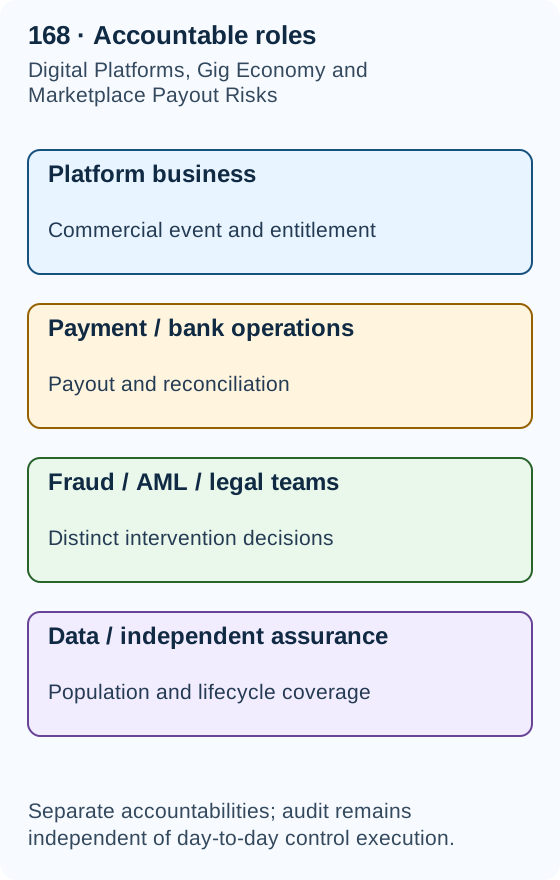
Platform risk crosses organisational boundaries. Product owners define entitlement and exceptional paths. Operations manage collection, payout and reconciliation. Fraud specialists address takeover and fabricated activity. AML specialists assess suspicion and reporting. Sanctions specialists resolve applicable restrictions. Legal assesses permissions, contract treatment and customer interventions. Technology and data owners maintain interfaces, logs and lineage. The bank should identify how these roles interact rather than assign all responsibility to one generic financial-crime team.
Outsourcing needs a clear accountability map. A platform may use one identity provider, another ledger vendor and several payout providers. Identify which party performs each control, which entity remains responsible and what evidence is available. Contracts should support suitable access, service and exit arrangements, but operational testing is necessary. A vendor assurance report may cover infrastructure without demonstrating that the platform's entitlement calculation or agency verification works. Match assurance scope to the control the bank relies on.
Escalation should include conflicting decisions. A commercial owner may want immediate payout, fraud may suspect takeover, and legal may identify limits on a proposed restriction. The workflow needs an authorised resolution path, recorded rationale and accurate implementation instructions. A queue status saying blocked should identify what decision is pending and who owns it. Staff should not bypass the control through another provider simply because the original service has held an instruction for review.
Independent assurance should examine design and operation across the value path. Test representative ordinary, exception and exit scenarios, source completeness and evidence quality. Review accepted explanations as well as escalations. Track targeted remediation and confirm that it survives subsequent product changes. Governance is effective when management can understand residual risk and customer impact and when operators can implement lawful decisions precisely. A committee meeting and a policy document do not establish those outcomes by themselves.
Validate changes and measure outcomes across the payout lifecycle
Every material product change should be assessed for its effect on identity, entitlement, funds flow, legal duties and data coverage. Instant payouts shorten the time available for verification. Split payments alter allocation and reconciliation. A new provider changes status definitions and retrieval arrangements. New participant types can change authority evidence. The approval should identify these effects and release conditions, with testing that demonstrates the affected controls still work on representative populations.
Acceptance tests should include legitimate exceptions and adverse cases. Test an authorised agency, a worker changing a closed bank account, a late refund, a failed payout, a delayed response and a partial batch replay. Confirm that rejected, returned and pending items remain visible. Test missing identifiers and unexpected schema versions. Check customer communication and escalation where an intervention is permitted. A system that processes the normal happy path quickly can still fail the scenarios most likely to create loss or obscure suspicious movement.
Performance measures should explain their denominators and decision stages. Payout success can mean submission acceptance or final settlement; specify which. Alert closure speed should be paired with decision quality and relevant missed-case testing. Track unresolved reconciliation items, destination-verification outcomes, correction rates and customer remedies where appropriate. Segment by model, participant type and provider so a global average does not hide a weak path. Avoid treating higher reporting volume or fewer alerts as proof of better control without supporting analysis.
Maintain review triggers after launch. Changes in the platform's activity, ownership, countries, provider arrangements or data definitions may invalidate earlier assumptions. Revisit the commercial model and legal assessment when those facts change. Retain versioned evidence so the bank can explain historical decisions as well as today's configuration. The release standard is practical: the bank can identify entitlement, trace value, detect relevant exceptions and defend each intervention with reliable evidence and an applicable basis. That remains the objective throughout the platform relationship and its eventual exit.
References and further reading
Reviewed 2 October 2026. FATF provides international standards; applicable national law determines binding duties. The operating examples are fictional teaching cases.
- FATF Recommendations, updated June 2026 — relevant anchors: 10, 16 and 20.