Canada Financial Crime Operating Model
Canada’s financial-crime framework is easiest to understand when it is treated as an operating system rather than a list of acronyms. The legal foundation for most anti-money-laundering and anti-terrorist-financing obligations is the Proceeds of Crime (Money Laundering) and Terrorist Financing Act, usually shortened to the PCMLTFA, together with its regulations. FINTRAC, the Financial Transactions and Reports Analysis Centre of Canada, has two roles that matter directly to a bank: it supervises reporting entities for compliance with the Act and Regulations, and it operates as Canada’s financial intelligence unit by receiving, analysing and, where legal thresholds are met, disclosing financial intelligence to competent authorities.
That already creates an important design principle. A bank’s Canada control framework is not simply “KYC plus transaction monitoring”. It has to join customer identification, beneficial ownership, risk assessment, ongoing monitoring, prescribed transaction reporting, suspicious transaction reporting, sanctions-related obligations, record keeping, training, quality control, technology, privacy, investigation and governance into one traceable chain. Some obligations are triggered by a transaction amount or event. Others depend on a risk assessment or a suspicion threshold. Some are FINTRAC obligations, while others arise under sanctions legislation administered through a different legal framework. A mature operating model keeps those distinctions visible even when the same data and case-management platform supports all of them.
The other essential principle is jurisdictional discipline. Canada is a federal state. Banks can be federally regulated, while other financial businesses may fall under provincial or territorial frameworks as well as federal AML requirements. A multinational banking group may also apply group standards, foreign sanctions requirements or correspondent-bank expectations because of the legal entity, currency, payment route, ownership structure or contractual relationship involved. The correct question is therefore never “What does Canada require?” in the abstract. It is “Which Canadian obligation applies to this reporting entity, product, customer, transaction and date, and what other binding or group requirements also apply?”
The mental model: five connected layers
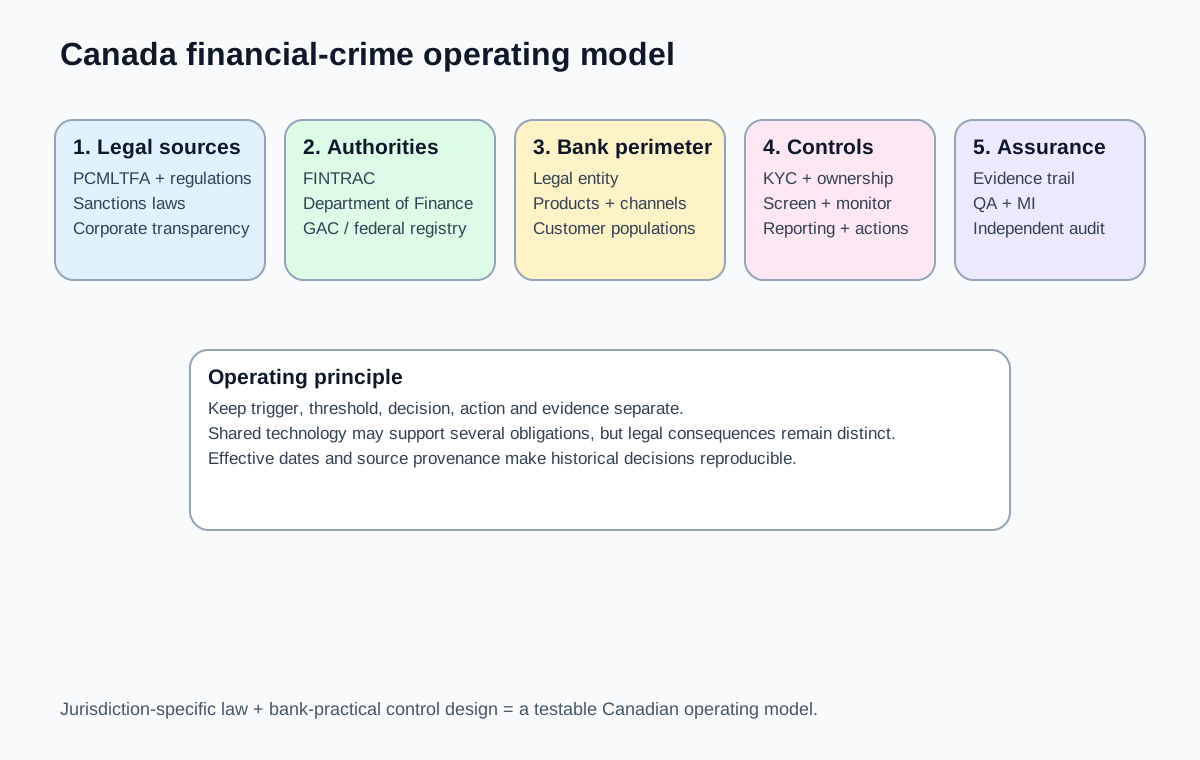
A practical Canada operating model can be visualised in five layers.
The first layer is law and public policy. The PCMLTFA and its regulations create the core AML/ATF framework for reporting entities. Canada’s sanctions architecture separately uses legislation including the United Nations Act, the Special Economic Measures Act and the Justice for Victims of Corrupt Foreign Officials Act. Other criminal, privacy, corporate-transparency, banking and law-enforcement frameworks interact with the financial-crime programme.
The second layer is public authorities. The Department of Finance coordinates federal AML/ATF policy. FINTRAC supervises compliance and functions as the FIU. Law-enforcement and national-security bodies receive financial intelligence or use their own lawful powers. Corporations Canada operates the federal beneficial ownership registry for corporations governed by the Canada Business Corporations Act. Global Affairs Canada publishes and administers information relating to Canadian sanctions regulations. The Office of the Superintendent of Financial Institutions supervises federally regulated financial institutions across its own prudential, integrity and security mandate; that mandate should not be confused with FINTRAC’s statutory AML compliance role.
The third layer is the bank’s legal-entity and product perimeter. The Canadian bank or branch has to know which of its businesses are reporting entities, which products and channels create reportable events, which systems hold customer and transaction evidence, which functions make decisions and which external reporting channels are used. It also needs to distinguish direct customers from parties appearing only in payment or correspondent data.
The fourth layer is the control chain. Customer due diligence establishes who the customer is and why the relationship makes sense. Risk assessment determines where additional measures are needed. Screening checks parties and other data against relevant sanctions or risk sources. Monitoring looks for behaviour that may warrant review. Investigators establish whether the facts and context reach a legal or policy threshold. Reporting teams submit required reports and preserve acknowledgements. Operations carry out any lawful restriction, hold, rejection, release or account action. Quality assurance and management information test whether the chain remains effective.
The fifth layer is evidence and assurance. Every material decision should be reproducible. A reviewer should be able to identify the data used, the rules or model version applied, the analyst reasoning, the applicable obligation, the approver, the customer or payment outcome, the external report reference where relevant and any later remediation. Without that evidence, a bank may have performed the right activity but still be unable to demonstrate control effectiveness.
What FINTRAC expects from a compliance programme
FINTRAC’s current compliance guidance explains that reporting entities must establish and implement a compliance programme. The programme is not one policy document. It includes appointment of a compliance officer, written and maintained policies and procedures approved at the appropriate senior level, a documented risk assessment, an ongoing training programme, and a plan for reviewing the effectiveness of the programme. The effectiveness review is not meant to be a ceremonial document. It should test whether policies, risk assessment, training and operational controls actually work.
For a bank, this becomes an ownership model. The first line owns customer and transaction processes and must execute controls correctly. A financial-crime compliance function designs or oversees policy, challenge, advice, risk assessment and regulatory interpretation. Technology teams provide screening, monitoring, reporting, case and data capabilities. Operations and investigators perform reviews and escalation. Internal audit provides independent assurance. Senior management and relevant committees need sufficient information to understand material weaknesses, backlogs, control failures, regulatory changes and remediation.
A common failure is to assign the entire programme to “Compliance” while leaving data and process ownership vague. An alert investigation can be excellent yet still fail if customer occupation is stale, a payment feed is missing, a sanctions list did not load, an aggregation rule is wrong or an external report failed transmission. Governance therefore has to follow the control end to end rather than stop at the analyst’s desk.
Customer identification is only the beginning
Canadian KYC obligations vary by reporting-entity type and triggering activity, so a bank must map the exact requirement rather than relying on one generic threshold. The operating objective is broader than identity verification. The bank needs enough information to understand the customer relationship, establish beneficial ownership where required, determine risk, monitor activity and explain later why a transaction was expected or unusual.
For an individual, relevant data may include identity evidence, occupation or business, address, intended products and expected account behaviour, subject to the applicable requirements and the bank’s risk-based procedures. For a corporation or other entity, the bank may need legal existence, ownership and control information, directors or authorised persons, business activity, expected geographies and expected transaction profile. The point is not to collect the maximum possible amount of data. It is to collect and maintain the data needed to meet legal obligations and make defensible risk decisions.
Ongoing monitoring then compares actual behaviour with the known relationship. A customer who opens a domestic operating account for a local consulting business and later begins receiving high-volume third-party international transfers may deserve review. That change is not automatically suspicious. The reviewer needs to understand whether the business changed, whether the customer can explain the counterparties, whether the payments fit contracts or invoices, whether funds are immediately moved onward and whether other indicators are present.
The system should support event-driven review. A change of ownership, an adverse intelligence event, a new high-risk product, a major behaviour change, a law-enforcement request or a sanctions development can all make old KYC information inadequate. Periodic review dates remain useful, but a control that waits for the next calendar review after a material event is not truly risk based.
Beneficial ownership and the federal registry
Beneficial ownership has become more operationally significant in Canada. FINTRAC guidance requires reporting entities, subject to scope and exceptions, to obtain and take reasonable measures to confirm beneficial ownership information. For corporations and other entities, the relevant ownership or control threshold is generally 25 per cent or more, directly or indirectly; trusts require identification of relevant trust parties such as trustees, known beneficiaries and settlors according to the applicable requirements.
The operating model should preserve the ownership chain, not only the final names. Investigators may need to know which entity owns which percentage, whether control is exercised through another mechanism, when the relationship became effective, what source supported it and whether the information was independently confirmed. Historical ownership matters because the person controlling a company today may not have controlled it when a past transaction occurred.
Since 1 October 2025, an additional requirement applies in the specific circumstances set out by FINTRAC and Corporations Canada. When a reporting entity has assessed an active corporation incorporated under the Canada Business Corporations Act as posing high ML/TF risk, it must consult Corporations Canada’s database and, if it identifies a material discrepancy between its beneficial ownership information and the individuals with significant control information in the federal database, report the discrepancy within 30 days and retain the acknowledgement. This is not a universal instruction to file every spelling difference. Official guidance excludes minor variations and explains what counts as a material discrepancy. A material discrepancy resolved within 30 days of identification does not have to be reported; the entity may also report upon identification without waiting for that period to elapse. The deadline runs from the day the discrepancy is identified, and the workflow must preserve any resolution evidence.
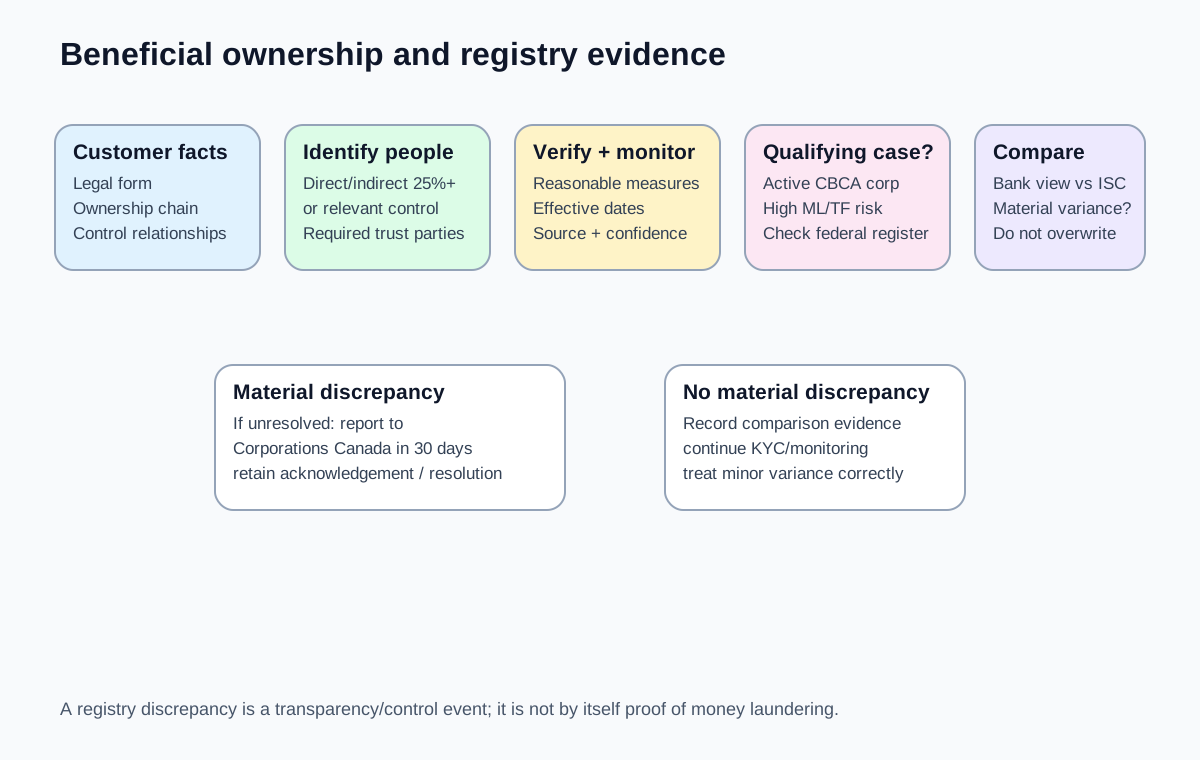
For a business analyst, the requirement has several hidden technology implications. The customer master needs a reliable corporation identifier and jurisdiction of incorporation. The risk engine needs to expose whether the high-risk condition is met. The beneficial ownership service needs effective-dated ownership data. The registry lookup needs audit evidence. The discrepancy workflow needs due dates, acknowledgement storage and a clear distinction between a registry discrepancy and a suspicion conclusion. A discrepancy may increase risk or require correction without by itself proving money laundering.
Risk assessment must drive stronger measures
Risk-based control is central to the Canadian model. A reporting entity assesses the risk of money laundering or terrorist financing occurring in the course of its activities using prescribed factors and its own business context. Higher-risk relationships require enhanced measures under the applicable framework. A good bank therefore links risk assessment to concrete actions rather than merely generating a score.
Customer risk can reflect business type, ownership complexity, geography, delivery channel, product use and other relevant factors. Product risk can reflect cash intensity, cross-border reach, speed, anonymity features, third-party funding or nested relationships. Channel risk can differ between branch, digital, correspondent, embedded or intermediary models. Geographic risk should use documented, current sources and should never become a proxy for ethnicity or nationality.
The strongest implementation is a rules-and-evidence model rather than a black-box number. If a customer is high risk, the system should explain the drivers and trigger the approved measures: stronger source-of-funds or source-of-wealth evidence where appropriate, senior approval where policy requires it, more frequent review, enhanced transaction monitoring, or other controls. If the risk later falls, the bank should record why.
Model governance matters here even when the bank does not use machine learning. A customer-risk engine is still a model of reality. Its factor weights, thresholds, source data, override rules and version history can materially affect control outcomes. Testing needs to include expected high-risk cases, ordinary low-risk cases, missing data, contradictory data and changes over time.
Prescribed reports and suspicious reports are different controls
Canada requires several types of transaction reports. The architecture should not merge them into one generic “regulatory report” pipeline because the trigger logic and purpose differ.
A Large Cash Transaction Report is triggered by receipt of the prescribed amount of cash, including aggregation under the applicable 24-hour rule. The key idea is objective reporting based on the transaction facts. The existence of an LCTR does not mean the customer is suspected of crime.
An Electronic Funds Transfer Report applies to prescribed international electronic funds transfers, including relevant aggregation. FINTRAC guidance states that applicable EFT reports are submitted within five business days after the day on which the transfer is initiated or finally received. Again, this is a prescribed event report, not a suspicion decision.
A Large Virtual Currency Transaction Report covers prescribed large virtual-currency receipts and has its own requirements. Other reporting types apply to other sectors and events. The bank’s obligation matrix should identify which legal entity and product can generate each type.
A Suspicious Transaction Report, by contrast, is judgement based. FINTRAC guidance states that the threshold is reasonable grounds to suspect that a completed or attempted transaction is related to the commission or attempted commission of a money-laundering or terrorist-financing offence; since August 2024 the framework also captures suspected sanctions-evasion offences through the STR process. There is no monetary threshold for an STR.
This distinction changes system design. Prescribed reporting needs complete event capture, aggregation, threshold calculation, transaction classification, deadlines and correction handling. Suspicion reporting needs alert review, context gathering, reasoning, escalation, decisioning and a narrative that explains the grounds for suspicion. A single workflow can support both, but the legal trigger must stay explicit.
The 24-hour rule is a data problem
Aggregation sounds simple until a bank attempts to implement it across channels. The relevant FINTRAC rules can require multiple transactions within a static 24-hour window to be treated together when the prescribed linking conditions are met. The bank therefore needs timestamps normalised correctly, party identifiers, third-party or beneficiary relationships where relevant, currency conversion rules, channel completeness and duplicate controls.
A branch cash deposit, ATM event and another eligible cash transaction may originate in different systems. Two international EFTs may be initiated through different customer channels. If the reporting engine receives one feed late or uses inconsistent customer identifiers, the threshold logic may fail even though each source system worked as designed.
Testing should therefore include boundary times, multiple time zones, late-arriving events, reversals, duplicate messages, joint accounts, third-party activity, multiple beneficiaries, currency conversion and corrected customer identifiers. The requirement should specify the legal aggregation logic in plain language before translating it into code.
From unusual activity to reasonable grounds to suspect
Transaction monitoring should not be designed to “find STRs”. It identifies activity that deserves assessment. The analyst then combines facts, context and relevant indicators to decide whether the reasonable-grounds-to-suspect threshold has been reached.
FINTRAC’s guidance is useful because it distinguishes a hunch from the reporting threshold. A gut feeling is not enough. At the same time, the bank does not need proof of the offence to file an STR. The investigator needs a reasonable, articulable basis grounded in the information available. The narrative should explain what happened, why it is inconsistent or concerning, what facts support that view, how the customer context was considered and which transactions are relevant.
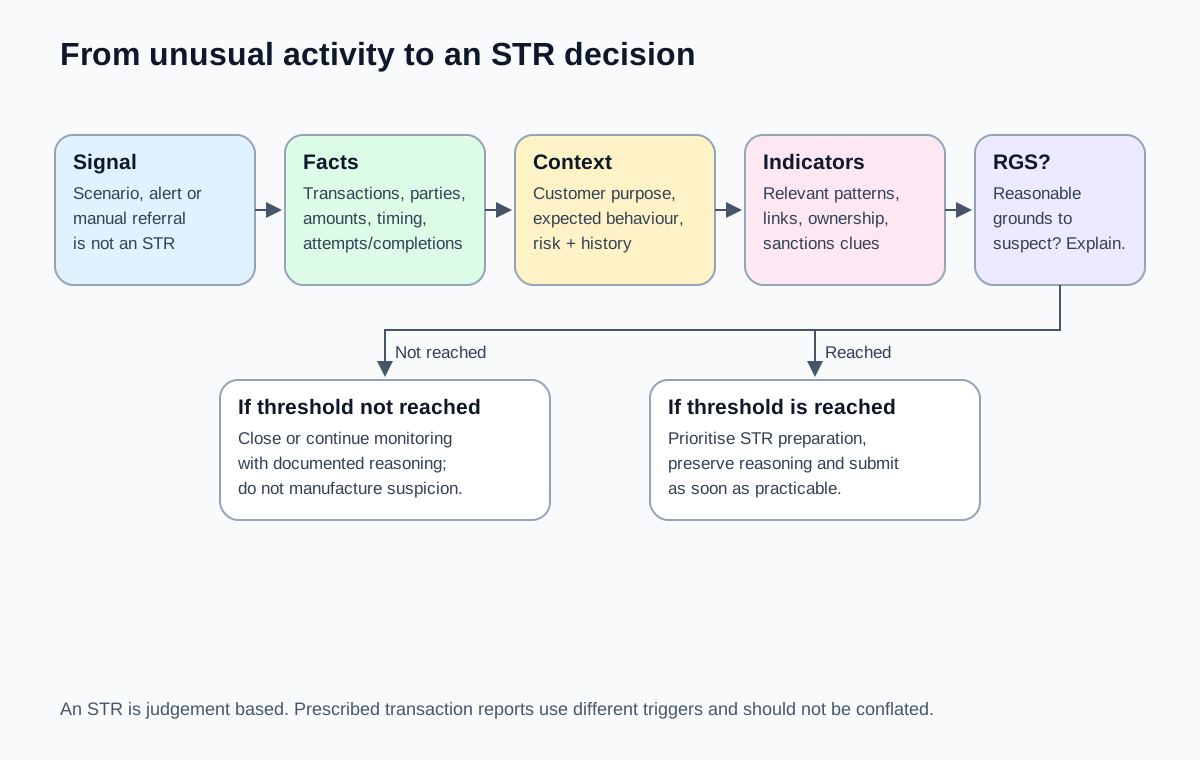
This should shape case tooling. A good case screen separates facts from inference. Transaction facts should be immutable or source linked. Customer profile should show effective dates. Investigator notes should identify hypotheses and unresolved gaps. The final decision should record the threshold, reason, approver where required and linked report reference. Reopening or subsequent suspicious activity should remain connected to the earlier case without overwriting history.
The customer-contact process also requires care. FINTRAC guidance warns against tipping off in a way that could prejudice a criminal investigation. A bank still needs to conduct normal customer due diligence and sometimes ask questions. The operational question is whether the timing and nature of the contact could reveal that an STR is being considered or filed. Policy, legal guidance and investigator training should make that boundary practical.
Reporting speed and quality
FINTRAC requires an STR to be submitted as soon as practicable after the reporting entity has completed the measures that allowed it to establish reasonable grounds to suspect. This is deliberately different from a fixed number-of-days target. Banks need a prioritisation model that prevents an alert backlog from becoming an excuse for avoidable reporting delay.
The best operational metric is therefore not simply “cases closed within SLA”. Management information should show time from signal to review, review to threshold decision, decision to report, ageing by risk, queue size, reopened cases, report rejection or correction, quality findings and reasons for delay. Time-sensitive terrorist-financing or national-security concerns need appropriate escalation.
Report quality matters because FINTRAC uses the information for financial-intelligence analysis. A narrative that says only “activity unusual” gives little investigative value. A high-quality narrative connects the customer, accounts, counterparties, dates, amounts, behaviour, risk context and reasons for suspicion. Structured fields and narrative should agree. If a case-management platform generates the report, mappings should be tested whenever source fields, message formats or report specifications change.
Sanctions is related, but not the same control
Canadian financial institutions also operate sanctions controls. Global Affairs Canada’s consolidated autonomous sanctions list is an important operational source, but the government itself states that the consolidated list is administrative and does not have the force of law. The relevant regulations must be consulted to determine the legal restriction. United Nations sanctions implemented in Canada also need to be considered through the applicable Canadian legal framework.
This is why a sanctions engine should not store only a name and a “blocked” flag. It needs the source regime, regulation or authority, effective date, identifiers, aliases, ownership/control interpretation under the applicable regime, decision reason and operational action. The legal result may depend on the specific measure.
Since August 2024, reporting entities also have an STR obligation where there are reasonable grounds to suspect that a completed or attempted transaction is related to the commission or attempted commission of a sanctions-evasion offence. FINTRAC’s guidance makes clear that this does not replace other sanctions obligations. A bank may have to consider property-related reporting or disclosure obligations under sanctions law while separately assessing whether an STR is required.
A practical case can therefore branch. A payment-screening match may be false and be released. It may be a confirmed listed party requiring an action under the applicable sanctions regulation. It may reveal attempted evasion using an intermediary, creating an STR decision even if the immediate payment name is not itself listed. The case tool should allow these outcomes to coexist without forcing one status to represent several legal conclusions.
Customer and payment screening
Screening in Canada should be designed around available identity and transaction data. Customer screening usually covers the customer and relevant connected parties according to policy. Payment screening may consider debtor, creditor, agents, addresses, remittance text and other available fields. Trade-finance controls may have goods, vessel and document data that an ordinary credit transfer does not.
False-positive handling is part of control effectiveness. A common name should not cause permanent customer friction simply because the engine lacks date of birth, address or other identifiers. Conversely, aggressive suppression rules can hide true matches. Tuning should be supported by test sets that include known matches, near matches, aliases, transliteration, reordered names, missing fields and innocent lookalikes.
List governance is equally important. The bank should record when a list or regulation update was received, validated, loaded and made effective. If an update fails, there should be alerting, fallback and retrospective impact assessment. A sanctions control is only as current as the data it uses.
Information sharing and privacy
Canada’s framework has evolved to permit more structured private-sector information sharing for detecting and deterring money laundering, terrorist financing and sanctions evasion, subject to statutory and privacy safeguards. The 2025 national risk assessment explains that participating reporting entities must operate within the voluntary framework and establish a code of practice, with an oversight role for the Office of the Privacy Commissioner under the regulations.
The design lesson is that information sharing is not “free access to other banks’ cases”. Purpose, authority, permitted data, access control, retention, onward use and audit evidence all matter. A shared indicator can be useful, but a receiving bank still needs to make its own legal and risk decisions.
For architects, this means separating intelligence received from facts independently verified. A case should record provenance. Analysts need to know whether a data point came from the customer, an internal system, a public source, a partner, another reporting entity or law enforcement. Confidence and permitted use can differ.
The 2025 risk assessment and what it means operationally
Canada’s 2025 Assessment of Money Laundering and Terrorist Financing Risks is a useful strategic source, but it should not be converted into a customer blacklist. Its value is in identifying threats, vulnerabilities and sectors that deserve attention in enterprise and product risk assessment.
A bank should use national risk information to challenge its own exposure: Are scenarios designed for the typologies relevant to our products? Do we understand trade-based financial crime where we finance trade? Can we see misuse of MSBs or payment-service relationships? Do we have good beneficial ownership evidence for complex corporations? Are our sanctions-evasion controls joined to trade, payment and customer data?
The answer should then feed the bank’s risk assessment, not bypass it. A national assessment describes system-level risk. A customer risk score describes a relationship. An STR decision concerns a specific transaction or attempted transaction. Mixing these levels creates unfair customer outcomes and weak legal reasoning.
Regulatory change must be engineered
Canada’s AML framework has changed materially in recent years: new sectors have entered the regime, private-sector information sharing has been expanded, beneficial-ownership discrepancy requirements have taken effect for qualifying cases, and sanctions-evasion reporting has become part of the STR framework. A bank cannot manage that pace with an annual policy refresh alone.
Regulatory change needs a traceable lifecycle. A source is identified. Legal or compliance specialists assess applicability. Obligations are mapped to products, entities, processes, data and controls. Requirements are approved. Technology and operating procedures change. Test evidence demonstrates implementation. Training is updated. Post-implementation review checks whether the control works in production.
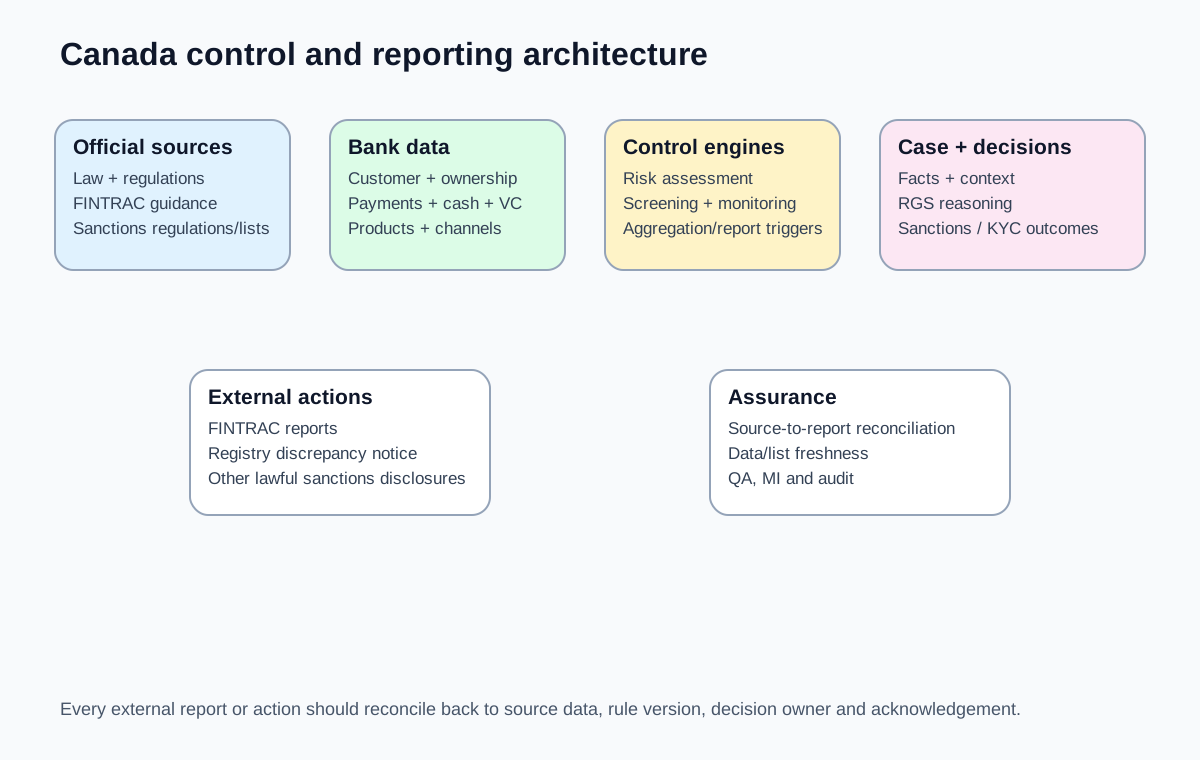
Effective dates are critical. The same transaction can be treated differently depending on when a rule came into force. Requirements repositories should therefore keep both the current rule and historical versions. Test cases should include the transition date and in-flight cases. When a list or guidance page changes, the bank should distinguish a binding legal change from new supervisory explanation.
Roles in a real bank
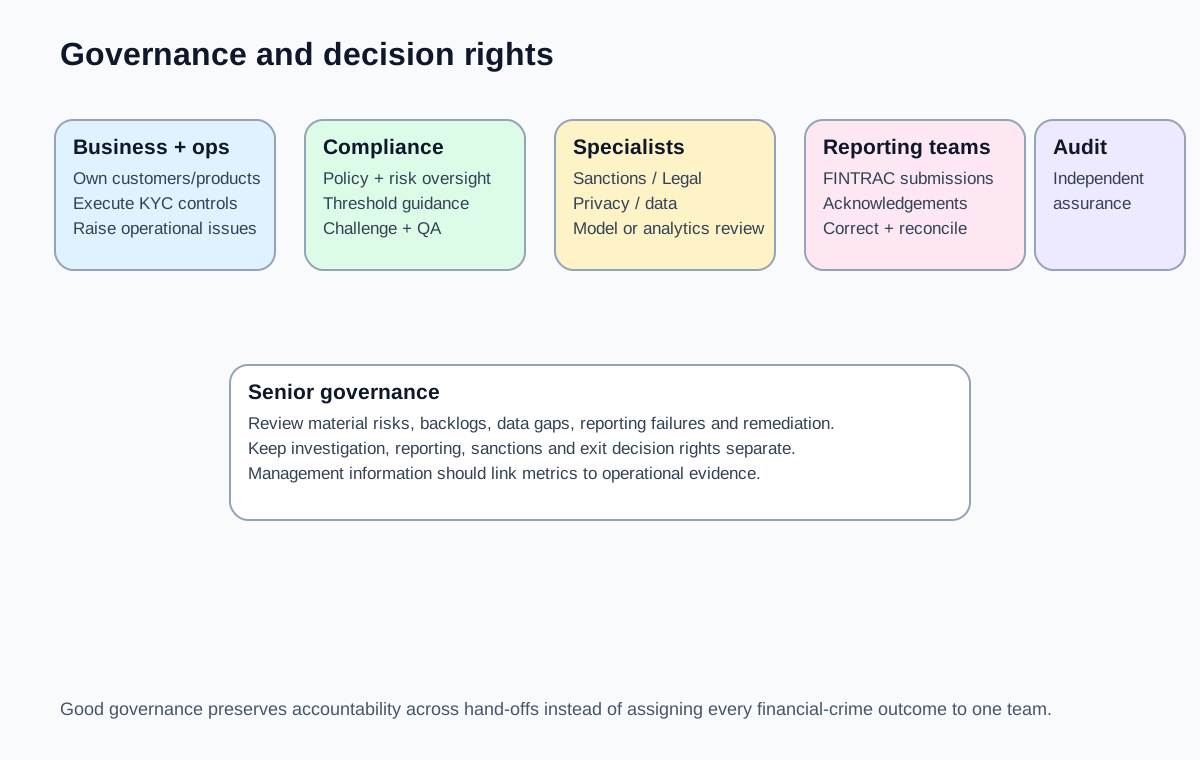
A Canadian financial-crime programme needs clear decision rights.
The board and senior management oversee risk and receive material control information at the level required by governance. The compliance officer is central to the statutory compliance programme. Business teams own customer and product processes. KYC operations gather and maintain evidence. Screening operations resolve potential matches. Transaction-monitoring teams investigate alerts. Specialist sanctions or legal teams interpret difficult restrictions. Regulatory reporting teams control submissions and acknowledgements. Technology teams maintain data, engines and workflows. Model-risk or validation functions may challenge advanced analytics. Privacy specialists govern personal-information use. Internal audit independently tests the programme.
These roles can be organised differently from bank to bank. The key is that each decision has one accountable owner and that hand-offs do not destroy evidence. An analyst should never need to rely on an undocumented chat message to know whether Legal approved a release or whether Compliance decided an STR was required.
What business analysts should specify
A strong requirement describes both the happy path and the evidence path. For a Canada STR workflow, requirements might define how monitoring alerts are created, which customer and transaction data are retrieved, how linked transactions are displayed, who can decide that reasonable grounds to suspect has been reached, how sanctions-evasion suspicion is identified, how report fields are populated, how the narrative is reviewed, how submission acknowledgement is stored, how corrections work and how confidentiality is enforced.
For beneficial ownership discrepancy handling, requirements should define how a CBCA corporation is identified, how high-risk status is obtained, how registry evidence is retrieved, what constitutes a material discrepancy under approved interpretation, how the 30-day deadline is tracked, how acknowledgement is stored and how the case feeds customer-risk review.
For prescribed reports, requirements should describe transaction inclusion, aggregation, exchange rates, timestamps, party linking, exceptions, due dates, resubmission and reconciliation. “System shall report transactions over $10,000” is not enough.
Non-functional requirements matter too. The case system needs access control, tamper-evident audit history, data lineage, search, retention, performance, resilience and privacy controls. A reporting deadline does not stop because a downstream service is unavailable. Fallback and recovery requirements therefore belong in financial-crime design.
Testing should prove legal logic, not only screens
Financial-crime UAT often fails by testing only whether a case can move from status A to status B. The better test is whether the control reaches the correct result with the correct evidence.
For transaction reporting, test below-threshold, at-threshold and above-threshold values; aggregation across channels; currency conversion; duplicate prevention; late transactions; amended transactions; joint or linked parties; and deadline calculation. For STR workflows, test cases that remain unusual but do not reach reasonable grounds to suspect, cases that clearly do, cases with attempted transactions, and cases with sanctions-evasion indicators.
For beneficial ownership, test multi-layer corporate chains, exactly 25 per cent, more than 25 per cent, indirect ownership, control without simple shareholding, data changes, CBCA versus non-CBCA corporations, high-risk versus non-high-risk cases and material versus immaterial registry differences.
For sanctions, include true matches, false positives, aliases, list updates, ownership/control escalation, different applicable regimes and cases where an STR may be required even though the payment itself does not produce a direct list match.
Evidence from these tests should show input, applicable rule version, expected outcome, actual outcome and source data. Screenshots alone do not prove data completeness or decision logic.
Operational failure modes
Several recurring failure modes deserve explicit control.
The first is fragmented customer identity. If the same customer has different identifiers across channels, 24-hour aggregation, transaction monitoring and case linkage can fail.
The second is stale ownership. A bank can screen yesterday’s shareholder while today’s controller is different.
The third is alert backlog disguised as capacity management. If high-risk signals wait too long, “as soon as practicable” reporting can be undermined.
The fourth is reporting without reconciliation. A system can generate files while some fail submission or acknowledgement. Regulatory reporting needs source-to-submission reconciliation.
The fifth is sanctions list latency. A valid screening engine with an out-of-date list is still an ineffective control.
The sixth is generic narratives. Poor STR narratives make it difficult to understand why the bank is suspicious and reduce intelligence value.
The seventh is legal-rule collapse. Treating an STR, a listed-person property report, a prescribed cash report and a sanctions action as the same “regulatory case” can produce the wrong decision and wrong disclosure.
The eighth is privacy overreach. Collecting or sharing more personal data than the legal purpose supports can create a different regulatory problem.
What good management information looks like
Management information should answer whether the programme is effective, not merely busy. Useful measures include report volumes with context, alert-to-case conversion, time to decision, time from decision to filing, backlog age, data-quality exceptions, list-update timeliness, rejected or corrected reports, beneficial ownership exceptions, high-risk customer review status, quality-assurance findings, repeat defects and remediation ageing.
Metrics need denominators. Ten missed reports mean something different in a process handling one hundred reportable events than in one handling a million. False-positive rates matter only if true-match sensitivity remains protected. Low alert volume may indicate good risk or missing data. High case closure may indicate efficiency or superficial investigation.
A governance forum should be able to move from a metric to the underlying evidence. If sanctions false positives rise, leaders should see whether the cause is a list update, a data-quality regression or tuning. If STR timeliness worsens, they should know whether the bottleneck is alert volume, investigator capacity, data retrieval or report review.
A realistic end-to-end case
Consider a Canadian corporate customer operating an import business. Its onboarding information shows established suppliers in two countries, moderate monthly international payments and a straightforward ownership chain. Several months later, the account begins receiving transfers from unrelated domestic companies and sending larger payments to a new overseas intermediary. Payment narratives are vague. Funds often leave within a day. A recent ownership update introduces a company whose control chain is not immediately clear.
No single fact proves money laundering. The transaction-monitoring system creates an alert because behaviour has changed relative to the customer’s baseline and peer group. The investigator reviews account history, KYC, beneficial ownership, counterparties, prior alerts and public information. The customer provides commercial documents, but some invoice descriptions do not align cleanly with the business profile and the intermediary’s role remains poorly explained.
The investigator distinguishes three questions. First, does the customer profile need remediation or re-risking? Yes, because ownership and activity have materially changed. Second, are any prescribed reports independently triggered? That is assessed from the transaction facts and reporting rules. Third, do the facts, context and indicators reach reasonable grounds to suspect that particular completed or attempted transactions relate to a relevant offence? That is a separate judgement.
During the review, the bank also checks whether any sanctions nexus exists. A screening alert on a connected company initially looks possible but is resolved as a false positive using identifiers. The investigator does not label the whole case “sanctions” merely because screening occurred.
After gathering the available evidence, the investigator concludes that the pattern, unexplained third-party funding, rapid onward movement, ownership opacity and commercial inconsistencies together reach the reasonable-grounds-to-suspect threshold. The case records the reasoning and relevant transactions. The STR is prioritised and submitted, acknowledgement is retained, and the customer relationship is moved to enhanced monitoring while a separate governance process considers whether restrictions or exit are appropriate under policy. The customer is not told that an STR has been filed.
The important lesson is the separation of decisions. Reporting suspicion does not automatically mean exiting the customer. A false sanctions match does not eliminate AML concern. A prescribed report does not prove suspicion. KYC remediation does not replace transaction investigation. The operating model works because each decision has a legal basis, an owner, an evidence trail and a controlled hand-off.
The standard to remember
A strong Canadian financial-crime operating model is not defined by how many alerts it produces or how many policies it owns. It is defined by whether the bank can connect current obligations to real customer and transaction data, reach the right decision at the right threshold, report accurately and promptly, protect customers and confidential information, and reconstruct the evidence later.
For practitioners, the most useful discipline is simple: keep trigger, threshold, decision, action and evidence separate. A transaction amount can trigger a prescribed report. A pattern can trigger an alert. Facts and context can reach the reasonable-grounds-to-suspect threshold. Sanctions law can require a separate property or transaction action. The customer relationship can require remediation or enhanced monitoring. When systems and teams preserve those distinctions, the Canadian framework becomes manageable and testable rather than a collection of disconnected obligations.
Deep dive: how Canada’s reporting logic changes systems
The practical difficulty in Canada is that several control decisions can be triggered by the same transaction while remaining legally distinct. A large international transfer may be included in an electronic funds transfer report because of objective transaction facts. The same transfer may be reviewed by transaction monitoring because it is unusual for the customer. A sanctions-screening engine may independently produce a potential match. If investigation establishes reasonable grounds to suspect money laundering, terrorist financing or sanctions evasion, an STR decision can arise as well. Good architecture permits all of those processes to coexist without allowing one to substitute for another.
A useful data model therefore treats the transaction as a shared object and attaches separate control events to it. A prescribed-report event records the report type, trigger, aggregation group, deadline, submission and acknowledgement. A monitoring event records the scenario or model, version, score and alert. A screening event records the screened field, list source, matching logic and disposition. An investigation event records facts, context, indicators, reasoning and outcome. A customer-risk event records a change in the relationship risk assessment. This event-based model makes audit reconstruction far easier than one overloaded case status.
The same design helps when transactions change. Payments can be reversed, corrected or returned. Customer identifiers can be merged. Ownership can change. Report fields can be amended. A bank needs effective-dated source records and an audit trail that explains which facts were known at the time of the original decision and which arrived later. Otherwise a reconstructed case can accidentally use future information and create the illusion that an analyst ignored evidence that did not yet exist.
Reconciliation is a regulatory control
Regulatory reporting should have an accounting-style reconciliation mindset. The bank should know how many eligible source events entered the reporting population, how many were excluded by defined logic, how many reports were created, how many were submitted, how many were acknowledged and how many remain in exception. The same approach should apply to corrections and resubmissions.
A pipeline can technically succeed while reporting remains incomplete. For example, the batch job may process every record it received, but an upstream channel could have failed to publish a subset of transactions. Control totals should therefore exist at several points: source system, ingestion, aggregation, report generation and external submission.
For BA requirements, this creates a clear traceability chain:
| Control question | Evidence the system should preserve |
|---|---|
| Was the transaction in scope? | Product, channel, amount, currency, direction, timestamp and legal-entity scope |
| Was aggregation required? | Linked party or beneficiary identifiers and static-window membership |
| What rule version applied? | Effective-dated configuration and calculation version |
| Was a report created? | Report identifier, payload version and validation result |
| Was it submitted? | Submission timestamp, channel and transmission result |
| Did FINTRAC accept or acknowledge it? | External acknowledgement or reference and any correction requirement |
This is much stronger than a dashboard that says “99.9% of reports sent” without proving the denominator.
The suspicion narrative as structured reasoning
Although the STR contains structured fields, the grounds-for-suspicion narrative is a core intelligence product. A case-management tool should help the investigator assemble the relevant story without turning the narrative into templated boilerplate.
The strongest workflow prompts the analyst to separate what happened, why it matters, and how the customer context changes the interpretation. Facts include dates, amounts, parties, accounts and observed behaviour. Context includes the customer’s business, expected activity and known relationships. Indicators are patterns that increase concern. The conclusion states why those combined elements create reasonable grounds to suspect.
A weak workflow asks the analyst to choose a generic typology and auto-generates “activity inconsistent with profile”. A stronger workflow presents linked transactions, counterparty concentration, prior alerts, ownership changes and relevant customer data so the analyst can write an evidence-based explanation.
Quality assurance should sample not only whether an STR was filed but whether the threshold reasoning is coherent. Two reviewers can reasonably disagree at the margins, but the file should let another trained person understand how the conclusion was reached.
Beneficial ownership as a graph
Beneficial ownership is naturally a graph problem. A corporation can be owned by another corporation, which can be held by a trust, which can involve several natural persons. A flat “UBO name” table loses the path between the customer and the person.
A practical graph stores nodes for persons and entities and edges for ownership or control relationships. Each edge has a percentage where relevant, relationship type, start and end date, evidence source and verification status. The customer record then derives the persons who meet the applicable beneficial-ownership test.
For the federal discrepancy workflow, the graph also needs to preserve the bank view and the registry view without silently overwriting one with the other. A discrepancy case exists precisely because the two sources do not align. The investigator or KYC reviewer must be able to compare them, determine whether the difference is material under the applicable guidance, submit the required notice where triggered and then manage any customer remediation separately.
Shared information does not become shared judgement
Canada’s private-sector information-sharing framework can improve detection of networks that spread activity across institutions. But shared information should enter a bank’s case as attributed intelligence, not as an unquestioned verdict.
Suppose Bank A shares a permitted indicator that an entity is connected to an investigation. Bank B should record the source and permitted purpose, check its own customer and transaction evidence, and make its own reporting and account decisions. If the information later proves incorrect, provenance allows the bank to correct its downstream decisions.
For technology teams, this means access controls, provenance metadata, purpose limitation, retention rules and immutable access logs are as important as the data-sharing API itself. A fast API without those controls can create privacy, evidential and governance risk.
Resilience and deadline management
Financial-crime systems need business-continuity design because statutory and supervisory expectations continue during outages. A reporting platform should have monitored queues, retry logic, duplicate protection, recovery procedures and a way to identify items whose deadlines or priority have been affected.
A sanctions-list ingestion failure should be treated differently from a case-management display failure. The former can affect the bank’s ability to identify restricted parties; the latter may delay analyst work. Severity should reflect control impact.
Testing should include partial outages, not only total system failure. The difficult incidents are often silent: one channel stops feeding transactions, one list fails to update, one time-zone conversion shifts aggregation windows, or one field mapping becomes null after a release. Data-quality monitoring should detect those failures before an external examination does.
Advanced practice: Canadian control design decisions
Design a legal obligation matrix, not a policy index
A global bank should translate Canadian requirements into a structured obligation matrix. Each entry should identify the obligation, legal source, reporting-entity scope, product or transaction scope, trigger, threshold, deadline, required data, decision owner, external recipient, record-retention treatment, effective date and linked controls.
This matrix prevents several common implementation errors. A developer can see that a prescribed transaction report and an STR use different triggers. An investigator can see that sanctions-evasion suspicion uses the STR process while separate sanctions-law duties can still apply. A product owner can see which new service creates additional reporting or identification obligations. A tester can derive acceptance criteria from the same source.
The matrix should be version controlled. When a rule changes, do not edit history in place. Create a new effective-dated version and retain the previous one. Historical cases then remain reproducible.
Treat FINTRAC guidance as operational interpretation, not as a substitute for law
FINTRAC guidance is indispensable for understanding expected operation, but the bank should maintain a hierarchy of authority. Legislation and regulations create obligations. Official guidance explains how FINTRAC expects reporting entities to apply them. Internal policy then translates those requirements into the bank’s own control environment. Procedures and technology implement the policy.
When those layers conflict, the issue should escalate rather than being hidden through system configuration. A requirement such as “submit within five business days” should link to the underlying reporting rule and approved internal interpretation, not merely to a developer ticket.
Build customer risk from explainable drivers
A Canadian customer-risk model should produce both a result and an explanation. For example, a higher risk result might arise from complex ownership, a higher-risk business activity, cross-border exposure and product usage. The output should show those drivers, their source data and the applicable model version.
Overrides should require reason codes and evidence. If a relationship manager lowers a score because the customer is commercially important, the control has failed. If compliance changes a classification because the source data was wrong and the correction is documented, the override may be entirely legitimate.
Risk scores should also have expiry and review logic. A high-risk trigger caused by an old event should not remain forever without reassessment, while a material new event should not wait for the next annual review.
Separate detection precision from investigation quality
Transaction-monitoring effectiveness has at least three stages: coverage, detection and investigation. Coverage asks whether the necessary source data and risk typologies are represented. Detection asks whether rules or models identify relevant patterns without unacceptable noise. Investigation asks whether analysts reach defensible decisions using sufficient context.
Improving one stage cannot compensate for another. A sophisticated model cannot detect transactions absent from the data feed. Perfect alerts do not help if cases sit in backlog. Experienced investigators cannot explain behaviour if KYC is stale. Management should therefore report the stages separately.
Sanctions and AML need controlled hand-offs
A payment can move from screening to sanctions investigation, from sanctions investigation to an STR assessment, and from there to broader customer review. Those hand-offs need defined data.
The screening case should carry the matched field, candidate list entry, match score or rule, identifiers and payment status. A confirmed sanctions concern should carry the legal or policy basis, required operational action and any reporting/disclosure steps. If the pattern also raises suspected evasion, the STR assessment should receive the transaction context and evasion indicators without assuming the reporting threshold is automatically met.
The reverse hand-off also matters. An AML investigator may discover a previously unknown owner or intermediary who should be screened. Case tooling should allow that information to be sent to sanctions review while preserving the source and purpose.
Use current sanctions data carefully
Global Affairs Canada’s consolidated autonomous sanctions list is operationally useful and was updated in September 2026, but its own notice says the list is administrative and may not always reflect the latest regulatory position. A production control should therefore have governance for the authoritative legal sources, list ingestion, validation and urgent changes.
A bank should never write a policy that says “if a name is on the consolidated list, every transaction is blocked” without checking the applicable regulation and restriction. Different measures can have different legal effects. Legal interpretation belongs in the sanctions rulebook; the screening engine identifies potential applicability.
Change assurance should include production evidence
After a Canada regulatory change goes live, the project should not close solely because UAT passed. Post-implementation review should prove that production data is arriving, rules are firing, cases are routeable, regulatory reports are accepted, list updates are current and users understand the new process.
For a beneficial ownership discrepancy change, for example, a production control test could sample qualifying high-risk CBCA corporations, confirm registry checks occurred, verify any material discrepancies were routed, confirm due dates were controlled and validate acknowledgement storage. That evidence is much more useful than a project plan marked “complete”.
Practical acceptance criteria
A few examples show the required precision:
- Given two international EFTs linked under the applicable rule and totalling at least the reportable amount within the static 24-hour window, the reporting engine must create the correct report population without double counting either transfer.
- Given a transaction-monitoring case that does not reach reasonable grounds to suspect, the analyst must be able to close it with documented reasoning without generating an STR.
- Given an attempted transaction that does reach reasonable grounds to suspect, the workflow must permit STR reporting even though settlement did not occur.
- Given a qualifying high-risk CBCA corporation with a material beneficial-ownership discrepancy, the workflow must calculate the 30-day action date and preserve the Corporations Canada acknowledgement.
- Given a sanctions screening candidate that is resolved as a false positive, the system must preserve the evidence used to distinguish the customer or payment party from the listed person or entity.
These are testable behaviours. “Comply with FINTRAC” is not a testable requirement.
Practice close: implementation and review checklist
A practitioner reviewing a Canadian financial-crime process can use five questions to expose most weaknesses.
First: do we know the applicable trigger? For every report or control action, the process should state whether the trigger is an amount, an aggregation rule, customer risk, a potential list match, reasonable grounds to suspect, a confirmed legal restriction or another defined event. If teams cannot state the trigger clearly, they will confuse prescribed reporting with suspicion.
Second: do we have the required data? Map each trigger to source fields. For an EFT report that means more than amount. For monitoring it means customer history and behavioural context. For beneficial ownership it means legal-entity identity and ownership relationships. For screening it means high-quality party data. A control should fail visibly when mandatory data is absent rather than silently treating null as “no risk”.
Third: can we reproduce the decision? Preserve source values, timestamps, rule versions, list versions, analyst notes, approvals and external acknowledgements. A bank should be able to reopen a two-year-old case and understand what the analyst knew at that time.
Fourth: did we complete the external action? Generating a report is not submission. Submission is not acknowledgement. A sanctions hold is not a legal conclusion. A registry lookup is not discrepancy reporting. Every external action needs completion evidence and exception handling.
Fifth: did the customer outcome follow from the right decision? A suspicious report does not automatically require customer exit. A high-risk rating does not mean the customer is criminal. A false sanctions match should not create lingering restrictions. Customer friction should be proportionate to the actual control need.
Review a sample case from end to end
Select one customer with at least one monitoring alert, one international transfer and an ownership change. Trace the case from onboarding to current state.
Check that the legal-entity identifier is consistent across KYC, payments and reporting. Confirm beneficial owners and effective dates can be reconstructed. Verify the transaction-monitoring alert shows which data and scenario version created it. If a prescribed report was triggered, reconcile the source transaction to the submitted report and acknowledgement. If an STR decision was made, read the grounds for suspicion and test whether facts, context and indicators support the conclusion.
Then check the opposite: search for evidence that should not have produced an action. Was a false sanctions candidate closed correctly? Was ordinary high-volume activity recognised as consistent with the customer’s business? Did a non-material ownership data difference avoid being mislabelled as suspicious? Good controls prove both detection and restraint.
Test data quality deliberately
Create a small controlled test pack containing:
- a normal retail customer with expected activity;
- a corporation with a multi-layer ownership chain;
- a customer whose behaviour changes sharply;
- multiple transactions that fall just below and just above an aggregation threshold;
- an attempted suspicious transaction;
- a common-name sanctions false positive; and
- a case where a new owner creates both KYC and screening work.
Run the pack after major releases. The purpose is not to replace full testing but to detect regression in the joined control chain.
Challenge management information
Ask what a dashboard means before accepting its colours. If “STR timeliness” is green, what is the start point? If “sanctions screening current” is green, how is the latest source update proven? If “KYC complete” is green, does that include beneficial ownership and event-driven reviews? If “reporting success” is 100 per cent, is the denominator source transactions or generated files?
Strong MI is traceable to operational evidence. Weak MI is a presentation layer detached from control reality.
Final learning check
A Canada operating model is working when teams can answer, consistently and with evidence:
- which legal entity and obligation applied;
- what data triggered review or reporting;
- whether the decision was objective or judgement based;
- which threshold was reached;
- what customer, payment or regulatory action followed;
- who approved it;
- whether external submission or disclosure completed;
- whether the evidence can be reconstructed; and
- whether subsequent changes were assessed.
If those answers are scattered across email, spreadsheets, case notes and tribal knowledge, the programme is not yet mature even if individual analysts are highly skilled.
Release-readiness questions for technology teams
Before production deployment, confirm that every external dependency has an owner. That includes FINTRAC submission connectivity, sanctions-list ingestion, registry access where used, currency-rate sources and customer-master feeds. Define what happens when each service is unavailable, how long data may be stale, who receives an operational alert and how affected transactions or reports are identified afterwards.
Also confirm that access design matches confidentiality. An investigator may need full case context; a customer-service colleague usually does not need to know that an STR exists. Production support may need technical logs without access to narrative content. Role design should follow task need and preserve an access audit trail.
Finally, require a rollback and reconciliation plan. If a release changes aggregation or report mapping and must be reversed, the team needs a way to identify transactions processed under the faulty version, re-run them safely, prevent duplicate submissions and document any late corrections. Financial-crime change management is complete only when recovery is designed as carefully as the normal path.
Masterclass case: one payment, four different control questions
A Toronto-based technology distributor has banked with the same institution for four years. The customer is profitable, has stable payroll and tax payments, and historically imports components from established suppliers. Its corporate ownership is simple and has not previously been rated high risk.
During a quarterly ownership refresh, the bank learns that a new holding company has acquired a controlling interest. The KYC platform records the new chain, but the ultimate ownership evidence is incomplete. At roughly the same time, the account receives several domestic transfers from businesses that do not appear connected to the distributor’s normal customers. The funds are combined with the customer’s own balance and sent in two international EFTs to a newly introduced intermediary.
The first control question is prescribed reporting. The reporting engine evaluates the international transfers under the applicable EFT reporting and aggregation logic. This is an objective calculation. Whether the activity is suspicious does not change the obligation.
The second question is customer risk and beneficial ownership. KYC operations need to resolve the new control chain. If the corporation is within the specific CBCA/high-risk scope that triggers the federal registry comparison requirement, the bank must apply that workflow. A discrepancy is analysed under the official materiality guidance. This work affects the customer record and may change risk, but it does not automatically answer the STR question.
The third question is sanctions. One new counterparty produces a possible name match. Screening operations compare identifiers and determine that the party is not the listed entity. The payment is therefore not treated as a confirmed sanctions match on that basis. The false positive is documented so that the bank can explain why it released the transaction.
The fourth question is suspicion. Transaction monitoring has linked the changed ownership, unrelated incoming funds, rapid onward movement and the new intermediary. Investigators obtain the available commercial explanation and supporting documents. Some facts are consistent with a legitimate acquisition and supply-chain change; others remain unexplained. The analyst must decide whether the whole picture reaches reasonable grounds to suspect, not whether one red flag exists.
Suppose the bank eventually reaches the threshold and files an STR. That decision does not retrospectively make the earlier prescribed EFT report “suspicious”. It also does not turn the false sanctions match into a true match. Each control outcome retains its own basis.
The case is then presented to relationship governance. Compliance recommends enhanced monitoring while ownership evidence is completed. The business considers customer-service implications. Legal advises on any contractual issues. No one tells the customer that an STR was filed. If the relationship is later restricted or exited, the decision is documented under the bank’s risk and customer-governance process rather than being recorded as “FINTRAC required exit”.
This case demonstrates why mature financial-crime architecture is modular. One transaction can create several regulatory and risk questions, but one status should never be allowed to answer all of them.
Decision log and post-case learning
After the case is closed, the bank should use it to improve the control environment without exposing confidential reporting information more widely than necessary. A de-identified lessons-learned record can show that acquisition-related ownership change, third-party funding and new overseas intermediaries appeared together and that the existing monitoring scenario detected the pattern only after several transactions. The lesson is not to create a rule saying that acquisitions are suspicious. It is to ask whether customer-change events should feed monitoring context more quickly.
The case also reveals a data-governance question. If the KYC platform recorded the new holding company three days before the transaction-monitoring engine received the ownership update, the control gap is a data-latency issue rather than an investigator failure. Remediation might therefore include event-driven publication from KYC to monitoring, service-level monitoring for that feed, and a reconciliation between customer-master updates and downstream consumption.
A second lesson concerns relationship management. The business team may know that the customer has been acquired, while the financial-crime platform still reflects the old profile. That knowledge should enter a controlled customer-review process rather than remain in email. A bank should design safe channels for first-line information to reach compliance and operations without allowing the relationship manager to dictate the suspicious-reporting conclusion.
Finally, quality assurance should review whether each branch of the case was handled independently: prescribed reporting, beneficial ownership, sanctions screening, suspicion assessment and customer-risk governance. If one branch was correct only because an experienced analyst remembered an undocumented workaround, the outcome was fortunate, not controlled. The remediation should remove reliance on memory.
This is the difference between case closure and control learning. A mature operating model does not merely finish investigations. It uses recurring evidence from cases, quality reviews, reporting exceptions and production incidents to refine data, rules, training and governance while preserving the legal boundaries around sensitive information.
References and further reading
The following public sources were used for this chapter. Canadian requirements change over time, so practitioners should confirm the current legislation, regulations and official guidance before applying a rule to a live case.
-
FINTRAC, Compliance program requirements
https://fintrac-canafe.canada.ca/guidance-directives/compliance-conformite/guide4/4-eng -
FINTRAC, Reporting suspicious transactions to FINTRAC
https://fintrac-canafe.canada.ca/guidance-directives/transaction-operation/str-dod/str-dod-eng -
FINTRAC, Reporting electronic funds transfers to FINTRAC
https://fintrac-canafe.canada.ca/guidance-directives/transaction-operation/eft-dt/eft-dt-eng -
FINTRAC, Reporting large cash transactions to FINTRAC
https://fintrac-canafe.canada.ca/guidance-directives/transaction-operation/lctr-doie/lctr-doie-eng -
FINTRAC, Reporting transactions to FINTRAC: the 24-hour rule
https://fintrac-canafe.canada.ca/guidance-directives/transaction-operation/24hour/1-eng -
FINTRAC, Beneficial ownership requirements
https://fintrac-canafe.canada.ca/guidance-directives/client-clientele/bor-eng -
Corporations Canada, Reporting entities required to report discrepancies in beneficial ownership information as of October 1, 2025
https://ised-isde.canada.ca/site/corporations-canada/en/reporting-entities-required-report-discrepancies-beneficial-ownership-information-october-1-2025 -
FINTRAC, Report suspected sanctions evasion
https://fintrac-canafe.canada.ca/guidance-directives/transaction-operation/sanctions/sanctions-eng -
FINTRAC, Special Bulletin on financial activity associated with suspected sanctions evasion
https://fintrac-canafe.canada.ca/intel/bulletins/sanctions-eng -
Global Affairs Canada, Consolidated Canadian Autonomous Sanctions List
https://www.international.gc.ca/world-monde/international_relations-relations_internationales/sanctions/consolidated-consolide.aspx?lang=eng -
Department of Finance Canada, 2025 Assessment of Money Laundering and Terrorist Financing Risks in Canada
https://www.canada.ca/en/department-finance/programs/financial-sector-policy/nira-neri-2025.html -
Department of Finance Canada, Government strengthens Canada’s anti-money laundering framework with new regulatory amendments, 7 March 2025
https://www.canada.ca/en/department-finance/news/2025/03/government-strengthens-canadas-anti-money-laundering-framework-with-new-regulatory-amendments.html -
FINTRAC, Modernization and upcoming changes impacting reporting entities
https://fintrac-canafe.canada.ca/businesses-entreprises/changes-changements-eng -
Office of the Superintendent of Financial Institutions, Integrity and Security Guideline
https://www.osfi-bsif.gc.ca/en/guidance/guidance-library/integrity-security-guideline -
FATF, The FATF Recommendations
https://www.fatf-gafi.org/en/publications/Fatfrecommendations/Fatf-recommendations.html -
Basel Committee on Banking Supervision, Sound management of risks related to money laundering and financing of terrorism
https://www.bis.org/bcbs/publ/d505.htm