AML/CFT Supervision, Mutual Evaluation and Effectiveness
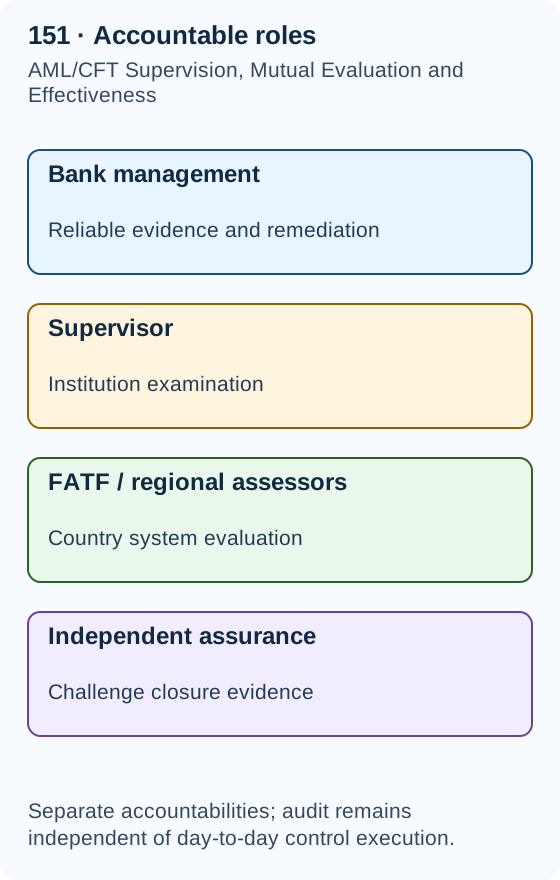
AML/CFT supervision assesses whether regulated institutions comply with applicable requirements and manage risk effectively. FATF mutual evaluation assesses a country's system. A bank may supply evidence or meet assessors, but it does not receive a FATF mutual-evaluation rating as an institution. Do not confuse a national assessment, a supervisor's examination and the bank's internal audit.
FATF assesses technical compliance with its Recommendations and effectiveness through eleven Immediate Outcomes. Technical compliance concerns laws, institutions and required measures; effectiveness concerns how well the system achieves results in the country's risk context. A country can have detailed legislation and still struggle to investigate cases or recover assets.
The FATF website distinguishes the 2013 and 2022 methodologies and their updates. The methodology applicable to a particular assessment depends on the round and procedures; publication of a newer methodology does not retroactively change the basis of every earlier report. Read the report's methodology, assessment period and follow-up status before using its ratings.
For a bank, compliance evidence includes risk assessment, CDD quality, reporting, monitoring coverage, governance and remediation. Supervisors can use risk-based examination and enforcement powers under national law. An inspection with no immediate finding does not prove that every control is effective or immunise a later failure.
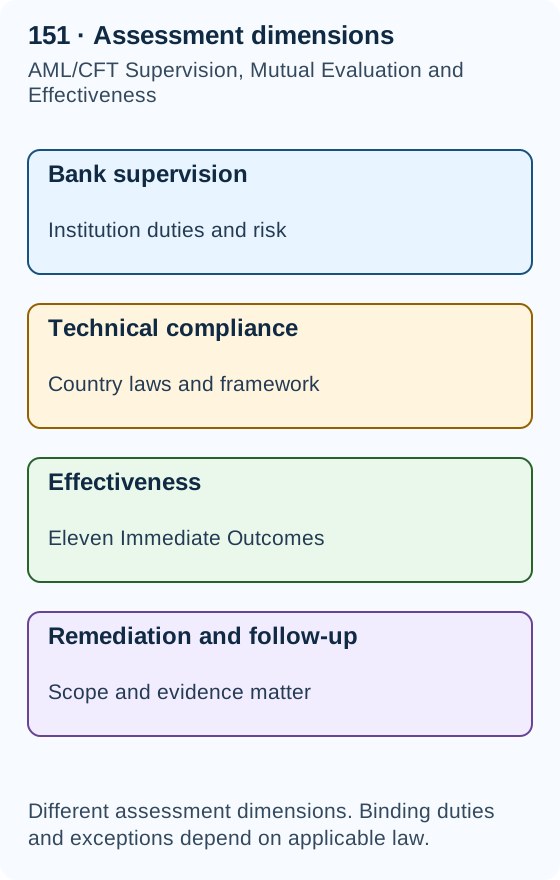
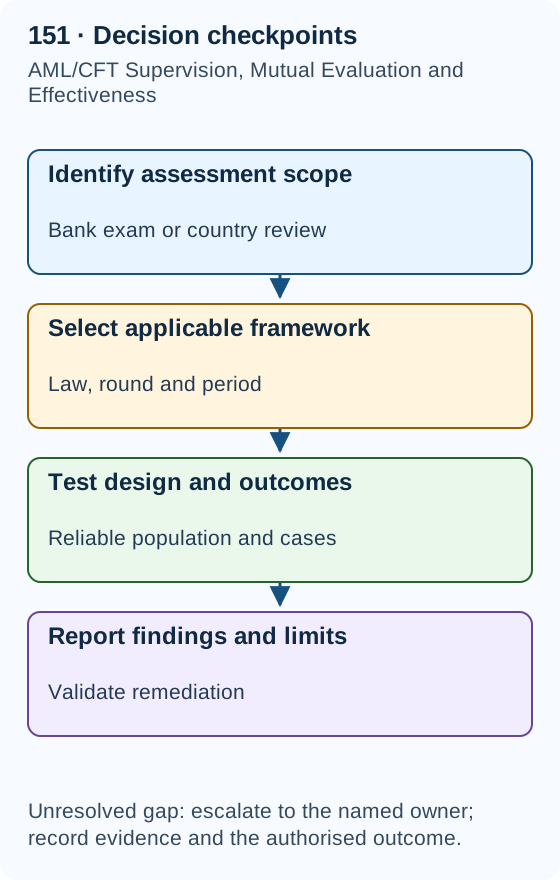
Three different questions: rules, implementation and results
Technical compliance asks whether the relevant legal and institutional framework meets the assessed requirements. Implementation asks whether institutions actually operate the measures described in that framework. Effectiveness asks whether the system achieves the intended results in its risk context. These questions are related, but an answer to one does not settle the others. A country can establish a reporting law while reports remain difficult to use. A bank can publish a sound monitoring policy while a payment channel is missing from the engine.
The FATF assessment framework distinguishes technical compliance with its Recommendations from effectiveness assessed through eleven Immediate Outcomes. Those are country-system assessments. A bank examination examines an institution under the applicable supervisory framework. Learners should avoid converting either exercise into a certificate that every account, product or customer is safe. A favourable country rating does not prove that a particular bank control works, and a weak country outcome does not prove that every resident customer is suspicious.
In practical bank work, the distinction changes evidence selection. A policy and legal analysis can demonstrate intended requirements. System configuration, population reconciliation, case samples and decision records can demonstrate operation. Evidence about detection, useful reporting, consistent risk treatment and durable remediation can support assessment of results. A pack containing only policy documents leaves an examiner unable to trace how the bank applied them. A pack containing only case screenshots may show activity without explaining why the relevant controls cover the bank's actual exposure.
A useful assurance conversation therefore identifies the question before choosing a metric. If management asks whether all relevant transfers reach screening, transaction reconciliation is more useful than a training-completion percentage. If the question concerns investigator judgement, a risk-sensitive sample of filed and non-filed cases is more useful than total alerts closed. If the question concerns national asset recovery, bank reporting volume is only one possible contribution. Clear questions keep evidence and conclusions aligned.
Supervisory responsibilities and bank accountability
Supervisory arrangements differ across jurisdictions. One authority may supervise prudential, conduct and AML matters, while another jurisdiction allocates them to separate agencies. An FIU may receive reports without being the bank's supervisor. A law-enforcement body may investigate offences without conducting routine supervisory examinations. A national assessment may involve all of them. The bank should maintain an authority map identifying the relevant responsibilities, legal powers and approved communication routes for each operating entity.
Within the bank, the board and senior management oversee the programme through the institution's governance arrangements. Business owners describe products, customers and funds flows. Compliance interprets AML/CFT obligations and challenges control design. Operations execute customer review, monitoring and reporting processes. Technology maintains systems and evidence. Internal audit or another independent assurance function assesses the relevant risks and controls. These responsibilities should be connected without suggesting that an audit opinion transfers operating accountability away from the control owner.
An examination coordinator manages the request and evidence process but should not become the undocumented author of every control explanation. The responsible owner needs to approve the factual account of their system or process. Legal reviews questions about authority, protected material and disclosure. Data owners explain populations and limitations. The coordinator preserves consistency, deadlines and version control. When an answer requires several owners, the pack should identify their contributions rather than present a composite response with no accountable factual reviewer.
Supervisory engagement should be candid. If the bank cannot retrieve an historical configuration, it should disclose the limitation and explain alternative evidence and remediation. If a finding affects a larger population than originally reported, it should revise the exposure assessment. An optimistic summary that hides known gaps may create a more serious governance problem than the original control defect. Professional examination readiness means producing accurate records and explanations, including uncomfortable facts, through an authorised process.
Reading the scope before collecting evidence
An examination or information request should be read for the entities, products, risks, period and questions it covers. A request about correspondent-bank customer due diligence is not automatically a request for every retail investigation file. A request for current design may require different records from one about historical operation. A bank should preserve the original wording, record any clarification and assign owners based on the actual scope. Informal verbal extensions should be documented through the approved channel.
The period is particularly important during migration. A bank may operate one monitoring engine at the start of the reviewed year and another at the end. The current procedure may be sound while the earlier engine had different exclusions. Collecting only today's configuration would not demonstrate historical coverage. The bank should map major changes, identify relevant versions and explain when each became effective. That chronology helps the examiner understand whether a sample result reflects the control that actually applied at the time.
Population boundaries should be explicit. A request for all high-risk business customers needs the definition used, the effective rating date, the legal entities included and the treatment of closed accounts. A request for transactions screened during a period may concern economic payments, messages or processing events. Those are different denominators. The response should explain the selected population and reconcile it to authoritative records rather than provide a number whose meaning changes between spreadsheets and narrative explanations.
The bank should also identify records it does not hold. A service provider may maintain technical logs, a subsidiary may retain local reporting records and an archive may contain older case attachments. Retrieval tasks need enough lead time to obtain those records lawfully and securely. The request register should show dependencies and unresolved questions. A deadline does not make a missing source disappear, and a partially collected population should not be labelled complete because the coordinator has finished the available tasks.
Technical-compliance ratings and their limits
A technical-compliance rating relates to the assessed Recommendation and the country's framework at the relevant assessment point. The categories should be read through the current methodology and report, not inferred from a headline. A bank using the report should identify the Recommendation, findings, assessment date and any later follow-up. A re-rating may address particular technical shortcomings without reassessing all effectiveness outcomes. A statement that the country improved should therefore identify what improved and what remains outside that conclusion.
The distinction is useful for country-risk analysis. A weakness in beneficial-ownership transparency may affect the evidence available for certain customer structures. A weakness in supervision may affect confidence in a respondent institution's oversight. A weakness in international cooperation may affect the ability of authorities to exchange information or recover assets. These are mechanisms to assess in the bank's exposure, not instructions to classify every customer from the jurisdiction as suspicious. Relevant controls should match the identified mechanism.
Source hierarchy matters when reports and summaries differ. The official mutual-evaluation report and follow-up documents provide the assessment detail. A commercial risk database may summarise them, but the bank should understand the transformation and date. A country may be discussed in a monitoring statement for reasons that differ from one Recommendation's rating. The bank should not merge those categories into an unexplained score or use an old headline after the relevant official position changes.
Documentation should show how the assessment influenced the bank's decision. If country findings support additional inquiry into a complex ownership structure, record the finding, the customer's actual connection and the evidence required. If the finding is not relevant to a particular exposure, explain why. That approach avoids both indiscriminate restrictions and uncritical acceptance. Country-level assessment is valuable context when it is translated into a reasoned, dated view of the bank's own risks.
Effectiveness outcomes and the bank's contribution
The eleven Immediate Outcomes cover an effective national system's risk understanding and coordination, international cooperation, supervision, preventive measures, ownership transparency, use of financial intelligence, money-laundering investigation and prosecution, confiscation, terrorist-financing investigation and prosecution, terrorist-financing preventive measures, and proliferation-financing targeted sanctions. They provide a structured way to examine results across institutions and authorities. They do not mean that an individual bank directly controls every national outcome or can prove effectiveness through its own activity counts alone.
A bank contributes by understanding its exposure, applying relevant preventive measures, identifying and reporting suspicion, retaining reliable records and cooperating through lawful routes. Those contributions may support several outcomes. A clear report can assist financial-intelligence analysis; accurate ownership information can help an investigation; a well-controlled sanctions process can support targeted financial measures. The institution should identify those contributions without claiming that a report automatically produced a conviction or that screening volume demonstrates successful prevention of proliferation financing.
Results need context. A jurisdiction facing complex cross-border threats may require different capabilities from one whose principal exposure is domestic cash-intensive activity. A low number of prosecutions can have several explanations, and a high number does not by itself establish quality or proportionality. The bank should read the assessment's analysis of risk, materiality and evidence. When using national findings for its own programme, it should focus on how the described strengths or weaknesses affect the institution's customers, products and counterparties.
The practical exercise is to select one bank control and explain its likely contribution and limits. For a beneficial-ownership review, identify the accuracy of collected information, the handling of uncertainty and the record's usability. Do not claim that completion of the review proves that the national ownership-transparency system is effective. For a suspicious-activity report, examine analytical quality and accepted delivery, while recognising that investigation and prosecution depend on other competent authorities and additional evidence.
Risk understanding as an operational product
A bank's risk assessment should explain the relevant threats, vulnerabilities and control exposure in terms its operating teams can use. An industry label or country score is a starting input, not the complete analysis. The institution should consider customers, products, channels, geography, transaction behaviour and service arrangements. It should identify where it has evidence, where visibility is limited and where controls depend on external participants. The output needs to influence decisions rather than remain an annual document prepared for examination.
Material changes deserve attention. A new instant-payment product can alter the time available for intervention. A correspondent arrangement can introduce nested access. A digital onboarding channel can change identity and fraud risks. A merger can create fragmented customer identifiers and inconsistent data feeds. The risk assessment should identify those changes and their control implications. Reusing last year's score without examining the changed operating model creates an apparent governance process without a current understanding of exposure.
The assessment should distinguish inherent exposure, control design, operating evidence and residual uncertainty. A strong policy may reduce risk in principle but provide little comfort if the relevant feed is incomplete. A vendor's stated capability may be useful but needs validation in the bank's actual population. A low alert count may reflect low risk, effective prevention or weak coverage. Management should understand those alternatives before approving a residual-risk conclusion or deciding that existing resources are sufficient.
An examiner should be able to trace a material assessment conclusion into action. If trade-finance transparency is a priority, identify the due-diligence, transaction review, training and assurance changes made. If the bank accepts a residual limitation, identify the authorised decision, rationale, interim controls and review date. The action does not need to be identical for every risk, but it should be accountable. A risk assessment has greater value when it explains what the bank changed and how it will know whether the change worked.
Building an honest supervisory evidence pack
Start with the request's scope, legal authority, entities, period and delivery deadline. Assign accountable owners and preserve the original request. Collect records from governed sources and explain limitations. A spreadsheet prepared for the examination should reconcile to source-system populations rather than becoming an unexplained replacement for them.
Demonstrate control design and operation separately. A monitoring policy describes intent; evidence of population coverage, tested scenarios, sample investigation quality and defect remediation shows implementation. An annual risk assessment should explain material changes and the data used, not reproduce last year's scores without challenge.
Use outcomes carefully. SAR volume, alert closure speed and training completion are activity measures. Combine them with useful narrative quality, missed-risk testing, severity of defects, backlog exposure and repeat findings. Prosecutorial and asset-recovery results may support country effectiveness assessments but are not fully controlled by an individual bank.
When a defect is found, establish affected populations and historical exposure before agreeing remediation. Correcting a rule today may leave prior transactions unreviewed. Agree milestones, interim controls and independent validation; do not present a new policy as proof that the operational defect disappeared.
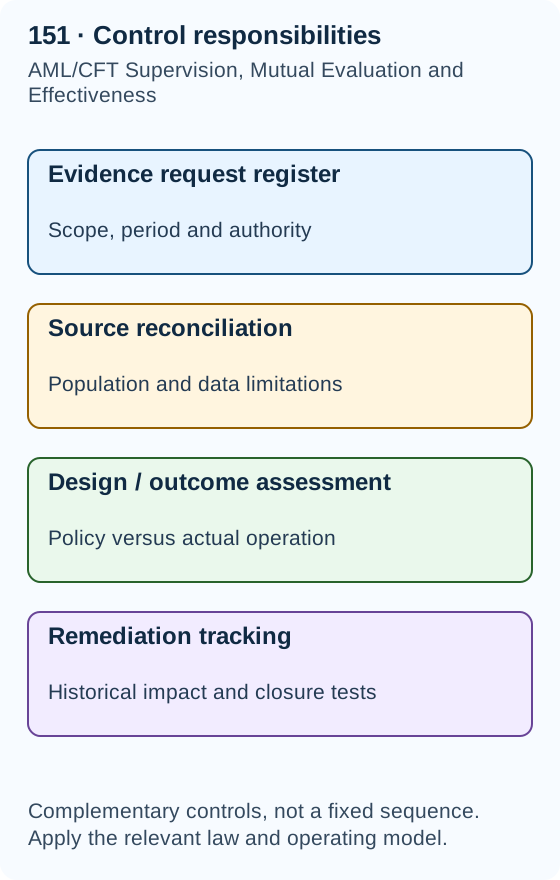
Evidence populations and denominators
Every metric needs a population definition. “Customers reviewed” could mean unique legal customers, accounts, relationships or review tasks. “Transactions screened” could mean payment instructions, messages, attempts or completed economic transfers. “Cases closed” could include duplicates, technical closures and substantive investigations. If those categories are mixed, a dashboard can produce an impressive percentage that answers no useful control question. The evidence pack should state the unit of analysis and the inclusions and exclusions for each material measure.
Completeness requires reconciliation to an authoritative source. For monitoring coverage, compare the expected transaction population with the population received and evaluated by the engine. Identify rejected records, duplicates, late records and excluded product codes. For customer reviews, reconcile the eligible customer population to assigned and completed reviews, with approved exceptions visible. The reconciliation should account for changes during the period rather than compare unrelated snapshots and assume that the difference represents a control outcome.
Denominators can drift after system change. A new application may combine related alerts into one case, making closures appear to fall even when the same activity is reviewed. A revised customer hierarchy may merge several accounts under one customer identifier. A payment hub may create more processing events for the same economic transfer. Management information should explain those changes and preserve comparability where possible. Otherwise, a trend can be mistaken for improved or deteriorated risk when it is mainly a change in counting.
The evidence should allow independent reproduction. Retain the query or extraction logic, source versions, execution date, relevant filters and reviewer approval. A spreadsheet prepared manually for the examiner needs reconciliation and explanation of adjustments. The institution should disclose unavailable fields or periods and explain their effect on the conclusion. An accurate partial measure is more useful than a broad completeness claim that cannot be recreated from governed records.
Sampling for different assurance questions
A sample should be designed around the question it is intended to answer. A statistically representative sample can support certain population estimates when its assumptions are met. A targeted sample of high-risk, failed or unusual cases can identify material weaknesses but cannot be interpreted as an unbiased prevalence estimate. A thematic review can assess a particular control mechanism. The bank should state the purpose, selection method, population and limitations before interpreting the result.
Sampling only successful cases creates false comfort. A customer-due-diligence review should consider incomplete files, escalations, rejected onboarding and exceptions where relevant. An investigation review should consider filed and non-filed cases, including cases closed after a plausible explanation. A payment-control review should consider repaired, rejected, returned and released payments, not only those that passed without intervention. Failures and difficult decisions often reveal whether the operating model works when the ordinary path breaks.
Stratification can improve relevance. Different legal entities, products, customer groups, investigators and system versions may have different exposure or control designs. A sample dominated by low-complexity retail cases may say little about a specialist trade-finance team. The reviewer should identify material strata and explain how selection covers them. Small high-risk populations may justify reviewing every case, while a large stable population may need a different method. The approach should be proportionate and transparent.
The review record should separate observed defects from inferred population consequences. One missing document may be a local execution issue or a sign of a system that never requests the document. The reviewer should investigate the mechanism before extrapolating. If the sample exposes a likely systemic defect, the bank may need a wider population analysis or lookback. Closing the finding by repairing only the sampled files would leave the underlying exposure unresolved.
Demonstrating data lineage during an examination
An examiner may ask how a transaction moved from a source system into monitoring, investigation, reporting and management information. The bank should be able to show the relevant identifiers, transformations and control versions. A final case screenshot is not enough if a critical field was dropped before the investigator received it. Lineage connects the source fact to the decision and explains where meaning changed. It also helps distinguish a source-data problem from a mapping defect or an investigator's misunderstanding.
The explanation should identify original and derived values. A bank may normalise a name, enrich a country, map a payment type or infer an entity relationship. Those transformations can be useful, but the evidence should retain provenance and limitations. An inferred country should not be presented as customer-supplied verified residence. A normalised party name should not silently replace the original message when identity ambiguity matters. The reviewer needs to understand what each control actually saw.
Historical lineage is essential for changed systems. If the bank corrected a mapping last month, it should identify the transactions affected before the correction and the evidence available for reconstructing them. A current successful test demonstrates the corrected path, not necessarily past completeness. The bank should preserve the relevant configuration, code or mapping version and explain when it became effective. Where historical reconstruction is incomplete, the gap should be visible in the exposure and assurance assessment.
A useful examination demonstration follows one ordinary case and one defective case end to end. The ordinary case shows the intended control path. The defective case shows detection of the gap, containment, correction, historical assessment and closure evidence. This comparison reveals whether the institution understands the mechanism rather than merely presenting architecture diagrams. The outcome should let an independent reviewer reproduce the key facts and identify the limits of what has been proven.
Operating evidence for investigator judgement
Investigation quality cannot be established from a completion status alone. A reviewer needs to see why the case arose, what context was considered, which evidence supported or contradicted concern and how the applicable decision threshold was used. A narrative copied from the alert may record the trigger without recording the assessment. A plausible customer explanation may be relevant, but the file should show the bank's corroboration and any remaining material uncertainty.
The assurance review should distinguish closure quality from filing quality. A sound closure can demonstrate proportionate treatment when unusual activity is explained. A weak closure can hide missed risk. A well-supported filing can communicate useful suspicion, while a weak filing can shift an unresolved internal task to the FIU. Review criteria should examine evidence and reasoning in both directions. A target that rewards filing conversion or fast closure can distort those decisions if it becomes the measure of success.
The bank should also examine consistency without demanding identical decisions in different facts. Two cases triggered by the same scenario may legitimately lead to different outcomes because customer purpose, counterparties, timing or corroboration differ. The reviewer should identify those differences. Inconsistent use of the same local threshold or repeated disregard of contradictory evidence is more concerning than different outcomes supported by different records. The assessment should document the specific reasoning defect rather than merely label a decision inconsistent.
Training can use fictional seeded cases and supervised review to improve judgement, but performance on training material does not prove production quality. The bank should connect training results with independent review of actual work, under appropriate confidentiality controls. Where errors recur, the cause may be workload, poor data, ambiguous policy, inadequate specialist support or weak supervision. Remediation should address that cause instead of treating every failure as a need for another generic learning module.
Demonstrating control change and durable remediation
A control change should have a documented problem, intended improvement, affected population and evidence plan. The bank should explain what failed and why the proposed change addresses it. Changing a threshold, rewriting a procedure or purchasing a new tool may be part of remediation, but the action alone does not demonstrate success. The evidence must show that the corrected control operates as intended and that any relevant historical exposure has been considered.
Acceptance criteria should reflect the failure mechanism. If transactions were excluded by product-code mapping, test the affected codes, normal and exceptional messages, rejected records and reconciliation. If customer reviews were incomplete because tasks were never assigned, test the population-to-workflow handoff and exception handling. If investigators lacked specialist support, assess access to expertise and review quality. A generic criterion such as “procedure updated and staff trained” may be insufficient for a data or workflow defect.
Independent challenge should test closure separately from implementation ownership. The control owner can provide evidence that the change was deployed. An appropriate assurance reviewer evaluates whether the evidence supports the closure conclusion and whether limitations remain. Independence should be proportionate to risk and the institution's framework; it does not mean the reviewer must recreate every technical step personally. It does mean that the same team should not rely on an unchallenged assertion that its own fix succeeded.
Durability requires observation after launch. A repair may work in a test environment but fail when a new channel, customer type or batch format appears. The bank should define monitoring of recurrence, residual exceptions and changed populations. A finding reopened after a later migration may show that the original control dependency was not embedded in change governance. A complete response therefore connects remediation to ongoing ownership, release checks and risk-sensitive assurance rather than treating closure as the end of learning.
Statistics that illuminate and statistics that distract
Activity metrics are useful for understanding workload, but they need careful interpretation. Alert volumes, cases completed, reports submitted, staff trained and customer reviews performed describe work. They do not automatically describe detection quality or reduced criminal exposure. A decline in alerts may reflect improved prevention, better calibration, a missing feed or an altered definition. An increase in reports may reflect higher risk, stronger investigation, duplicate filings or pressure to meet a target.
Quality and exposure measures add context. Examples include unresolved population gaps, material narrative defects, repeat findings, high-priority ageing, rejected submissions and failed-control recurrence. These measures also need definitions and limitations. A low defect rate from a small manager-selected sample provides weak assurance. An ageing average can hide a small population of severe overdue cases. The bank should explain the distribution and risk relevance rather than present one green aggregate as the entire control story.
External outcomes can inform evaluation when they are available, but attribution is difficult. An investigation may use several institutions' reports and other intelligence. A bank may not receive feedback about the result. A prosecution may occur years after the activity. Those facts do not make reporting quality unmeasurable, but they limit what the bank can claim. The institution should focus on contributions it can evidence and describe external results as contextual information rather than proof that one report caused the final outcome.
The committee should ask whether a measure could improve while the underlying risk worsens. Closure speed can rise if analysts stop corroborating explanations. Report acceptance can improve while narratives become less useful. Training completion can be perfect while staff cannot apply the policy. Testing those counterexamples helps select balanced management information. A defensible dashboard supports questioning and action; it should not be designed mainly to create an appearance of compliance during an examination.
Reading mutual-evaluation and follow-up findings
Check whether a rating concerns a Recommendation or an Immediate Outcome. Follow-up may re-rate technical compliance without reassessing all effectiveness outcomes. A country's improvement in one area therefore does not automatically demonstrate complete system effectiveness.
Use national findings as context for the bank's own exposure: weaknesses in ownership transparency, supervision or asset recovery may justify additional inquiry into relevant customers and counterparties. They do not prove that every resident is suspicious. Keep the source date and reasoning visible in country-risk governance.
Test evidence reproducibility. An independent reviewer should be able to obtain the same population and understand exclusions. Sampling should include risk-sensitive and failed cases rather than only successful files. Where statistics are incomplete, disclose the limitation and explain how it affects the conclusion.
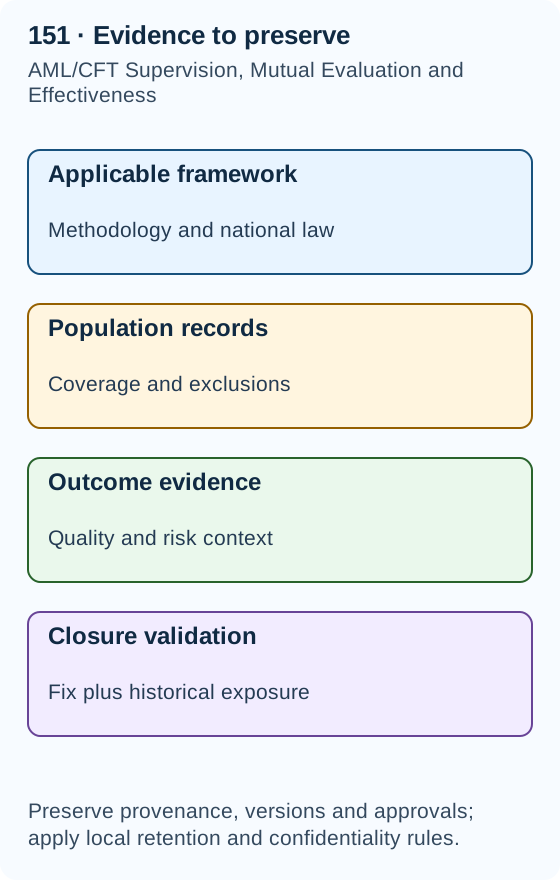
Fictional case: fewer alerts after a payment migration
Northbridge Bank is fictional. It moves business payments to a new hub and reports a substantial decline in transaction-monitoring alerts during the following month. Management initially describes the change as improved efficiency. The product team confirms that transaction volumes increased, while the monitoring team says the rules were unchanged. An examiner asks how the bank established that the new hub's payments were included. The case is about evidence of coverage, not whether a lower alert count is inherently good or bad.
The first review compares authoritative payment records with records received and evaluated by the monitoring engine. It identifies the relevant legal entities, products, period and transaction unit. The bank should distinguish attempted payments, completed transfers, returns and duplicate technical messages. A broad comparison of daily row counts may conceal product exclusions if one feed produces more events per payment than another. The reviewer therefore reconciles the relevant population using identifiers and documented transformations rather than treating similar totals as proof of completeness.
The investigation finds that one newly introduced product code maps to an unsupported transaction type. Those payments reach the integration layer but are rejected before scenario evaluation. The operational dashboard counts receipt at the integration layer as monitoring coverage. The mapping defect and the misleading metric are separate weaknesses. Fixing the product code will restore evaluation, while changing the metric will make future rejected records visible. Neither action alone explains the historical exposure during the period before the correction.
The bank establishes the affected transactions, customers and time interval. It assesses whether replay is technically possible, which historical data and scenario versions are available and what other controls operated during the gap. Fraud prevention or sanctions screening may have continued, but their operation does not automatically replace AML pattern monitoring. The bank should identify their actual contribution and limitations. Historical review should distinguish missed alerts, suspicious cases and reporting decisions instead of assuming that every affected payment requires a report.
The remediation pack includes the defect mechanism, population analysis, interim controls, corrected mapping, regression evidence, reconciliation, historical review and independent challenge. It explains the limits of reconstructed testing and the treatment of missing evidence. Management revises its earlier efficiency claim because the original explanation was unsupported. The corrected account can still identify genuine operational benefits of the new hub, but it should separate those benefits from a decline caused partly by lost coverage.
The learner's task is to propose three acceptance criteria for closure. One should prove that the affected product reaches evaluation. Another should prove that rejection and exclusion measures are visible. The third should address historical exposure and residual uncertainty. Explain why updating the monitoring procedure or completing staff training would not, by itself, meet those criteria. The case demonstrates how technical implementation, operating evidence and effectiveness claims connect without being interchangeable.
Fictional case: complete customer reviews with an incomplete population
A fictional bank announces that every high-risk customer review due in the quarter was completed. Its workflow dashboard shows all assigned tasks closed. During an examination, the supervisor asks how the eligible customer population became the assigned-task population. The bank discovers that customers whose risk rating changed after a system migration were not included in the scheduling extract. The workflow team completed its queue, but the institution did not prove that the queue covered every eligible customer.
The review begins with the risk-rating source, effective dates and scheduling logic. It identifies which legal customers, relationships and accounts the institution treats as review units. It also examines closed or transferred relationships and approved exceptions. The denominator should come from the eligible population under the relevant policy, not from the tasks the scheduling job happened to create. The reviewer should be able to reproduce both populations and explain each difference.
Some missing customers may have received a review through another process, such as a material event or onboarding refresh. Those records can be relevant, but the bank should examine whether they meet the intended review scope and timing. A brief address update is not automatically equivalent to a full risk review. Conversely, a documented comprehensive review should not be ignored simply because it was initiated through another valid route. The exposure assessment needs evidence about the actual work, not a rigid assumption based only on workflow labels.
Remediation includes fixing scheduling logic, identifying affected customers, prioritising review based on risk and urgency, and monitoring new rating changes. The bank should consider customer impact when requests become concentrated during catch-up. It may need additional trained capacity, coordinated document requests and clear explanations of ordinary requirements. It should not lower review standards merely to restore a green dashboard. It should also avoid unnecessary repeated requests where governed records already provide the required information.
Independent closure review tests the source-to-task handoff and the quality of completed catch-up reviews. It should include boundary events such as rating changes near the extract time, merged customer records and reopened relationships. The bank then revises management information so that assignment completeness and task completion are separate measures. That design makes it harder for a fully closed queue to conceal an incomplete population.
The teaching question is whether the original management statement was false or merely ambiguous. The answer should explain that it accurately described assigned tasks but overstated customer coverage if presented as complete review compliance. Rewrite the statement with the correct denominator, identify the residual exposure and propose a sustainable assurance measure. This case shows why examination evidence must trace the population, not stop at the final workflow status.
Fictional case: a country improves, but the bank's exposure changes
A fictional country receives a favourable technical-compliance re-rating in a follow-up report. A bank's country-risk team proposes removing enhanced inquiry from every business customer connected to that country. At the same time, the bank launches a service for complex cross-border holding companies whose ownership evidence depends on local registries. The committee should examine the precise improvement and the bank's changed exposure before treating the re-rating as a complete answer to customer risk.
The analyst reads the official report and identifies the Recommendation assessed, the shortcomings addressed and any remaining limitations. The follow-up does not necessarily reassess all effectiveness outcomes. The bank should therefore avoid claiming that the entire national system became effective or that every registry record is reliable. It should identify how the improved framework affects the specific evidence and controls relevant to the new customer service.
The product team maps the structures it expects to onboard, including ownership layers, controlling persons, professional intermediaries and transaction patterns. Compliance identifies the evidence required under the bank's applicable obligations. Operations tests whether the registry information is available, current and usable for those structures. A legal change can improve access while operational data remains incomplete during implementation. The bank needs evidence about its actual customer population, not only the existence of a revised national rule.
Proportionality cuts both ways. Retaining burdensome measures solely because of an obsolete country headline can harm legitimate customers and weaken risk differentiation. Removing every measure solely because of a technical re-rating can create false comfort. The committee should identify which controls remain justified, which can be reduced and which new ones are needed for the changed product. The decision should have a source date, rationale, owner and review trigger.
The bank can use targeted sampling after launch to test whether ownership evidence and customer explanations support the approved model. It should track unresolved structures, exception quality and material changes rather than demand a particular rejection rate. If a customer has no relevant connection to the weakness described in the report, the bank should not invent one merely to maintain an old classification. If the customer's structure introduces a real transparency problem, improved country ratings do not eliminate that problem.
The learner should write a revised committee recommendation separating national framework improvement, national effectiveness uncertainty and the bank's new product exposure. Explain why the same source can justify reducing one control while strengthening another. A mature country-risk process uses official assessments as evidence for a specific mechanism rather than an all-purpose verdict on customers.
Fictional case: the vendor certificate and the unanswered control question
A fictional bank buys a monitoring platform and receives a vendor assurance report about selected service controls. The project team presents it as proof that transaction monitoring is effective. The examiner asks whether all relevant bank transactions reach the platform, whether scenarios reflect the bank's risk assessment and whether investigators use the resulting evidence well. The vendor report may provide useful assurance within its scope, but it cannot settle those bank-specific questions automatically.
The bank should read the report's service scope, period, tested controls, exceptions and dependencies. It should identify what the vendor actually assessed and what remains the customer's responsibility. A report about service availability or access management is not necessarily an assessment of the bank's scenario calibration, source mappings or investigator decisions. The bank should retain the vendor evidence while avoiding a broader conclusion than the evidence supports.
Implementation testing follows the actual bank data. The team reconciles populations, verifies critical fields, examines transformations and tests rejected records. Scenario testing considers the bank's products, customers and risk hypotheses, with historical labels and legitimate comparisons treated carefully. Investigator review examines whether alerts provide usable context and whether decisions are reasoned. These tests answer questions that a generic service assurance document may not cover.
The institution should also examine change and dependency risk. A vendor upgrade can alter matching, aggregation or reporting. A bank interface change can remove a field without changing the vendor product. A model may operate differently on a new customer population. Responsibility for each dependency should be clear, and evidence should identify the version deployed. Neither party should assume that the other's assurance automatically covers changes in the shared operating chain.
The evidence pack should connect vendor assurance to the bank's own assurance programme. It can explain which controls rely on the vendor report, what additional work was performed and what limitations remain. If a material exception appears in the report, the bank should assess its relevance rather than treat the existence of the report as an unconditional pass. A defensible conclusion is scoped, dated and supported by the institution's actual operating evidence.
The exercise asks learners to classify five pieces of evidence: a service availability report, a population reconciliation, scenario test results, a sample investigation and a deployment change record. Identify the question each can answer and the questions it cannot answer alone. The purpose is to build a coherent assurance argument rather than collect impressive documents with unrelated scopes.
Fictional case: a repeated finding after apparent closure
A fictional bank closes an examination finding about missing beneficial-owner evidence after updating a procedure and training staff. Nine months later, a sample shows the same gap in a newly launched customer segment. Management initially attributes the recurrence to staff error. A deeper review finds that the new onboarding form cannot represent the relevant ownership arrangement and that the launch checklist did not include the original finding's control dependency. The earlier action improved instructions but did not embed the requirement in product change.
The institution should compare the original failure mechanism with the new one. If the original issue arose from ambiguous policy and the new issue from form design, the same visible symptom may have different causes. If both arose because ownership requirements were never translated into data and workflow controls, the recurrence indicates incomplete root-cause remediation. The review should preserve that distinction and avoid deciding the cause from the fact that staff attended training.
Exposure analysis identifies affected customers, products, periods and decisions. The bank should determine whether alternative records provide the missing evidence, whether reviews need to be reopened and whether any reporting or customer-risk consequences arise under the applicable framework. It should not automatically treat every incomplete file as suspicious or assume that a document request resolves every risk. The assessment needs the actual facts and the significance of the missing information.
The revised remediation addresses data representation, workflow validation, exception routing and launch governance. Acceptance testing includes the relevant ownership arrangements and cases where information is unavailable or conflicting. A requirement should explain what staff do in those circumstances, not merely prevent progression until they enter a convenient value. Where an exception is permitted, its owner and evidence need to be visible. Where information is required, the system should not encourage invented certainty.
Independent assurance tests both the repaired process and the change-control dependency. It asks whether a future product team would identify and preserve the same requirement. Management also reviews how the original closure was approved and whether its criteria were too narrow. The aim is not to reopen every finding automatically after a new defect, but to understand whether the earlier conclusion still stands and what organisational lesson is necessary.
The learner should draft a closure criterion that would have prevented the recurrence. It should connect customer evidence, system capability and future product change. Explain why another training reminder may be useful but insufficient. The case demonstrates that durable remediation is a property of the operating model, not merely a completed action list.
Worked effectiveness challenge
A fictional bank reports a fifty-percent decline in alerts as evidence that financial-crime risk fell. During the same period a new payment feed was introduced. Review should first test whether the new feed reaches the engine and whether rules cover its transaction types. A lower count could reflect changed risk, improved tuning or missing data.
Identify the evidence needed to distinguish those explanations. Explain why a country-level technical-compliance re-rating cannot settle that operational question.
Laboratory: conduct an examination walkthrough
Provide learners with a fictional bank's risk assessment, product inventory, monitoring architecture, reconciliation results, case samples and findings register. Ask them to choose a material risk and trace it from assessment through control design, operation and assurance. They should identify the relevant population, scenario or preventive measure, decision rights and supporting evidence. The walkthrough should include a normal case and an exception so that the learner can test the operating model beyond its ideal path.
The learner should ask owners to explain the same control in their own terms. A product owner describes the customer need and funds flow. A data owner identifies sources and transformations. Operations describes the review process and difficult cases. Compliance explains the requirement and threshold. Technology explains configuration and change. Assurance explains what it tested and what it did not. Differences may reveal ambiguity, but they should be resolved against records rather than treated as automatic misconduct.
The output is an evidence map with specific gaps. A missing query definition, an unexplained exclusion or an unsupported claim of historical coverage should be recorded separately. Learners should distinguish a request for more evidence from a finding that the control failed. They should also distinguish a design weakness from an execution failure. The exercise rewards accurate scope and reasoning, not the number of deficiencies listed.
Conclude with a concise management explanation. State what was demonstrated, what remains uncertain and what action would resolve the uncertainty. If a control appears effective for one population but untested for another, preserve that boundary. A walkthrough becomes useful when it produces a reproducible understanding of the bank's exposure and operating evidence rather than a catalogue of screenshots.
Laboratory: challenge a management dashboard
The fictional dashboard reports perfect training completion, rapid alert closure, low filing rejection and no overdue high-risk customer tasks. Learners receive the definitions and extraction logic behind each measure. They discover that temporary staff are excluded from training counts, duplicate closures dominate throughput, rejected submissions are removed from the denominator after retry and customer-task assignment completeness is not measured. The exercise asks whether each displayed statement is accurate, misleading or incomplete.
For each metric, the learner identifies its purpose, population, denominator, time basis and transformation. They propose a complementary measure where necessary. Training completion may need role coverage and applied competence. Throughput may need complexity and quality context. Submission delivery may need attempt history and unresolved acceptance states. Customer reviews may need eligible-population reconciliation. The revised dashboard should remain usable; adding many unrelated numbers is not the objective.
The learner also identifies incentives. A closure target may encourage premature decisions. A zero-rejection target may encourage staff to suppress difficult records from the reporting pipeline. A simple overdue measure may encourage changing due dates without resolving risk. Controls should make legitimate adjustments visible and preserve original commitments where relevant. The committee needs enough detail to distinguish actual improvement from a change in classification or counting.
Finally, learners write the questions management should ask before accepting an improvement claim. They should identify which questions require case samples, data reconciliation or independent assurance. A well-designed dashboard directs attention to evidence and decisions; it does not eliminate the need for judgement. The laboratory demonstrates how management information can support supervision without pretending that green indicators prove every control effective.
Laboratory: build a finding-to-closure record
Give the learner a fictional finding about payment-address data lost between the channel and screening system. The proposed response is to add a validation rule and close the issue after deployment. Learners should identify the failure mechanism, affected population, historical period, customer impact and control consequences. They should ask whether the missing data affected identity resolution, required information, investigation traceability or several of these issues. A field gap is not automatically a sanctions match or a reporting conclusion.
The remediation plan should separate containment, correction and historical assessment. Containment may involve a lawful temporary review process or another approved control. Correction repairs the mapping and validates relevant message paths. Historical assessment identifies affected payments and decides what review or replay is appropriate, with limitations recorded. The plan should assign owners, dependencies, dates and evidence for each track. Completing one track does not automatically close the others.
Learners then define acceptance tests. Include normal and exceptional input, repair, resubmission, alternate channels, rejected records and relevant changes to the payment version. Verify that the released payment has the required control decision for the actual data used. Test reconciliation so a future lost field becomes visible. The results should identify the source and configuration versions and preserve evidence sufficient for independent review.
The closure recommendation should state what has been demonstrated and which residual risks remain. An assurance reviewer should be able to challenge it without relying on the implementer's confidence. If historical records are incomplete, the recommendation should explain the alternative assessment and authorised residual-risk treatment. The exercise teaches a durable response to a specific mechanism rather than a generic promise that staff will follow the procedure more carefully.
Examination readiness as normal operations
Maintain a request register, source lineage, controlled evidence versions and the approving owner for each submission. Separate privileged legal advice from operational records according to the applicable disclosure framework. Record corrections transparently when an initial submission was incomplete.
Management should review unresolved findings by severity, affected population, interim protection and overdue milestones. Independent assurance validates closure and tests whether the fix survived product or system change. A repeated finding usually requires a root-cause response beyond another training reminder.
Good readiness makes routine control evidence retrievable. It should not depend on a temporary team reconstructing decisions from individual mailboxes shortly before the examiner arrives.
Evidence labels that prevent overstatement
Designed. The control is specified in an approved requirement, procedure or configuration. This establishes intent and may support design assessment. It does not prove that every relevant transaction or customer passed through the control or that staff applied judgement consistently.
Implemented. The control is deployed in the stated environment and version. Deployment evidence can establish that a change reached production. Operating evidence is still needed to show that the relevant population uses the path and that exceptions are handled appropriately.
Tested. The bank examined the control through a stated method and population. The result should identify scenarios, period, configuration, exclusions and limitations. A passing test is evidence within that scope, not an assurance claim about every future event or untested channel.
Reconciled. Populations or records have been compared against an authoritative basis, with differences explained. This can support completeness and integrity. It should identify the unit of analysis, transformations and unresolved breaks rather than treat matching totals as sufficient proof.
Effective within scope. The evidence supports the intended result for the examined exposure and period. The phrase should be accompanied by the actual scope and limits. It is stronger than a design assertion but should not become a timeless promise that circumstances cannot change.
Residual risk accepted. An authorised owner has considered an identified limitation and its consequences under the institution's framework. This is a governance decision, not proof that the gap has disappeared. Record the rationale, conditions, review date and circumstances requiring escalation.
Closed. The finding meets approved closure criteria, with relevant evidence and challenge completed. Closure should identify what was resolved, what historical assessment occurred and what remains under ongoing monitoring. It should not mean only that an action tracker has no open rows.
Re-rated. A country assessment has changed the rating of a stated Recommendation or other assessed dimension through the relevant process. The bank should identify the source, date and scope. It should not infer that every effectiveness outcome or institution was reassessed unless the official record says so.
Group programmes and locally accountable evidence
A banking group may have a central policy, shared monitoring technology and a regional investigation team. Each arrangement can improve consistency, but it does not eliminate the need to understand local legal entities, obligations and operating evidence. An examiner reviewing one subsidiary needs to know which services it receives, which decisions remain local and how it can obtain records. A group statement that a central control exists is insufficient if the subsidiary cannot explain whether its transactions are included or how local exceptions are handled.
The group should identify service dependencies explicitly. A local entity may rely on a central customer master, a shared sanctions-list service, a regional reporting team or an outsourced archive. For each dependency, the institution should understand scope, responsibilities, data routes, access restrictions and escalation. A service agreement can document those arrangements, while operating evidence demonstrates that the arrangement works. Where one country restricts information sharing, the group needs an approved mechanism that respects the restriction without leaving local risk invisible.
Country and entity variation should be recorded in requirements. Different reporting channels, recordkeeping rules, customer categories or legal interpretations may require local configuration. A global template should identify which provisions are common and which need local implementation. An exception should have a reason, owner and evidence, rather than arise accidentally from a system's default setting. The examination pack should show the relevant local version and how group assurance addresses its particular exposure.
Cross-entity trends need comparable definitions. One subsidiary may count cases while another counts alerts, or define high risk differently under its framework. Aggregating those figures can conceal a severe local issue behind group averages. Management should retain the entity-level view and explain material differences. A central review should identify recurring mechanisms across entities, while local owners remain accountable for implementing and evidencing the required response. Consistency is achieved through understood responsibilities and tested controls, not through identical labels on incompatible data.
Remediation and legitimate customer access
Supervisory remediation can create substantial customer friction if the bank responds indiscriminately. A file-completeness finding may lead to repeated document requests, payment delays or blanket account restrictions. The institution should identify the actual control gap and the evidence needed to resolve it. It should distinguish customers whose information is missing from customers whose activity presents an unresolved substantive concern. The applicable legal framework governs required measures; the bank should not treat every administrative defect as proof of suspicion.
Requests should be specific and coordinated. If the bank already holds a current document in a governed system, asking the customer to supply it again may add burden without improving assurance. If a record is stale or cannot support the required fact, explain the relevant request through an approved customer communication. Vulnerable customers, small businesses and customers with limited digital access may need practical alternatives. Those alternatives should preserve the evidence standard rather than create an undocumented exception or encourage staff to enter invented values.
Interim controls also require proportionate design. A bank may lawfully intensify review, limit a particular service, seek additional information or take another authorised step. It should identify why the step addresses the gap, which activity it affects and how it will be reviewed. A broad restriction may have consequences for payroll, rent or ordinary commerce that a targeted measure could avoid. Customer impact is part of the decision analysis, while binding sanctions or restraint requirements still need to be respected.
Assurance should examine whether remediation creates new defects. A forced field may produce placeholder data. A compressed review target may cause weak corroboration. A bulk request may overwhelm customer-service channels and leave genuine questions unanswered. The institution should monitor evidence quality, exception handling and complaints alongside completion. A closure pack should demonstrate that the original weakness was addressed without merely moving the problem into customer treatment, data accuracy or another control process.
Supporting a national assessment without staging the evidence
An institution may be asked to contribute information or participate in discussions during a country's mutual evaluation. It should understand the request, competent-authority route and confidentiality conditions. The bank's role is to describe its relevant practice accurately, supported by records and appropriate examples. It should not present a temporary process created for the assessment as the ordinary operating model or assume that participation replaces normal supervisory accountability.
Preparation should focus on clarity and reproducibility. Staff should be able to explain how the bank understands risk, applies preventive measures, investigates concern, reports through the applicable channel and handles information requests. Examples should represent actual capabilities and limitations within the permitted disclosure scope. If sensitive cases cannot be shared in full, the bank should use an approved explanation or anonymised material that preserves the control lesson without exposing protected information. Legal and compliance should govern that handling.
Statistics supplied for assessment should have definitions and source lineage. If figures cover only certain entities or products, state that boundary. If a change in counting affects comparability, explain it. If external feedback is unavailable, do not invent an intelligence outcome to make the institution's contribution appear more successful. The country assessment may combine information from many authorities and sectors, so accurate institutional evidence is more useful than a broad claim that the bank has solved a national problem.
After the assessment, the bank should review relevant findings and decide what they mean for its programme. Some findings may concern authorities or sectors outside the bank's direct control. Others may identify vulnerabilities relevant to its customers, data or cooperation arrangements. The response should distinguish those categories and identify proportionate action. A mutual-evaluation report becomes valuable when it informs a current risk and control assessment, rather than remaining a document cited only during the next examination.
Assessment vocabulary and the evidence behind it
Technical-compliance and effectiveness ratings use different scales. The former includes compliant, largely compliant, partially compliant and non-compliant categories; the latter includes high, substantial, moderate and low effectiveness. Read the definition and assessed area before comparing results. The words describe an assessment under a methodology, not a bank customer's legal status or an automatic permission to conduct a transaction.
A table is an entry point into the report. The underlying findings explain material weaknesses, context and evidence. A bank should retain that explanation when translating assessment information into country risk. Two countries with the same headline category may have different weaknesses and different relevance to the institution's products. Likewise, a later change may concern a narrow technical issue rather than the whole system. The useful professional habit is to ask what the rating assesses, when it was assessed and which mechanism matters to the bank's exposure.
References and further reading
Reviewed 2 October 2026. FATF provides international standards; applicable national law determines binding duties. The operating examples are fictional teaching cases.
- FATF Recommendations, updated June 2026 — relevant anchors: 26, 27, 33 and 35.
- FATF assessment methodologies