Trust, Transparency & Dark Patterns
Design choices that protect informed customer decisions
Make the actual choice understandable
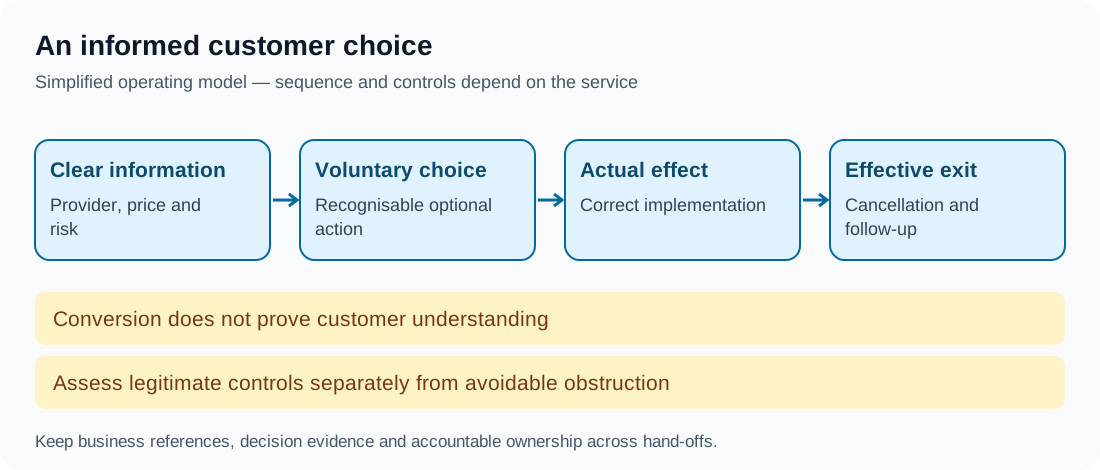
Transparent banking design helps customers understand the provider, product, price, risks, action and exit. A disclosure can be technically present and still be difficult to find or comprehend at the point of decision. Assess the whole journey and the choice it creates.
Dark patterns are design techniques that manipulate, obscure or obstruct customer choice. Legal treatment depends on the jurisdiction and activity. The term is useful for design review but does not make every unequal button size or additional step automatically unlawful.
Common patterns in financial journeys
Look for late mandatory charges, preselected optional products, misleading prominence, repeated pressure, unclear recurring payments and avoidable cancellation barriers. Compare the customer's impression with the actual terms and effect. A security check can justify friction; an unexplained obstacle designed to prevent lawful exit needs challenge.
Show material price and conditions where needed before commitment. For foreign exchange, distinguish a quote's rate, explicit fees and any described comparison basis. A claim of “no fee” can still need explanation of the exchange-rate economics; do not assume a spread is always an separately charged fee.
Permission and commercial placement
Separate necessary service processing from optional data uses and marketing choices. Evaluate the applicable basis and consent requirements rather than assuming every checkbox is consent or every service notice can be switched off. Do not bundle an unrelated optional grant invisibly into payment confirmation.
Label sponsored or partner selection appropriately and keep provider responsibilities clear. A product offer on a servicing screen needs assessment of timing, prominence and customer understanding. Conversion does not prove a choice was informed, especially when customers were trying to solve an urgent problem.
Exit is an implemented journey
Explain cancellation, closure, transfer and data-control routes appropriate to the product. Requirements and legitimate constraints differ: an outstanding debt or unresolved transaction can affect closure, while a subscription cancellation may follow another process.
Do not assume sign-up and exit must always take exactly the same number of clicks. Instead assess whether obstacles are justified and whether the promised exit actually happens. Confirm the relevant outcome, stop future charges as required and reconcile partner systems. Preserve records that must be retained without representing that retention as unrestricted reuse.
Worked example: the hidden subscription
In this fictional payment app, an optional monthly service is preselected in a transfer flow and the recurring price appears only after confirmation. Customers think they approved only the transfer. The team separates the optional service, makes its terms and choice clear and investigates affected customers under the applicable remediation process.
It also fixes the cancellation path so the billing system receives the customer's instruction. Merely changing the promotional label would leave the recurring-charge defect. Research checks that customers understand both choices before a wider rollout.
Evidence and governance
Retain proportionate evidence of journey versions, material terms and significant presentation decisions. Test understanding, accessibility, fee awareness, cancellation completion, complaints and repeat pressure. Avoid collecting unnecessary sensitive screen recordings simply to prove every interaction.
The UK FCA Consumer Duty is one scoped framework for customer outcomes. Other markets apply their own promotion, unfair-practice, privacy and product rules; do not merge them into one invented global dark-pattern law.
Takeaway
Trust grows when the customer's understood choice matches the actual financial and information effect. Clear presentation and working exit processes should be tested alongside the conversion funnel.
Continue to Open Banking Foundations.