Tokenisation of Assets
How an asset right is represented, transferred and serviced on a digital platform
The token and the right it represents
Tokenisation records a digital representation of an asset or claim on a programmable platform. The asset can be a security, a fund interest or another legally recognised right. A token may help move or service that right, but the token balance alone does not establish ownership. The issuer's terms, applicable law and authoritative register determine what the holder can claim.
A bank considering a tokenised asset should ask six questions: What is the underlying right? Who creates it? Which record is legally authoritative? Who can transfer it? When does a transfer become final? How does the holder receive income, redemption proceeds or other benefits? If the answers are split between a blockchain and another register, the bank must reconcile them and specify which wins when they disagree.
The BIS/CPMI report on tokenisation describes possible changes to market structure and asset life cycles while stressing governance and risk management. IOSCO's 2025 report on tokenisation of financial assets identifies familiar financial risks alongside risks that can materialise differently through new technology. Neither source makes every tokenised asset legally equivalent to its traditional counterpart.
Native issue and representation of an existing asset
In a native digital issue, the instrument is created under terms that make the platform or a linked register part of the original issuance arrangement. The legal framework still determines the holder's rights and how changes to the record are recognised.
In a representation of an existing asset, a token points to an asset or interest already recorded elsewhere. The arrangement must prevent one right from being transferred twice and explain how token transfers update the underlying register. A bank should be wary of a “wrapped” balance when the custodian, nominee or register operator can change the underlying position without a corresponding token event.
These are design patterns, not permission categories. Securities, fund, property and other asset rules differ. The product team must obtain legal analysis for the actual instrument, parties and markets.
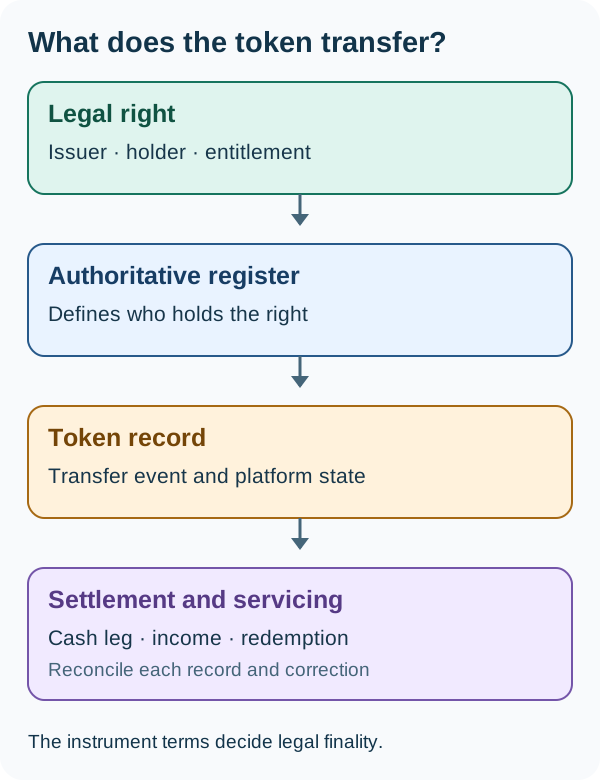
The life cycle a bank must support
Issue. The issuer defines the rights, eligibility, quantity, transfer restrictions and servicing duties. The platform creates a record that can be reconciled to those terms and any off-platform register.
Distribute. A bank or intermediary checks customer eligibility, disclosures and any applicable suitability or appropriateness obligations. It records the order and the version of terms the customer accepted.
Transfer and settle. The asset leg and payment leg need clear finality. Delivery versus payment can reduce the risk that one leg completes without the other, but a technical atomic event does not automatically resolve legal finality, the quality of the settlement asset or liquidity needed to pre-position funds.
Service. Income, corporate actions, voting, redemptions and tax or reporting information must reach the current legal holder. The platform's token count should reconcile to the issuer or agent's obligation and the bank's customer records.
Correct or exit. A lost key, mistaken transfer, freeze, platform failure or insolvency requires a defined process. The bank should know whether a token can be replaced, whether a legal register can be corrected and which party has authority to decide.
Worked example: tokenised bond interest
Assume an issuer creates a bond whose interests are represented on a digital platform. A bank distributes it to eligible investors. At an interest date the issuer or paying agent calculates who is entitled under the instrument's record-date rule. The bank must not infer that a wallet address holding a token at an arbitrary moment is necessarily the legal payee.
The paying agent needs the authoritative holdings register, the bank needs a customer-level entitlement record, and finance needs the cash and securities postings. A transfer after the record date may move the token but not the accrued payment right. The product's terms and market rules decide this. Operations should rehearse a missed payment, a disputed holding and a corporate-action correction before launch.
A second test is settlement. If the bond token transfers at 10:00 but the cash leg fails at 10:01, the bank needs a rule for whether delivery occurred, whether the asset can be returned and what the customer sees. If the platform claims both legs are atomic, test legal effectiveness and the fallback when a participant, bridge or settlement asset fails.
Risks and operating controls
- Rights linkage: reconcile token supply and holdings to the authoritative asset register; document the legal effect of a transfer.
- Custody and keys: separate who controls signing from who owns the asset; test recovery, segregation and provider failure.
- Settlement and liquidity: identify the payment asset, finality rule, prefunding need and failed-leg treatment.
- Servicing: link the current holder to income, voting and redemption; handle record dates and corrections.
- Market integrity: control information asymmetry, conflicts, manipulation and distribution practices under the rules that apply to the instrument.
- Technology and concentration: test platform upgrades, interoperability claims, outages and the bank's ability to export records and exit.
IOSCO notes that atomic settlement can reduce some settlement risk while requiring pre-positioned assets, and that operational transfer and final legal settlement may differ. A bank should therefore measure unresolved register differences, failed settlement legs, corporate-action corrections and time to restore customer entitlements rather than counting minted tokens.
Takeaway
Tokenisation can change how an asset is issued, transferred and serviced. The bank's central job is to keep the holder's legal right, token record, settlement cash and customer statement in agreement. A faster platform is useful only when those records can be reconciled and corrected.
Sources and review scope
These international publications explain concepts and risks. The rights and obligations of a specific instrument come from its terms and applicable law.
- BIS/CPMI, Tokenisation in the context of money and other assets (2024) — token arrangements and market-structure implications.
- IOSCO, Tokenization of Financial Assets (2025) — benefits, costs and risks for financial markets.
- CPMI-IOSCO, Principles for Financial Market Infrastructures — relevant settlement-risk concepts where an arrangement is an FMI or subject to related standards.