Stablecoin Business & Settlement Models
Reserve models, redemption, distribution, settlement use cases and risks
What the customer holds
A stablecoin is a digital token designed to maintain value against a reference asset, commonly a currency. The name does not guarantee a stable price or a right to redeem. A bank should identify the issuer, the holder's legal claim, the backing mechanism, the redemption terms and the network on which the token moves before treating it as a payment or settlement asset.
A token transfer, redemption into bank money and settlement of an underlying purchase are three separate events. The token may move on a network while the customer's bank balance is unchanged; a merchant may deliver goods before the issuer has honoured a redemption request. The customer experience must say which event has occurred and what remains pending.
The arrangement behind one token
A typical fiat-referenced arrangement can involve an issuer, reserve custodian, token network, wallet providers, exchanges or distributors, banks that provide cash accounts, and holders. Roles and contracts vary. A single firm may perform several functions, but the risk does not disappear when functions share a brand.
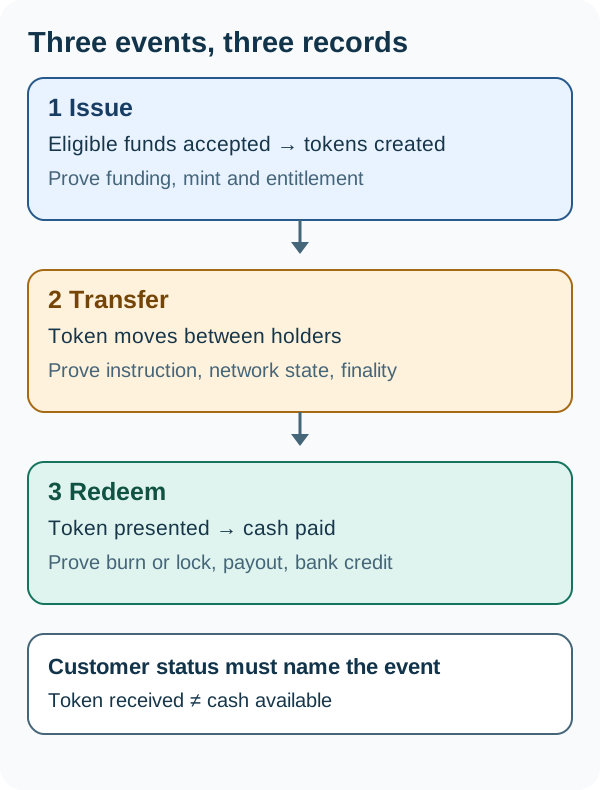
| Stage | Economic event | Evidence the bank needs |
|---|---|---|
| Issue | The issuer accepts eligible funds and creates tokens under its terms | Funding receipt, mint record, reserve movement and holder entitlement |
| Transfer | A holder instructs movement between wallets or intermediaries | Authorisation, network reference, control decision and finality policy |
| Use | The token is exchanged for goods, assets or another currency | Merchant or counterparty obligation and whether delivery depends on token settlement |
| Redeem | An eligible holder presents tokens for payout | Burn or lock record, cash instruction, fee, payout status and exception owner |
Do not label all four stages “instant settlement.” Network confirmation may be quick while cash payout, asset delivery and bank reconciliation follow different clocks. The applicable arrangement rules define when a transfer is final; the bank should not invent one universal confirmation count.
Backing and stability models
Fiat and short-term asset reserves. Some issuers seek to maintain value with cash and other reserve assets. The holder needs to know what claim exists, whether reserves are segregated, how they are held, when they are valued and how redemption works under stress. A reserve report describes assets at a point in time; it does not by itself prove that every holder can receive cash immediately.
Crypto-asset collateral. Other designs use volatile collateral with overcollateralisation and liquidation rules. The apparent cushion can shrink quickly when prices fall or markets become illiquid. Oracle design, liquidation execution and governance become part of the stability model.
Algorithmic mechanisms. A mechanism that relies primarily on incentives or another token to absorb selling pressure does not provide the same claim as a redeemable fiat reserve. A bank should avoid presenting the peg target as a cash guarantee. The exact legal and economic rights must be read from the arrangement.
These are analytical categories, not a list of regulatory permissions. A jurisdiction may define, restrict or prohibit particular instruments or activities differently.
Two settlement use cases
In a customer payment, a payer acquires tokens, transfers them to a recipient and the recipient may keep or redeem them. The bank should model the full path from the payer's funding account to the recipient's usable money. It needs to identify the foreign-exchange spread, network fee, issuer fee, redemption eligibility, sanctions and fraud controls, dispute route, tax or reporting implications where relevant, and what happens if the recipient cannot redeem. A cheaper token transfer does not prove a cheaper end-to-end payment.
In delivery versus payment for a tokenised asset, the asset leg and stablecoin leg may be programmed to exchange together on a platform. That reduces one form of principal risk only if the platform execution is legally effective, both assets are usable after the exchange, and the settlement asset retains value. The bank still needs a route from stablecoin holdings to money it can use for its own obligations. The tokenised deposits and CBDC chapters explain other settlement-asset models.
Worked example: a Friday redemption queue
A customer receives 1,000 currency units of a stablecoin for a sale and asks for cash in a bank account. The wallet records the incoming token transfer. The issuer accepts a redemption request, but its cash bank is outside processing hours. The customer sees “received” on the network and assumes the bank deposit is available.
A sound design shows three states separately: token received, redemption accepted and cash credited. It records the token transfer ID, issuer request ID, payout instruction and bank posting ID. It states any eligibility or minimum-size condition before the customer accepts the token. If cash payout fails, operations can identify whether the token was burned, is locked or remains spendable and can tell the customer who owns the next action.
The example is deliberately simplified. The actual redemption right, timing and protection depend on the issuer's terms and the applicable law. A bank must test these against the specific arrangement before using “cash equivalent” or “settles instantly” in customer language.
Risks and controls to test
- Reserve and run risk: compare outstanding tokens with the relevant reserve and liabilities records; test liquidity under concentrated redemptions and disruption at reserve banks.
- Credit and legal risk: establish who owes redemption, who has a claim on reserve assets and what happens in insolvency.
- Operational and cyber risk: control minting, burning, signing, upgrades, freezes and key recovery; rehearse outages and compromised keys.
- Market and liquidity risk: monitor price dislocation and the depth of conversion routes, not only the reference value printed in the app.
- Financial crime and conduct: apply the controls required for the actual activity and jurisdiction; make fees, eligibility, restrictions, complaints and loss allocation clear.
- Intermediary risk: test access to records and customer servicing if an exchange, wallet provider or issuer fails.
The FSB's recommendations for global stablecoin arrangements call for clear governance, disclosure, risk management, recovery planning, robust legal claims and timely redemption. They are high-level recommendations to authorities, not direct permission for a particular product. For single-fiat referenced global stablecoins, the FSB recommends redemption at par into fiat. The bank must still check binding local requirements and the precise rights in the instrument it proposes to use.
Measures that reveal the real service
Track successful cash redemption as well as token transfer: request-to-cash time, failures by cause, reserve and token reconciliation breaks, concentration of redemption channels, price deviation during stress, and customer complaints that arise from confusing pending with available. Include the cost of funding, liquidity buffers and exception handling in the business case. A network throughput chart cannot show whether customers received money.
Takeaway
The settlement model is the whole route from funding through token transfer to cash or asset delivery. A stablecoin may improve one leg while leaving redemption, legal finality and customer support unresolved. Assess the issuer's claim, reserve, intermediaries and exit path together.
Sources and review scope
This chapter explains general operating models. It does not state a universal licence, reserve composition, protection limit or redemption deadline.
- FSB, High-level recommendations for global stablecoin arrangements (2023) — governance, disclosure, legal claim, redemption and recovery.
- BIS/CPMI, Tokenisation in the context of money and other assets (2024) — token arrangements and settlement-asset considerations.
- BIS, Annual Economic Report 2025 — stablecoins, singleness of money and financial-system implications.