Responsible AI in Digital Banking
Responsible AI in digital banking: fairness, explainability, oversight and customer outcomes
Govern the use, not only the model
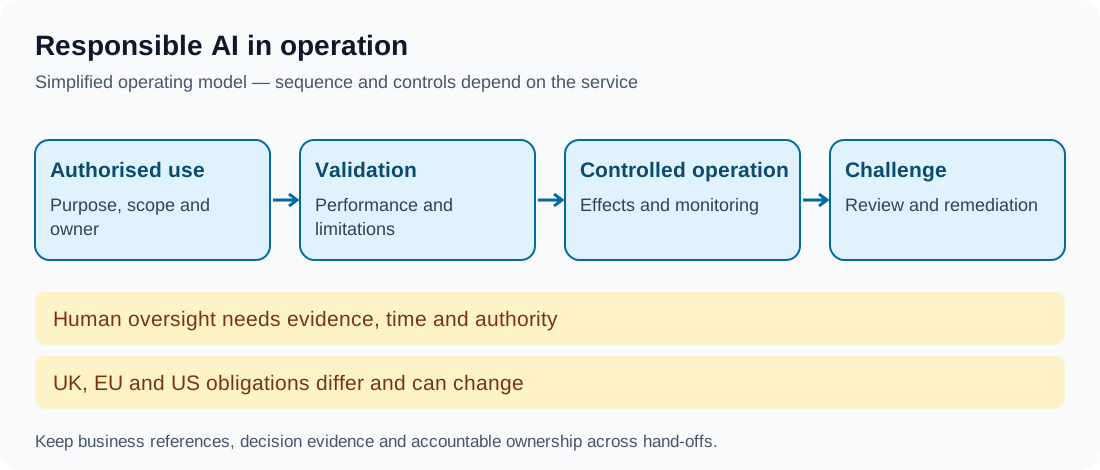
Responsible AI covers the system's purpose, data, decisions, business effects and customer outcomes. This includes predictive decision models and generative tools used for customer service or staff assistance. An accurate model can still be unsuitable for an activity, use inappropriate information or produce an effect the firm cannot explain or control.
Maintain an inventory of uses, owners, providers and consequences. Distinguish informational assistance, recommendations and binding decisions. Assess materiality and controls proportionate to the activity. Not every automation is AI, and not every AI output has the same legal significance.
Validate before and after release
Review intended use, relevant data, performance, limitations, fairness and failure behaviour. Separate development from appropriate independent challenge. Check that validation covers the actual customer population and business process rather than only a favourable test dataset.
The US interagency guidance issued as SR 26-2 in April 2026 supersedes SR 11-7 and SR 21-8. It emphasises a tailored risk-based approach and is expected to be most relevant to Federal Reserve-regulated banking organisations above 30 billion dollars in assets. It is scoped supervisory guidance, not a universal AI law.
Fairness and explanations
Evaluate performance and consequential errors across relevant populations using lawful methods. A difference in approval rates can identify a question without proving either unlawful discrimination or fairness. Consider data quality, selection, features, outcomes and applicable discrimination rules; document the analysis and remediation.
Explanations should represent the actual decision. A generic reason assembled after the event may mislead the customer. In US credit, Regulation B's interpretation links required adverse-action reasons to the actual principal factors used. Technical explainability tools do not automatically produce compliant customer notices.
Significant automated decisions: distinguish regimes
The EU GDPR Article 22 addresses decisions based solely on automated processing with legal or similarly significant effects. It includes specified exceptions and safeguards. Do not interpret every automated message as a prohibited significant decision, or treat the mere presence of a staff member as meaningful involvement.
UK rules changed through the Data (Use and Access) Act 2025. The ICO's summary explains broader permitted circumstances with safeguards for significant solely automated decisions, while retaining restrictions for special-category information. Safeguards include information about the decision, representations, human intervention and contesting it. A lawful basis and other applicable duties still matter. UK and EU conditions should not be described as identical.
As checked on 1 October 2026, the ICO guidance-development page lists its detailed automated-decision update as in development. Draft guidance should not be represented as a final rule. EU AI Act classification, dates and obligations require a separate assessment of the use and applicable law.
Human oversight that can operate
Give reviewers relevant evidence, adequate time, training and authority to change or escalate outcomes. Define the route when evidence is missing or a reviewer disagrees. An overturn rate of zero is not automatically failure, but a queue whose staff cannot investigate may provide only ceremonial review.
In this fictional credit case, an income feature is wrong. The customer challenges the decline. A reviewer checks the source, corrects the information, reassesses through the authorised process and records the outcome. The team checks other affected cases; changing the customer-facing reason alone would leave the underlying defect.
Generative tools and continuing control
For generative AI, ground responses in authorised sources, test unsupported answers and information leakage, and constrain tool access. Retrieved text or customer messages must not grant authority to disclose data or move money. A fluent answer is not evidence that the payment status is true.
Version systems and monitor errors, drift, complaints, overrides and downstream effects. Define suspension, fallback and recovery procedures. Rolling back a model does not automatically undo completed decisions; affected customers and records may require separate remediation.
Takeaway
Responsible AI requires accountable use, tested limitations, real oversight and challenge routes. Apply the current rules for the actual jurisdiction and decision, and monitor what happens after the model produces an answer.
Continue to Experimentation & A B Testing.