Regulatory Expectations for Digital Security
Applicable obligations, implementation evidence and accurate reporting clocks
Map requirements to the actual entity and service
Digital-security obligations vary by legal entity, jurisdiction, activity and relationship. Banks, payment institutions, technology providers and financial distributors do not automatically have identical duties. Standards, supervisory guidance, binding rules and internal policies also have different legal status.
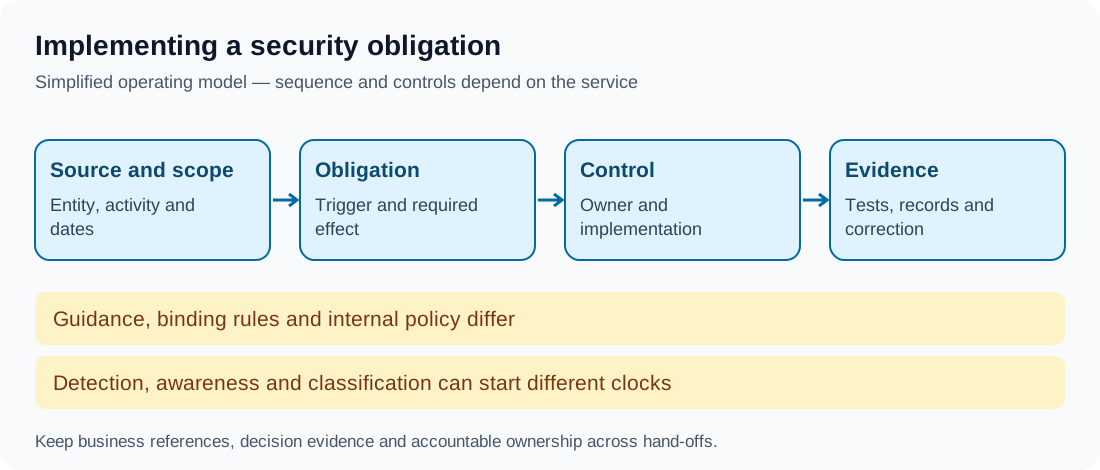
Maintain an obligation register with the primary source, scope, effective date, trigger, responsible owner and implemented control. A general reference to Basel, NIST or a regulator's homepage cannot establish a specific notification deadline or required technology.
Governance, resilience and third parties
The Basel operational-resilience principles provide a banking framework, with national implementation relevant. Governance, critical operations, dependencies and resilience need appropriate evidence. Do not invent a universal board technology committee, one mandatory CISO reporting line or a four-hour tolerance for every bank service.
The FCA operational-resilience framework is a scoped UK example of important business services, impact tolerances, mapping and testing. A software component such as authentication is not automatically a separately designated important business service in every institution; assess the service and customer harm under the framework.
DORA applies to in-scope EU financial entities from 17 January 2025, with its defined scope, exceptions and related standards. It addresses ICT risk, incidents, testing and third-party risk. It is not interchangeable with a global mandatory zero-trust design.
The Basel third-party-risk principles provide a separate banking-risk reference. Determine the relevant outsourcing, ICT and other relationship duties rather than assuming all old frameworks apply unchanged to every provider.
Security and data requirements
Identity, least privilege, secure development, vulnerability management, data protection and key management are common subjects. Particular frameworks may prescribe measures or technical details; it is inaccurate to claim regulators never prescribe technology. It is equally inaccurate to present TLS 1.3, quarterly red-team tests or a 14-day patch clock as universal worldwide banking rules.
Risk assessment should identify exposure, compensating controls, deadlines and evidence. Certifications and control mappings support assurance but do not alone prove the customer service is secure. Data localisation, cross-border access, retention and transfer restrictions need their actual legal scope; storing one copy in a country does not answer every requirement.
Reporting triggers and clocks
Track detection, awareness and legal classification separately. Different reporting obligations can apply to one incident, with different recipients, content and deadlines. An internal severity label cannot substitute for those tests.
Under EU GDPR Article 33, a controller's supervisory notification is generally required within 72 hours of awareness unless the breach is unlikely to risk individuals' rights and freedoms. This is not a notification rule for every technical outage or every jurisdiction.
For DORA major ICT incidents, Delegated Regulation 2025/301 specifies reporting stages and time limits. The initial notification is generally as early as possible, within four hours of major classification and no later than 24 hours from awareness, with treatment for later classification. The intermediate limit is tied to submission of the initial notification, not simply the original detection time. Use the final text, conditions and applicable procedures rather than a generic 24-hour table.
Evidence and remediation
Retain meaningful decisions, control tests, incident records, financial reconciliation, provider evidence and correction outcomes. Independent challenge and audit should assess the actual control, not only the mapping spreadsheet. A closed finding needs evidence that the required effect was implemented.
Fictional example: outage with possible data breach
A bank detects a service outage and later confirms unauthorised access to personal data. It records the distinct awareness and classification facts and evaluates each applicable reporting duty. It restores service, resolves affected financial work and documents remaining remediation without assuming one notification satisfies every regime.
Takeaway
Security compliance needs accurate source, scope, dates and evidence. Avoid copying global tables of clocks or technical mandates into a local operating obligation.