Measuring Digital Success
Customer outcomes, adoption, efficiency, risk and sustainable value
Measure the result of the task
Digital success combines usable customer service, sustainable economics and effective risk control. Downloads, logins, features and automated decisions can describe activity, but they do not alone show that payments completed, customers understood products or financial records reconciled.
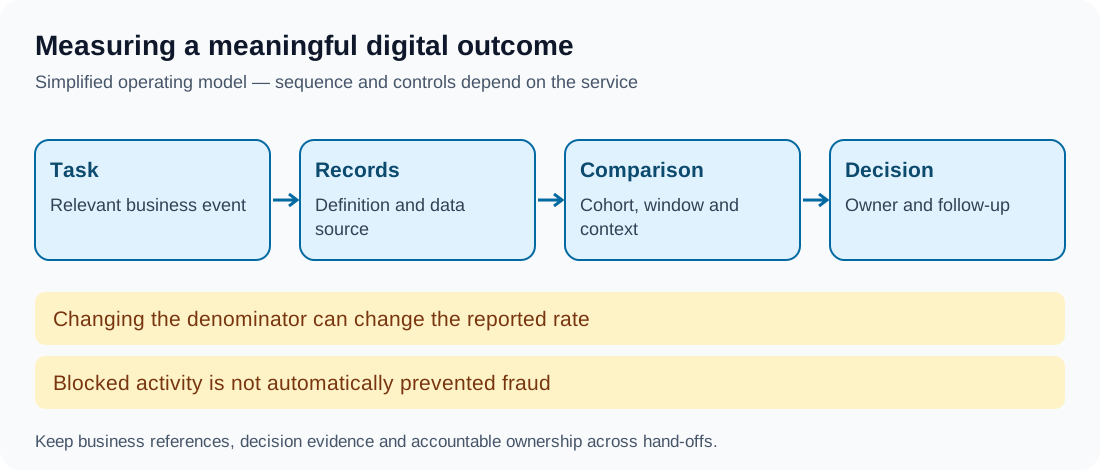
Define each metric's business event, population, numerator, denominator, time window and data source. Distinguish customers, attempts and transactions. Preserve version changes so a release that redefines activation does not create fictitious growth.
Use a balanced set of measures
| Question | Useful measures with defined scope |
|---|---|
| Can customers finish? | Task completion, delays, repeat contacts and unresolved effects |
| Is service used? | Activation and continuing useful activity by cohort |
| Is it sustainable? | Contribution, operating cost, mature losses and cash needs |
| Do controls work? | Confirmed outcomes, legitimate declines, reconciliation breaks and recurrence |
| Can it recover? | Service restoration and resolution of affected customer work |
No table is a universal scorecard. Select measures for the proposition and establish meaningful limits and decision owners. A falling contact rate may mean better self-service or that customers cannot reach help; investigate the context.
Cohorts, maturity and comparison
Compare like populations and clearly label differences in product, channel and eligibility. A new lending cohort has had less time to experience arrears than an old one. A change in customer mix can improve an average while worsening outcomes within particular groups.
Observe relevant accessibility, language and vulnerable-customer outcomes lawfully and proportionately. Differences are evidence for investigation, not automatic proof of discrimination or its absence. Statistical uncertainty, missing data and repeated measurements should influence the confidence of conclusions.
Economics and control evidence
Name the cost pool and qualifying event. Cost per acquired account, active customer and completed task answer different questions. Include relevant direct costs, rework and losses; explain central cost allocation separately. Revenue minus specified direct costs is contribution, not automatically whole-firm profit.
Fraud measures should distinguish attempts, blocked events, confirmed losses, recoveries and reimbursements. Not every blocked payment is prevented fraud. Resilience measures should distinguish server recovery from restored business service and resolved financial uncertainty.
Fictional example: completion-rate denominators
A journey records 1,000 starts, 800 submissions and 500 usable accounts in a defined cohort and window. Start-to-usability is 50%; submission-to-usability is 62.5%. Both can be correct when labelled. Reporting 62.5% as the rate for all starts would be misleading.
Some applicants may be legitimately ineligible, while others abandoned due to errors. Separate those outcomes before deciding whether to change eligibility, the journey or support. Track later activity and complaints as well as the initial account state.
Reporting should lead to action
Link adverse results to investigation, a decision owner and follow-up evidence. Record when action was taken and how affected customers were handled. Do not close a finding merely because a dashboard was rebuilt or a training session occurred.
Public reference and application
For in-scope UK retail business, the FCA Consumer Duty requires firms to consider customer outcomes. A dashboard should not equate activity or sales volume with evidence of good outcomes.
Takeaway
Good measurement makes definitions and limitations visible and supports practical decisions. Report customer outcomes, financial sustainability and control effectiveness together, with enough evidence to explain apparent improvements.