Fraud Prevention and Detection Systems
Signals, decisions, case management and a controlled feedback loop
Fraud controls assess a particular risk
Fraud systems evaluate events and relationships for possible deception, compromise or misuse. They can use rules, models, device context, payment patterns and external intelligence. Different products and fraud types require different evidence; one score does not establish every risk or legal outcome.
Prevention can act before a financial effect, while detection and investigation can continue afterwards. Required latency depends on the service, not a universal millisecond target. A fast decision is useful only if its inputs, effect and customer handling are appropriate.
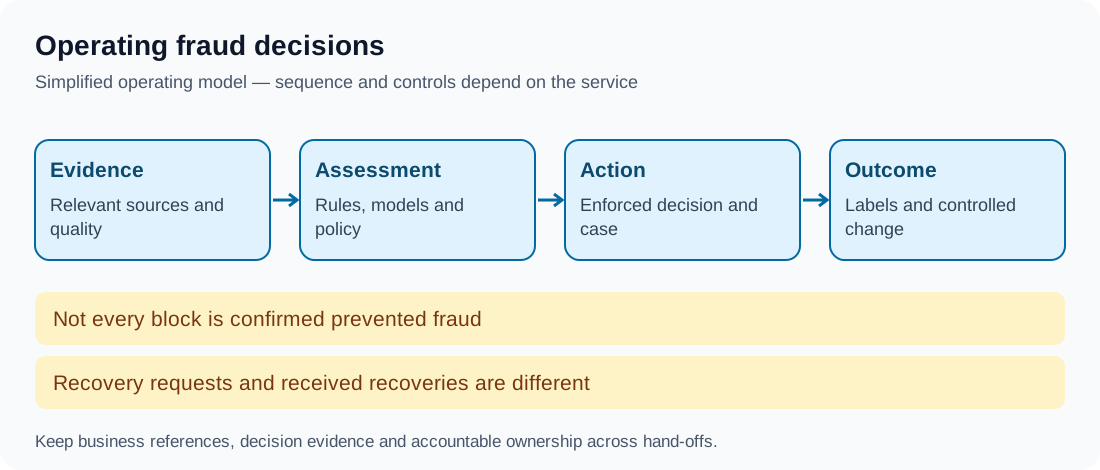
Data and feature controls
Define source, freshness, permitted use and meaning. A device match is not proof of identity, gross sales are not available income, and an absent adverse record is not proof of safety. Features may have different acceptable ages according to their role.
Join relevant customer, session, account and transaction evidence through reliable references. Avoid assuming every channel shares one session identifier. Preserve important decision-time facts rather than silently rewriting historical features with later information.
Rules, models and enforcement
Rules can express known conditions and limits. Models can estimate patterns and uncertainty. They can coexist with policy and human decisions. Evaluate precision, sensitivity, calibration, customer friction and financial costs in the actual population rather than using model accuracy alone.
Select thresholds and actions through appropriate governance. Allow, challenge, refer, decline and restrict have different effects. A referred instruction needs explicit ownership and customer status; a queue entry does not by itself prevent execution. Fallback decisions during outage should respect the approved controls and actual product risk, not a blanket global fail-open or fail-closed claim.
Review and customer intervention
Analysts need evidence and authority for the decision. Safe contact should account for compromised details and scammer coaching. Strong authentication may address account compromise but does not establish that a customer-authorised payment is free from deception.
Record decisions and implemented effects. Return requests, disputes, recalls and account restrictions are different actions. A recovery request is not guaranteed receipt of funds. Preserve applicable rights and deadlines while investigating.
Outcome labels and model governance
Not every blocked event is prevented fraud, every reimbursement a confirmed fraud label, or every unreported transaction legitimate. Labels can be delayed, incomplete or affected by intervention. Understand how case outcomes were established before using them for training.
Monitor drift, feature changes and performance by relevant cohorts. Validate changes and retain appropriate rollback or restriction plans. US Federal Reserve SR 26-2, issued in April 2026, replaced SR 11-7 and SR 21-8; its scoped model-risk guidance is not a universal rule for every global fraud system.
Fictional example: legitimate payments blocked
A feature changes after an app release and more genuine customer payments are referred. The bank identifies the version, assesses affected instructions and corrects or restricts the faulty use. It clears cases through authorised actions and monitors the resulting outcomes.
The team does not count the referral spike as increased fraud prevented without evidence. Feature freshness and meaning become part of the change review.
Takeaway
Evaluate fraud controls through financial effects, confirmed outcomes and legitimate customer service. A sound feedback loop improves decisions without converting uncertain labels into assumed truth.