Fintech Landscape
Major fintech categories and where they sit in financial services
Map the financial function and service role
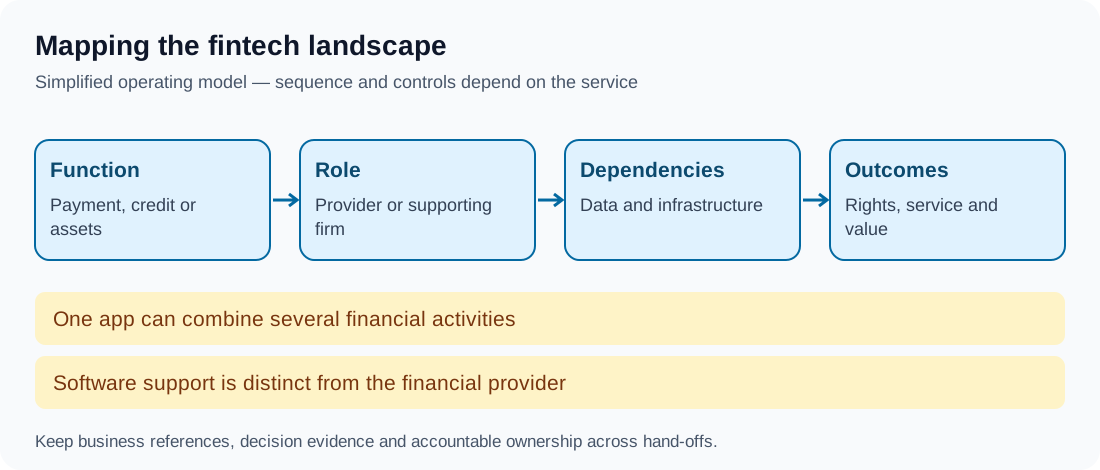
Fintech covers technology used to deliver or support financial services. The landscape includes financial providers, distributors, software firms and infrastructure operators. Categories help explain the field but overlap: one firm may offer payments, analytics and credit through several legal entities or partners.
Classify the actual activity, customer and financial claim before judging the business. A software provider that supports lending is different from the creditor; an investment dashboard may be different from an adviser or custodian. Marketing labels do not determine permissions.
Main categories
| Category | Typical functions and questions |
|---|---|
| Payments | Initiation, acceptance, processing and payouts; who moves or holds funds? |
| Credit | Distribution, assessment, funding and servicing; who is the creditor? |
| Wealth | Access, advice, execution and custody; what asset and service is provided? |
| Insurance | Distribution, underwriting support and claims; who provides cover? |
| Regtech | Compliance tooling and evidence; who decides and owns the obligation? |
| Infrastructure | Identity, core services, APIs and cloud; what depends on the service? |
Digital assets and embedded services can span several categories. A tokenised record is not automatically a new bank product; a commerce interface does not erase the underlying payment or credit relationship.
Follow the value and information
For each proposition, map the user request, authority, decision, financial effect and support. Identify custody or funds holding separately from message transport. Payment notifications and software statuses cannot alone prove settlement, ownership or entitlement.
Map important data sources, permitted use and downstream access. More integration can improve convenience while adding dependencies and privacy risk. Data visibility does not automatically authorise financial actions or reuse for unrelated purposes.
Regulation and commercial models
Financial activity and entity frameworks can impose licensing, prudential, conduct, financial-crime and data duties with different scopes. Technology firms can also face contractual and legal obligations without being banks. A startup label does not establish an exemption.
Income may come from subscriptions, processing, distribution, lending or other actual arrangements. Compare recognised revenue, cash receipts and contribution carefully. Funding rounds and transaction volume are not service revenue, and customer funds should not be assumed to finance operations freely.
Dependencies and change
Examine processors, sponsor institutions, identity providers, cloud services and subcontractors. The Basel third-party-risk principles provide a banking-risk reference for relevant relationships. Several different fintech partners can still depend on one common infrastructure service.
Assess what happens during failure, contract change or exit. Customer balances, credit, claims and retained records may continue after new sales stop. A portable data file does not necessarily establish a complete authorised transfer of service.
Fictional example: invoicing software with finance
A small business uses software to issue invoices and sees an offer to receive funds early. The software may distribute the offer while another firm provides the finance. The customer needs to understand charges, creditor or receivable-holder identity, collection directions and ongoing service.
The example sits across software, distribution and credit categories. A landscape map becomes useful when it explains these roles rather than classifying the whole app under one convenient word.
Takeaway
Use fintech categories to organise questions, then examine actual roles, rights, economics and dependencies. Evaluate continuing customer outcomes as well as innovation and acquisition.
Continue to Banking as a Platform.