Embedded Finance
Financial capabilities placed inside commerce and platform experiences
Finance inside another customer task
Embedded finance places a financial capability inside a broader journey, such as paying in a marketplace, borrowing within business software or buying cover with a trip. The distribution context changes how customers discover and use the service. It does not change the legal nature of the underlying money, credit, insurance or investment.
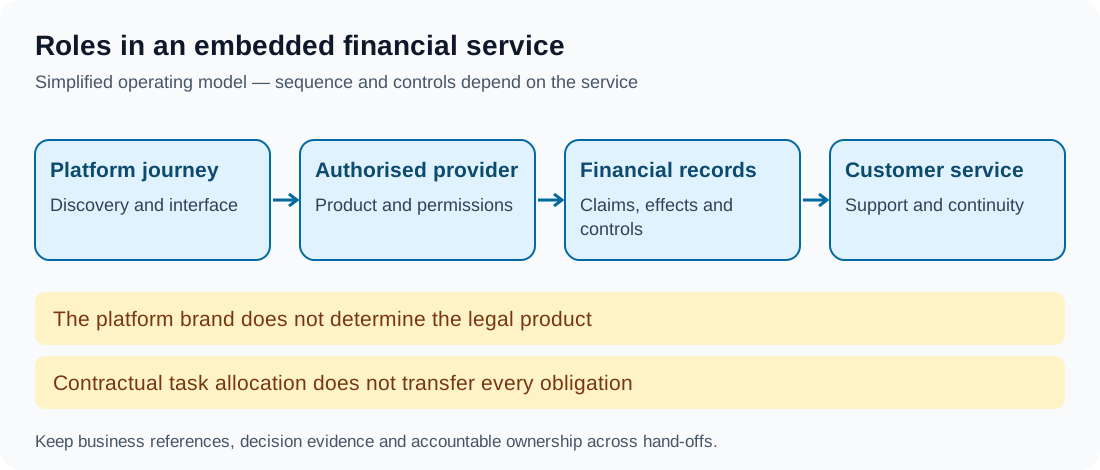
Name the actual product and firms. The platform may own the interface, a regulated provider may supply the financial service, and an infrastructure firm may connect them. Some firms perform several roles. Activities and permissions must be assessed separately; a partnership agreement is not a transferable licence.
Roles and customer understanding
Explain who provides the product, enters the relevant contract, holds money or assets, makes decisions and handles support. Avoid a vague statement that one firm “owns the customer” when the relationship spans several contracts and duties. The customer needs an understandable route when something goes wrong.
Deposit, e-money, safeguarded payment funds and investments can look similar on a screen but have different claims and protections. The FDIC's third-party-app explanation illustrates the US boundary: nonbanks are not themselves FDIC-insured, pass-through coverage has conditions, and deposit insurance does not protect against nonbank insolvency. Do not export that coverage model to every country or product.
Join the interface to the financial record
Link applications, permissions, instructions, financial effects and cases using durable references. A platform state should represent the relevant provider state, with uncertainty and freshness visible. API acceptance does not prove settlement, loan disbursement or insurance binding.
Agree where money moves and how customer entitlements are reconciled. A middleware balance should not be treated as authoritative merely because the UI reads it quickly. Identify the actual legal and accounting records, their reconciliation and the process for resolving disagreement.
Data and control boundaries
Share information necessary for a permitted purpose, with the appropriate basis and protections. A platform's possession of transaction data does not grant unlimited access to bank accounts or unrestricted use for targeting. Provider controls must operate at the effect boundary and survive direct calls, retries and compromised platform sessions.
Allocate relevant identity checks, financial-crime controls, credit assessment, disclosure and customer-support responsibilities. Outsourcing a task does not automatically transfer every legal obligation. Monitor evidence of performance rather than accepting a contractual allocation as proof the task was completed.
Worked example: a marketplace balance
In this fictional marketplace, sellers see proceeds available for payout through a partner payment service. A middleware outage prevents the normal dashboard from loading. The firms use reconciled entitlement records and a planned support route to determine actual balances and pending payouts.
The platform does not describe inaccessible dashboard data as lost funds, nor promise withdrawals before the responsible provider can confirm them. Cases link to original payout references. After restoration, transactions and customer cases are reconciled before the incident is treated as fully resolved.
Commercial model and continuity
Model platform distribution income, provider costs, infrastructure charges, support, losses and required buffers. Commercial incentives can affect product placement and decision pressure; evaluate customer understanding and outcomes alongside conversion.
Plan changes and exit before launch. Consider access to records, customer notices, servicing, outstanding obligations and migration authority. Provider replacement may require new agreements or permissions and is not simply switching an API endpoint. The following chapters examine the distinct payment, lending, insurance and investment processes.
Takeaway
Embedded finance is a distribution and operating model built around an identifiable financial product. Clear roles, reconciled records, enforceable controls and customer continuity make the integration usable beyond the initial checkout.
Continue to Embedded Payments.