Digital Product Analytics
Funnels, activation, engagement, retention and failure points
Measure the customer job
Digital product analytics explains how people discover, use and leave a service and where tasks fail. Page views and downloads can describe reach, but they do not establish successful banking outcomes. Start with the product's purpose and define what completion means in its actual business process.
For a payment journey, initiation, acceptance, settlement and recipient credit may be distinct events. For account opening, submitting an application is not the same as an active usable account. Maintain that distinction across dashboards, operational reports and unit-economics calculations.
A shared event contract
Define event name, version, trigger, business identity, relevant timestamps and permitted fields. Distinguish a customer, session, account and transaction. Retries and repeated event delivery need suitable deduplication; removing every repeated action could also hide legitimate repeat attempts.
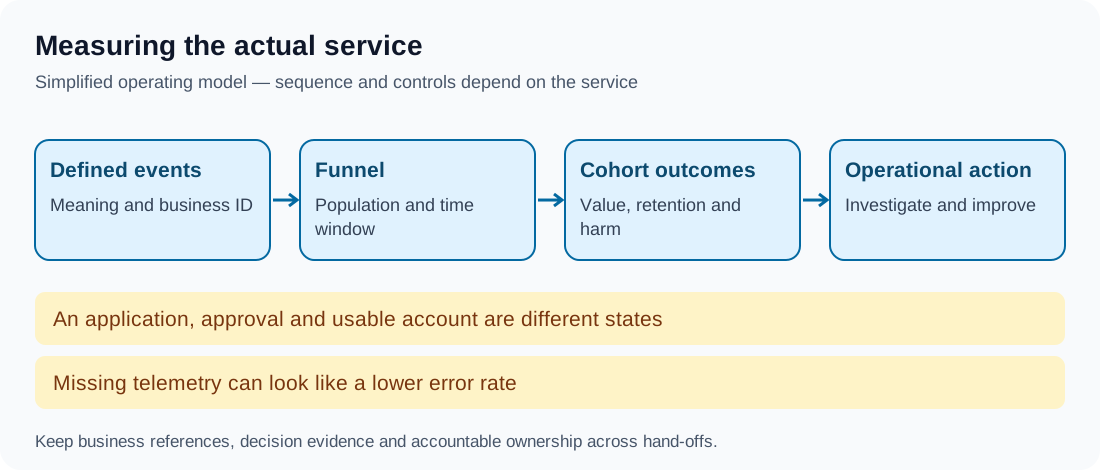
Choose authoritative backend evidence for consequential completion where possible. Client events can reveal experience but may be blocked, offline or lost. Reconcile coverage and monitor missing instrumentation. A falling recorded error count can reflect a broken event pipeline rather than improved service.
Funnels and denominators
Specify who enters the funnel, eligibility exclusions, time window and each step. Distinguish all visitors from applicants, approved customers and usable accounts. Customer-based conversion differs from attempt-based conversion when one customer tries several times.
Record known reasons for failure or referral without inventing explanations for every missing event. Some abandonment is intentional; some reflects unsupported eligibility or a technical problem. Link relevant support cases and errors while minimising personal information and controlling access.
Activation, retention and cohorts
Activation is a product-specific evidence of initial value. Retention describes continuing use or relationship over a defined period. Monthly logins are not a universal retention definition; an infrequent but useful mortgage service need not generate daily activity.
Track acquisition cohorts and distinguish mature observation windows from recent ones. Exclude or label internal/test accounts and promotional effects where relevant. Report cohort counts and changes in customer mix. Do not compare a fully observed twelve-month cohort with customers acquired last week as if they had equal opportunity to return.
Worked example: registrations versus usable accounts
In this fictional month, 1,000 eligible applicants begin onboarding, 800 submit, 600 are approved and 500 reach a usable account state. Start-to-usable conversion is 50 percent. Submission-to-usable conversion is 62.5 percent; both can be valid when labelled, but they answer different questions.
An additional 200 retries are attempts, not 200 additional people. Operations investigates why 100 approved customers have not reached usability. Counting approvals as finished onboarding would hide that queue and misstate acquisition economics.
Privacy and practical action
Collect only information needed for a permitted measurement purpose. Control session capture, exports and vendor access, and define retention. Pseudonymous analytics can still involve personal data; hashing an identifier does not automatically remove the relevant obligations.
Use the measures to guide investigation and improvement. Review completion time distributions, aged referrals, repeat contacts, complaints and financial outcomes alongside engagement. Correlation between a feature and retention does not prove the feature caused retention; appropriate experiments or other analysis may be needed.
Public reference and application
The NIST Cybersecurity Framework 2.0 supports defining and measuring relevant cybersecurity outcomes; product metrics should also distinguish usage, service quality and customer outcomes.
Takeaway
Reliable analytics uses stable definitions and joins interface activity to business outcomes. Denominators, cohort maturity and failure visibility determine whether the dashboard helps the bank act on the real service.
Continue to Digital Operations & Control.