Cyber Resilience and Incident Response
Preparing, containing, restoring and learning from disruption
Resilience concerns the financial service
Cyber resilience supports continuing or restoring service during security disruption. Prevention, detection, response and recovery work together. A server being healthy again does not prove that customer payments, balances, permissions and unresolved work are correct.
The NIST Cybersecurity Framework 2.0 includes Govern, Identify, Protect, Detect, Respond and Recover. Treat it as a risk framework, not a global banking notification statute. Recovery objectives and legal reporting depend on the actual service and applicable obligations.
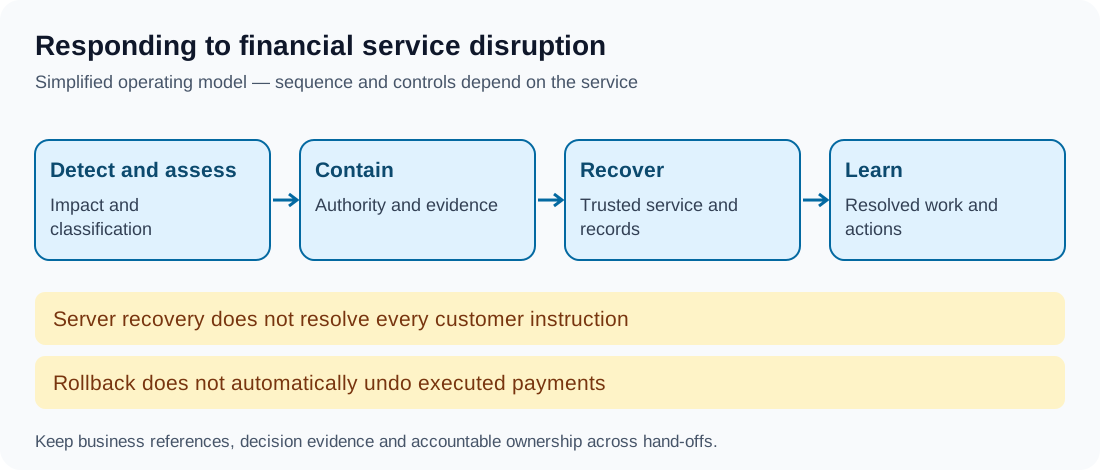
Prepare dependencies and executable actions
Map important services, systems, records, providers and common failure points. Identify what users can still do during disruption. Recovery time objectives, recovery point objectives and customer impact tolerances answer different questions; a backup interval alone does not establish tolerable financial loss or completed recovery.
Prepare access, contacts, decisions, communications and safe response procedures. Automation can help, but a runbook is not defective merely because it includes a controlled manual step. Test whether representative staff can execute it under realistic access and provider constraints.
Detect and contain with authority
Join relevant security, service and financial evidence. A spike in login failure, altered records or provider timeouts needs assessment, not automatic assumptions about attack cause. Record detection, awareness, classification and material decisions separately.
Contain affected access or activity proportionately. Segmentation, credential revocation, feature restriction and controlled failover have different effects. A rules-only fraud fallback may be approved for some services and unsafe for others; it is not a universal permission to continue all payments.
Preserve logs and relevant artefacts with integrity and appropriate access. Containment and evidence preservation may need coordination, but critical protection should not wait for perfect documentation. Do not expose credentials or unnecessary customer data in incident chat or public updates.
Reporting and communication
Identify actual legal triggers, recipients and clocks. An internal P1 label does not itself start every regulatory deadline. Under EU GDPR Article 33, the relevant supervisory notification is generally within 72 hours of awareness where required, with the applicable conditions. That is not a universal deadline for every cyber event.
For in-scope financial entities, DORA and its incident-reporting standards have separate major-incident classification and reporting requirements. Track those rather than borrowing an old PSD2 or generic GDPR table for every incident.
Customer communication should explain confirmed effects, uncertainty, useful alternatives and updates. Do not guarantee that money is safe when integrity or financial status remains unresolved. Support needs current operational context to avoid unverified duplicate instructions.
Restore the effects, then close the incident
Validate trusted systems, credentials, records and important financial states. Reconcile potentially lost, duplicated, delayed or wrongly executed instructions. Restoring software does not undo transactions already completed; use authorised financial remediation where needed.
Confirm appropriate model and configuration versions. Reproducing every numeric score exactly is not a universal test for stochastic systems; evaluate expected behaviour and integrity under the actual design. Restart new activity only under defined authority and evidence.
Fictional example: payment service recovery
A service recovers after an outage with some requests still uncertain. The team enquires and reconciles original references before retries. It communicates pending cases and restores usable access without declaring all customer work complete merely because traffic resumed.
The review assigns material corrective actions and verifies their effect. A training meeting or closed ticket alone does not prove the underlying risk was reduced.
Takeaway
Cyber recovery should restore trustworthy financial service and resolve affected work. Preparation, containment, reporting and learning need actual authority and evidence.