AML and Sanctions in Digital Channels
Distinct obligations, decision evidence and continuing investigation
Fraud, AML and sanctions address different questions
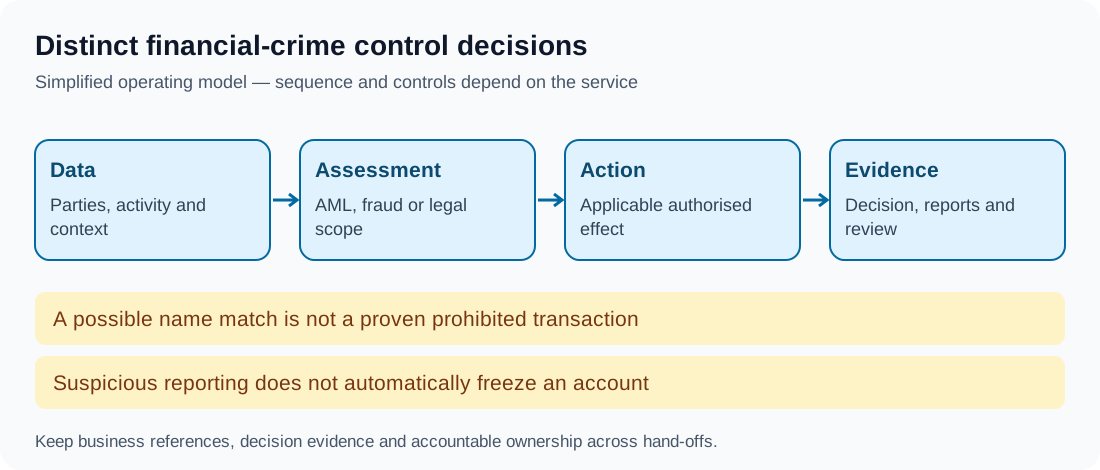
Fraud controls assess deception or misuse. Anti-money-laundering controls assess relevant financial-crime risks and reporting obligations. Sanctions controls determine whether activity or property is restricted under applicable regimes. Information can be shared appropriately, but these are not identical decisions with one universal timeline.
AML monitoring can combine event-driven and batch analysis. Sanctions screening can use probabilistic name matching even when legal prohibitions require definite action once the relevant facts are established. It is inaccurate to describe every sanctions engine as deterministic or every possible name match as a confirmed prohibited transaction.
Sanctions scope and matching
Identify the relevant jurisdiction, persons, activity, ownership and restrictions. Screening a list is not the entire legal analysis. Under OFAC's 50 Percent Rule, entities owned 50 percent or more in aggregate, directly or indirectly, by blocked persons can be blocked even when not separately listed. Other regimes have their own ownership and control rules.
Potential matches need appropriate resolution using identifiers and context. Required controls can include customer and transaction screening, list-change handling, ownership analysis and other measures according to scope. Do not prescribe every possible field at every hop or invent a universal sub-50-millisecond duty.
Blocking property, rejecting a transaction, suspending for enquiry and proceeding under an applicable authorisation are different outcomes. Not every sanctions restriction requires the same block, report or licence. False matches can be resolved and applicable delistings or authorisations can change treatment. OFAC's sanctions-compliance framework is a scoped US reference.
Customer communication should be accurate and lawful. AML reporting confidentiality is not a general rule that every publicly listed sanctions fact must be hidden. Avoid misleading retry messages for a restriction the customer cannot fix by resubmitting.
AML monitoring and investigation
Use risk-based scenarios, customer context and relevant information. Rapid movement, unfamiliar corridors or round-number payments can be legitimate; an alert is a question, not proof. Entity resolution and network links also need source quality and uncertainty controls.
Cash and other statutory reporting rules are jurisdiction-specific and separate from suspicious-transaction reporting. There is no universal 10,000 threshold for every currency, cash transaction or cross-border transfer. Suspicion can require reporting below a monetary threshold or for attempted activity under the applicable framework.
The FATF Recommendations provide international standards, including suspicious-transaction reporting and confidentiality in Recommendations 20 and 21. National law determines the actual obligation and procedure. A report concerns suspicion under the relevant test, not necessarily a proven crime.
Reporting, restrictions and continuing management
Record the investigation, decision authority, report where required and subsequent risk decisions. Filing a report does not automatically freeze funds, require closure or keep a case open until an FIU response or statute of limitations. Assess applicable law, consent or authorisation processes, ongoing risk and customer rights separately.
Confidentiality and tipping-off provisions need accurate scope. Provide lawful information, practical support and proportionate restrictions where possible. Neither silence nor unrestricted disclosure is a universally correct response. Fraud and AML coordination must not override sanctions duties or permit suspicious activity without appropriate authority.
Customer information and quality assurance
Refresh relevant customer information under actual periodic and trigger-based requirements. Continuous tools can support that work, but daily scores or registry feeds do not automatically replace all required reviews. Not every incorporation document expires or every risk-rating change justifies repricing.
Monitor unresolved matches, list-update coverage, alert age, investigation quality, reporting compliance and data gaps. A high reporting conversion rate alone is not proof of effectiveness; inappropriate defensive reporting can also distort that measure.
Fictional example: similar name
A payment produces a potential match to a restricted person. The authorised process examines date of birth, identifiers, ownership and applicable rules. If evidence establishes a false match, the appropriate release is recorded. If restrictions apply, implement their actual required treatment and reports.
Takeaway
Keep legal scope, matching uncertainty, suspicious reporting and financial restrictions distinct. Digital speed needs reliable evidence and authorised action, not invented universal clocks or screening sequences.