Alternative Data
Non traditional data used for access, risk and affordability
Additional evidence, additional responsibilities
Alternative data uses information beyond the sources traditionally used for a particular decision. Credit examples include permissioned cash-flow data, merchant sales or utility-payment history. What counts as alternative depends on the market and existing practice; the label does not establish quality, inclusion or lawful use.
Define which problem the extra data should solve. It may provide evidence for a thin-file applicant, improve an income estimate or support fraud assessment. Prove incremental usefulness against relevant baselines and costs. More fields can add noise or reproduce existing exclusion through different proxies.
Source, meaning and authority
Understand who collected the data, what the fields represent, how coverage changes and whether the planned use is permitted. A customer permission for account access does not automatically cover unrelated model training or sale of a score. Applicable privacy, credit-reporting, confidentiality and sector rules need separate assessment.
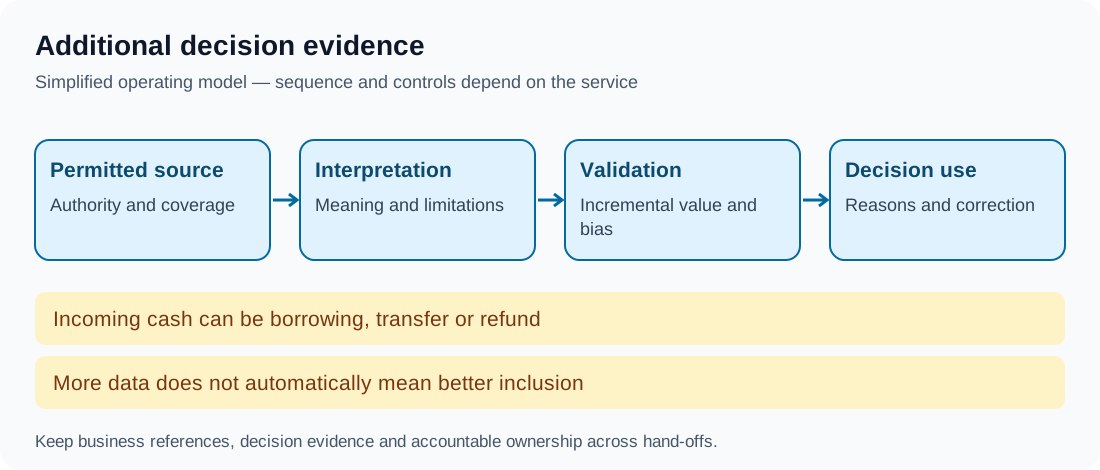
Evaluate correction and challenge routes. Vendor documentation should explain material fields and transformations sufficiently for the firm's obligations. Commercial secrecy does not eliminate the bank's need to understand a consequential decision. A vendor exit plan should consider data access, features and decision continuity.
Cash flow is not all income
Separate payroll, business sales, transfers between own accounts, refunds, borrowing and one-time receipts where relevant. Assess recurring obligations, volatility and observation coverage. A single strong month may reflect seasonality rather than sustainable repayment capacity.
If only one account is connected, its balance and transactions may not represent the customer's complete finances. Missing cash activity or disconnected accounts should be treated as a limitation, not automatically as dishonesty. Categorisation errors and uncertain merchant labels need controlled handling.
Device and behavioural evidence
Device or telecommunications signals can be useful for security, but they may identify a handset or subscription rather than the applicant's financial capacity. Shared devices, connectivity constraints and accessibility needs can distort interpretation. Avoid presenting a correlation as a direct explanation of creditworthiness.
Test incremental discrimination risk and outcomes across relevant populations using lawful, appropriate methods. Data collection itself must follow applicable rules. Higher approval rates are not proof of inclusion if the resulting product causes unaffordable debt or shifts customers into worse prices.
Worked example: seasonal merchant receipts
In this fictional credit assessment, three months of merchant sales include a seasonal peak and a large loan disbursement. An initial feature treats all incoming amounts as recurring income. The lender separates financing from sales and evaluates a longer relevant period, costs and uncertainty.
The additional feed can still help assess a merchant with limited bureau history. Its value is the better-supported cash-flow assessment, not the original larger total. The customer receives the applicable decision explanation and a route to correct inaccurate information.
Validation and operating controls
Compare performance with and without the new features, validate data lineage and test shifts in provider coverage. Avoid leakage from information available only after the predicted event. Back-tests should represent the live population and acknowledge selection bias, especially when outcomes exist only for previously approved applicants.
For a scoped US credit example, Regulation B's official interpretation requires specific adverse-action reasons grounded in the actual factors used. General claims about algorithm complexity or proprietary data do not replace the applicable notice assessment.
Takeaway
Alternative data should supply permitted, interpretable and useful evidence. Its benefit must survive quality checks, customer correction, decision explanation and observed outcomes.
Continue to Behavioural Analytics.