Why scheduling and batch control still matters
A bank can process a card authorisation in seconds and send an instant payment around the clock, yet still depend on timed processing for a very large part of its financial and control life. Interest accrual, fee assessment, statement production, card settlement, direct-debit cycles, payroll files, regulatory extracts, general-ledger interfaces, reconciliation, data retention, risk monitoring and month-end close do not become unimportant because a mobile app is real time. They become more important because the bank now has to join an always-on customer experience to a controlled financial day.
Scheduling and batch control is the discipline that makes this possible. It defines what must run, when it may run, the data and predecessor conditions it needs, the evidence that proves its result, who can decide when it fails, and how the bank recovers without creating a second error. It is not simply a scheduler console and it is not an overnight operations job. It is a business control capability supported by technology.
This chapter is deliberately focused on that capability. It explains business-day calendars, cut-offs, end-of-day and beginning-of-day, dependency chains, file and batch controls, control totals, reruns, restarts, recovery, sign-off, reconciliation, resilience and the operating boundary between real-time and scheduled work. It applies the subject to both consumer and business banking without turning it into a general chapter on controls.
The story behind a “successful” batch
At 02:10, an overnight interest run reports success. The scheduler shows green, the job produced an output file, and no platform alarm is open. At 07:00, however, the operations team finds that one product group was excluded after a late product-parameter change. Customers have not been debited incorrectly; they have not been processed at all. That means the green technical status was true but incomplete as a business result.
A mature bank does not call this a minor scheduler incident. It asks four separate questions. Was the required population complete? Were amounts and accounting entries correct? Did the result reach every required downstream consumer? Did somebody with the right authority review and accept the outcome before customer-facing or financial consequences were released? Scheduling and batch control exists to make those questions routine rather than heroic.
The same thinking applies to a business payment file. A file can be syntactically valid and still be wrong for the customer because it arrived after cut-off, contained a duplicate payroll instruction, was approved under an expired mandate, or was released on a holiday in the beneficiary market. The bank needs a controlled clock, not just a fast computer.
What a batch is — and what it is not
A batch is a defined unit of work that processes a bounded population under a known business purpose and execution rule. The population may be all accounts eligible for daily accrual, all card transactions captured in a settlement window, all approved payments in a file, all customers due for periodic screening, or all posting entries awaiting an interface to the general ledger. The job may be started by time, a business event, file arrival, completion of another job, a manual release, or a combination of those conditions.
The word “batch” should not be used as a shortcut for any work that is not instant. A scheduled report, a payment-clearing cycle, an inbound file, a database maintenance activity and a month-end close sequence have different risks. Each needs its own documented purpose, population, business date, trigger, ownership, input condition, output condition, control evidence, failure threshold and recovery route.
A batch is also not automatically a single technical job. A business batch may comprise data extraction, validation, enrichment, calculation, posting, message creation, acknowledgement processing, reconciliation and reporting. The bank should model the business unit of work as well as the individual executable jobs. If a technical component succeeds while the business unit is unfinished, operations must be able to see that distinction immediately.
The business day is a governed object
The calendar date on a server is not necessarily the bank’s business date. A bank may be operating late in the evening in one country while another legal entity has already begun the next business day. A payment scheme may be open while a local public holiday affects value-date treatment. A month-end may fall on a weekend but financial close may use a defined prior or following business date. These are business decisions and controls, not formatting choices.
A business-day calendar should identify legal entity, branch or booking location where relevant, currency, product, market, settlement system, customer channel, public-holiday source, weekend convention, cut-off time zone, daylight-saving treatment, early-close rules, month-end and year-end rules, and effective-from/effective-to dates. It should be versioned and subject to controlled change. A mistaken calendar can cause interest to accrue on the wrong basis, payments to miss settlement, files to be released when a market is closed, or reports to misstate a period.
No single team should quietly amend the calendar because “it is only a holiday”. The business owner determines the business effect, operations confirms the execution impact, technology applies the controlled change, and the affected service owners validate it. Where a calendar feeds customer-visible cut-offs, the bank must also make sure channel content and customer communications are aligned with the authorised calendar version.
Cut-offs are a customer promise and a control boundary
A cut-off is the latest point at which an instruction is treated as received for a defined service outcome. It is not merely the time at which a batch begins. A consumer may submit a transfer at 17:01 and reasonably expect the bank to explain whether it will be processed today, next business day, or immediately. A corporate treasury team may submit a payroll file before the customer cut-off but miss an internal approval deadline. These are different time events and the system must preserve both.
Every cut-off rule should state the service, currency, destination, channel, day type, customer segment if applicable, required authorisations, time zone, customer-facing wording, exception policy and downstream processing commitment. The bank should distinguish instruction receipt, validation completion, customer approval completion, bank acceptance, release to clearing, settlement and beneficiary availability. Collapsing those moments into a single word such as “processed” creates complaints and operational confusion.
Cut-off changes require more than configuration testing. The test should prove that web, mobile, host-to-host, branch and operations channels apply the same rule; that daylight-saving transitions do not create a missing or duplicated hour; that a queued transaction retains the correct business date; and that status messages are understandable. For business files, the result must state whether the whole file or individual payment items missed the required condition.
One clean operating picture
The diagram above shows the core business control cycle. A calendar and an authorised cut-off establish the permitted window. Inputs are prepared and validated. The dependency chain runs only when its preconditions are met. Control totals and reconciliations determine whether the result is complete. Exceptions either enter a controlled recovery route or the authorised owner signs off. The cycle then closes with evidence, reporting and lessons before the next business day.
End-of-day is not just “run everything overnight”
End-of-day, often called EOD, is the controlled transition from the active business day to the next one. Its content varies by bank and product, but commonly includes closure of product cut-offs, posting of eligible transactions, interest accrual, fee calculation, settlement processing, ledger updates, reconciliation, statement preparation, data extracts and status publication. The important point is that EOD is a business state transition with financial consequences.
Before EOD starts, the bank must define its entry conditions. Examples include completion of settlement windows, receipt or justified absence of expected files, resolution or documented acceptance of material payment queues, availability of required reference data, and confirmation that no change freeze breach exists. A scheduler may start at a fixed time, but operations should not assume that a time trigger proves business readiness.
During EOD, the bank needs visibility of both job execution and business progress. A dashboard should show the business date, critical path, current stage, start and end timestamps, expected and actual populations, amounts where relevant, breaches, manual actions, responsible team and latest safe completion time. A “green” dashboard that hides a late but non-failed predecessor is dangerous because it gives false confidence.
Beginning-of-day makes the bank safe to open
Beginning-of-day, or BOD, is the controlled release of the next business day. It is not simply the moment at which systems are reachable. Before BOD, the bank needs to know that prior-day posting and settlement controls are complete or that authorised residual risk has been accepted. Opening customer channels before account balances, available funds, payment statuses or limits are coherent can expose the bank to duplicate payments, incorrect withdrawals, unauthorised credit use and avoidable customer harm.
BOD requirements commonly include activation of the correct business date, loading of rate and calendar data, release of channel and operational queues, confirmation of balance and ledger availability, refresh of limits and exposure data where designed, opening of customer service windows, and publication of expected statements or notifications. The exact order must be explicit. For example, a mobile channel may be safely open for balance enquiry before outbound file release is safe; those are separate service decisions.
A BOD sign-off should never mean that every non-critical item is perfect. It should mean that the accountable service owner has reviewed the defined readiness criteria, material exceptions, mitigating controls, customer impact and escalation position. Any residual action must have a named owner, deadline and communication plan.
Critical paths and dependency design
A dependency is a condition that must be true before a job or business step may proceed. Dependencies can be technical, data-related, financial, operational or external. A reconciliation cannot be final before all relevant postings and statements are available. A payment file cannot be released before validation and customer authorisation are complete. A ledger interface cannot be considered complete merely because the source file was created; the receiving system must acknowledge and balance it.
Good dependency design uses clear semantics. “Completed” is insufficient unless the bank knows whether it means technically completed, completed with warnings, business-complete, reconciled, or accepted under an exception. Each critical dependency should have an expected completion time, latest safe completion time, owner, health status, evidence source, timeout action and escalation path. The design should also identify whether a dependency can be bypassed, and who alone can authorise that bypass.
Circular dependencies are a common source of late-night failure. A reporting job waits for a posting confirmation; the posting process waits for a report-derived control check; operations then has no safe action. The solution is not an emergency manual start button. It is a design review that separates prevention controls from after-the-event reporting and makes ownership explicit.
Input readiness: completeness comes before speed
Before a batch begins, the bank needs to establish what population it is supposed to process. This is especially important for inbound and outbound files, customer payment batches, rate loads, data feeds and end-of-period calculations. The input control should define the expected source, naming or identification rule, delivery window, schema or format version, encryption or signature expectation, control count, control amount where meaningful, duplicate-detection rule, business date, source-system status and quarantine route.
File arrival alone is not sufficient. A file may be truncated, duplicated, delivered under the wrong business date, encoded incorrectly, or contain valid records from an unauthorised source. The bank should validate at the boundary and retain a receipt record that allows later reconstruction: who or what sent it, when it was received, whether it passed integrity checks, which version of the interface contract was used, and whether it entered processing or quarantine.
For internal source data, readiness means more than a successful extract. The bank should know whether the source period closed, whether late-arriving events are within an agreed tolerance, whether reference data versions match the calculation, and whether any upstream incident has changed the population. A controlled “no file received” outcome is better than silently creating an empty output.
Control totals are independent evidence
Control totals are simple but powerful. They compare an expected population or value with the result at a defined boundary. Typical controls include record count, debit amount, credit amount, hash total, file total, account count, transaction count, value-date distribution, currency totals, rejected-item count and suspense movement. The correct total depends on the process; a zero-difference total is not automatically meaningful if it masks offsetting errors.
A good control total has a documented source, calculation method, owner, tolerance, comparison point and response rule. The bank should avoid allowing the process that creates an output also to certify itself without challenge. For a payment file, the file creator’s total, the payment hub’s accepted total, the clearing acknowledgement and the settlement or account statement can form different points of evidence. They should be reconciled according to the process risk.
A total must also be explainable. If a statement run has fewer accounts than the prior cycle, the operations team should be able to distinguish deliberate account closures, eligibility changes, data exclusions and processing failure. A threshold may help prioritise response, but it does not remove the need to understand the difference.
Posting, accounting and the general ledger
Batch control is inseparable from financial control where a process creates, amends or reports a financial position. Interest accrual, fee charging, settlement, suspense clearance, card settlement, loan collections, reversals and end-of-day adjustments may all create subledger and general-ledger consequences. The bank needs a traceable chain from business event to product account, posting rule, journal, interface, ledger receipt and reconciliation result.
A job should not be treated as complete when it has only produced a journal file. Completion requires defined evidence that the receiving ledger accepted the file, that duplicate protection operated, that debit and credit postings balanced as designed, and that any rejected entries entered a controlled suspense or repair route. Where the source and general ledger operate on different calendars or close times, the bank must document the timing difference and the reconciliation used to manage it.
Month-end creates additional discipline. A late rerun may be operationally convenient but financially unsafe if it changes a closed period without proper authorisation. The bank should distinguish correction in the original accounting period, correction in the next open period, manual adjustment, prior-period restatement and disclosure or regulatory escalation. Those decisions belong to the financial-control framework, not to an overnight operator alone.
Rerun, restart and replay are not the same thing
These words are frequently used loosely, which creates risk. A restart resumes a failed technical job from a defined checkpoint without deliberately reprocessing already-committed work. A rerun executes a business or technical process again, potentially for the same population. A replay sends an already-created message or event again, normally only when the bank can prove the receiving party did not process it or has duplicate protection. A recovery run is a controlled process specifically designed to correct an identified omission or defect.
The control design must state which actions are permitted for every critical batch. It should describe idempotency behaviour, checkpoint location, committed transaction handling, duplicate keys, compensation or reversal route, required approvals, customer and ledger impact, revalidation needs and post-recovery reconciliation. “Run it again” is never a safe instruction until those questions have an answer.
Consider a fee run that fails after charging some accounts but before producing customer notifications. A blind rerun may charge early accounts twice. A controlled restart may continue from a verified checkpoint. A recovery may instead identify the uncharged population, calculate it separately and reconcile both sets. The right choice is governed by what has actually committed, not by the colour of the scheduler icon.
Exception management and the operational decision
An exception is not simply an error log. It is a departure from the expected business outcome that needs triage, ownership and evidence. The exception record should identify the affected service, business date, batch or file identifier, severity, population and value impact, customer impact, financial impact, data sensitivity, current containment, decision owner, technical facts, action timeline and closure evidence.
Operations must have a decision framework before the incident. The choices may include wait for a dependency, restart from checkpoint, hold a release, rerun a non-posting calculation, repair selected records, invoke a manual contingency, open a customer-service message, accept a time-bound residual risk, or escalate to crisis governance. Each decision should have a defined authority level. The same person should not both make an emergency change and independently approve the financial result of that change.
A useful escalation question is: “What becomes unsafe if we wait, and what becomes unsafe if we proceed?” It brings customer impact, market deadlines, liquidity, accounting, regulatory obligations and operational resilience into one decision. The answer must be recorded; hindsight is not an operating control.
Managing late and missing dependencies
A late dependency does not automatically mean failure. Some data feeds have a tolerance window; some payment systems publish statements after an expected time; some customer files may arrive under a pre-agreed late-submission service. The bank should define the latest safe time, not only the expected time. The difference gives operations room to monitor and communicate before a crisis begins.
When a dependency becomes missing, the bank must identify whether the condition is a true absence, an interface visibility problem, a duplicate-prevention hold, a security quarantine or a supplier delay. Starting the downstream job on incomplete input may create a harder problem than a controlled delay. For example, an AML-monitoring batch that processes only part of the transaction population may create a misleading “complete” record and disrupt required investigation timing.
Where the process permits a substitute input or contingency, that path should be designed and tested in advance. A manually prepared file, a previous-day reference rate, a partial release or an alternative delivery channel should never be improvised simply because the normal route is unavailable. The contingency itself needs authorisation, control totals, documented assumptions and subsequent reconciliation.
File processing in consumer and business banking
For a consumer bank, scheduled file processing may include direct-debit presentments, statement outputs, card settlement files, credit-bureau feeds, dormant-account notices, tax reporting and bulk customer communications. Most customers never see the file, but they feel its outcome in their balance, statement, service status or notification. The bank must therefore test the full path from file receipt to customer result.
Business banking adds customer-originated bulk payments, payroll, supplier runs, host-to-host collections, lockbox or receivables files, treasury statements and ERP acknowledgements. A file may have a header and trailer, multiple payment groups, different requested execution dates, multiple debtor accounts, mixed currencies and complex approval mandates. The bank should control the file-level result separately from item-level result. A file can be accepted while some items are rejected; the customer must receive a coherent status at both levels.
The bank also needs a record-retention design. The original file, validation report, approval evidence, item decisions, release confirmation, acknowledgements, exception actions and customer notifications may all be needed later for dispute handling, audit, financial-crime investigation or regulatory inquiry. Retention periods and access controls must follow applicable legal and policy requirements.
Payments: processing time is not settlement time
Scheduled payment control is particularly sensitive because several clocks apply. The customer may submit an instruction, the bank may accept it, a clearing cycle may operate at another time, settlement may occur later, and the beneficiary bank may credit according to its own process. For immediate-payment services, some of those events can be close together; for batch schemes they may be separated by hours or business days.
The payment scheduler should use a service model, not only a job model. It needs to account for scheme calendars, market holidays, customer cut-offs, sanctions and fraud holds, funding or liquidity conditions, correspondent or clearing windows, returns, recalls and status reporting. An outbound file should not be released merely because it is queued; it must be eligible and authorised for the relevant payment route.
Payment recovery is high-risk. Replaying a pacs.008, a clearing file or a proprietary payment instruction without a clear duplicate strategy can create a customer loss. The bank should prefer an evidence-led approach: confirm the original instruction identifier, message status, clearing acknowledgement, settlement status, account posting and counterparty response before selecting a recovery action. Operational urgency never removes the need for that evidence.
Interest, fees and statement cycles
Interest and fees are often described as routine overnight work, but they require precise control because they affect customer money and trust. A calculation must use the authorised rate, balance basis, day-count convention, product eligibility, account status, tax rule where relevant, fee waiver or concession and effective date. The batch should retain enough information to explain the result to a customer or auditor without reconstructing the entire calculation manually.
Changes in product parameters are a common risk point. A rate may be approved for a future effective date but loaded early; a fee may be waived for a particular customer group; a new product code may be absent from the eligibility population; or a backdated correction may interact with an earlier accrual. Calendar control and versioned reference data are therefore central to calculation control.
Statement production needs its own completeness evidence. The bank should know the population eligible for a statement, the generated population, delivery or availability outcome, suppressed-statement reasons, failures by channel, and the reconciliation of displayed balances and transactions to the underlying account data. A technically generated PDF is not evidence that the customer could access a complete statement.
Risk and compliance batches
Some risk processes are scheduled because they need a defined population and controlled evidence: transaction monitoring, customer-risk refresh, sanctions rescreening, fraud retrospective review, liquidity reporting, capital or exposure feeds, complaints trend analysis and regulatory returns. Timeliness matters, but so does the integrity of the population. A late data feed can change not only the quantity of alerts but the period to which the bank can truthfully attest.
For financial-crime monitoring, the bank should document the intended coverage period, source populations, exclusions, scenario version, run result, alerts generated, failures, reruns and remediation. It should not silently let a failed batch disappear into a technical queue. Compliance needs a business-facing status that makes clear whether monitoring coverage has been complete, partial, delayed or otherwise affected.
Sanctions rescreening deserves special care. The trigger may be a list update, customer-data change, ownership change or scheduled refresh. The bank must know which list version and matching configuration were used, which population was screened, which matches were created, and what happened to records not processed due to error or timing. Jurisdiction-specific legal obligations govern the ultimate decision, but the scheduling control must make the execution evidence reliable.
Resilience and operational resilience
A resilient batch capability is not one that never fails. It is one that detects failure quickly, contains impact, restores the service within the bank’s tolerance, preserves integrity and learns from the event. The bank should map important business services to their scheduled dependencies: for example, customer balance availability may depend on end-of-day posting, while business-payment reporting may depend on file status and clearing acknowledgements.
The design should identify single points of failure such as one scheduler instance, a single certificate, a shared file-transfer route, an unmonitored service account, a manual calendar spreadsheet or a critical vendor feed. It should set recovery-time and recovery-point objectives appropriate to the service and test realistic scenarios: a delayed upstream feed, corrupted input, scheduler outage, database failover, data-centre loss, operator unavailability, cyber containment, market holiday error and a stuck payment queue.
Testing must be business-led. A technical failover that starts a job elsewhere is not enough if the bank cannot prove which records were already processed, whether duplicate prevention still works and whether customer status will remain accurate. The recovery exercise should end with reconciliation and evidence review, not merely platform availability.
Change management and release control
Scheduling changes can look deceptively small: a time is altered, a dependency is renamed, a calendar date is loaded, a parameter file is moved, a timeout is extended or a new product is added to a batch. Any one of these can affect thousands of accounts or payments. The bank should therefore classify changes by business criticality, customer and financial impact, reversibility and testing need rather than by how few technical lines changed.
A proper release includes a business requirement, impact assessment, updated runbook, controlled configuration, peer review, test evidence, production implementation plan, back-out or recovery plan, monitoring period and post-implementation verification. The test should include business-date and calendar conditions, not just today’s ordinary data. A fee batch change tested on a weekday may fail on month-end, leap day, daylight-saving transition or a market holiday.
Emergency change is sometimes necessary, especially to stop customer harm or meet a market deadline. It should still leave an audit trail: who authorised it, why normal approval was not possible, what was changed, how the result was monitored, and when retrospective review occurred. Emergency does not mean undocumented.
Data, audit and evidence
A bank should be able to reconstruct an important batch outcome without relying on the memory of the night operator. The evidence set normally includes schedule definition and version, business-calendar version, input identifiers and checks, start and end times, technical execution logs, control totals, exception decisions, approvals, output identifiers, downstream acknowledgements, reconciliation results, customer-impact assessment and closure record.
Evidence needs retention, access control and integrity protection. Sensitive files and logs may contain personal data, account identifiers, payment details or confidential corporate information. The bank must balance operational retrieval with confidentiality, data-minimisation and legal-retention obligations. An audit trail that is so restricted that no authorised investigator can use it is ineffective; one that is broadly downloadable is unsafe.
Metrics should measure control quality, not just job uptime. Useful measures include on-time critical-path completion, late dependency rate, failed and restarted runs, manual intervention rate, control-total breaks, rerun frequency, unresolved exception age, customer-impact incidents, reconciliation break age, calendar defects, change-related failures and time taken to produce decision evidence. Trends matter more than a single red day.
Roles and segregation of duties
Ownership should follow the business service. The product or service owner defines the required outcome and risk tolerance. Operations owns day-to-day execution and first response. Technology owns scheduler, platform, interface and change capability. Finance owns accounting interpretation and financial close controls. Risk and compliance provide independent challenge for their respective obligations. Internal audit independently assesses whether the framework is designed and operating effectively.
Segregation of duties is particularly important for manual interventions. A person who changes a production batch parameter should not be the only person who declares the financial result correct. A person who uploads a sensitive business payment file should not bypass the agreed customer mandate. A person who approves a residual-risk release should have authority appropriate to the impact and should not be pressured into a decision simply to meet a dashboard target.
Runbooks should be practical. They should state what the operator observes, what facts to collect, the actions allowed without approval, the actions requiring approval, the exact escalation contacts or roles, evidence to attach, customer communication trigger and closure check. A runbook is useful when the experienced person is unavailable.
A controlled failure scenario
Imagine that a weekday end-of-day run has completed account posting and interest accrual, but the general-ledger interface fails after producing a file. The scheduler cannot decide whether the ledger received any entries. An unsafe response would be to resend the file immediately. A safe response starts by freezing further related releases, obtaining the outbound file identifier and control totals, checking the receiving ledger’s receipt and duplicate-detection records, and reconciling the source posting population to the ledger status.
If the ledger proves that nothing was received, an authorised replay may be possible. If it received some entries, the bank must identify the exact accepted population and use a controlled recovery or correction process. If the answer is uncertain, finance and technology should treat the interface as unresolved rather than inventing a clean status. The customer may not be directly affected, but the bank’s financial position and close evidence are.
The incident record should capture the timeline, decision, approvals, recovery population, before-and-after totals, reconciliation evidence and root cause. The next review should ask whether a better acknowledgement, a stronger idempotency key, a clearer dashboard or a faster escalation threshold would prevent recurrence. This is what turns an incident into a control improvement.
Design and testing checklist in prose
A delivery team designing a scheduled process should be able to answer these questions before build completes. What business result is produced, for which population, on which business date and under whose ownership? Which calendar and cut-off determine eligibility? What exact inputs and reference data are required? Which predecessor states are acceptable? What evidence proves input completeness, processing completeness, output acceptance and financial accuracy? What happens if the process stops at each material point?
The team should then test normal processing, no-input and late-input conditions, duplicate input, corrupt input, partial success, timeout, late predecessor, wrong calendar, daylight-saving transition, month-end, year-end, holiday, failed downstream acknowledgement, restart, rerun, manual recovery, customer notification, financial reconciliation, access control, audit retrieval and monitoring alert. For payment and accounting processes, the test must prove that a recovery does not create duplicate money movement or duplicate postings.
The final operational acceptance should include a readable runbook, monitoring thresholds, ownership model, support hours, escalation path, evidence retention and a rehearsal with the people who will operate the process. A process is not finished when code is deployed. It is finished when the bank can run it safely on an ordinary day and recover it safely on a difficult one.
The real-time boundary
Real-time processing does not eliminate batch control; it changes its role. The real-time path usually makes an immediate decision and records an event, while scheduled work consolidates, reconciles, enriches, reports, calculates or supervises that outcome later. For example, an instant payment may post immediately, while liquidity reporting, fraud retrospective analysis, statement presentation, general-ledger feed and management reporting are timed processes.
The bank must define which customer facts are immediately final and which are provisional or subject to later control. It must avoid a design where a real-time customer status says “complete” while the back-office cannot distinguish successful settlement from accepted instruction. Likewise, a batch correction must not quietly rewrite a real-time history without an auditable reversal or adjustment trail.
The strongest architecture uses shared identifiers, authoritative status models, immutable event records where appropriate, reconciliation across the two modes and clear customer language. The goal is not to make everything batch or everything real time. It is to ensure both modes tell one coherent banking story.
The minimum business data model for a batch
A bank does not need one universal scheduler product to have a coherent control model, but it does need common data concepts. Every critical process should be identifiable by a stable process name, service owner, legal entity, business date, scheduled window, execution identifier, version, source population, expected and actual totals, status, exception indicator, recovery relationship and evidence location. Those facts make it possible to join a technical execution to the business result it was intended to produce.
The process definition should be separate from each run. The definition describes the approved design: purpose, calendar, dependencies, input contracts, control rules, tolerance, recovery authority and retention requirements. The run records what happened on one business date: the exact configuration version, input references, timestamps, status transitions, amounts, decisions, output references and reconciliation outcome. Without this distinction, a later investigation cannot tell whether a problem was caused by bad execution or an unauthorised design change.
Status vocabulary needs discipline. A useful model can distinguish planned, waiting for input, ready, running, technically complete, awaiting business control, exception, recovery in progress, reconciled, signed off, closed and cancelled. It should not use “successful” for a result that has not yet been reconciled or accepted. Customer-facing statuses should be simpler but must be derived from the authoritative operational state rather than from an unrelated scheduler message.
Observability that helps a human decide
Monitoring should be designed around decisions. A dashboard that lists hundreds of jobs may be useful to an infrastructure team but does not tell a service owner whether the bank can still meet its payment, statement, financial-close or regulatory obligation. The operational view should group technical work into business services and show the critical path, relevant clock, current business date, expected result, latest safe completion time and customer or financial consequence of a delay.
Alerts should be meaningful. An alert may trigger because a job is late, a file is missing, a total breaches tolerance, a downstream acknowledgement is absent, a queue has stopped draining, a calendar is inconsistent or a recovery action requires approval. Each alert should identify the owning role, severity, related run, available evidence and next decision. A vague “batch failed” message forces people to spend their first minutes finding the basics.
The bank should avoid alert fatigue by tuning thresholds against operating experience. However, suppression must be controlled and time-bound. If a known issue is muted for a planned maintenance window, the suppression should have an owner, expiry and check that it does not hide a separate material failure. Observability is part of the control design, not a decorative operations screen.
Weekend, quarter-end and year-end operating patterns
A normal weekday is a poor test of a bank’s timing controls. Weekends may have limited staffing, changed market availability, different customer expectations and maintenance windows. Quarter-end and year-end may add financial-close work, regulatory reporting, tax processes, valuation feeds, increased payment volume and restrictions on late adjustments. The bank should define these patterns in a controlled operating calendar rather than relying on informal knowledge.
A year-end schedule needs especially clear ownership because different processes may use different definitions of the final business day, financial close date, tax year, market holiday and customer statement period. A late correction might be permitted operationally but require finance approval or a different accounting treatment. At the same time, customers still expect payments, cards and digital channels to behave clearly. The operating plan should state what is normal, what is suspended, what is extended and what customer communications apply.
Operational rehearsals should cover these special days. A well-run rehearsal validates calendar setup, staffing, escalation coverage, supplier contacts, capacity assumptions, contingency procedures and reporting. It is far less expensive to find a conflicting year-end dependency in a rehearsal than at midnight on the actual close.
From policy to daily discipline
Policy becomes credible only when its requirements can be seen in daily behaviour. If policy says material batches require independent review, the operating record should show which runs were reviewed, by whom, against which criteria and with what result. If policy says a customer-impacting exception must be escalated, the incident record should show the decision time and communication outcome. If policy requires change control, the deployed schedule and parameter version should be traceable to an approved change.
Senior management and risk committees do not need every job log. They need an honest view of control health: critical misses, recovery events, late sign-offs, recurring manual interventions, aging breaks, unresolved audit actions, calendar defects, supplier performance and trends in customer impact. This allows governance to challenge whether the control environment is genuinely improving or simply getting better at explaining exceptions.
For the practitioner, the discipline is simple to state and demanding to maintain: know the expected business result, know the clock that governs it, know the evidence required to prove it, and know who decides if reality differs from plan. Those four questions make scheduling and batch control a reliable part of banking rather than an invisible overnight gamble.
Closing perspective
Scheduling and batch control is where a bank proves that time is part of its control environment. The capability protects customers from incorrect timing, protects the bank from duplicate or incomplete processing, protects finance from unexplained positions, and protects operations from improvising under pressure.
The best batch run is not the one that finishes fastest. It is the one for which the bank can confidently say: the correct population was processed on the correct business date; the result was complete and reconciled; any exception was understood and authorised; the evidence is retrievable; and customers and markets received the outcome they were promised.
Daylight saving, time zones and clock discipline
Time-zone design is an operational requirement, not a display preference. A multinational bank may store a technical timestamp in UTC, apply a local business date for an account, use a scheme cut-off in another time zone and show a customer a time in the channel locale. Those four facts can all be valid, but only if their meaning is explicit. A record should preserve the authoritative timestamp, time zone or offset, business date, event type and source. Converting times for display must never lose the original evidence.
Daylight-saving changes create two especially difficult days. When clocks move forward, a local time interval may not exist. When clocks move back, the same local clock time can occur twice. A scheduler that relies on a naïve local timestamp can skip a run, launch it twice or assign the wrong business date. Critical processes should use unambiguous scheduling rules, retain UTC timestamps, document local-calendar behaviour and be tested across both transitions. The test must include customer cut-offs, payment files, EOD/BOD, statement cycles and any external market window affected by the change.
Clock synchronisation also matters. If systems disagree about time, a payment may appear to be approved after release, an audit trail may be hard to reconstruct, or a timeout may act incorrectly. The bank should monitor time-service health and understand which system provides the authoritative event time for each material process. Operators should not manually “fix” an operational sequence by changing a server clock.
Capacity, queues and the latest safe completion time
A batch can be correct in principle and still fail the bank if it has insufficient capacity to finish before the service deadline. Capacity planning should use realistic peak populations, not average-day volume. Consider seasonal payment spikes, month-end, tax periods, salary dates, card settlement peaks, business file concentration, new-product growth, extended retention, increased monitoring scenarios and recovery processing after a disruption. The capacity model should include network, storage, database, file transfer, API limits, third-party service constraints and human operations capacity.
Queues must be observable. A rising queue can be a normal buffer; it becomes a control issue when its projected clearance time passes the latest safe completion time. The dashboard should therefore show arrival rate, processing rate, oldest-item age, value or customer impact where relevant, dependency state, expected drain time and escalation threshold. Merely reporting “queue depth” without context invites either complacency or unnecessary panic.
The bank should design degradation rules in advance. It may prioritise high-value payments, delay non-customer-facing reports, reduce a non-critical extract frequency, hold a release until a reconciliation is complete, or invoke an approved additional processing window. These actions affect customer, market and control outcomes, so they require documented authority. Capacity management is not just keeping infrastructure busy; it is protecting the business deadline with safe choices.
Third parties and external market dependencies
Many critical batch chains extend outside the bank: payment-system windows, cloud services, managed file transfer, card schemes, credit bureaus, print or digital-delivery providers, data vendors, sanctions-list suppliers and correspondent banks. The bank remains accountable for the service outcome even when the failure occurs elsewhere. Its control design should identify each external dependency, the agreed service level, monitoring source, contact route, contingency, data-reconciliation method and exit or substitution option.
A supplier notice that “service is restored” is not complete evidence for the bank. The bank should verify what data was received, what work was processed, what work is outstanding, whether any duplication occurred and whether customer or financial records need repair. Service contracts should support the operational evidence the bank needs: timely incident notification, logs, acknowledgement details, retention, support coverage, recovery commitments and cooperation in investigation.
Market infrastructure adds a special constraint: the bank may not be able to extend a settlement window simply because its own processing was late. The operating model must distinguish a bank-controlled delay from a market deadline. Where the deadline is at risk, operations should know who decides whether to hold, reroute where rules permit, communicate with customers or counterparties, and record a service breach. The right decision is usually made before the final minute because the process has credible early warning.
Reconciliation after recovery and close discipline
A recovery is only complete when the bank has reconciled the corrected state, not when the repair job ends. The reconciliation must be designed for the risk. It may compare the original expected population to the final processed population; source account movements to product postings; accepted payments to clearing acknowledgements; settlement statements to nostro movements; subledger journals to general ledger; generated statements to customer-accessible outputs; or alerts expected to alerts actually created.
The bank should capture both gross and net views where they matter. A net-zero difference may hide a missed debit and an unrelated extra credit. Item-level traceability is necessary for material, high-risk or disputed populations. Breaks should be categorised by known cause, aging, financial value, customer impact, owner and planned resolution. An old reconciliation break is not merely an accounting issue; it can indicate a lost transaction, a duplicate, a system mapping defect or an unrecognised control failure.
Close discipline means knowing what must be completed before a business day, accounting period or regulatory report can be declared closed. It should be possible to identify work completed late, actions performed after close, residual exceptions accepted at close, and any subsequent adjustments. This is how finance, operations and audit maintain a shared truth rather than each holding a different version of the day.
Learning from batch incidents without blaming the operator
A serious review starts with facts: what was expected, what happened, when the first warning was available, how the decision was made, and what evidence existed at the time. It should not begin by searching for one individual to blame. Operators often expose weaknesses created earlier in schedule design, monitoring, capacity planning, change control, documentation or ownership.
The review should separate root cause from contributing factors. A certificate expiry may be the immediate cause; missing expiry monitoring, unclear ownership and no recovery rehearsal may be the contributors. The remediation should therefore include the immediate fix and the system-level improvements. Actions need owners, dates, verification evidence and a decision on whether similar processes share the weakness.
A bank with a healthy control culture gives people permission to escalate before a missed deadline becomes an incident. That is especially important for overnight and weekend operations, where the person seeing the problem may not have all the authority to resolve it. The strongest scheduling control is not an elaborate runbook alone. It is a bank that makes early, evidence-based escalation normal.
Official reference points
The precise regulatory obligations, retention periods, payment timings and reporting deadlines depend on the bank’s jurisdiction, products and market participation. These official sources provide the broader supervisory context for resilient, controlled banking operations:
Reconcile a recovery population before releasing the result
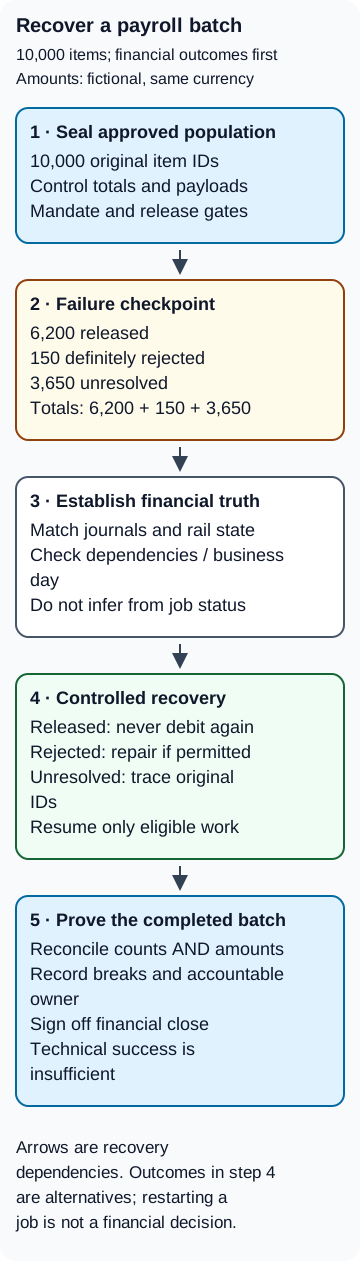
A fictional payroll batch has 10,000 immutable item identifiers. At a crash, durable outcomes show 6,200 released, 150 rejected and 3,650 unresolved: the counts reconcile to 10,000. Recover externally uncertain items before deciding which unresolved items can execute. Resume under the same identities; do not create 10,000 fresh payments. Counts alone are insufficient: amounts, currencies, customer/entity scope and settlement/posting state must also reconcile.
Technical recovery completes when services resume. Business recovery completes when the expected population and financial/customer outcomes are accounted for, exceptions have authorised owners and required sign-off is evidenced. A job status of 'success' cannot substitute for that evidence. The diagram presents this decision boundary; it is a control model, not a universal scheduler or rail sequence.
This application uses JavaScript for the full interactive experience. This text summary is served for accessibility and search indexing.