The controlled journey of moving money from intent to final state
Payments and transfers are the heart of money movement. A customer may describe the action simply: send money to my friend, move funds to savings, pay a supplier, transfer salary, make a loan payment, top up a wallet, or schedule rent. The bank sees a much larger functional journey. It must capture intent, identify the parties, validate the source of funds, authenticate the actor, check limits, screen risk, select the route, create the instruction, post accounting entries, send or settle the payment, update status, notify the customer, reconcile the outcome, and repair exceptions.
Money movement is not one feature. It is an operating discipline that touches channels, authentication, accounts, balances, payments rails, posting, fees, FX, sanctions, fraud, AML, customer notifications, statements, investigations, operations, treasury, finance, and regulatory reporting. A payment journey that looks easy on a mobile screen succeeds only because many controls work quietly underneath.
A world-class payment platform is not judged only by speed. It is judged by correctness, explainability, recoverability, and trust. Customers need to know whether money moved, when it will arrive, what it cost, whether it can be cancelled, and what to do if something goes wrong. Business customers need maker-checker, bulk files, approvals, audit, status, cut-offs, remittance, and reconciliation. Operations teams need queues, repair tools, investigation evidence, and exception ownership. Finance needs postings and settlement to tie out. Risk teams need screening and monitoring. Every group depends on the same payment truth.
This chapter introduces payments and transfers as the foundation of the Money Movement section. It stays focused on the functional banking model: how a payment instruction is created, controlled, routed, posted, monitored, and completed.
Learning objectives
By the end of this chapter, you should be able to explain the difference between payments and transfers, how payment intent becomes an instruction, how the bank validates source account and beneficiary, how limits and cut-offs work, how internal and external routing differ, how standing orders and recurring transfers are controlled, how business approvals work, how payment statuses should be modelled, how rejects, returns, reversals, recalls, and investigations differ, and how reconciliation proves that customer balances and settlement outcomes are correct.
You should also be able to identify weak implementations: a payment marked successful before final confirmation, duplicate debits after retry, inconsistent statuses across channels, beneficiary data that cannot be verified, business approvals that bypass mandates, pending payments with no owner, returns that do not notify customers, and reports that cannot tie payment instructions to postings.
What a payment is
A payment is an instruction to move value from one party to another. It may move money between accounts inside the same bank, to another bank, across a payment scheme, through a card rail, through a real-time rail, by batch clearing, through a correspondent network, or through an internal ledger. In consumer and business banking, most payment journeys begin with a customer or system asking the bank to debit one source and credit one beneficiary.
A transfer is often used for movement between accounts controlled by the same customer or within the same bank. In practice, the terms overlap. A savings transfer, own-account transfer, loan repayment, and wallet top-up may be called transfers. A supplier payment, bill payment, salary file, external account payment, tax payment, and cross-border remittance may be called payments. The system should not rely only on labels. It should classify payment type, source, destination, rail, currency, timing, risk, and accounting treatment.
The payment lifecycle has several states: draft, created, pending approval, approved, validating, rejected, scheduled, queued, processing, posted, sent, settled, credited, returned, reversed, cancelled, recalled, investigated, repaired, completed, failed, and expired. Not every rail uses every state, but the platform should be precise. A payment can be debited but not yet settled. A payment can be accepted by the bank but rejected by a scheme. A payment can be credited internally but later reversed due to fraud or operational error. Status language must reflect real operational truth.
Payment parties and data
A payment involves parties. At minimum, there is a debtor or payer, a creditor or beneficiary, a source account, and a destination account or proxy. There may also be debtor agent, creditor agent, intermediary, initiating party, ultimate debtor, ultimate creditor, business user, approver, file submitter, partner, scheme, clearing system, settlement account, and operations owner.
Payment data must be structured enough to route, screen, post, communicate, and investigate. Important data includes amount, currency, value date, requested execution date, source account, beneficiary name, beneficiary account, bank identifier, payment type, purpose, remittance information, reference, charge option, exchange-rate quote, fee, customer ID, business entity, user ID, approval ID, channel, device, instruction ID, end-to-end reference, and status.
Data quality matters because payment defects are painful. A wrong account number can send funds to the wrong place. A missing remittance reference can stop a supplier from reconciling. A wrong value date can create overdraft or settlement issues. A missing regulatory purpose can block cross-border payment. A weak beneficiary name can increase fraud risk. Payment capture should guide the customer without hiding the required detail.
Consumer and business payment journeys
Consumer payment journeys should be simple, safe, and clear. A customer selects account, enters beneficiary, amount, date, reference, and confirms. The bank checks beneficiary, balance, limit, authentication, risk, fee, and route. The customer receives a clear status and receipt. If the payment is scheduled or pending, the customer should see that. If it fails, the customer should know why in safe language.
Business payment journeys are more complex. A company may upload a file, create a single supplier payment, approve payroll, schedule tax payment, make intercompany transfer, or initiate high-value treasury movement. Business journeys need roles, maker-checker, mandates, approval limits, file validation, duplicate detection, cut-off rules, audit export, remittance detail, status reporting, and integration with ERP. The bank should support operational reality: one user creates, another approves, operations repairs, finance reconciles.
Both consumer and business journeys need explainability. The customer should never be left with a mysterious spinning status after money is debited. The system should show whether the payment is pending approval, scheduled, processing, sent, credited, returned, or failed. Support teams should see more detail: which validation passed, which screening fired, which route was chosen, which posting occurred, which external response arrived, and which exception queue owns the case.
Functional payment operating catalogue
The following catalogue is the functional backbone for payments and transfers. Each capability should have ownership, rules, evidence, operational process, and test coverage. It is intentionally practical so delivery teams can turn the chapter into requirements and acceptance criteria.
Payment intent capture
Payment intent capture should define the payment types in scope, eligible channels, customer segment, source data, required validation, risk controls, status impact, posting impact, customer message, operations owner, and audit evidence. Runtime behaviour should be deterministic: the same customer, account, beneficiary, amount, date, currency, channel, entitlement, and payment type should produce the same validation result and route unless an approved rule version has changed. The platform should retain instruction ID, actor, channel, source account, beneficiary, amount, currency, timestamps, rule versions, decision result, status history, and correlation references.
For consumer banking, Payment intent capture must support clear language, safe confirmation, real-time feedback where possible, and a support path when the customer is worried about money. For business banking, it must also support entities, roles, approval mandates, bulk files, cut-offs, repair queues, remittance, audit exports, and reconciliation references. The capability should stay connected to accounts, posting, limits, sanctions, fraud, fees, FX, notifications, statements, and investigations rather than building its own isolated truth.
Testing should cover happy path, insufficient funds, blocked account, closed account, invalid beneficiary, duplicate instruction, same-day payment, future-dated payment, recurring payment, limit breach, cut-off miss, authentication failure, approval pending, approval rejection, downstream timeout, scheme rejection, return, reversal, cancellation, retry, idempotency, notification, statement display, reconciliation, and production support retrieval. A payment capability is complete only when the bank can explain where the money is and what must happen next.
Transfer type selection
Transfer type selection should define the payment types in scope, eligible channels, customer segment, source data, required validation, risk controls, status impact, posting impact, customer message, operations owner, and audit evidence.
For consumer banking, Transfer type selection must support clear language, safe confirmation, real-time feedback where possible, and a support path when the customer is worried about money.
Status model
A strong payment status model avoids customer confusion. Draft means the customer has not submitted. Pending approval means the bank has a valid instruction waiting for authorised approval. Scheduled means the instruction is accepted for a future date. Processing means the bank is validating, posting, or routing. Sent means the instruction has left the bank or internal processor. Settled means interbank settlement has completed where applicable. Credited means the beneficiary account is credited where the bank has that visibility. Returned means funds came back. Rejected means the instruction was not accepted. Cancelled means the customer or bank stopped it before execution. Reversed means a posted entry was corrected. Investigated means a case is open.
The same external word should not hide different internal states. Customers need safe, simple status. Operations need exact state. Finance needs accounting state. Risk needs screening state. Channels should translate without lying.
Acceptance scenarios
| Scenario | Expected behaviour | Evidence |
|---|
| Consumer sends immediate transfer | Balance, limit, authentication, beneficiary, posting, status, receipt, and notification work end to end. | Instruction, validation, posting, status history, receipt. |
| Business payment needs approval | Payment remains pending until mandate-required approvers act. | Maker, checker, mandate, approval audit. |
| Duplicate mobile retry | Idempotency prevents duplicate debit. | Idempotency key, duplicate decision, single posting. |
| Future-dated payment | Payment stores schedule and executes on due date subject to rules. | Schedule record, execution event, customer status. |
| Beneficiary invalid | Payment is rejected before debit where possible. | Validation reason, customer message, no debit. |
| External rail returns payment | Customer is credited or notified according to return rules. | Return message, posting, notification. |
| Payment stuck in processing | Exception queue owns the item with SLA and support explanation. | Queue item, owner, status, resolution. |
| Business file has one bad item | File handling follows policy for reject whole file or repair item. | File validation, item status, customer report. |
| Payment fee applies | Fee is disclosed and posted correctly. | Fee rule, customer confirmation, GL posting. |
| Investigation opened | Case links instruction, postings, external references, and customer communication. | Case ID, payment reference, updates. |
Common implementation mistakes
Marking payment complete too early
A payment accepted by the bank is not always completed. The status should reflect actual lifecycle stage, not optimistic channel wording.
Weak idempotency
Retries happen constantly in digital channels and APIs. Without idempotency, customers can be debited twice.
No operational owner for pending states
Pending payments need ownership. A payment stuck in queue without SLA is a customer trust problem.
Business mandates too shallow
Business payments need proper creator, approver, amount, product, entity, and file controls. One generic approver role is not enough.
Poor return handling
Returns should update customer balance, status, notification, and reconciliation. A returned payment hidden in operations creates complaints.
Best-practice principles
Keep payment truth central. Model statuses precisely. Separate customer wording from operational state. Use idempotency for every submission. Validate early. Route explicitly. Post with accounting discipline. Screen risk without hiding ownership. Notify clearly. Reconcile daily. Give operations repair tools. Test exceptions as deeply as happy paths.
Final perspective
Payments and transfers are the customer's most emotional banking journeys because money is either where it should be or it is not. The bank must make the movement safe, clear, controlled, and explainable. Speed is valuable, but speed without certainty is not trust.
A world-class payment platform lets customers move money confidently, lets businesses control money properly, lets operations repair issues quickly, and lets finance prove every debit, credit, fee, settlement, and exception.
Standards and authoritative references
Implementations should use current official and bank-approved sources covering payment schemes, local payment laws, sanctions, AML, fraud, strong customer authentication, customer communications, data retention, complaints, settlement, accounting, and operational resilience. Bank-approved product rules, payment routing policy, limit policy, fee policy, risk policy, notification policy, posting rules, and investigation procedures should be binding implementation inputs.
Follow the instruction, money and customer promise separately
A useful state model has independent dimensions: instruction accepted, approval complete, risk released, funds reserved or posted, external settlement known, beneficiary credit known, and investigation open. 'Under investigation' is not necessarily a new financial state. A payment can remain settled while a recall case is open. Each event should identify its source, event time, processing time, instruction version and correlation reference. Present a receipt with the amount, fee, exchange-rate assumptions, execution date and the actual known outcome.
Harbour Tools submits 40 payroll items totalling 96,000. Policy permits partial release after authorised review; 37 items totalling 88,800 pass and three totalling 7,200 remain held. The file status is partial, with item status and privacy-controlled reports. A debit/reservation total of 96,000 with 88,800 released requires explanation of the remaining 7,200, not a 'completed' flag. A whole-file policy would instead withhold all items; publish which policy applies before acceptance.
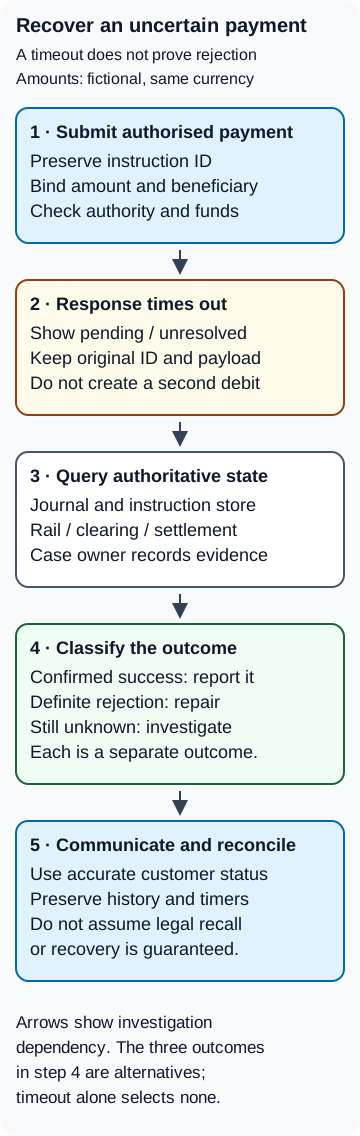
For duplicate protection, bind a submission key to the submitting entity, intent and canonical payload hash. The same key with a changed amount must be rejected, not treated as the earlier payment. Preserve the key across a lost response and query the instruction outcome. A business may legitimately send two identical-value invoices; deduplication cannot rely only on amount and beneficiary. An outbox written with the posting commit can safely publish the resulting event repeatedly if consumers deduplicate it. Exactly-once financial effect is a design objective supported by durable state, not a promise that networks never redeliver.
US consumer EFT protections apply to covered accounts and transfers. Regulation E §1005.3 distinguishes accounts established primarily for personal, family or household use; do not automatically apply its consumer error-resolution clocks to an SME operating account. Local law, contract and rail rules determine business rights.
This application uses JavaScript for the full interactive experience. This text summary is served for accessibility and search indexing.