Why this topic matters
Limits and exposure management is the governance discipline for understanding how much risk the bank has accepted, who carries that risk, how it is aggregated, how it changes, and whether it remains within appetite. It connects credit facilities, overdrafts, cards, business groups, guarantors, collateral, merchants, counterparties, countries, industries, products, currencies, and settlement positions. In consumer and business banking, exposure is not only a lending concept. It also appears in payment risk, merchant risk, overdraft usage, card credit, settlement timing, and concentration risk.
Control and governance is the discipline that makes banking scalable without becoming careless. A bank can have attractive products, fast channels, strong core processing, and modern analytics, but it still needs clear authority, evidence, approval, segregation of duties, monitoring, auditability, escalation, and accountability. Control is how the bank makes sure actions are allowed, complete, accurate, fair, secure, and recorded. Governance is how the bank decides who owns the rules, who approves change, who monitors outcomes, who accepts risk, and who fixes weaknesses.
In consumer and business banking, control and governance cannot be abstract. It must show up in everyday banking behavior: who can open an account, who can approve a business payment, who can change a fee, who can override a limit, who can release a hold, who can adjust a ledger entry, who can view documents, who can close an account, who can change a workflow, who can run a batch, and who can attest that a report is complete. If these controls are vague, the bank becomes dependent on staff memory and informal trust. That is not a control environment.
This chapter is about aggregate exposure and risk appetite. It is separate from operational Limits Management, which governs transaction, channel, user, card, payment, and self-service limits at execution time. Exposure management asks how much risk the bank has with a customer, group, facility, product, portfolio, or counterparty. Operational limits ask whether a specific transaction or user action should be allowed right now.
Fundamentals
A world-class limits & exposure management capability has five foundations: policy, authority, data, evidence, and oversight. Policy defines what must happen. Authority defines who can decide or act. Data gives the facts needed for the decision. Evidence records what happened. Oversight checks whether the control worked and whether the bank is improving. Missing any one of these foundations creates operational risk. A policy without evidence cannot be audited. Authority without oversight becomes entitlement sprawl. Data without ownership becomes mistrust. Evidence without quality is noise.
The bank should design controls close to the action. A payment limit should be checked when the payment is created and approved. A document should be captured when the customer signs. A GL entry should be created when the posting occurs. A workflow status should update when the decision is made. A batch should record its control totals when it runs. A case should preserve notes when staff communicate with the customer. Controls that appear only at month-end or audit time are usually too late to prevent harm.
Good governance also separates ownership. The business owns product purpose and customer outcome. Operations owns process execution. Risk and compliance own independent challenge and obligations. Technology owns platform resilience, access, and change delivery. Finance owns accounting and financial control. Internal audit provides independent assurance. Senior management owns risk appetite and accountability. A mature bank does not let one team design, execute, approve, and review the same sensitive activity without checks.
Consumer and business banking alignment
Limits & Exposure Management must support both consumer and business banking with different depth and the same discipline. Consumer banking needs simple customer experiences, clear account control, fair treatment, privacy, accurate disclosures, fast service recovery, protected digital access, correct fees and interest, safe payment limits, and reliable evidence when a dispute arises. The customer should not see governance machinery, but they should feel its benefits: fewer errors, safer money movement, clearer explanations, and fair decisions.
Business banking needs stronger structural controls. A business customer may have legal entities, subsidiaries, administrators, makers, approvers, signers, payroll users, treasury users, ERP integrations, credit facilities, collateral, covenants, merchant activity, and high-value payment flows. The bank must govern authority at entity, user, account, product, file, facility, and transaction level. A small business may need practical simplicity. A corporate customer may need complex mandate, limit, workflow, audit export, and host-to-host controls.
The control design should avoid two failures. The first is treating business customers like single consumers, which weakens mandates and exposes the bank to unauthorized activity. The second is forcing consumer customers through corporate-style complexity, which creates confusion and service friction. A good model uses common control principles but segment-specific execution.
Functional map
The governance model has four practical layers. The policy layer defines rules, obligations, scope, and risk appetite. In consumer banking this can appear as a fee refund policy for vulnerable customers. In business banking it can appear as a dual-approval policy for high-value payments.
The authority layer defines who may view, create, approve, override, or close a sensitive item. In consumer banking this can appear as branch supervisor approval for an account correction. In business banking it can appear as a treasury administrator managing user limits under an agreed mandate.
The evidence layer preserves data, logs, documents, status, and decision rationale. In consumer banking this can appear as consent evidence and a statement correction record. In business banking it can appear as a board resolution, mandate, payment file approval trail, or facility document pack.
The oversight layer monitors, tests, reports, and remediates the control environment. In consumer banking this can appear as complaint trends leading to a control change. In business banking it can appear as an audit finding driving workflow remediation, entitlement review, or payment approval redesign.
Functional operating catalogue
The following catalogue turns Limits & Exposure Management into delivery-grade banking requirements. Each capability should define ownership, data, controls, permission model, approval logic, customer impact, business impact, financial impact, reporting, evidence, quality testing, and remediation. The purpose is not to create bureaucracy. The purpose is to let the bank move quickly with confidence because sensitive actions are controlled and explainable.
Exposure taxonomy
Exposure taxonomy in limits and exposure management must define the control objective, triggering event, system of record, source data, decision authority, maker-checker requirement, eligible products, eligible accounts, customer segment, business entity impact, financial impact, operational status, downstream integration, audit evidence, exception path, and closure rule. The design should state whether the control prevents an action, detects an issue, approves a change, records evidence, reconciles an outcome, or governs a process. When those purposes are mixed, staff cannot tell whether they are allowed to act or only allowed to escalate.
For consumer banking, exposure taxonomy should protect the customer while keeping the experience clear. A consumer may encounter the control through a payment limit, a document request, a statement correction, an account restriction, a consent capture, a loan condition, a card dispute, a fee reversal, or a service case. The bank should make the rule understandable without exposing sensitive internal logic. Staff should be able to retrieve the decision reason, evidence, timestamp, actor, and next step quickly.
For business banking, exposure taxonomy should support entity structure, user roles, approval mandates, treasury workflows, file-level controls, ERP references, exposure aggregation, facility usage, collateral, relationship manager visibility, operations queues, and audit exports. Business customers need control they can rely on for their own governance. The bank should provide evidence that a payment, limit change, document acceptance, case decision, or batch process followed the agreed mandate and policy.
Controls should cover role-based access, segregation of duties, maker-checker approval, override authority, reason codes, version control, aging, escalation, audit logs, data lineage, reconciliation, customer communication, business communication, regulatory retention, management reporting, quality assurance, and independent review. Testing should include happy path, unauthorized user, maker-checker conflict, missing evidence, duplicate request, stale data, expired document, high-value transaction, business mandate conflict, reversal, rejected approval, downstream outage, audit retrieval, and remediation after a failed control. Exposure governance risk is mature only when the bank can explain the action, prove it, monitor it, and improve it.
Customer exposure aggregation
Customer exposure aggregation in limits and exposure management must define the control objective, triggering event, system of record, source data, decision authority, maker-checker requirement, eligible products, eligible accounts, customer segment, business entity impact, financial impact, operational status, downstream integration, audit evidence, exception path, and closure rule. When those purposes are mixed, staff cannot tell whether they are allowed to act or only allowed to escalate.
For consumer banking, customer exposure aggregation should protect the customer while keeping the experience clear. The bank should make the rule understandable without exposing sensitive internal logic. Staff should be able to retrieve the decision reason, evidence, timestamp, actor, and next step quickly.
For business banking, customer exposure aggregation should support entity structure, user roles, approval mandates, treasury workflows, file-level controls, ERP references, exposure aggregation, facility usage, collateral, relationship manager visibility, operations queues, and audit exports. Business customers need control they can rely on for their own governance.
Audit evidence
Audit evidence in limits and exposure management must define the control objective, triggering event, system of record, source data, decision authority, maker-checker requirement, eligible products, eligible accounts, customer segment, business entity impact, financial impact, operational status, downstream integration, audit evidence, exception path, and closure rule. When those purposes are mixed, staff cannot tell whether they are allowed to act or only allowed to escalate.
Advanced information and modernization
Advanced control and governance design is increasingly event-driven. The bank should not wait for monthly reports to discover that a control failed. Sensitive actions should emit events: limit changed, override approved, document expired, GL entry posted, workflow breached service level, batch failed, case reopened, control attestation missed, reconciliation break aged, user entitlement changed, or approval bypass attempted. Those events allow operations, risk, compliance, technology, finance, and audit to monitor the bank continuously.
Automation can strengthen governance when rules are clear. Automated evidence capture, entitlement review reminders, document expiry alerts, GL mapping validation, workflow routing, duplicate case detection, batch dependency checks, limit consumption alerts, and control testing samples can reduce manual weakness. But automation must be governed. Rules need owners, versioning, approval, testing, rollback, monitoring, and evidence. An automated bad control is still a bad control, only faster.
A mature bank also designs for explainability. If a business payment is blocked, the bank should know whether the cause was user limit, account limit, daily limit, exposure limit, sanctions hold, fraud hold, insufficient funds, product restriction, or workflow approval state. If a GL reconciliation breaks, the bank should trace source posting, transaction code, account, product, batch, interface, and finance mapping. If a document is rejected, staff should know the missing clause, expiry, authority issue, or signature problem. Explainability reduces customer pain and improves audit outcomes.
Governance should be measured through outcome-based metrics: control breach count, override rate, aged exceptions, missing evidence rate, maker-checker conflict rate, entitlement review completion, audit finding aging, document expiry exposure, GL break value, workflow SLA breach, batch failure recovery time, case reopen rate, regulatory issue aging, and repeat root-cause rate. These metrics should lead to action, not decorative dashboards.
Implementation checklist
A production-grade Limits & Exposure Management capability should include policy mapping, control taxonomy, system-of-record definition, data dictionary, entitlement model, approval matrix, workflow status model, audit logging, document retention, reporting, quality review, control testing, exception queues, escalation paths, business continuity procedures, training, governance forum ownership, issue remediation, and independent assurance. Every sensitive action should have a clear answer to: who did it, who approved it, what rule allowed it, what evidence supports it, what financial impact occurred, what customer impact occurred, and how it can be reviewed later.
The best implementation test is a hard cross-domain scenario. For example: a business customer requests an emergency payment-limit increase while a sanctions alert is pending; a consumer disputes a debit that requires GL adjustment and document evidence; a batch interest process fails after partial posting; a workflow route sends a case to the wrong authority; a document expires after loan disbursement; a reconciliation break reveals incorrect transaction-code mapping. The control model is strong only when ownership, authority, financial truth, customer communication, and audit evidence remain consistent.
Closing view
Limits & Exposure Management is not paperwork around banking. It is the structure that lets banking scale safely. Good governance lets honest staff act confidently, helps customers receive fair treatment, protects the bank from uncontrolled risk, and gives auditors and regulators evidence that the institution knows what it is doing.
Credit headroom and payment permission are different limits
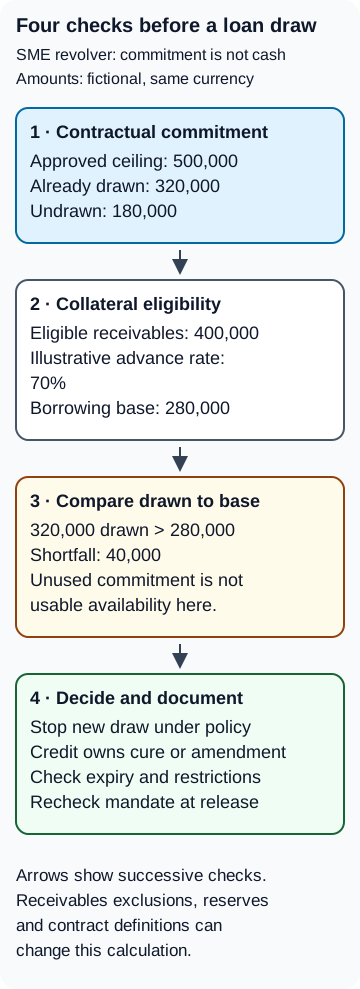
A 500,000 revolving credit commitment with 320,000 drawn has 180,000 undrawn contractual headroom before reservations, borrowing-base constraints, expiry or other restrictions. If a proposed 150,000 draw is eligible and committed, drawn becomes 470,000 and undrawn 30,000. Do not add 500,000 commitment and 320,000 drawn as if they were separate principal exposures; the measure may instead combine drawn and appropriately treated undrawn exposure under its defined purpose.
A borrowing base can constrain usable availability below the contractual headroom. If eligible receivables are 400,000 with a 70-percent advance rate, base availability is 280,000 before reserves. A borrower already drawn 320,000 would have a 40,000 shortfall under that simplified definition, despite remaining contractual undrawn limit. Product/credit owns the cure, extra collateral or approved amendment; the portal cannot manufacture availability by choosing the larger figure.
Distinguish account overdraft, facility commitment, collateral/borrowing base, counterparty/group concentration, regulatory exposure measure and transaction approval limit. A user authorised to approve 200,000 cannot exceed a facility's 30,000 availability. Aggregate related obligors according to the measure and applicable connected-counterparty rules; avoid double-counting guaranteed exposures or netting collateral without the permitted method. Record currency conversion and observation time.
At utilisation, reserve/commit exposure atomically or under durable controlled orchestration; release reservations on definitive rejection, not on an unresolved timeout. Test simultaneous draw requests, rate/FX movements, collateral removal, facility expiry, a suspended borrower, a stale mandate and a reversal after settlement. The limit service, loan/core ledger, collateral service and risk reporting must explain the same purpose-specific totals and differences.
This application uses JavaScript for the full interactive experience. This text summary is served for accessibility and search indexing.