The discipline of knowing what money exists and what money can be used
Ledger and balance management is the part of the core banking engine that answers the most sensitive daily question in banking: what is the balance, what is available, what is restricted, and why. Customers usually experience this as a number on a mobile screen, a statement line, a teller response, a payment rejection, an overdraft alert, or a business cash-position report. The bank experiences it as a controlled financial model involving posted entries, pending entries, holds, liens, uncleared funds, value dates, overdraft limits, settlement accounts, subledger totals, and general ledger reconciliation.
A balance is not one number. Ledger balance, available balance, current balance, collected balance, memo balance, reserved balance, shadow balance, loan outstanding balance, accrued interest, available credit, and business cash position can all be correct at the same time because they answer different questions. A world-class core does not collapse them into vague labels. It defines each balance, calculates it consistently, exposes it safely, and records enough evidence to explain it after the fact.
Consumer banking needs balance clarity because money stress is personal. A customer wants to know whether salary is available, whether a card hold reduced spending power, whether a mobile deposit is still on hold, whether an overdraft fee is coming, and why a payment failed. Business banking needs balance control because money movement is operational. A business wants to know whether payroll can run, whether receivables are collected, whether a sweep executed, whether a lien restricts funds, whether a bulk file reserved liquidity, and whether ERP can reconcile the statement.
Functional meaning of ledger
A ledger is the formal record of financial entries. In core banking, the customer account ledger records debits and credits against a customer account. The general ledger records the bank's accounting position. The subledger connects customer-level detail to finance-level control accounts. Strong banks never treat balance management as only a screen calculation. They treat it as accounting evidence.
The core must maintain a clear relationship between transaction postings and balance updates. Every posted debit or credit should have a transaction code, amount, currency, account, date, value date, narration, reference, origin, authorization evidence, and accounting mapping. Pending activities may affect available balance before they become final ledger postings. Holds and reservations may restrict funds without becoming debit entries. Accruals may affect accounting before they appear as paid interest. The platform must keep these categories separate and understandable.
Balance fundamentals
Ledger balance normally reflects posted financial transactions. Available balance usually reflects ledger balance plus or minus holds, uncleared funds, overdraft limits, pending debits, and other restrictions. Current balance may represent the customer-visible posted position at a point in time. Collected balance may exclude funds not yet cleared. Average balance may support interest or account analysis. Business banking may use available funds, controlled disbursement, collected funds, target balances, and sweep balances for treasury operations.
The best balance model has naming discipline. If the mobile app says available, the branch should not call the same number current unless it is truly the same definition. If a business file validation uses available balance, the support team should know whether it includes overdraft limit. If a payment hub reserves funds, the statement should eventually tie that reservation to a posted debit or released hold. If a backdated transaction changes value-dated balances, the bank should know whether interest, fees, and statements are affected.
Functional operating catalogue
The following catalogue is written as delivery-grade banking content. Each capability should become requirements, configuration, test cases, operating procedures, exception handling, reporting, and audit evidence. The wording is detailed because core banking failures rarely come from one missing screen. They come from small gaps between product rules, account state, posting behavior, balance calculation, channel expectations, and operational ownership.
Balance taxonomy
Balance taxonomy in ledger and balance management must define the business rule, system-of-record owner, source data, validation sequence, posting impact, accounting impact, status impact, customer visibility, operations ownership, audit evidence, and downstream events. The design should be deterministic: the same account, product, customer segment, currency, amount, effective date, channel, transaction code, and rule version should be reproducible when all relevant state and input versions are the same. Changed balances, restrictions, mandates, risk decisions or reference data can legitimately change a later decision even without a configuration deployment. Determinism is what lets a bank explain why a balance changed, why a transaction was accepted, why a transaction was rejected, and why a statement shows what it shows.
For consumer banking, balance taxonomy must support simple customer journeys without hiding banking truth. The customer may only see a balance, a transaction line, a charge, an interest credit, or a failed payment, but the core must preserve the complete reason behind that outcome. Mobile, web, branch, ATM, card, contact center, and notification channels should see consistent account status and balance language. If the account is dormant, frozen, overdrawn, closed, pending closure, pledged, or restricted, the customer-facing answer should be clear and safe.
For business banking, balance taxonomy must support more structure: legal entities, operating accounts, signer mandates, maker-checker approval, bulk activity, cash management, sweeps, overdraft facilities, service charges, statement delivery, ERP reconciliation, audit exports, account analysis, and treasury visibility. Business customers do not only ask whether a transaction happened. They ask who initiated it, who approved it, which file or invoice it relates to, which account it impacted, when it will value, whether it used credit, whether fees apply, and how it can be reconciled.
Control design should cover entitlement, segregation of duties, idempotency, duplicate prevention, value date versus booking date, reversal behavior, exception queue routing, retry rules, service-level expectations, branch override permissions, regulatory evidence, and finance reconciliation. Testing should include happy path, rejected path, partial failure, timeout, retry, reversal, backdated correction, branch and digital initiation, consumer and business scenarios, large value, small value, zero or negative edge cases where applicable, holiday and cut-off behavior, and production support retrieval. A capability is complete only when operations, technology, risk, finance, support, and the customer-facing teams can all explain the same outcome from the same evidence.
Ledger balance
Ledger balance in ledger and balance management must define the business rule, system-of-record owner, source data, validation sequence, posting impact, accounting impact, status impact, customer visibility, operations ownership, audit evidence, and downstream events.
For consumer banking, ledger balance must support simple customer journeys without hiding banking truth. Mobile, web, branch, ATM, card, contact center, and notification channels should see consistent account status and balance language.
For business banking, ledger balance must support more structure: legal entities, operating accounts, signer mandates, maker-checker approval, bulk activity, cash management, sweeps, overdraft facilities, service charges, statement delivery, ERP reconciliation, audit exports, account analysis, and treasury visibility. Business customers do not only ask whether a transaction happened.
Shared architecture controls
The Core Banking System chapter covers coexistence, migration, vendor accountability and shared consumer/business architecture. Apply those controls to this specialist process, with the following topic-specific evidence.
Implementation checklist
A bank can use this checklist to judge whether ledger and balance management is ready for serious production use. The implementation should have approved product definitions, account-state rules, transaction-code definitions, posting rules, balance rules, interest rules where relevant, fee rules, accounting maps, exception queues, operational reports, customer messages, API contracts, event contracts, migration controls, reconciliation routines, maker-checker controls for configuration, role-based access, branch override governance, audit logs, data-retention rules, test evidence, performance evidence, recovery procedures, and production support playbooks.
The strongest test is not a demonstration screen. The strongest test is an explained exception. Pick a real-world hard case: a backdated business-account correction after statement generation, a consumer refund to a closed account, an overdraft fee reversal after interest accrual, a duplicate payment retry after channel timeout, a loan payment posted across a holiday, a pledged account with partial available balance, or a bulk payroll file that partially rejects. If the core can explain the customer balance, accounting entry, status, notification, audit trail, operational owner, and reconciliation result, the design is strong.
Reconcile an available balance without double counting
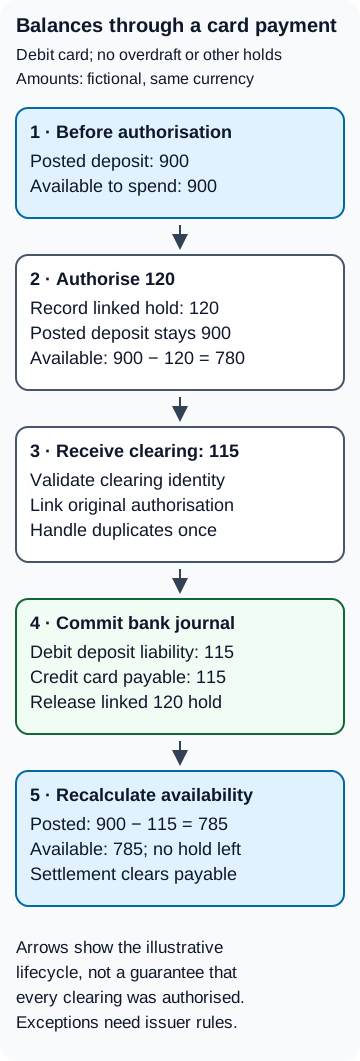
Assume a posted deposit balance of 80,000, a distinct card hold of 12,000 and a distinct legal restriction of 5,000. With no uncleared credit or authorised overdraft, availability is 63,000. If a 10,000 clearing item matches the 12,000 hold, post the debit and release the matched hold: posted balance becomes 70,000 and availability 65,000 while the 5,000 restriction remains. Charging the debit while retaining the full matched hold would display 53,000 and wrongly restrict 12,000. Partial capture and genuinely separate holds require separate treatment.
Store hold identifier, reason, amount, currency, creating event, expiry and release/matching evidence. A reservation is not a journal debit. A legal lien may restrict only part of a balance; dormant, frozen and closed are not synonyms. Identify credits allowed during a debit restriction and the authority needed to release it. Never delete a restriction just because a scheduled expiry job ran without checking the applicable legal condition.
| Quantity | What it answers | Reconciliation evidence |
|---|
| Posted customer balance | What account entries have been committed? | Journal sequence and opening balance plus signed movements |
| Spendable balance | What can this instruction use now? | Posted state, non-overlapping holds, eligible uncleared funds and credit rules |
| Value-dated balance | Which economic dates enter interest? | Value dates and approved backdated adjustments |
| GL control-account total | What does finance recognise across accounts? | Customer/subledger totals plus explicit timing and mapping differences |
Recompute a sampled account independently from immutable entries. Check that statements, support screens and channel APIs use declared definitions and observation times. An eventually updated analytical replica may be useful for reporting but must not approve a spend against stale availability. Reconciliation should detect missing entries, duplicates, currency mismatches and offsetting account errors, rather than only comparing two grand totals.
The bank-side journal for a deposit cash receipt debits the appropriate cash asset and credits the customer deposit liability. Creating an on-book loan by crediting a deposit debits the loan asset and credits the deposit liability; external use of the deposit can then consume settlement liquidity. See the Bank of England explanation of money creation. This illustration excludes impairment, fees and tax.
This application uses JavaScript for the full interactive experience. This text summary is served for accessibility and search indexing.