Two sisters, one shared record
A woman walks into a branch to open her first account. The same afternoon her sister, who runs a small catering company, asks the relationship team for a business account. To the staff at the counter these are two unrelated visits; to the bank's customer master they are two distinct parties, each with their own identity, evidence, and links to accounts not yet created. Years later the catering company grows, the sister adds a corporate deposit account, the other sister becomes a guarantor on a business loan, and the bank is suddenly expected to know that one legal entity is connected to another through a beneficial-owner relationship, and that a single natural person may sit on both customer files in different capacities. The customer master is the file that has to hold all of this without collapsing it into confusion.
This chapter is about what a bank means by customer, party, identity, and ownership, and why a disciplined separation of those concepts is the single most important data decision a retail and business bank makes. It is deliberately about the data and ownership model, not about the journey; the journey through prospect, onboarding, active servicing, review, restriction, offboarding, and closure is the subject of Customer Lifecycle Management, which is the next chapter. Read this chapter as the architecture of who the bank is dealing with; the next chapter as the biography of how the relationship moves through time.
Why this matters is that almost every defect in banking eventually touches customer data. A payment that cannot be screened correctly because the customer record disagrees between two systems; a credit decision that ignores an exposure because the same person is held as two customers in different product books; a tax statement that is wrong because the residency was captured against the wrong customer node; a mandate dispute that turns on whether a signatory was really authorised. The architecture of customer and identity is the architecture of the bank's ground truth, and everything else is built on it.
One person is one party, one legal entity is one party, and the customer is what the bank chooses to onboard them as. When those distinctions blur, every downstream control silently weakens.
What the words mean
Banking uses a small set of overlapping words imprecisely at its own risk. Treating them as synonyms causes the defects that follow. The party is the real-world actor, a natural person or a legal entity, that can exist independently of the bank. A party can exist as a person on the street before the bank has ever heard of them; the bank's record of them is a representation, not the person themselves. The customer is a party with which the bank has agreed a relationship: an account, a product, a contract, a mandate. The same party can be a customer several times in different capacities (a personal account, a beneficial-owner declaration on a company account, a signatory under a mandate), and that is normal. The identity is the verifiable claim that a party is who they say they are: a national identity number, a passport, a registered company identifier, a government-issued licence. A party can carry several identities; one of them is the primary identifier the bank relies upon, and the others are supporting evidence.
The legal entity is a legally recognised organisation or arrangement: companies usually have separate legal personality, while the status of partnerships, trusts and associations depends on local law. The beneficial owner is the natural person who ultimately owns or controls a legal entity, typically through a chain of ownership that the bank is expected to trace. The signatory is a party authorised under a mandate to act for a customer, usually a business customer. The account holder is the party in whose name the account is held. The mandate is the binding instrument that defines who may act on the account, with whom, and within what limits.
A bank that confuses customer with account holder will struggle with tax residency; one that confuses customer with signatory will misread authority on a business account; one that confuses party with identity will perform screening against identifiers rather than against the real actors; one that confuses legal entity with beneficial owner will miss the person who truly controls the flow of money. The vocabulary is not academic; it is the difference between a control that works and a control that looks as though it works.
Consumer and business banking in customer and identity terms
Retail and business banking use the same vocabulary but model the world very differently. A retail customer is a natural-person party with a personal identity and personal accounts held in its own name. The data is relatively compact: one party, one or more identities, some demographic attributes, residency and tax information, a contact address, and a set of products each linked to the party. Verification is centred on the person: a passport, a national identity card, a driver's licence, a biometric. The beneficial-owner question barely arises because the party is the person.
A business customer may be a company, partnership, trust, association or an individual trading as a sole proprietor. Model its legal status, operating authority and required ownership/control information under the applicable law. The data is graph-shaped rather than star-shaped: one legal entity may have several signatories; each signatory is itself a party; the legal entity may be owned by other legal entities; and the chain of ownership terminates in the ultimate beneficial owners, who are natural persons. A single legal-entity customer may have accounts that span multiple product families in different countries, and the bank must see them as one customer for exposure and onboarding purposes while letting each product system manage its own relationship record.
The table contrasts the modelling decisions without treating any one as universal; banks shape these to their markets and regulation.
| Aspect | Retail customer | Business customer |
|---|
| Party type | Natural person | Legal entity (or sole trader) |
| Primary identity | Government identity document | Registered entity identifier plus representatives' identities |
| Signatories | The party itself | One or more parties authorised under a mandate |
| Beneficial owners | The party itself | Natural persons reached through ownership chains |
| Mandate | Personal identity carries authority | Mandate document defines authority and signing rules |
| Hierarchy | Single party | Group structure with parents, subsidiaries, and associated parties |
| Verification focus | Identity of the person | Identity of the entity, authority of signatories, ownership of the entity |
| Exposure view | Per individual, often enhanced by household relationships | Per legal entity and relationship group |
| Servicing authority | The person themselves | Authorised users under mandate only |
A common design error is to model a business customer as a retail customer with a company name field. The error becomes obvious the first time the bank needs to know which of the three signatories approved a payment, or which of the four beneficial owners is on a sanctions list. Both retail and business party data can be graph-shaped: joint holders, guardians, representatives, beneficial owners and signatories have distinct relationships. Forcing the graph into a row is the source of a great many corporate banking defects.
The end-to-end identity journey at a glance
The end-to-end identity journey can be read as an ordered operating chain: party recognised as a prospect or referred customer; identity captured and verified with primary and supporting documents; party linked to relationship structure, including signatories, beneficial owners, and group relationships; risk classification and screening applied to all linked parties; customer relationship opened with a product or account; mandate and entitlements defined; golden source updated and downstream systems synchronised; identity continuously verified through periodic refresh and event-driven updates; and finally relationship closure with the party record retained or archived under legal retention rules.
Each arrow is a handoff with its own owner, evidence, and recovery path. Skipping the risk classification at onboarding does not remove the risk; it removes the bank's preparedness for it. Skipping the reconciliation between the channel's view and the golden source does not make the customer simpler; it makes the bank's view of the customer ambiguous. Skipping the entitlement step does not liberate the customer; it lets any signatory act as if they held any authority, which is the opposite of a mandate.
Actors and ownership
Within the bank, several teams touch customer and identity. The front office (relationship managers, branch staff, contact centre, and the digital channel) capture identity at first contact and request changes during the relationship. The onboarding team performs verification and risk classification. The KYC and KYB team owns the periodic refresh of those classifications and the escalation of adverse information. The operations team maintains the party record, the mandate, and the signatory list, and executes maker-checker controlled changes. The risk and compliance teams own the screening of the party and its related parties, and own the alert and case backlog that arises from screening. The technology team builds and runs the customer master, the identity service, and the entitlement service. The data team owns the quality, lineage, and governance of the customer data estate. Auditors and regulators confirm that the records maintain their meaning and their controls.
| Actor | Owns in customer and identity |
|---|
| Front office | Initial capture; in-life change requests |
| Onboarding | Verification and risk classification at entry |
| KYC and KYB | Refresh, ongoing monitoring, adverse information escalation |
| Operations | Maintenance of party, mandate, signatory; controlled repairs |
| Risk and compliance | Screening decisions, alert investigation, regulatory reporting |
| Technology | Customer master, identity service, entitlement service |
| Data and governance | Quality, lineage, retention, master data rules |
| Audit and regulator | Independence assurance over the records and controls |
A defect in customer data is rarely owned by a single team. A wrong address is a front office capture problem, an operations maintenance problem, and a data quality problem all at once. Treating these as a single-team issue explains why the same defects recur across projects; the resolution needs all three teams aligned on a single golden source and a single workflow for changing it.
Products and business rules
Customer and identity is not a product domain in the revenue sense, but it is the substrate on which every product rule evaluates. Product eligibility rules reference party attributes: age, residency, tax status, segment, and risk rating. A youth account requires a minimum age and a guardian link to another party; a corporate lending product requires a legal-entity party with a verified mandate and a beneficial-owner chain above the regulatory threshold. A card product requires an entitlement check that the requesting party is an authorised signatory on the linked account. A treasury product requires group-level exposure limits that aggregate across the party hierarchy.
Business rules in this domain fall into several families:
Eligibility rules — which party types may hold which products, and what attributes must be present (for example, a verified primary identity, a current risk classification, a valid mandate). These rules are evaluated at onboarding and re-evaluated at periodic review.
Authority rules — what a signatory may do on a given account. A mandate can specify single sign, dual sign, threshold-based authority, role-based authority (payroll approver vs. treasury approver), and channel-specific restrictions (host-to-host only, no mobile). The entitlement service evaluates these rules in real time for every action.
Ownership and control rules — the beneficial-owner threshold (often 25 percent but jurisdiction-dependent), the treatment of trusts and foundations, the handling of dispersed ownership where no natural person crosses the threshold. These rules drive KYB classification and regulatory reporting.
Screening rules — which lists are screened (UN, OFAC, EU, UK, local), which entities are screened (customer, signatories, beneficial owners, counterparties), at what frequency (onboarding, real-time, daily batch, event-driven), and what disposition is required for a match (auto-clear below threshold, manual review, mandatory block).
Refresh rules — the periodic KYC and KYB cadence (set by applicable law and documented risk-based policy, with event-driven review for material changes), the evidence required for refresh, the escalation path when evidence is not provided, and the restriction or exit process when refresh lapses.
Retention and archival rules — how long party records, identity evidence, screening results, and audit events must be retained after relationship closure, driven by AML law, tax law, and the bank's own litigation hold policies.
These rules live in the customer master and the KYC/KYB platform; they are configuration, not hard-coded logic, because regulators change thresholds and lists change composition without notice.
Systems and architecture
A representative architecture, without pretending any one shape is universal, centres on a customer master or party hub that is the golden source for the party, its identities, signatories, beneficial owners, and relationships. An identity verification service captures and verifies evidence at onboarding and at refresh, often integrating with external document verification, biometric, and identity-check providers. A KYC and KYB platform manages the risk classification, the periodic refresh, and the case backlog from screening. A sanctions screening engine screens parties, related parties, and transactions against the applicable lists. An entitlement service derives, for a given signatory and a given account under a mandate, the set of actions they may perform. The core banking system holds account records that link back to the party identifier, and the channel applications authenticate users against an identity provider that maps the digital credential to a party record.
Integrations between these systems are themselves a design point. Some carry authoritative reads (the channel asks the customer master for the current address) and some carry authoritative writes (the channel submits an address change event to the customer master, which propagates). The discipline is to make every write flow to the golden source and every read flow from it, with caching treated as an optimisation that must invalidate on update, not as a separate source of truth. A bank that lets the channel update its own address copy because it is faster has, in effect, two customer masters; the regulator will discover this during an examination.
The master is not a service that answers one synchronous call and forgets; it is a service that emits events when the truth changes, so that every consumer can react. When an address changes, the master writes the new value, writes the audit trail, and emits an address-changed event, which downstream systems consume to invalidate caches, re-run controls, and refresh their views. When a signatory is removed, the master emits a signatory-removed event, which the channel consumes to stop showing that user as authorised, the limits service consumes to recompute per-account authority, and the audit platform consumes to record the loss of authority. The discipline of event-driven propagation is what keeps a large bank's customer view consistent across many systems without forcing synchronous coupling between them.
Resilience and operational architecture
Resilience matters here more than in most domains because the master is foundational. If the master is unavailable, channels that read it cannot decide who to serve; if its propagation is broken, channels continue serving against a stale view and the bank books decisions it later has to undo. The architecture answer is to read the master with a cached view that degrades safely — stale data is better than no data for read-only operations, but writes must fail loudly when the master is unavailable rather than letting the channel update its own copy. A bank that quietly lets the channel write to its own cache when the master is down has, in that moment, two customer masters, and the resynchronisation afterwards will surface disagreements that nobody wants to resolve under pressure.
Event ordering is a subtle but critical concern. A signatory removal must be checked at the applicable authorisation/release boundary; an already irrevocable payment cannot necessarily be stopped at settlement. a beneficial-owner change must propagate before a credit covenant tied to the old owner is re-evaluated. The master sequences these events and assigns a logical timestamp; downstream consumers process in timestamp order, and the reconciliation job verifies that no consumer has fallen behind. Idempotency is mandatory: the same change event may be delivered more than once during retries, and the master must apply it once and tell the caller the resulting state rather than applying it twice.
API design and versioning discipline
API design in this domain is unusually consequential because every consumer of the customer master is also a consumer of its contract. Versioning discipline matters: a breaking change to the party endpoint forces coordinated deployments across every client, and banks that neglect this discover the cost during an outage. The master exposes services for party lookup, identity verification, mandate retrieval, and relationship traversal. Writes are received as events with explicit context: who is making the change, on what authority, with what evidence, and with what effective date. Validation ownership is layered: the channel validates that the request is well-formed and authenticated; the customer master validates that the change is permitted under the mandate and the control rules; the entitlement service validates that the requesting actor has the right to request this change.
Privacy and logging controls
Logging includes the actor, the action, the affected party, the previous and new values, the time, and the reason, with correlation identifiers that let an investigator walk an event across many systems. Privacy controls govern what is logged: a record of changes is required, but storing sensitive document images in audit logs is a privacy breach waiting to happen. The master logs metadata about the document (type, issuer, expiry, verification result) but not the image itself; the image lives in a document vault with its own access controls and retention policy.
Resilience and operational architecture
Resilience matters here more than in most domains because the master is foundational. If the master is unavailable, channels that read it cannot decide who to serve; if its propagation is broken, channels continue serving against a stale view and the bank books decisions it later has to undo. The architecture answer is to read the master with a cached view that degrades safely, and to fail writes loudly when the master is unavailable rather than letting the channel update its own copy. A bank that quietly lets the channel write to its own cache when the master is down has, in that moment, two customer masters, and the resynchronisation afterwards will surface disagreements that nobody wants to resolve under pressure.
Data model
The central entities are worth naming in one place so the rest of the library can refer back to them. The party is the root, identified by a party identifier that the bank generates and treats as its durable anchor for the actor. The identity is a credential or document that supports a claim about the party, with type, number, issuing authority, expiry, and verification evidence. The customer is the business relationship between the bank and a party, carrying status, segment, and risk classification. The account is a financial container opened in the name of one or more customers, with relationships that name the account holders. The signatory is a party authorised under a mandate, with a signatory role that scopes their authority. The mandate is the binding instrument that records who may act on which accounts in which ways. The beneficial owner is a linked party reached through an ownership chain, with an ownership percentage and a control flag. The relationship is the directed link between parties that supports household, group, guarantee, and control views. The party status tracks the operational state of the party record itself: active, restricted, suspended, archived. The audit event records every change to the record, including before and after values, the actor, the time, and the reason.
Identifiers deserve care. The party identifier is internal and durable; the bank should never reuse it, even after archival. The national identity or registration identifier may change, because documents lapse and legal entities restructure; the bank must keep the party identifier stable while tracking the changes to the underlying identity. Customer numbers, account numbers, and card numbers are separate identifiers for separate entities, and conflating them produces confused servicing and confused reporting. Lifecycle states of the party and the customer are independent; a party can be active while its customer relationship is suspended by a compliance decision.
Data-quality risks and failure modes
Data-quality risks concentrate around three failure modes. Duplication occurs when the same real actor is onboarded twice under different identifiers because no matching was performed, and it is the origin of exposure undercounting and duplicate servicing. Fragmentation occurs when one party is split across several records because name spelling or date of birth differed between channels, and it is the origin of incorrect tax statements and AML gaps. Drift occurs when downstream copies are not refreshed from the golden source, and it is the origin of inconsistent treatment across channels. Each of these is a flow problem in disguise: a missing match step at onboarding, a missing reconciliation between systems, a missing propagation event on update.
Entity relationship nuances
The party-to-customer relationship is one-to-many: one party can be a customer multiple times (personal, joint, guarantor, beneficial owner). The customer-to-account relationship is many-to-many: joint accounts have multiple customers, and one customer can hold multiple accounts. The mandate-to-signatory relationship is one-to-many, but a signatory can appear under multiple mandates for different customers. The beneficial-owner chain is recursive: a legal entity party links to an upper party (another legal entity or a natural person) with an ownership percentage and a control flag; that upper party may itself link to a further upper party, and so on until natural persons are reached. The relationship entity supports typed links: household (shared address, shared financial interest), group (parent-subsidiary), guarantee (guarantor-guaranteed), control (controller-controlled), and custom types for jurisdiction-specific structures.
Temporal dimensions
Every entity in this model carries temporal dimensions. Identities have issue and expiry dates; verifications have a performed-at timestamp and a valid-until date; mandates have an effective date and a revocation date; risk classifications have a rated-at date and a review-due date. The master must answer "what was true as of date X" for audit and regulatory reconstruction, not only "what is true now." This requires bi-temporal or at least valid-time modelling on the core entities, with snapshots or event sourcing to reconstruct past state.
Controls, risk and compliance
Identity is the substrate on which most other controls run, and so weak identity produces weak controls. Authentication confirms that the actor presenting themselves is the party the bank thinks they are, using credentials, biometrics, one-time passcodes, or passkeys. Authorisation confirms that the party may perform the requested action, against the mandate and entitlement records. Segregation of duties between capture, verification, and maintenance prevents a single operator from creating and approving a contradictory party record. Maker-checker discipline governs changes to mandates, signatories, and beneficial owners, because a forged mandate change is one of the oldest frauds in banking. Screening against sanctions lists is required at onboarding and ongoing, and applies to related parties as well as to the named customer. KYC and KYB refresh cycles keep the bank's knowledge of the customer current, because yesterday's clean customer may be tomorrow's adverse media story. Privacy and data retention controls govern what may be stored, who may see it, and how long it must persist, framed by the law of the market the bank operates in.
It is essential to keep compliance domains distinct. Sanctions screening answers whether the bank may deal with a party at all, under applicable restrictions. AML monitoring answers whether the party's behaviour warrants investigation and possibly reporting. Credit risk answers whether the party can repay a borrowing. Operational risk answers whether the bank's own processes failed in handling the party. Regulatory compliance binds all of these to the law and rules the bank must follow. Treating these as a single "compliance" bucket is the source of controls that screen for one another's problems and miss their own.
Exceptions and operational reality
Customer data attracts a particular class of exceptions that return often. A new identity document arrives that does not match the record; the bank must decide whether to update the record, investigate a possible identity fraud, or reject the change. A signatory leaves a company, but the mandate was never updated; the next payment authorised by the departed signatory will surface the gap. A beneficial owner's identity document expires, and the next periodic review opens a case to refresh it before the relationship is allowed to continue. A sanctions screening match resolves to a false positive, and the case must be closed with clear evidence; a screening match resolves to a true positive, and the relationship may need to be exited under regulatory procedure. Two records refer to the same natural person but disagree on date of birth; a de-duplication case is opened, the records are reconciled under operations control, and the downstream systems are notified.
The operational pattern is the same in each case: an event surfaces an inconsistency, a case captures the context, an owner works the case, a maker-checker control approves the resolution, and the golden source is updated to encode it, with downstream systems refreshed, customer notified where required, and an audit event written. Banks that handle these exceptions as an integrated workflow resolve them quickly and learn from their frequency; banks that handle them as one-off emails resolve them slowly and accumulate a backlog of disagreements that eventually surfaces as a regulatory finding.
Accounting and reporting
Customer and identity records do not generally post accounting entries themselves, but they shape the accounting of every flow that runs across them. A transfer between two accounts held by the same party may attract a different fee from a transfer to a third party; a beneficial-owner relationship may determine how a deposit is reported in the bank's concentration risk; a mandate change may switch the signatory who should have approved a payment, and so the audit trail of the posting. Residency and tax classification of the party drives withholding and reporting obligations that translate directly into tax postings and regulatory returns. A wrong customer record produces wrong accounting indirectly but reliably, which is why finance teams should be stakeholders in customer data quality and not bystanders.
The accounting side of customer and identity runs through tax, reporting, and exposure rather than through individual postings. The residency and tax classification of a party drives withholding on interest, on certain fees, and on cross-border income, and feeds regulatory tax returns to the relevant authority; a misclassified residency produces a tax posting to the wrong account and a regulatory return that the bank cannot defend. A beneficial-owner declaration drives ownership-concentration reporting in many jurisdictions, where the bank must aggregate exposures to a natural person across all the legal entities they ultimately control; a missing declaration means the bank reports the person once where it should report them four times. A corporate group structure drives intra-group reporting and large-exposure reporting, where the bank must show its exposure to a group even when individual accounts look unremarkable. Each of these reporting obligations is a downstream view of the party graph, and the quality of the view depends on the quality of the graph itself.
There is a subtler accounting link that finance teams watch carefully. When a customer relationship is exited and accounts are closed, balances return to the bank or to the customer, and the postings that achieve this depend on the customer record being unambiguous. A customer record that disagrees with the account record at exit creates suspense balances that nobody can release cleanly, and reconciliation breaks until the mismatch is resolved. The lesson is that customer and identity data is not a back-office concern that finance can ignore; it is upstream of finance's ability to close the books.
Business analyst perspective
A BA working on a customer and identity change should start by mapping the current golden source arrangement and the disagreements between systems. Useful questions include: which system is the authority for party, identity, signatory, beneficial owner, and relationship; how do downstream systems get refreshed; what is the matching discipline at onboarding; what is the refresh cadence for KYC and KYB; what is the evidence trail for mandate changes; who can change a party record and under what approval. Stakeholders to involve span front office, onboarding, KYC and KYB, operations, risk, compliance, technology, data governance, and finance where tax reporting is in scope. Current-state artefacts worth requesting include data models of the candidate masters, samples of fields and their values across systems, recent audit findings, complaint logs that touch mismatched customer records, and any regulatory exam letters that referenced customer data.
Business rules to clarify include the primary identity rule (which identity the bank relies on for a given party type), the beneficial-owner threshold (the ownership percentage above which a natural person must be declared), the mandate rule (what constitutes a valid mandate and how it is stored), the screening rule (which lists are screened against which entities, at onboarding and ongoing), the refresh rule (when periodic KYC and KYB must be conducted), the retention rule (how long records are kept after the relationship ends), and the de-duplication rule (when two records should be merged and how). Statuses to define include the party status, the customer status, the identity status, and the relationship status, and the transitions between them, because the same word across two systems can hide different semantics.
Acceptance criteria should be testable at the data level: given a known party, when an address is updated on the channel, then the master is updated within a defined latency, and downstream systems reflect the update before being read for a decision. Reporting requirements extend to regulatory returns that consume party data, because the controller expects consistency between what the bank reported last quarter and what the golden source says now. Operational readiness means that someone can be paged when the master fails to propagate, and that the runbook explains how to recover from a propagation backlog without leaving the bank's systems disagreeing overnight.
A useful artefact in this work is the customer data lineage map: for each entity, the system that owns it, the systems that copy it, the cadence of replication, the consumers that read it, and the controls that depend on it. The lineage map is rarely complete when first drawn, and the gaps it exposes are themselves findings. A bank that has never drawn the lineage cannot answer which controls stop working if a replication job fails; a bank that has drawn it can name the controls and order the recovery.
Developer and integration perspective
From an engineering seat, the customer and identity domain is a bounded context that owns party, identity, signatory, mandate, beneficial owner, and relationship. The customer master exposes services for party lookup, identity verification, mandate retrieval, and relationship traversal. Writes are received as events with explicit context: who is making the change, on what authority, with what evidence, and with what effective date. Idempotency matters because the same change event may be presented more than once during retries, and the master must apply it once and tell the caller the resulting state rather than applying it twice. Sequencing matters because a signatory removal must propagate before a payment created by that signatory is allowed to settle. State transitions are observable: a party that moves from active to restricted must fire an event that downstream systems consume to disable actions or to open cases.
API design and versioning discipline
API design in this domain is unusually consequential because every consumer of the customer master is also a consumer of its contract. Versioning discipline matters: a breaking change to the party endpoint forces coordinated deployments across every client, and banks that neglect this discover the cost during an outage. Validation ownership is layered: the channel validates that the request is well-formed and authenticated; the customer master validates that the change is permitted under the mandate and the control rules; the entitlement service validates that the requesting actor has the right to request this change. Logging includes the actor, the action, the affected party, the previous and new values, the time, and the reason, with correlation identifiers that let an investigator walk an event across many systems. Privacy controls govern what is logged: a record of changes is required, but storing sensitive document images in audit logs is a privacy breach waiting to happen.
Testing perspective
Testing customer and identity touches every other domain because every flow depends on it. Useful coverage includes onboarding happy path for each party type (retail, sole trader, SME, corporate), verification with primary and supporting identities, beneficial-owner chain construction and refresh, mandate creation with single and dual signatories, signatory add and remove, beneficial-owner add and remove, de-duplication of two records for the same natural person, address update propagation to downstream systems, party restriction by a compliance case, party archival after relationship closure, screening of the party and related parties, periodic refresh of an expired identity, and reconciliation of the master against downstream copies at the end of a window. Negative paths include a signatory change requested by an actor who is not entitled to request it, an identity verification with an expired document, and a beneficial-owner chain that cannot be resolved above the regulatory threshold.
A representative set of test scenarios follows.
| Scenario | Precondition | Action | Expected outcome |
|---|
| Retail onboarding | Prospect with valid identity | Onboard and open account | Party and customer created, account linked, screening completed |
| Corporate beneficial owner | Legal entity with multi-level ownership | Trace to ultimate beneficial owners | All natural persons above threshold declared and screened |
| Mandate dual signatory | Business customer, mandate requires two signatories | Single signatory approves large payment | Declined; case raised for missing co-signatory |
| Address update propagation | Customer changes address on app | Master updated | Downstream systems refreshed; customer sees consistent address |
| Signatory departure | Mandate updated by operations | Remove departed signatory | Signatory loses authority; pending payments by them fail |
| Expired identity refresh | Periodic review falls due | Refresh identity | Case opened; relationship may be restricted until refreshed |
| Sanctions false positive | New party matches list loosely | Investigate | Case closed with clear rationale; no relationship restriction |
| Duplicate detection | Two records same natural person | Merge under control | Single party survives; downstream systems reconciled |
| Restriction by compliance | Adverse information surfaces | Restrict party | Downstream systems disable actions; servicing queue opened |
| Archival after closure | Relationship closed and retention elapsed | Archive | Party retained per rules; accessible to audit; not activatable |
A test plan that leaves any of these uncovered leaves a corresponding crack the bank will discover during a real incident.
Practical scenarios
A worked consumer scenario
A young professional applies to open a current account on the mobile app. The app captures her national identity number, full name, date of birth, and address, and runs them against the party master. The matching service returns a probable match with low confidence, because a similarly named relative already onboarded holds a similar address. The onboarding queue opens a case; an investigator confirms, from the identity document images, that the applicant is a different person. A new party is created under a fresh party identifier, with the identity verification evidence attached. Screening runs on the new party and returns no match. The customer relationship is opened with a current account, the product catalogue supplies the product rules, and the core banking system creates the account linked to the party identifier. The mandate, trivial for a retail customer, is the party itself. The KYC risk classification settles at a standard rating. Downstream systems, including the CRM and the channel, are refreshed from the master, and the customer receives a welcome notification and a digital banking enrolment. Months later she applies for a card; the card system reads the existing party record rather than creating a new one, and the card is issued against the same customer file. The continuity across products is the visible consequence of an invisible discipline.
A worked business scenario
A regional wholesaler applies for a business account through a relationship manager. The relationship team captures the registration certificate, which identifies the legal entity and its registered name and number; the identities of two directors who will be signatories; a signed mandate specifying which of them may approve payments alone and which require the other's co-signature; and a structure declaration that traces ownership through a holding company to a single individual who is the ultimate beneficial owner. The onboarding team verifies each piece of evidence, screens every named party and the legal entity, and opens a case to refresh the beneficial-owner evidence after twelve months. The customer master creates the legal-entity party, links the two director parties as signatories under the mandate, and links the holding company and the ultimate beneficial owner through two beneficial-owner relationships.
Some weeks later the wholesaler restructures: the holding company is sold, and the ultimate beneficial owner changes. The relationship manager submits the change; the mandate is reissued; the beneficial-owner chain is rebuilt and re-verified; and every related party is screened again. During the update, the bank's exposure to the wholesaler is reassessed against the new control structure, and a credit covenant is reviewed because a covenant was tied to the original beneficial owner's guarantees. The whole change is handled under maker-checker discipline, with the master updated, downstream systems refreshed, and the audit trail capturing the before and after of every field. The wholesaler sees none of the machinery; it receives a confirmation that the change has taken effect and that its accounts and instruments remain active. Behind the scenes, however, dozens of records across a dozen systems have been brought into a new consistent state, all derived from one golden source.
Party resolution and matching
Before a party can become a customer, the bank must decide whether the actor at the counter is already known. This is the party resolution problem, and it is harder than it looks. A naive implementation compares name and date of birth and declares duplicates when both match. A real implementation considers identifier evidence, spelling variation, transliteration differences, address proximity, document numbers, and the graph of relationships the actor claims to belong to. False negatives create duplicate parties, which undermine exposure counting and consolidate later only with painful de-duplication. False positives merge two genuinely different people, which is worse because it produces a fused record that misattributes accounts, balances, and screening outcomes to the wrong actor.
The discipline of matching has several layers. At onboarding, the front office captures identifiers and submits them to a matching service that searches the party master, ranking candidate matches and returning a decision: an exact match, a probable match with a confidence score, or no match. Exact matches reuse the existing party; probable matches are referred to a queue for investigation by a person who can read the evidence; no match proceeds to create a new party. In life, when an actor is presented through a new channel, the same matching service runs again, and the same discipline applies. For legal entities, the search includes registered name and registered identifier, but also trading name, jurisdiction, and historic identifiers, because companies rename and re-register. For natural persons, the search is more conservative because privacy considerations weigh heavier.
A bank that underinvests in matching pays a quiet tax. Two screening events run against the same person held twice; risk reporting counts one of them twice and the other not at all; relationship managers working adjacent desks hold the same corporate group as two separate customers and discover the merge only when a credit committee asks for aggregate exposure. The investment in a fitting match service, with a tuned confidence threshold and an owned investigation queue, repays itself the first time an examiner asks how the bank reconciles its party count against the regulator's expectation.
Beneficial-owner chains and control
Among the structures attached to a legal-entity party, the beneficial-owner chain is the one whose discipline a regulator most often tests. The expectation, shaped by standards such as those of the Financial Action Task Force and embedded in many national laws, is that the bank traces ownership and control of a legal entity up to the natural persons who ultimately own or control it, typically above a defined ownership threshold. A company may be owned by another company, which is owned by a trust, which is controlled by a trustee on behalf of beneficiaries, and the bank is expected to be able to draw this on a page and name the natural persons at the top.
The data model that supports this is recursive: a beneficial-owner relationship links a lower party to an upper party, with an ownership percentage and a control flag, and there may be several levels. Verification applies to each identified natural person: identity is captured, screened, and refreshed. When the chain changes, because a shareholding transfers or a trustee replaces another, the bank's record must change with it, under maker-checker discipline. When a chain cannot be completed to the threshold, because ownership is dispersed or information is unavailable in a jurisdiction, a case is opened and the relationship is restricted until it can be evidenced.
The discipline of the beneficial-owner chain is what separates a bank that can answer a regulator's question from one that cannot. Tracing the chain on demand, with evidence at each level, is a competency that takes deliberate design. A bank that treats it as a form to fill in once at onboarding has the illusion of compliance rather than the substance.
Relevant tables
| Business rule family | Key parameters |
|---|
| Eligibility rules | Party type, verified identity, risk classification, valid mandate |
| Authority rules | Signing rules, thresholds, role-based authority, channel restrictions |
| Ownership and control rules | Beneficial-owner threshold, trust treatment, dispersed ownership handling |
| Screening rules | Lists, entities screened, frequency, disposition logic |
| Refresh rules | Cadence by risk tier, evidence requirements, escalation, restriction/exit |
| Retention and archival rules | Retention periods by artefact type, litigation hold overrides |
Common misunderstandings
A handful of confusions recur often enough to name. Treating a customer and an account holder as the same is the first: an account is held in the name of one or more customers, and the distinction matters when residency, tax, and authority are at stake. Treating a party and an identity as the same is the second: a party carries one or more identities, and the bank's durable anchor should be the party identifier rather than the identity document, because documents lapse and entities restructure. Treating the customer master as merely a directory is the third: it is the golden source for the bank's most regulated data, and treating it as a lookup service rather than an authority degrades every control that depends on it. Treating business customers as retail customers with a company name is the fourth: the legal entity, the signatories, the mandate, and the beneficial owners are a graph, not a row, and trying to flatten that graph is the root cause of many corporate banking defects. Treating the channel's address copy as authoritative is the fifth: the channel is a view, the master is the truth, and the bank that lets the view override the master has two masters and no truth. Treating sanctions screening and AML as the same is the sixth: screening answers whether you may deal with a party, AML answers whether the party's behaviour is suspicious; they ask different questions and produce different evidence. Treating party matching as a name comparison is the seventh: real matching considers many attributes and produces a confidence-scored decision, and the discipline is in the threshold and the investigation queue, not in the perfect answer. Treating beneficial-owner capture as a one-time onboarding form is the eighth: it is a living obligation that must be tracked, refreshed, and re-verified, and that recurs whenever the structure changes.
The golden source principle in depth
The phrase golden source appears throughout this chapter and deserves a fuller treatment, because it is the single design decision that separates banks in control of their customer data from banks permanently reconciling contradictions.
A golden source is the one system, agreed by the whole bank, that owns the authoritative version of a defined set of facts. For the customer's legal name, date of birth, identification documents and core contact details, the golden source is the party or customer master. For balances, it is the core banking ledger. For the mandate, it is the entitlement or mandate store. The principle sounds obvious and is routinely violated: a channel keeps its own copy of the address because the master was once too slow, a lending system keeps its own copy of the customer's employer because underwriting needs it, a marketing platform builds a profile from campaign responses, and within a few years the bank holds five versions of the customer that disagree in fifty fields.
The cost of violation is compounding. Every downstream decision inherits the quality of the copy it reads: a letter sent to the marketing platform's address misses the customer who updated the master; a sanctions screen run against the lending system's spelling produces different results from the screening run at onboarding; a deceased-customer flag known to the branch system but not the payments hub lets pension credits flow into an account that should have been restricted. Each incident is investigated as a local defect, fixed locally, and the structural cause, multiple competing truths, survives to produce the next incident.
Operating a golden source is organisational work more than technical work. The bank must decide, attribute by attribute, which system is authoritative, and write that decision down where architects and auditors can find it. Every other system is then classified: a view that reads the master and never writes back, or a contributor that proposes changes through a governed maintenance flow. The maintenance flow is where the principle is defended: changes are validated, verified where regulation requires it, applied to the master once, and published to the views. When a team is tempted to keep a private copy for performance, the disciplined answer is a replica that is clearly a replica, refreshed on a known cadence, never edited, and labelled with its freshness, rather than a fork that quietly becomes a second master.
The principle extends to history. A golden source is not only the current truth but the truth as it was known on any date, because investigations, disputes and audits always ask the past tense: what did the bank believe about this customer when it accepted that instruction? A master that overwrites without history cannot answer, and answering is not optional.
Party identification and deduplication: matching in practice
Before a bank can refuse to create a second record for the same person, it must be able to tell that the person asking already exists. This is party matching, and it is one of the most consequential and most underestimated capabilities in consumer and business banking.
Matching is hard because the evidence is messy. Names vary by spelling, transliteration, marriage, and cultural convention: the same person may legitimately appear with a surname first or last, with a middle name or without, in two scripts. Dates of birth are misremembered and mistyped. Addresses change and are formatted differently in every source. Identification documents expire and are reissued with new numbers. Business names are worse: trading names differ from registered names, abbreviations multiply, and a company may be known by its brand everywhere except the registry. A matching capability that demands exact equality on any of these fields will either duplicate freely or block legitimate customers, usually both.
Practical matching therefore works with confidence rather than certainty. Candidate records are retrieved using blocking keys that are forgiving, such as phonetic encodings of the surname combined with a date of birth or a document number. Each candidate is then scored across weighted attributes: document identifiers weigh heavily because they are designed to be unique; names weigh moderately with fuzzy comparison; addresses and contact details weigh lightly because they change. The score feeds a threshold decision: above the upper threshold, treat as the same party; below the lower threshold, treat as new; between the two, send to a human review queue where an analyst compares the evidence side by side.
The thresholds are governance, not mathematics. Setting them too tight duplicates customers, and duplicates are expensive: fragmented relationships, duplicated screening, contradictory records, and the particular embarrassment of a bank that cannot recognise its own customer. Setting them too loose merges strangers, which is far worse: one customer's data disclosed to another is a reportable privacy breach and a fraud vector. Regulated identity decisions therefore sit behind human review until the bank has statistical confidence in its model, and the review queue's decisions are captured as training evidence so the model improves under control.
Deduplication continues after onboarding. Banks discover duplicates through screening collisions, through customers volunteering that they have two online profiles, through mergers of acquired portfolios, and through data-quality sweeps. Merging two party records is a delicate flow of its own: accounts, mandates, consents, screening results and histories must be re-pointed to the surviving record, the retired record preserved for evidence, and every downstream system notified, because a merge that the lending system misses leaves a customer with two credit files.
Identity proofing: documents, biometrics and trust levels
Knowing who a record describes is only half of identity; the other half is proving that the person presenting themselves is the person the record describes. This is identity proofing, and the depth of proof required scales with what the customer is asking the bank to risk.
Documentary proofing is the traditional layer: a government-issued identity document is examined for authenticity, validity and consistency with the applicant. In a branch this is a trained officer under good light; in a digital channel it is a capture of the document by the customer's phone, checked by forensic software for the security features a genuine document carries and the tampering a forged one betrays. Documentary proofing alone has a known weakness: it proves the document is genuine, not that the holder is its subject.
The binding layer closes that gap. A selfie compared against the document portrait by facial matching, a liveness challenge that defeats a held-up photograph or a replayed video, or an in-person sighting by staff: each binds the presenter to the document. The strength of the binding is chosen by risk: opening a low-limit savings account may accept automated binding with sampling review; onboarding a business with payment powers over millions demands the strongest practical binding plus human review.
Evidence-based verification adds a third layer in many markets: checking the applicant's asserted facts against authoritative sources such as credit bureaus, population registers, company registries and tax records. This layer does double duty, because it verifies identity and simultaneously establishes the residency, registration and standing facts that regulation requires the bank to know.
The design principle that unifies the layers is proportionality with an audit trail. The bank defines, per product and per risk rating, the combination of proofs it requires, applies it consistently, records what was checked and what resulted, and can later show a supervisor not merely that the customer was onboarded but how the bank came to believe who they were. When proofing fails, the failure is a designed outcome with a route to manual review, not a dead end that pushes genuine customers to competitors and determined fraudsters to the next attempt.
The mandate: who may act for a business
For an individual, the right to act is simple: the customer acts for themselves. For a business, the right to act is a legal construct that the bank must model, store, and enforce on every instruction, and this construct is the mandate.
A mandate records who may bind the customer: which signatories may initiate payments, approve them, view balances, add users, change limits, open or close accounts, and within what amounts and combinations. Signing rules express the combinations that bind the company: any one director alone, any two of four named officers together, one from group A and one from group B. These rules come from the company's own governance, its board resolutions and constitutional documents, and the bank's obligation is to enforce them faithfully, because a bank that pays out on an instruction outside the mandate may carry the loss.
Modelling the mandate well requires separating three ideas that systems often conflate. Identity answers who the person is. Entitlement answers what this person may do in this bank's systems. Authority answers what this person may legally commit the customer to. A finance manager may be entitled to initiate any payment but authorised to commit the company only up to a threshold; a director may be authorised to commit the company to anything but not entitled to touch the online channel at all. Flows that check only entitlement will accept instructions the company is not bound by; flows that check only authority will frustrate legitimate delegation. The mandate is the join of the two, evaluated at the moment of action.
Mandates are living data. Staff join and leave, directors rotate, thresholds change, and the bank's copy must track the customer's governance with evidence: the board minute, the signed form, the registry extract. A leaver who retains payment rights is one of the most common and most damaging findings in business-banking audits, and the defence is not trust but process: periodic customer attestation of the mandate, immediate leaver-notification routes, and entitlement reviews tied to the mandate rather than to individual user accounts. The chapter on limits and the chapters on authentication return to this theme; here it is enough to hold the principle that for a business customer, the mandate is as much a part of identity as the company's name.
Beneficial ownership: following the ownership chain
A company is a legal fiction, and financial crime exploits fictions. Regulation therefore requires banks to look through the company to the natural persons who ultimately own or control it, the beneficial owners, and to know them nearly as well as the bank knows a personal customer.
Beneficial ownership combines ownership and control tests defined by the applicable regime. Thresholds, inclusivity and fallback tests differ; a percentage alone is insufficient. For example, US CDD generally identifies each individual owning 25 percent or more and one control person, while Indian ownership and control tests must be configured from the applicable bank-specific consolidated direction and amendments. Do not substitute the US threshold for another jurisdiction or entity type. A senior-manager fallback in some regimes does not remove the obligation to understand the ownership structure. Control matters as much as ownership: a person with the right to appoint the board controls the company while owning nothing. Trusts, foundations and partnerships have their own translations of the concept, and layered structures, where a company is owned by companies in several jurisdictions, require the bank to walk the chain until natural persons are reached at every branch above the threshold.
The operational weight of this is considerable. The bank must collect the ownership structure with evidence, verify the persons at the end of it, screen each of them, and store the structure as data rather than as a picture in a file, because ownership is consulted repeatedly: at periodic review, when screening lists change, when the customer requests a product that changes its risk, and when a transaction pattern suggests the declared structure is not the real one. An ownership chain stored only as an uploaded chart cannot be screened, monitored or refreshed; it can only be looked at.
Ownership is also dynamic. Shares are sold, investors enter, groups restructure, and each event can move a person above or below the threshold. The bank learns of some changes through the customer's obligation to tell it, of others through registry filings, media, or the behaviour of the account itself. Refresh cycles by risk tier give the obligation a heartbeat, but the deeper control is treating the declared structure as a hypothesis to be tested: when the account's activity fits a different party than the declared owners, a good monitoring function asks why.
Customer data maintenance: the flows that keep the master true
Onboarding gets the customer record right once; maintenance is the thirty-year effort to keep it right. Maintenance flows are unglamorous, high-volume, and decisive for the quality of everything else the bank does.
The simple maintenance flows are customer-driven: a change of address, phone number, email, name, or marital status, captured in the app or the branch, validated, sometimes evidenced, and applied to the master with history. Even these carry design choices with real consequences. Which changes are self-service and which require evidence? A phone number is the anchor of authentication, so changing it is a security event as much as a data event, and banks that treat it casually hand account-takeover fraud its favourite tool. Which changes propagate instantly to every system, and which propagate overnight? A customer who updates an address and receives the next statement at the old one experiences the bank as broken, even though every system performed as designed.
The evidence-driven flows are heavier: a legal name change needs a deed or certificate; a change of residency may trigger tax self-certification; a change in a company's directors needs registry evidence and re-screening; a change in ownership needs the beneficial-ownership flow again. Each is a small onboarding, with intake, validation, verification, approval where risk demands it, and publication, and each leaves evidence that the bank exercised the diligence the change required.
There are also bank-driven maintenance flows: periodic review by risk tier, data-quality remediation when a sweep finds missing tax identifiers, re-verification when a document expires, and restriction when the customer does not respond. Restriction is the tool that makes maintenance enforceable: an account limited until records are refreshed concentrates the customer's attention in a way letters never do, and the flow that applies and lifts restrictions must be designed with the same care as the maintenance itself, because a wrongly restricted customer is a complaint and a rightly restricted one is protection.
Identity through life events
A customer record is static; a life is not. The identity domain earns its complexity from the life events that change who the customer is in law, in risk, and in the bank's duties, and each event needs a designed flow rather than an improvised one.
Marriage and divorce change names, households, and sometimes financial associations. Bereavement is the most sensitive flow in retail banking: the bank must establish the death with evidence, restrict the accounts appropriately, identify the executor or administrator, continue essential payments such as funeral costs under defined rules, and eventually distribute or retitle the balances, all while treating grieving relatives with a humanity that rigid process can easily destroy. A well-designed deceased-customer flow is one of the clearest measures of a bank's character, and one of the areas regulators and ombudsmen examine most closely after complaints.
Capacity events are the hardest: a customer who can no longer manage their affairs. Powers of attorney, court deputies and guardianships give another person the right to act, and the bank must verify the instrument, register the attorney as an actor with defined powers, monitor for the abuse that vulnerable-customer statistics say is tragically common, and unwind the arrangement on death or revocation. Emigration and changes of residency alter tax status, product eligibility and sometimes the bank's ability to serve the customer at all in the new jurisdiction. Coming of age converts a minor's account into an adult one, with new terms, new rights and sometimes a new onboarding of a customer the bank has served for years.
Each of these flows shares a shape: an event is detected or declared, evidence is gathered and verified, the record and its entitlements are transformed under control, dependent products are reviewed, and the outcome is communicated with evidence retained. Banks that have designed these flows meet life's hardest moments competently; banks that have not meet them with improvisation, delay and complaint.
Business structures: sole traders to multinationals
The business side of the customer domain is a spectrum of legal forms, and the bank's party model must represent all of them without forcing one shape onto every customer.
The sole trader is the simplest: a natural person trading, where the business and the person are legally one. The bank's model must still separate the trading identity from the personal one, because the customer thinks of them as distinct and regulation treats their accounts differently in many markets. Partnerships and limited liability partnerships introduce several persons bound together, with partnership agreements defining authority and liability that the mandate must reflect. Limited companies introduce the full apparatus: a legal person distinct from its owners, directors who manage, shareholders who own, secretaries who file, and possibly a group structure above them all.
Groups multiply everything. A holding company with twenty subsidiaries is one relationship to the relationship manager, twenty legal customers to the compliance function, and one economic exposure to the credit function, and the party model must let all three views coexist. Cross-border structures add registries in several jurisdictions, documents in several languages, and ownership chains that pass through entities formed precisely to be opaque. Charities, clubs, public bodies and trusts each carry their own constitutions, their own authorised actors, and their own evidence.
The design lesson is that the business party model is a graph, not a table. Entities relate to entities by ownership and control; persons relate to entities by roles; roles carry entitlements and mandates; and every edge of the graph may carry evidence, validity dates and screening status. Systems that flatten this graph into rows force the bank's most complex customers into its simplest structures, and the forcing is paid for in onboarding friction, screening noise and credit blind spots. The graph is not a luxury for large corporates; a two-director company with one holding company above it is already a graph, and it deserves to be stored as one.
Privacy, consent and the lawful use of customer data
The customer master is the bank's most useful dataset and its most regulated one. Privacy law in most markets gives the customer rights over it, and the identity domain is where those rights are engineered into daily operation.
Lawful basis is the foundation: the bank must know, for each use of customer data, which legal basis permits it. Contract necessity covers using the data to run the account. Legal obligation covers screening, tax reporting and record-keeping. Legitimate interest covers much of risk management and service improvement, subject to balancing tests. Consent covers what nothing else does, most visibly marketing, and consent must be as easy to withdraw as to give, granular rather than bundled, and recorded with its evidence. A marketing platform that emails a customer who withdrew consent has not made a mailing error; it has breached a recorded legal state, and the identity domain is where that state must be mastered so every consuming system can respect it.
Customer rights translate into flows. The right of access becomes a subject-access flow that assembles the customer's data from every system within a statutory clock, which is only feasible where the bank knows where its customer data lives. The right to rectification becomes the maintenance flow with a statutory face. The right to erasure collides deliberately with the bank's obligation to retain records for years after a relationship ends, and the resolution, erase what may be erased, retain what must be retained, restrict what is retained to its legal purpose, must be implemented as data behaviour rather than as policy prose. The rights to object and to restrict processing become flags in the master that downstream systems are built to honour.
Data minimisation and purpose limitation are the architectural expressions of privacy: collect what the purpose requires, use it for the purposes declared, and resist the gravitational pull towards keeping everything forever because it might be useful. The identity domain that takes privacy seriously is not a compliance burden on the bank; it is the reason customers are willing to hand a bank their identity at all.
Identity fraud and the defence of the front door
Every control in this chapter exists to be attacked, and identity is where the attack begins. Understanding the attacker's playbook is part of designing the domain, because each defensive mechanism answers a specific threat.
Synthetic identity fraud assembles a person who does not exist: a real document number here, a fabricated name there, a credit history patiently built over months until the identity is strong enough to borrow and vanish. The defence is evidence-based verification against authoritative sources, which a synthetic identity cannot fully satisfy, and behavioural patience detection, which notices the identity that behaves like an investment. Identity theft uses a real person without their knowledge: documents intercepted, data breached, answers harvested. The defence is binding the presenter to the identity strongly, watching for the maintenance events that precede takeover, especially contact-detail changes, and out-of-band confirmation for the highest-risk changes.
First-party fraud, where the customer is genuinely who they claim but intends to default or dispute falsely, is not preventable at the identity layer, but the identity layer still serves it: strong proofing and complete evidence make later claims that it was not me difficult to sustain. Mule networks, where real accounts are operated on behalf of criminals, are detected where identity meets behaviour: the account whose declared profile does not match its activity is an identity-domain signal as much as a monitoring one.
The strategic point is that identity controls are the bank's front door, and their quality sets the ceiling on everything downstream. Fraud teams, AML monitoring and credit models all assume the customer is who the record says. When that assumption fails, every downstream control is defending against the wrong person. Investment at the front door is therefore not a cost centre; it is the foundation on which the rest of the control architecture stands.
Reference data and identifiers: the vocabulary of identity
Identity work runs on identifiers, and a short taxonomy prevents a great deal of confusion.
Internal identifiers are issued by the bank: the party number, customer number, account numbers, user identifiers. Their essential property is stability: the party number never changes and is never reissued, because every system in the bank and every archived record points at it. External identifiers are issued by authorities: national identity numbers, tax identifiers, company registration numbers, passport numbers. Their properties are that they expire, are reissued, are sometimes recycled, and differ in meaning by jurisdiction, which is why the durable anchor is always the internal identifier with the externals stored as verifiable attributes rather than as keys.
Scheme and directory identifiers locate the customer in payment systems: account numbers in national formats, international bank account numbers, bank identifier codes, card numbers, and the proxy identifiers, phone numbers and email addresses, that modern payment schemes map to accounts. Each has a lifecycle and an owner outside the bank, and each changes for reasons the bank does not control.
The discipline around identifiers is the discipline of the whole identity domain in miniature: know which identifier is authoritative for what, store it once, verify it against its issuer where possible, record its validity period, and never let a display convenience become a stored key. A surprising share of data defects in mature banks trace back to a system that keyed records on something, a phone number, an email, a document number, that was never designed to be a key.
Migrating and merging customer masters
Sooner or later most banks face the largest identity flow of all: moving a customer master, whether through a system replacement, an acquisition, or a merger of two banks' books. Migration is where every weakness in the identity domain becomes visible at once, because the migration must decide, for millions of records, what is true.
The work begins with profiling: measuring the source data's completeness, validity and duplication before promising anything. The profiling report is always sobering, and it should be, because it prices the remediation honestly. Mapping follows: every attribute in the source needs a destination, a transformation, and a rule for the cases the transformation cannot handle, and the unmapped residue needs a decision rather than a shrug. Matching and deduplication across the two portfolios decide which records describe the same party, at thresholds set with the governance described earlier, and those decisions are the riskiest of the migration, because a wrong merge in the destination is a privacy breach manufactured at industrial scale.
Rehearsals are the difference between migrations that succeed and migrations that become case studies. The full portfolio is migrated into a proving environment, reconciled record by record and balance by balance, downstream systems are pointed at it, and the failures are counted and fixed, repeatedly, until the failure count reaches a level the bank has consciously accepted. Cutover is then a flow like any other: sequenced, owned, observable, and reversible for as long as reversal remains possible, with customer communication that tells people what will change, what will not, and what to do if something looks wrong. The banks that migrate well are not the ones with the fewest data problems; they are the ones that measured their problems before the customers did.
Measuring identity data quality
What gets measured gets maintained, and the identity domain has natural measures that predict its health.
Completeness measures track the share of records with each mandatory attribute populated, sliced by risk tier and product, because a missing tax identifier on a high-risk business is a different problem from a missing marketing preference. Validity measures track formats, ranges and cross-field consistency: dates of birth that imply impossible ages, addresses that fail postal validation, documents past expiry. Duplication measures track the estimated duplicate population from sampling and the yield of the review queue. Currency measures track the age of the record against its refresh obligation by tier. Consistency measures compare the master against its major replicas and count the divergences.
The measures matter most as trends with owners. A completeness figure that falls two points in a quarter is a flow that changed somewhere, a new channel capture that stopped asking, a migration that introduced blanks, and trend-watching finds it before the regulator's sampling does. Identity data quality is never finished; it is held at a standard by measurement, maintenance and the occasional enforced remediation, and the banks that hold it find that every other domain in this library, screening, monitoring, credit, servicing, inherits the benefit without knowing why its own job got easier.
Vulnerable customers and accessibility in identity
Identity processes are designed for a standard customer who does not exist: one who reads screens fluently, holds current documents, remembers passwords, and can visit a branch in working hours. Real populations include customers who cannot do one or more of these things, and an identity domain that only serves the standard customer fails the bank's duty to the rest.
Vulnerability takes many forms: age-related cognitive or physical decline, disability, illness, low literacy or digital confidence, language barriers, financial distress, and temporary crises such as bereavement or fleeing danger. Each interacts with identity. The customer who cannot provide a utility bill because their partner holds the accounts, the elderly customer whose signature no longer matches the card from thirty years ago, the customer with a visual impairment facing a document-capture screen that assumes sight: a rigid process reads each as a failure to prove identity, when the true failure is a process with no alternative path.
Well-designed identity domains build the alternatives in advance. Multiple evidence routes to the same assurance level, so that the customer without a passport is not lesser than the customer with one. Assisted channels with trained staff and adjusted verification, so that help does not mean bypassing controls but meeting them differently. Flagging, with consent and strict purpose limitation, so that a known vulnerable customer is routed to patience and appropriate checks rather than rediscovering their situation at every contact. And oversight, because vulnerability flags are exactly the data that must never leak into pricing or marketing.
The fraud dimension cuts both ways and must be held honestly: vulnerable customers are disproportionately targeted, and a carer or relative granted access can also be a source of abuse. The answer is not suspicion of every helper but design: third-party access instruments with defined powers, monitoring tuned to the patterns of elder and vulnerability abuse, and staff trained to notice the customer who is being coached. Identity done well protects the customer from the world and, sometimes, from the person standing beside them.
Staff and insider identity: the other population
Everything in this chapter applies to customers, but the bank holds a second population whose identity is just as consequential: its own staff. The disciplines mirror each other closely enough that mature banks run them as one family.
Staff identity begins with hiring checks appropriate to the role, jurisdiction and access being granted, because staff will hold powers no customer ever holds. It continues through lifecycle events with far tighter clocks: a leaver's access must end with their employment, not at the next quarterly review, and a mover's access must change with their role, because accumulated access, the long-serving employee who still holds the powers of every job they have ever done, is one of the most reliable findings in every access audit ever conducted.
The mandate concept has its staff twin in role-based entitlement: what this officer may do, over which customers, up to what amounts, alone or with a checker. Segregation of duties is the mandate's signing rule applied internally: the person who creates a payee must not approve it, the person who posts an adjustment must not reconcile it. Privileged access, the administrators and engineers who can touch the systems themselves, sits under the strictest regime of all: named rather than shared accounts, session recording, just-in-time elevation, and review of what was done.
The insider threat is the reason for the rigour. Some serious banking fraud involves an insider, and the defence is the same architecture this chapter describes for customers, applied with even less sentiment: strong proofing, least privilege, living entitlements, monitored behaviour, and immediate lifecycle transitions. Trust is given to people; powers are given to roles, and the difference is the design.
Third parties and delegated access
Between the customer and the bank stands a growing cast of third parties the customer has chosen to act on their behalf, and the identity domain must give each a governed place.
The oldest instrument is delegation inside the bank's own model: the accountant given view access to a business's accounts, the family member given a card on an elderly parent's account, the payroll bureau given file-upload rights. Each is an actor linked to the customer by a defined relationship, with entitlements scoped to the delegation's purpose, an expiry or review date, and evidence of the customer's informed grant. Open banking regulation in many markets has formalised a newer class: licensed third-party providers who, with the customer's explicit consent, read account data or initiate payments through regulated interfaces. Here the bank must verify the provider's regulatory status, capture the consent with its scope and duration, provide the customer a dashboard to see and revoke what they have granted, and log every access for the disputes that will come.
The design principles are constant across all of them. The delegation is the customer's act and must be revocable by the customer. The third party is identified and verified as an actor in its own right, never as a sharer of the customer's credentials, because credential sharing destroys attribution, the ability to say who actually did what, which is the foundation of every investigation. And the scope granted is the scope enforced, checked at the moment of action rather than assumed from the moment of grant.
The identity domain across jurisdictions
A bank operating in one market designs identity once; a bank operating across markets designs it as a framework with local expressions, because identity is one of the least harmonised domains in banking.
Documents differ: what counts as strong identity evidence in one country does not exist in another. Registries differ: some markets offer real-time population and company registers the bank may query, others offer paper and delay. Numbers differ: national identity schemes range from universal and mandatory to absent and politically impossible. Privacy regimes differ in what may be collected, asked, stored and shared across borders, and data-localisation rules can forbid the obvious architecture of one global master. Screening obligations, retention periods, and the definitions of beneficial ownership all carry local variation.
The architectural answer is a global core of concepts, party, identity, role, mandate, consent, evidence, expressed in a canonical model, with jurisdictional profiles that specify the local documents, thresholds, checks and retention rules. Onboarding journeys, proofing levels and maintenance flows are assembled from the profile rather than hard-coded, so that entering a new market is configuration and legal review rather than a fork of the identity platform. The failure mode to avoid is the lowest-common-denominator design that satisfies no regulator fully, and its opposite, the accidental export of one market's strictness into markets where it is unlawful.
Recognition versus proofing: identity in daily use
Proofing establishes who the customer is; recognition is the thousands of daily moments when the bank must be confident it is still them. Confusing the two produces two opposite defects: re-proofing customers constantly, which exhausts them, and treating weak recognition as proof, which invites takeover.
Recognition is the domain of authentication, covered in depth in its own chapter, but the identity domain supplies its foundations: the bound credentials, the registered devices, the verified contact points, and the recovery flows for when recognition fails. Recovery deserves the emphasis it rarely gets. The customer who loses their phone, forgets their credentials, or changes their number must re-establish recognition, and that flow is the attacker's favourite target precisely because it is designed to bypass the normal checks. Strong recovery re-proofs at an appropriate level, applies cooling-off periods to the highest-risk changes, and notifies the customer through the old contact points it still trusts, so that a takeover attempt announces itself to the victim.
The identity domain also carries the trust signals recognition consumes: how long since the contact details changed, whether the device is new, whether the behaviour fits the established pattern. Recognition at its best is invisible to the genuine customer and expensive for the impostor, and that asymmetry is engineered from the identity data this chapter describes.
When identity data is breached: response and recovery
The customer master is the dataset attackers most want, and every bank must assume that some portion of its identity data will, across decades, be exposed, whether through its own incident, a vendor's, or the breaches of the wider world that put customers' documents and credentials into circulation.
Prepared response begins before the incident: knowing which identity data lives where, so the question what was taken has an answer measured in days rather than months; pre-agreed playbooks for each class of exposure, because the response to leaked email addresses differs from the response to leaked identity documents; and rehearsed communication, because the customer's trust is won or lost in the first days by whether the bank tells them plainly what happened, what it means, and what to do.
Recovery is identity work. Customers whose documents are exposed may need re-proofing; customers whose credentials are exposed need forced resets executed without locking out the genuine users en masse; the bank's recognition systems must raise their suspicion of everything presented from the exposed population for a period. The long tail is vigilance: breached identity data fuels fraud attempts for years, and the incident is not closed when the regulator's report is filed but woven into the risk models that watch the front door thereafter.
The party relationship graph: households, groups and associations
Customers do not exist in isolation, and the bank's picture of risk and opportunity is incomplete until it can represent how customers relate to one another. The party relationship graph is the identity domain's answer, and it quietly powers credit decisions, financial-crime detection and customer service alike.
Households are the consumer version: partners sharing an address and finances, dependants, guarantors. The graph matters here for affordability assessment, where one applicant's income supports a family's obligations; for marketing eligibility, where one approach per household is polite and five is harassment; and for fraud detection, where a device, address or account shared across many unrelated parties is a signal. Business associations are the corporate version: directors who sit on several boards, companies sharing registered addresses, common signatories across unrelated-seeming entities, suppliers and their factors. Financial-crime investigators think in exactly these terms, because networks, not individuals, are the unit of organised abuse.
Building the graph is deliberate work. Some edges are declared: the customer names a spouse, a company files its directors. Some are derived: shared addresses, devices, contact points and accounts, computed under privacy rules that constrain what may be inferred and for what purpose. Each edge carries a type, a source, evidence where the edge has legal force, and validity dates, because relationships form and dissolve. And the graph is governed like everything else in this chapter: an individual's inclusion in a household edge is their data too, subject to the same rights and purposes.
Used well, the graph makes the bank more accurate and more humane at once: the widow is not dunned for her late husband's sole debt, the group's exposure is seen whole before one more facility is granted, and the investigator follows the network rather than stopping at the first innocent-looking account. Used carelessly, it becomes a surveillance artefact the bank cannot justify. The difference is purpose limitation, governance, and the discipline of this chapter applied to edges as carefully as to nodes.
Documents as identity artefacts: capture, validity and expiry
Identity in a bank is ultimately carried by documents, and treating documents as managed artefacts, with lifecycles of their own, separates orderly identity operations from filing-cabinet chaos.
Capture sets the tone. A document captured well, complete, legible, authenticated at capture where the channel allows, and classified correctly, serves every downstream purpose without being asked for again. A document captured badly haunts the relationship: the blurry passport re-requested at card upgrade, the registry extract that was actually a utility bill filed under the wrong type. Classification is not clerical pedantry; screening, review and audit all query documents by type and validity, and a misfiled artefact is invisible to all three.
Validity and expiry give documents their rhythm. Identity documents expire, registry extracts go stale, proof-of-address documents age out of acceptability, and mandates rest on board resolutions that rotations invalidate. The identity domain tracks validity per artefact, warns the customer before expiry disrupts service, triggers re-verification flows when lapse occurs, and applies defined restriction where the lapse persists, because an account operated on a long-expired identity is a finding, not an oversight. Retention rules run in the other direction: documents must be kept for statutory periods after they stop being current, and destroyed when those periods end, with legal holds overriding destruction when litigation or investigation requires.
The storage discipline completes the picture: documents live in a managed store with access control, versioning, and linkage to the party and the purpose for which each was collected, not scattered across email inboxes and shared drives. Auditors test this directly, and banks that can produce, in minutes, the complete evidence chain for any customer's identity are banks whose identity domain is genuinely under control.
Identity events and the systems that listen
A modern identity domain does not merely store state; it broadcasts change. When an address is corrected, a document expires, a director is added, a customer dies, or a screening flag is raised, dozens of downstream systems need to know, and the mechanism by which they learn is an architectural decision with operational consequences.
The polling model, where each system asks the master for changes on a schedule, is simple and lossy: changes arrive late, bursts overload the master, and every consumer implements the asking differently. The event model inverts this: the master publishes each significant change as a small, well-formed event on a shared backbone, and consumers subscribe to what they need. The card system hears the address change and queues a replacement; the marketing platform hears the marketing-consent withdrawal and suppresses; the screening engine hears the director change and screens; the deceased-customer event fans out to products, payments, and communications so that one verified fact stops twenty inappropriate processes at once.
The design details decide whether events help or harm. Events carry identifiers and changed attributes, not whole records, with consumers fetching detail under their own entitlements. Events are ordered and deduplicated where order matters, because an expiry followed by a renewal must not arrive reversed. Events are persisted and replayable, so a consumer that was down overnight catches up rather than silently diverging. And the event catalogue is governed: what constitutes a publishable identity event is a designed list, versioned like an interface, because the moment forty systems depend on it, it is one.
Identity economics: the cost of knowing the customer
Identity work is expensive, and making its economics explicit helps the bank spend deliberately rather than resentfully.
The cost stack has several layers. Verification itself costs money: registry queries, bureau checks, document forensics and screening services are largely priced per call, so capture design that fails first time doubles the bill as well as the friction. Human review is the heaviest layer: every alert, match candidate and exception consumes trained analyst minutes, and review volumes are driven by data quality and threshold governance more than by customer behaviour. Maintenance is the quiet layer: refresh cycles, expiry chasing and remediation programmes, perpetual and unglamorous. And failure has its own price list: regulatory findings, fraud losses that entered through weak proofing, and the customer acquisition spend wasted when onboarding abandons at a broken capture step.
The levers follow from the stack. First-time-right capture reduces per-call and review costs together; good matching reduces duplicate screening and duplicated review; proportionate, risk-based proofing concentrates expensive diligence where risk justifies it; and quality measurement turns maintenance from blanket campaigns into targeted repair. The banks that understand identity economics stop asking why knowing the customer costs so much and start asking which specific step is buying assurance cheaply and which is buying none at all, which is the only version of the question that improves the answer.
Bringing the identity domain together
The disciplines in this chapter are not a checklist of independent crafts; they are one capability viewed from different angles. Proofing without a governed master produces well-verified data stored nowhere trustworthy. A golden source without matching fills with beautiful duplicates. Matching without lifecycle maintenance is accurate on day one and wrong by year three. Maintenance without measurement decays unnoticed. Consent without enforcement across replicas is a promise the systems cannot keep. The identity domain works when the whole loop runs: capture well, verify proportionately, match honestly, master once, publish faithfully, maintain continuously, measure visibly, and govern the whole with named owners who answer for quality.
The reader who holds that loop holds the chapter. Every later chapter in this library, products, channels, payments, lending, operations, compliance, assumes that the party at the centre of its flows is known, singular, current and lawfully usable. That assumption is made true here, daily, expensively, and mostly invisibly, which is exactly what good infrastructure looks like.
Where this chapter leaves you
A reader who has absorbed this chapter should be able to talk about customer and identity with the discipline that the rest of the bank expects. You should be able to separate party, identity, customer, signatory, mandate, beneficial owner, and relationship in a sentence without blurring them, to state what each system is the golden source for, to spot when a downstream system is being treated as a master instead of a view, and to frame the exceptions that customer data attracts as work with owners rather than as noise to be tolerated. You should expect the journey of the relationship through time to be a different subject and to be covered next, and you should know that whatever change you propose to a customer record will touch almost every other flow in the bank through its dependencies. The takeaway is simple and worth keeping close: build a party once, onboard the customer on top of it, link the relationships around it, and let the rest of the bank read from a truth that everyone agrees on. The cost of that discipline is low; the cost of its absence is paid in incidents, regulatory findings, and customer trust, every single time.
Worked SME case: owner, customer and operator are different roles
This is a fictional operating example. Harbour Tools Ltd holds the deposit account. Mara owns 60 percent of its shares; a holding company owns 40 percent. Mara is a beneficial owner under the applicable ownership test, but this alone gives her no online payment authority. The bank traces the holding company to its natural-person ownership and control as required by the local regime. The company appoints Dev as payment preparer and Noor as approver under a documented mandate. Neither needs to be a shareholder.
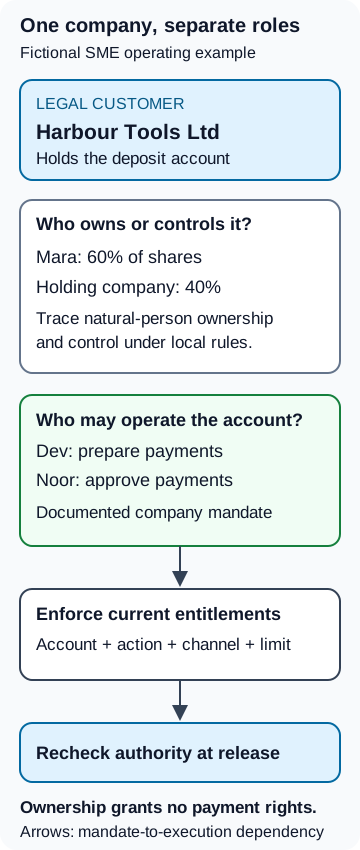
The customer master owns party identity and relationship evidence. The mandate record owns legal authority; the entitlement service translates that authority into permitted account, channel and action combinations. A director resignation is an event requiring verification and authority review, not permission to delete historical approvals. If Noor leaves, revoke live approval access and update the mandate through the required process while retaining attributed prior decisions. A concurrent payment awaiting approval must be re-evaluated against current authority at release.
Periodic updating combines the applicable risk-based maximum intervals with earlier event-driven review where required. Store the governing rule version, risk category, completed review scope, next due date and reason for any permitted adjustment. An address-only review does not automatically reset a full-review clock. Ownership requirements are separate from permissions, and sanctions ownership tests are separate again. See the FinCEN CDD rule and linked relief.
For Indian implementation, identify the bank type and use the applicable consolidated Commercial Banks KYC Directions, updated 1 October 2026, or the separate directions governing that entity type, together with amendments. The official archived edition updated 18 September 2026 provides accessible framework evidence, including entity-specific ownership/control and record-management distinctions. Its commercial-bank definition excludes specified other bank types. The 18 September amendment extends the specified alternative certified-copy facility to foreign portfolio investors. This chapter does not reproduce unverified current Indian numerical requirements; the archived edition is not a substitute for the current applicable rulebook in a live implementation.
This application uses JavaScript for the full interactive experience. This text summary is served for accessibility and search indexing.