Chapter 086: European Union Reporting
Section 18: Regional Regulatory Reporting Tracks · Chapter 086 of 100
A bank uses a common reconciled accounting baseline, with the distinct reference dates, contractual attributes and statistical transaction feeds required by FINREP, COREP and ECB statistics — three frameworks, one ledger, documented explanations for differences. EU reporting standardises financial and prudential data through EBA taxonomies (DPM/XBRL) and ECB statistical demands. This chapter overviews FINREP's purpose and structure, its COREP sibling, and ECB data — with explicit date, population and measurement bridges connecting them.
1. Chapter opening
FINREP standardises balance-sheet, P&L, asset-quality and impairment reporting from IFRS (or national GAAP bridges) for supervision; COREP standardises own-funds, adequacy and exposure calculations; ECB statistics (balance-sheet items, interest rates, granular AnaCredit-style loan data) serve monetary policy and supervision. Their financial-balance inputs use a reconciled close baseline; each return also preserves its required reference dates, statistical transactions, risk measures and attributes through versioned mappings; validation rules gate submission; remits/frequencies follow proportionality. The European Union reporting framework operates under the Capital Requirements Regulation (CRR) and the Capital Requirements Directive (CRD), which together establish the prudential rules for credit institutions. CRR provides directly applicable regulations across member states, while member states transpose CRD into national law; CRR and CRD together implement relevant Basel standards within the EU framework. This dual-layer architecture means that while the regulatory text is harmonised, national competent authorities (NCAs) retain discretion on certain calibrations and transitional measures — creating a reporting landscape that is uniform in structure but nuanced in application. The European Central Bank (ECB), acting through the Single Supervisory Mechanism (SSM) for significant institutions, coordinates with NCAs to ensure consistent supervisory expectations, and the EBA's Implementing Technical Standards (ITS) on reporting provide the operational detail that banks must follow in practice.
2. Learning objectives
- State FINREP's scope (financial information under the applicable IFRS or national-GAAP reporting arrangement) vs COREP (prudential).
- List FINREP template families (balance sheet, P&L, asset quality, impairment, forbearance).
- Explain DPM/XBRL taxonomy versioning and validation gates.
- Describe ECB statistical demands (aggregates + granular loan-level).
- Run the single-close-to-three-returns control.
3. Business context
EU reporting supports supervisory comparison but does not require identical amounts across different definitions. Maintain a common reconciled accounting baseline together with the contract, risk and statistical data each return requires. Deadlines, frequencies and reporting scope follow the legal instructions; neither a generic 30-working-day filing cycle nor an industry return-count estimate should drive the bank's calendar.
| Return | Asks | Consumes |
|---|---|---|
| FINREP | Financial position/performance | Applicable accounting close + classifications |
| COREP | Solvency adequacy | RWA + capital engines |
| ECB stats | Monetary/economic picture | Transactions, balances, rates |
4. Finance and accounting view
4.1 FINREP structure (headline)
FINREP templates are organised into families that together present a comprehensive picture of the institution's financial position and performance. Balance-sheet templates present assets, liabilities, equity and off-balance-sheet items broken down by instrument type (loans, debt securities, equities, derivatives), counterparty sector (central governments, financial corporations, non-financial corporations, households), and geography. P&L templates decompose income into interest income/expense by instrument type, fee and commission income, trading and hedging results, other operating income, and administrative expenses — each with the granularity needed to assess earnings quality and sustainability. Asset quality templates cover the non-performing exposure (NPE) framework: performing and non-performing splits, forbearance flags, staging under IFRS 9, and geographic/sector breakdowns. Impairment templates track allowance movements by stage, with gross carrying amounts, loss allowances, and write-off disclosures. Every cell in every template maps from the chart of accounts plus dimensioned attributes; these mappings are versioned per DPM release and regression-tested on upgrade. Validation (EBA rules plus internal plausibility checks) gates filing — a single blocking validation error prevents the entire submission.
4.2 COREP + ECB linkage
COREP own-funds, adequacy and exposure templates share exposure inputs with FINREP asset data — cross-return consistency is checked every cycle (FINREP loans vs COREP exposures bridged by documented scope and measure differences). For example, FINREP reports gross carrying amounts and allowances separately where specified, while accounting net balances reflect the allowance; COREP exposures for credit risk may use different exposure measures depending on the approach (SA or IRB). Off-balance-sheet items appear in FINREP as contingent liabilities and in COREP as credit conversion factor (CCF) applied exposures — the bridge must reconcile both views. ECB statistics reuse balance-sheet aggregates from FINREP plus rate and granular feeds; AnaCredit-style loan-level attributes (borrower identifiers, collateral values, credit ratings, contractual terms) demand contract-level completeness with no gaps. The interconnection means that a data-quality issue in one framework — say, an incorrect sector classification — can propagate to three or four returns simultaneously, amplifying both the correction workload and the supervisory scrutiny.
4.3 Deep dive: DPM version management and granular-data strategy
The EBA publishes release-specific data definitions, technical taxonomies and validation artefacts. Record their first applicable reference dates and gateway support. Test changes on frozen inputs, explain added/removed/changed facts and approve mappings before use. Technical DPM or taxonomy files implement reporting obligations; they are not themselves a substitute for the governing legal text. A filing format such as XBRL-XML or xBRL-CSV is determined by the applicable framework and collection channel, not by assuming one format indefinitely.
Granular-data strategy (AnaCredit-style loan-level and beyond) requires contract-level completeness: every reportable contract must carry a full attribute set (purpose, collateral type and value, contractual interest rate, maturity dates, borrower sector and geography, credit rating, forbearance status) or explicit exemption with documented expiry. Attribute freshness matters as much as completeness: ratings must be refreshed within defined service-level agreements, collateral valuations must be current, and IFRS 9 staging must reflect the latest forward-looking information — not the last filing date. Threshold monitoring tracks reporting thresholds per counterparty and exposure size, with proximity alerts when balances approach the point at which new attributes become required. Correction discipline demands that granular corrections be re-filed with full lineage tracing, not silently patched at the aggregate level. The compounding effect is powerful: clean contract data feeds FINREP aggregates, COREP exposures, stress-test models, and Pillar 3 disclosures consistently — one fix improves five returns. Examiners sample granular-to-aggregate consistency live during inspections; breaks here invalidate aggregates downstream and can trigger broader data-quality reviews.
5. Product and customer impact
Template granularity shapes product coding at origination: counterparty sector codes, loan purpose classifications, forbearance flags, and collateral attribute fields must be captured when the product is set up, not retrofitted at reporting time. Interest-rate statistics require contractual-rate feeds per product — fixed, floating, or hybrid — with reset dates and reference rates recorded. Granular reporting raises data-privacy obligations: borrower-level data with personally identifiable information requires access controls, encryption at rest and in transit, and audit trails for every query. Products launched without the necessary reporting attributes create filing gaps that only surface at quarter-end, forcing emergency remediation or qualified filings. The modern approach is to embed FINREP and ECB impact assessment into the product approval process itself, requiring sign-off from the data and reporting functions before any new product goes live. This front-loading of reporting obligations is more efficient than end-of-quarter panic, and it prevents the common problem of products booked into legal entities whose reporting capabilities cannot support the data requirements.
6. Regulatory and supervisory view
The EBA reporting framework operates through ITS (Implementing Technical Standards) versions that specify templates, filing calendars, validation rules, andXBRL taxonomy references — banks must verify the current DPM release and filing deadlines at the start of each cycle. ECB regulations (BSI for balance-sheet items, MIR for interest rates, AnaCredit for credit data) carry their own thresholds and derogations: smaller institutions may benefit from reduced reporting obligations, but apply the specific conditions, review and expiry provisions for each derogation. National competent-authority overlays add jurisdiction-specific requirements — for example, additional templates for macro-prudential purposes or higher-frequency reporting for institutions under enhanced surveillance. Late or incorrect filing draws formal findings; persistent errors may inform the supervisory assessment and remediation; no fixed standalone “SREP data-quality score” or automatic capital increase is implied. The remit depends on institution size and classification: significant institutions under direct ECB supervision face the most demanding requirements, while less-significant institutions may have tailored obligations set by their NCA. Supervisors increasingly use data analytics to cross-check submitted data against market intelligence, peer benchmarks, and public disclosures — inconsistencies that might have gone unnoticed a decade ago now trigger targeted enquiries.
7. Systems and data view
The EU reporting stack follows a layered architecture: close snapshots capture the frozen general ledger at period-end, feeding a mapping and transformation layer that translates chart-of-accounts entries into DPM-versioned data points. Calculation engines compute derived values (risk-weighted amounts, ratios, aggregations) and feed an XBRL generator that produces the filing instance. Validation runs in two stages: internal plausibility checks (range tests, cross-template consistency, trend analysis) followed by EBA rule validation (blocking and warning rules per the taxonomy). A filing gateway transmits the XBRL instance and receives acknowledgements; any rejection triggers a query and correction workflow. The archive stores all inputs, mappings, outputs, and evidence with retention periods specified per regime — under the applicable legal and approved retention schedule. Granular feeds require contract-level pipelines with completeness monitoring: every loan, derivative, and security must carry its full attribute set through the transformation chain. Controls include taxonomy-version lockdown (preventing ad-hoc version mixing), mapping regression testing on every upgrade, four-eyes review of filings before submission, and automated reconciliation between the GL source and the filed data points.
8. End to end process
- Lock close — freeze the general ledger and sub-ledgers at period-end, preventing post-close adjustments from creating source-data drift.
- Run mappings per taxonomy version — apply the versioned mapping rules to translate chart-of-accounts entries into DPM data points, flagging unmapped or newly added cells.
- Calculate and aggregate — compute derived values (RWA, ratios, sub-totals) and apply consolidation rules where required.
- Validate (rules + cross-return) — run EBA blocking and warning rules, internal plausibility checks, and cross-return bridge reconciliation (FINREP ↔ COREP ↔ ECB stats).
- Review, attest, file with receipt — responsible officers review the filing, attest to its accuracy, submit through the gateway, and confirm receipt.
- Handle queries; correct with impact analysis — respond to supervisory queries with full lineage; any correction triggers cross-family impact analysis to prevent cascading errors.
- Archive inputs + outputs + evidence — store all artefacts with the retention schedule, ensuring retrievability for future examinations.
9. Controls and risks
| Risk | Control | Evidence |
|---|---|---|
| Taxonomy-version drift | Version lockdown + upgrade regression | Version logs, test packs |
| Cross-return divergence | FINREP↔COREP bridge checks | Bridge reports |
| Granular incompleteness | Contract-level completeness monitoring | Completeness dashboards |
| Late filing | Calendar with close linkage | Receipts |
| Mapping errors | Dual-version parallel run + regression | Parallel-run comparisons |
| Validation overrides | Blocking rules enforced; overrides logged | Override register |
10. Practical examples
A (fictional): DPM upgrade breaks 200 cells: mapping regression catches unmapped new dimensions pre-filing; release delayed 3 days, filed correctly. Lesson: taxonomy upgrades are mini-programmes with parallel runs and rollback plans. B (fictional): Granular gap: 5% of loans missing purpose codes; AnaCredit rejects the entire file; emergency remediation includes origination-system fix and backfill of historical records. C (fictional): Cross-return cascade: a sector reclassification in FINREP flows through to COREP concentration metrics and ECB statistical breakdowns — the bank discovers the cascade only after filing FINREP, requiring two resubmissions and an additional three-day window.
10.3 Worked example: reconciling three views (fictional, billions)
Gross loans are 60.0 and allowance 1.2, so accounting net loans are 58.8. Product splits of 25.0 mortgages, 30.0 corporate and 5.0 other total 60.0. An NPE balance of 1.8 and assigned NPE allowance of 0.81 give 45% coverage (0.81 / 1.8); the remaining allowance is 0.39.
For a simplified prudential bridge, start with 58.8 net loans, subtract 0.2 out-of-perimeter loans and add 2.5 of post-CCF off-balance-sheet exposures: total exposure is 61.1. RWA of 38.0 is a separate weighted measure; CET1 of 7.0 gives a ratio of 18.42% (7 /38). The remaining 1.0 difference between equity 8.0 and CET1 7.0 requires its own deduction/filter bridge. Statistical loans may use gross or nominal values and their own sector and residence definitions. Reconcile the stated basis instead of demanding all three totals match. Each reported balance retains the relevant source snapshot and adjustment history.
11. Diagrams
Figure 1. EU reporting preparation.
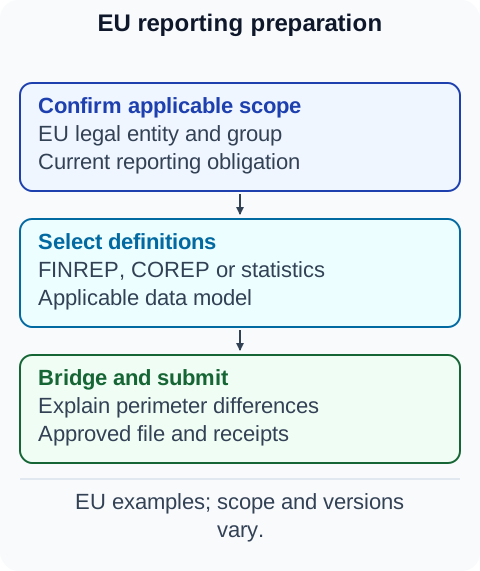 Figure 2. EU reporting lenses.
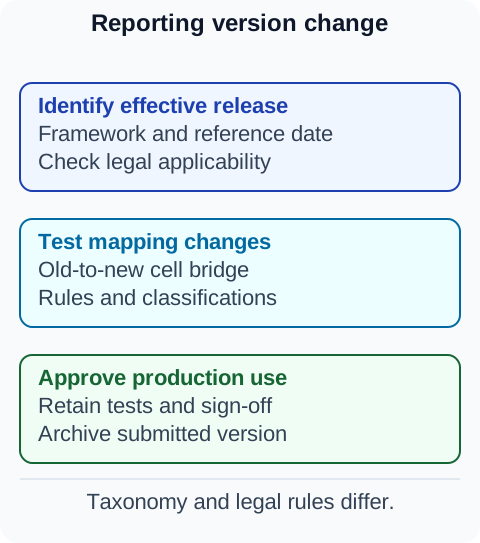
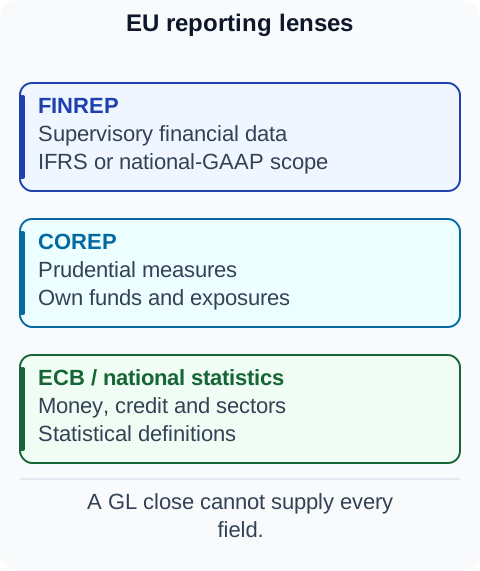 Figure 3. Reporting version change.
12. Tables
Table 1 — FINREP families (headline)
| Family | Contents |
|---|---|
| Balance sheet | Assets, liabilities, equity, OBS by breakdowns |
| P&L | Interest, fees, trading, impairment |
| Asset quality | NPE, forbearance, staging |
| Allowances | Movements by stage |
| Geographical | Assets/liabilities/income by country |
| Institutional sector | Relevant government, financial, nonfinancial, household and other classifications |
| Economic activity | NACE-based industry classification where the template requires it |
Table 2 — Filing hygiene
| Practice | Standard |
|---|---|
| Taxonomy version | Locked per cycle, regression-tested |
| Validation | EBA rules + internal plausibility, both green |
| Cross-return | FINREP↔COREP bridged every cycle |
| Archival | Inputs + outputs + evidence retained per schedule |
| Query response | Internal targets; authority's deadline remains binding |
13. Illustrative banking case study
Three snapshots without a bridge (fictional). Financial reporting uses period-end data, while a statistical return requires a different reference basis. The defect is an unexplained difference, not the mere use of different snapshots. Preserve each required date or average, reconcile the differences and prevent accidental use of a later unapproved close. Common data governance allows several correctly labelled reporting views.
14. BA, developer, tester and operations guidance
- BA: Map each cell to CoA/dimensions with taxonomy version; specify cross-return bridges with documented scope and measure differences; maintain a return inventory with owners, frequencies, and dependencies.
- Developer: Version mappings per DPM; freeze snapshots at defined cut-off points; validate before filing technically; automate bridge reconciliation where possible.
- Tester: Taxonomy-upgrade regression (full template coverage); cross-return consistency checks; resubmission paths tested end-to-end; archive retrieval validated.
- Operations: Calendar close-to-filing chain visibly; track validation pass rates daily; manage query-response workflows with SLA tracking; maintain filing evidence packs.
15. Common mistakes
- Filing families from different snapshots without documented snapshot policy.
- Skipping mapping regression on taxonomy upgrades, discovering breaks at submission.
- Unbridged FINREP↔COREP divergence discovered only by supervisors.
- Granular attributes missing at origination, forcing emergency backfill.
- Treating validation warnings as advisory rather than investigating root causes.
- Failing to coordinate with vendors on taxonomy-version delivery timelines.
- Assuming national GAAP-to-IFRS bridges are stable across reporting periods.
16. Key takeaways
- FINREP, COREP and ECB statistics share reconciled facts but require their own measures, dates, populations and attributes.
- Lock applicable legal and technical versions; regression-test upgrades.
- Cross-return bridges prove consistency every cycle; document scope and measure differences.
- Granular data needs contract-level completeness — clean data improves five returns simultaneously.
- Filing hygiene (validate, attest, receipt, archive) is non-negotiable; revision history is a supervised metric.
- Product approval must include reporting-impact sign-off to prevent filing gaps.
- Snapshot and version governance prevents accidental use of the wrong reference basis; reconcile legitimate differences between frameworks.
17. References and verification notes
- ECB AnaCredit: loans to legal entities, mostly monthly; binding regulation and explanatory manual have different legal status.
- EBA reporting frameworks: applicable DPM, taxonomy and validation packages.
- EU CRR: statutory prudential basis, with the applicable reporting ITS and consolidated amendments.
- Template descriptions are headline simplifications; confirm per taxonomy version.
- CRR/CRD legal texts for regulatory basis; SSM supervisory expectations for significant institutions.
- EBA validation rule catalogue (EBA vN validation rules) for current blocking and warning classifications.